What Is Active Directory Penetration Testing?

Written By
Sarwat Iftikhar
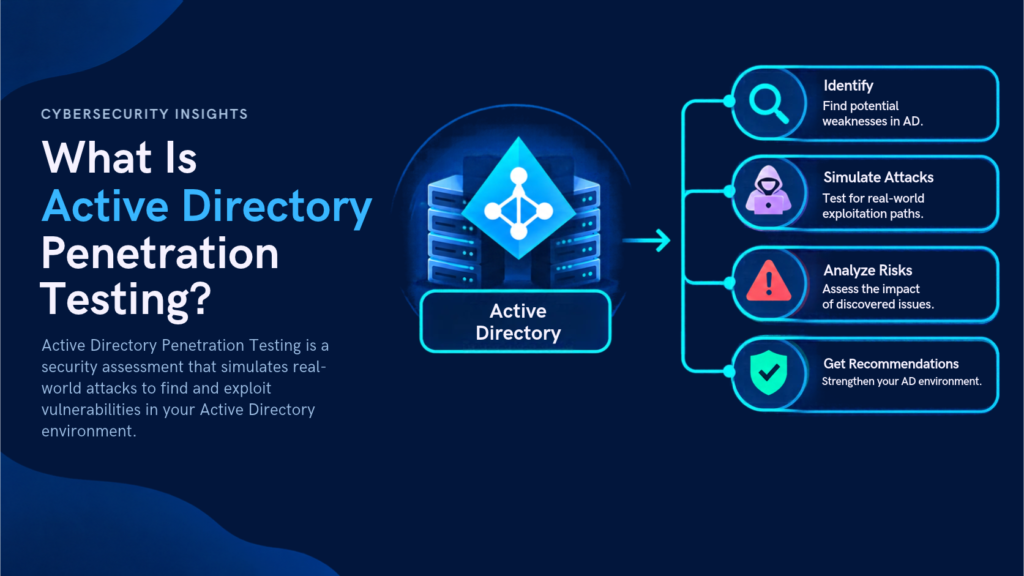
Active Directory penetration testing is a structured security assessment in which testers simulate real-world attacker techniques against a Windows domain environment to determine whether a low-privileged user can escalate to domain administrator. Rather than checking configuration settings against a checklist, an AD pentest answers a harder question: can someone who has already reached the inside of your network use your identity infrastructure to take complete control?
Most enterprise networks run Active Directory as their central authentication and authorization system. Every user login, every permission assignment, every group policy, and every service account flows through it. That centrality is exactly what makes it a primary target. Attackers who compromise an AD environment do not just access one machine. They gain the ability to move freely, persist invisibly, and extract credentials for every system on the domain. Penetration testing in AD environments is designed to find those paths before attackers do.
Key Takeaways
- Active Directory sits at the center of authentication and authorization for most enterprise Windows environments, making it the highest-value target in an internal attack
- An AD penetration test simulates real attacker techniques to determine whether a standard user account can be escalated to domain admin
- Common techniques include Kerberoasting, AS-REP roasting, ACL abuse, pass-the-hash, and DCSync, none of which trigger conventional signature-based detection
- The assessment produces a prioritized list of privilege escalation paths with evidence of exploitability, not just configuration findings
- AD pentests should run on a separate cadence from general network assessments because the attack surface changes every time a user account, group, or permission is modified
Why Does Active Directory Get Targeted So Heavily?
Active Directory is the operating system of trust in a Windows environment. When it is compromised, every system that relies on it for authentication is compromised by extension. Attackers understand this, which is why domain controller access is almost always the objective, not just a waypoint.
Several structural properties make AD attractive as an attack surface. The first is complexity. A typical enterprise AD environment contains thousands of user accounts, service accounts, security groups, organizational units, and group policy objects. Most organizations do not have a complete picture of what permissions exist across all of these objects, which means misconfigurations and overly permissive ACLs accumulate silently over years.
The second is protocol exposure. Active Directory relies on Kerberos for authentication, and Kerberos was designed decades before modern threat models existed. Several of its design choices, including the way service tickets are issued and how pre-authentication is handled, create opportunities for offline credential attacks that do not require any interaction with a live system and do not generate log entries that most organizations monitor.
The third is lateral reach. Once an attacker compromises one privileged account or machine in an AD environment, they can often move to additional systems using legitimate authentication protocols. The movement looks like normal traffic. Identity and Access Management controls that appear solid on paper frequently fail in practice because the underlying AD permissions structure creates trust paths that bypass those controls entirely.
What Does an Active Directory Penetration Test Examine?
An AD pentest is not a scan, and it is not a configuration review. It is an attempt to replicate what a real attacker would do starting from a foothold on the internal network. Bugstrix testers begin with a standard domain user account, the same starting position a threat actor would have after phishing a low-level employee, and then systematically work through the techniques most commonly used to escalate toward domain admin.
Domain enumeration is the foundation of every assessment. Testers map the full structure of the domain, including users, groups, computers, trusts, and delegation settings. Tools like BloodHound build a graph of all these relationships and automatically identify the shortest paths to high-privilege accounts. The enumeration phase often surfaces the clearest findings because organizations rarely audit what their AD structure actually looks like from an attacker’s perspective.
Kerberos-based attacks form the core of most AD escalation chains. Kerberoasting extracts service ticket hashes for service accounts running with SPNs and cracks them offline. AS-REP roasting targets accounts with Kerberos pre-authentication disabled. Both techniques require no special privileges to execute and leave minimal evidence. They work reliably against service accounts that have been granted broad permissions and have never had their passwords rotated.
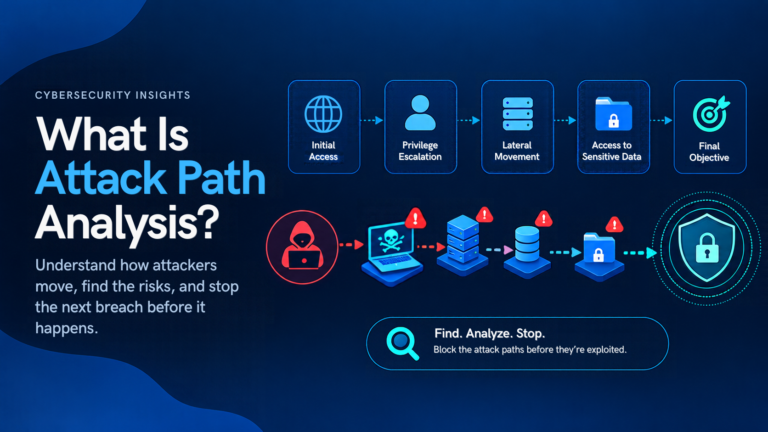
Access control list abuse covers a category of findings that scanners almost never catch. Every object in Active Directory has an ACL that defines who can modify it. When users or groups have been granted write permissions to high-value objects, such as the ability to reset a privileged user’s password or add members to a security group, those permissions can be chained together to reach domain admin without ever exploiting a vulnerability in the traditional sense. Bugstrix’s attack path analysis methodology maps these chains precisely.
Credential and session abuse techniques, including pass-the-hash, pass-the-ticket, and token impersonation, allow testers to authenticate as other users using captured credential material without knowing the cleartext password. In environments where administrative accounts log into workstations directly, lateral movement through these techniques is often trivial once any single machine is compromised.
Domain controller attacks represent the end-stage of an AD engagement. DCSync allows an account with replication rights to pull password hashes for every user in the domain, including the krbtgt account used to sign all Kerberos tickets. A Golden Ticket attack, once the krbtgt hash is obtained, gives an attacker persistent, undetectable authentication as any user in the domain for the lifetime of that hash.
How Is an Active Directory Pentest Different from a Network or Internal Pentest?
The terminology overlaps, but the scope and methodology are meaningfully different. Network penetration testing focuses on the network layer: firewall rules, open ports, exposed services, and protocol weaknesses. It covers whether a host is reachable and whether the services running on it can be exploited. An internal penetration test extends that to the internal environment and typically includes a range of systems, applications, and infrastructure components from a foothold inside the network.
An AD pentest is narrower in terms of systems but deeper in terms of identity and privilege analysis. Its primary objective is the domain itself. The tester is not trying to exploit every host on the network. They are trying to determine whether the identity infrastructure that governs all those hosts can be compromised, and whether that compromise can be achieved through the kind of techniques that leave no obvious trace in standard monitoring.
An AD pentest is also distinct from a red team exercise. Red teaming is a broader simulation of a full attack campaign, often with detection and response objectives. An AD pentest is a focused technical assessment of a specific attack surface. Red team engagements frequently include AD techniques, but the AD pentest disciplines those techniques into a structured assessment with defined scope, documented findings, and a remediation-focused output.
The methodology also differs by what information testers start with. Bugstrix conducts AD pentests primarily as gray-box or white-box assessments, where testers have at minimum a standard domain user account and sometimes more detailed configuration information. This reflects how real attacks actually progress, since most attackers reach an AD environment through credential phishing or initial compromise rather than through the external perimeter. The differences between black-box, white-box, and gray-box testing approaches are worth understanding when scoping which methodology fits your environment.
What Does the Report Cover and What Should You Do with It?
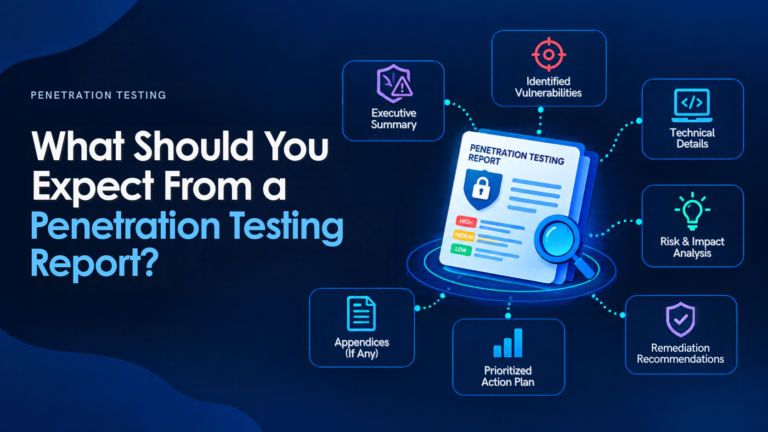
A well-structured AD pentest report does more than list vulnerabilities. It documents the attack paths that actually worked during the engagement, shows the evidence of each step, and explains what an attacker could have done at each stage of escalation.
Executive findings give business stakeholders a clear picture of the risk without requiring deep technical knowledge. The most important output is usually a summary of the highest-impact path: the shortest route from a standard user account to domain admin, expressed in plain terms.
Technical findings cover each vulnerability in detail, with evidence screenshots, commands used, accounts or objects involved, and a CVSS-aligned severity rating. Each finding includes a remediation recommendation and, where relevant, a reference to the specific AD attribute, permission, or configuration that needs to change.
Attack path mapping documents the chains that connect individual findings into escalation sequences. This is often where organizations get the most value, because it shows how findings that might appear low-severity in isolation become critical when combined. Bugstrix’s approach to attack path documentation uses the same methodology described in detail in the attack path analysis framework.
After remediation, the logical next layer is detection. Fixing the privilege escalation paths that the pentest found does not guarantee that future attacks will be caught. Identity Threat Detection and Response capabilities address the monitoring side of the same risk, providing ongoing visibility into suspicious identity activity between assessments.
What Scope and Access Does an AD Pentest Require?
Defining scope is one of the most consequential decisions in the engagement. A pentest scoped too narrowly may miss the actual escalation path an attacker would take. A scope defined without excluding critical production systems can create unnecessary operational risk if testing activity is not carefully managed.
Access requirements for a standard AD engagement include at minimum one standard domain user account with no special privileges. Some organizations provide a machine on the domain to simulate an insider threat or post-phishing scenario. Others allow testers to connect remotely using VPN access to the internal network. Either approach works. The goal is to replicate the realistic starting position an attacker would occupy after achieving initial access.
Scope inclusions typically cover all AD objects within the target domain, including users, computers, groups, OUs, GPOs, service accounts, and trust relationships. If the environment includes Azure AD or Entra ID integration, hybrid identity scenarios should be explicitly included because the attack surface extends across both environments.
Out-of-scope considerations usually include production database servers or critical infrastructure where testing activity could cause disruption. Bugstrix coordinates with the client’s IT team before testing to establish a communication channel for any activity that might require verification.
A broader security assessment can be run alongside or after an AD pentest to cover other parts of the environment, including applications, APIs, and cloud configurations that exist outside the AD scope but connect to it through authentication integrations.
How Often Should You Run an Active Directory Penetration Test?
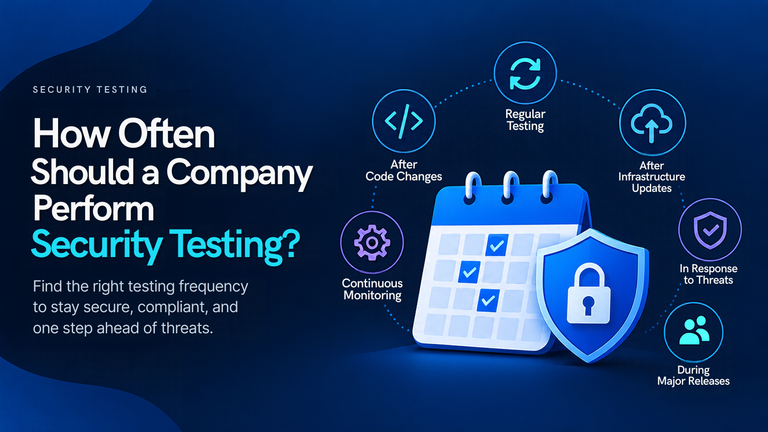
Active Directory environments change constantly. New user accounts are created. Service accounts accumulate permissions. Group memberships expand. Trust relationships are added during migrations. Each of these changes can create new escalation paths that did not exist when the last assessment was completed.
Bugstrix recommends treating AD pentests as a distinct item on your security testing calendar rather than folding them into an annual internal pentest. The specific frequency depends on the pace of change in your environment, but organizations that make significant infrastructure changes, run mergers or acquisitions, migrate to hybrid cloud, or operate in regulated industries should plan for AD assessments at least twice per year.
Organizations that have never had an AD pentest often discover that their environment has accumulated years of misconfiguration. Initial findings tend to be more severe than in environments that are tested regularly. Establishing a baseline through an initial assessment, remediating critical findings, and then retesting gives a much cleaner picture of actual residual risk.
Bugstrix’s penetration testing services cover full-scope AD engagements, including pre-engagement scoping, testing, detailed reporting, and post-remediation retesting to confirm that fixes are effective.
Frequently Asked Questions
What credentials or access does Bugstrix need to start an AD pentest?
A standard domain user account with no special privileges is the typical starting point. Bugstrix also needs network access to the internal environment, either through an on-site connection or a client-provided VPN. The goal is to simulate the position of an attacker who has already achieved initial access through phishing or another initial compromise vector.
Does an AD pentest affect production systems or user accounts?
Bugstrix conducts AD pentests in a controlled manner to minimize operational impact. Exploitation is carried out with care, avoiding techniques that could lock accounts or disrupt authentication services. Before testing begins, a communication channel is established with the client’s IT team so that any flagged activity can be quickly verified. Disruptive techniques are disclosed in advance and only executed with explicit client approval.
What is the difference between an AD pentest and an AD security review?
An AD security review examines configuration settings, group policies, and permissions against a security baseline. It identifies what is wrong. An AD penetration test goes further by attempting to actually exploit those weaknesses, chaining them into privilege escalation paths and documenting what an attacker could realistically accomplish. Reviews tell you what should be fixed. Pentests tell you what an attacker can actually do right now.
Does an AD pentest cover Azure AD or Entra ID?
It can, and for organizations running hybrid environments, it should. Azure AD Connect and Entra ID integrations create attack paths that bridge on-premises AD and cloud identity systems. Bugstrix includes hybrid identity attack scenarios when they are in scope, covering techniques like password hash synchronization abuse, seamless SSO exploitation, and federation trust attacks.
How long does an Active Directory penetration test take?
Most AD engagements run between five and ten business days depending on domain size, number of trust relationships, and scope complexity. Environments with large user populations, multiple domains, or hybrid cloud components typically require more time. Bugstrix provides a detailed timeline estimate after the initial scoping call.
Active Directory Is Where Most Enterprise Compromises End Up
Every significant internal breach involves Active Directory at some point. Attackers who reach a domain environment eventually focus on escalating to domain admin, because domain admin access is the master key to every system the domain governs. The question a penetration test answers is not whether that path theoretically exists but whether it works against your environment right now, with the accounts, permissions, and configurations that are actually in place.
Bugstrix Active Directory penetration testing engagements are designed to answer that question with documented evidence. Every escalation path that works is confirmed through an active exploit attempt, every finding is calibrated to your actual deployment environment, and every remediation is validated independently before a finding is marked closed. The result is not a list of potential issues. It is a confirmed picture of what an attacker inside your network could actually accomplish.
Contact us to discuss how Bugstrix can assess your Active Directory environment