What Is Identity Threat Detection and Response (ITDR)?

Written By
Sarwat Iftikhar
The way attackers get into organizations has shifted. A decade ago, the most common path was exploiting a vulnerability, a misconfigured server, an unpatched system. Those paths still exist, but they are harder than they used to be. Most organizations have patched their internet-facing systems. They have firewalls, endpoint protection, and vulnerability management programs that make the technical exploitation route increasingly expensive for attackers to pursue.
The path that is now most commonly exploited is simpler: compromised credentials. An attacker who buys a valid username and password from a criminal marketplace, harvests credentials through a phishing campaign, or sprays common passwords against a login portal does not need to find a vulnerability. They log in with legitimate access and then operate from inside a trusted identity. Traditional security controls, designed to detect unusual system behavior or network anomalies, struggle to distinguish this from a legitimate user doing their job.
Identity Threat Detection and Response is the discipline specifically designed to address this. ITDR applies behavioral analytics, threat intelligence, and anomaly detection specifically to the identity layer, identifying when legitimate credentials are being abused, when an authenticated session is behaving in ways inconsistent with the account’s history, and when an attacker who has obtained valid access is using it to move toward sensitive targets.
Key Takeaways
- Compromised credentials are now the leading initial access vector in security breaches. ITDR specifically addresses this by detecting abuse of valid credentials rather than relying on vulnerability exploitation signatures that credential-based attacks bypass entirely.
- ITDR is not the same as IAM. IAM governs who should have access and enforces access policies. ITDR detects when that access is being abused, whether by an external attacker with stolen credentials or by an insider acting outside their normal behavior pattern.
- In Bugstrix cloud security assessments, identity-based lateral movement using valid credentials is consistently among the hardest attack paths for security operations teams to detect, because the authentication itself is legitimate even when the subsequent behavior is not.
- ITDR capabilities include behavioral analytics across authentication events, anomaly detection in session activity, threat intelligence correlation against known compromised credential databases, and automated response to contain suspicious identity activity.
- A complete identity security program requires both IAM for governance and ITDR for detection. IAM prevents unauthorized access. ITDR catches cases where authorized access is being misused.
What Is Identity Threat Detection and Response?
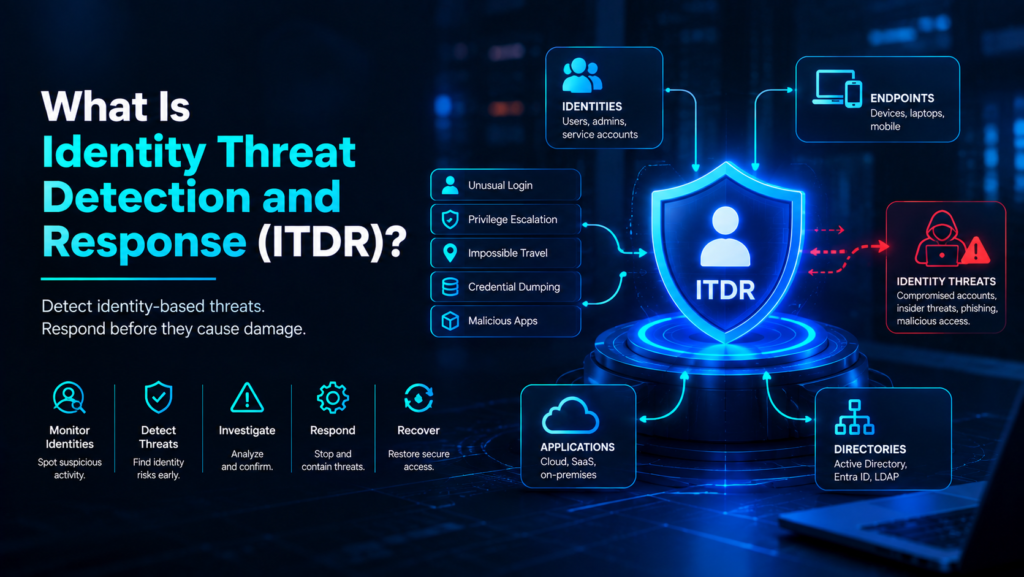
Identity Threat Detection and Response is a security discipline that applies behavioral analytics, machine learning, and threat intelligence specifically to identity infrastructure and authentication activity, detecting when valid credentials are being misused, when privileged accounts are behaving anomalously, or when authentication patterns indicate an active attack, and enabling security teams to respond before the attacker achieves their objective.
ITDR emerged as a distinct discipline because existing security detection categories were not designed to address the specific characteristics of identity-based attacks. Endpoint detection and response tools detect malicious behavior on devices. Network monitoring detects unusual traffic patterns. SIEM platforms aggregate and correlate events from multiple sources. None of these tools have an identity-first perspective that can distinguish between a legitimate user authenticating from an unusual location because they are travelling and the same authentication event representing an attacker who has compromised that account.
ITDR builds this identity-first detection capability by establishing behavioral baselines for individual identities, correlating authentication and access events against those baselines, enriching detection with threat intelligence about compromised credentials and known attacker techniques, and providing the response capabilities to contain suspicious identity activity before it progresses to a full breach.
Understanding the IAM foundation that ITDR builds on is important context. Identity and Access Management defines the access policy. ITDR monitors whether that policy is being correctly used or abused. Both are necessary, and neither makes the other redundant.
Why Has Identity Become the Primary Threat Vector?
Identity has become the primary threat vector because it is where the security perimeter has effectively moved. Organizations have invested heavily in network perimeter security, endpoint protection, and vulnerability management, making those attack paths harder and more expensive. Attackers have adapted by targeting the path of least resistance, which is now the identity layer.
The practical reality is that credential theft is cheap and scalable. A single successful phishing campaign can harvest hundreds of credentials. Dark web marketplaces sell credential sets from past breaches for trivial amounts. Password spraying attacks test commonly used passwords against large numbers of accounts with minimal effort. Once a valid credential is obtained, the attacker authenticates through the normal login flow and is inside the environment with the same access the legitimate account holder has.
From inside, the attacker faces a different challenge: reaching the data or systems they are after without triggering detection. This is where ITDR becomes most directly valuable. The attacker is using a legitimate identity, but their session behavior tells a different story. They access resources the account never accesses, at a time of day inconsistent with the user’s normal schedule, from a location that differs from the user’s historical locations, at a velocity that suggests automated enumeration rather than human browsing.
These behavioral signals are visible if someone is looking for them with the right analytical framework. They are invisible to controls that only look at whether the authentication credentials were valid.
What Does ITDR Detect?
ITDR detects the behavioral and contextual signals that distinguish legitimate use of valid credentials from abusive use of the same credentials, covering attack scenarios from initial account takeover through post-compromise lateral movement and privilege escalation.
Account takeover detection identifies when a valid account is being accessed by someone other than the legitimate account holder. Detection signals include impossible travel, where a session appears in two geographically distant locations within a timeframe that does not allow physical travel between them; new device or new location access that deviates from the account’s established behavioral pattern; and authentication velocity patterns consistent with automated credential stuffing rather than human login attempts.
MFA bypass detection addresses the growing category of attacks that defeat multi-factor authentication without breaking the underlying technology. MFA fatigue attacks, where an attacker repeatedly sends push notifications until a tired or distracted user approves one, SIM swap attacks that redirect SMS codes to an attacker-controlled phone number, and real-time phishing proxies that harvest and immediately replay MFA tokens are all detectable through behavioral and contextual anomalies in the authentication pattern.
Privilege escalation detection monitors changes to role assignments, policy modifications, and permission grants that deviate from established administrative patterns. An attacker with access to a standard user account may attempt to grant themselves elevated permissions or to modify IAM policies in ways that expand their access, and these actions leave behavioral traces that ITDR systems can identify as anomalous.
Lateral movement detection identifies post-compromise activity in which an attacker uses a compromised identity to access resources, services, or accounts beyond what the initial compromise provided. Unusual access to resources the account has never previously reached, cross-account access in cloud environments, and API calls to services outside the account’s established usage pattern are all lateral movement indicators.
Insider threat detection monitors for behavioral patterns associated with malicious or negligent insider activity: bulk data access or export inconsistent with the user’s role, activity outside normal working hours combined with unusual resource access, and behavioral patterns consistent with data staging prior to exfiltration.
Service account abuse detection addresses the increasing attacker use of compromised service accounts as persistent, high-privilege footholds. Service accounts used interactively in ways inconsistent with their programmatic purpose, service accounts making API calls outside their defined function, or service account permissions being expanded without change management authorization all indicate potential service account compromise.
How Does ITDR Work?
ITDR works by aggregating authentication and access event data from identity infrastructure, establishing behavioral baselines for individual identities and groups, applying anomaly detection and machine learning to identify deviations from those baselines, correlating events with threat intelligence about known attack patterns and compromised credentials, and triggering response actions when the combined signals cross a confidence threshold.
Data ingestion. ITDR pulls authentication events from identity providers, access logs from cloud IAM systems, session data from single sign-on platforms, endpoint authentication events, and privileged access management logs. The completeness of this data collection directly determines detection coverage: blind spots in the event data create detection gaps that cannot be compensated for analytically.
Baseline establishment. The system learns what normal looks like for each identity: typical login times, geographic patterns, device types, resource access patterns, session durations, and API call volumes. This baseline is continuously updated as normal behavior evolves, and it forms the reference against which anomaly detection operates.
Anomaly detection and risk scoring. Events that deviate from established baselines are scored for risk based on the magnitude of the deviation and the specific behavioral signals involved. A single low-deviation anomaly produces a low-risk score. Multiple simultaneous anomalies, particularly combinations consistent with known attack patterns, produce high-risk scores that trigger alert escalation.
Threat intelligence enrichment. Authentication events are checked against threat intelligence sources including known compromised credential databases, lists of IP addresses associated with credential stuffing infrastructure, and indicators of compromise from identity-focused attack campaigns. An authentication that passes behavioral analysis but originates from an IP address known to be part of a credential stuffing botnet receives elevated risk scoring from the intelligence layer.
Response. High-confidence detections trigger automated response actions: requiring step-up authentication, temporarily suspending the account, forcing session termination, notifying the security operations team, or triggering an incident response playbook. Response actions are calibrated to confidence level to avoid disrupting legitimate users on lower-confidence detections.
How Is ITDR Different from IAM?
ITDR and IAM address adjacent but fundamentally different problems in identity security. IAM is a governance discipline: it defines who should have access to what, provisions and manages identities throughout their lifecycle, and enforces access policies. ITDR is a detection discipline: it monitors whether the access that IAM has granted is being used legitimately or abused.
The clearest way to distinguish them is through the attacker scenario they address. IAM prevents an unauthorized person from being granted access. ITDR detects when an authorized person’s credentials are being used by someone who is not that person. IAM catches the case where the security policy was violated in its definition. ITDR catches the case where the policy is being correctly enforced, but the identity it is enforcing the policy for has been compromised.
| Security layer | What it governs | What it misses |
| IAM | Who should have access; access policies | Whether valid access is being abused |
| ITDR | Whether access behavior is legitimate | Access policy definition; provisioning |
| Both together | Complete identity security lifecycle |
A related discipline that is sometimes confused with ITDR is cloud security posture management. Cloud security posture management monitors whether cloud IAM configurations conform to security policies. CSPM asks whether IAM is configured correctly. ITDR asks whether the correctly configured identities are behaving correctly at runtime. The two catch different failure modes: CSPM finds the misconfigured policy that grants too much access; ITDR detects the valid account that is being used by an attacker.
What Are the Most Common Identity-Based Attacks ITDR Addresses?
Identity-based attacks are the most common attack category in data breaches in 2026, and the specific techniques attackers use are well-documented and consistently recurring. ITDR is specifically designed around detecting these known patterns.
Credential stuffing. Attackers use lists of credentials harvested from breaches of other services to attempt login to target applications, exploiting the widespread practice of password reuse. ITDR detects this through authentication velocity patterns, the geographic distribution of login attempts, device fingerprint patterns, and correlation against known breached credential sets.
Phishing-based credential theft. A user is manipulated into entering credentials on a fake login page, giving the attacker valid credentials with no technical exploit required. ITDR detects the subsequent attacker session through behavioral anomalies: the attacker uses the credentials from a different location, device, and at different times than the legitimate user, and accesses different resources than the legitimate user typically reaches.
MFA fatigue. The attacker has valid credentials but needs to bypass MFA. They repeatedly trigger push notification requests until the user approves one to make the notifications stop. ITDR detects this through unusual MFA request frequency patterns before the approval and through the behavioral anomalies in the subsequent session that indicate the session holder is not the legitimate user.
Privileged account targeting. Attackers specifically target administrator accounts, service accounts, and accounts with elevated permissions because compromise of these accounts provides broader access and higher-impact attack capability. ITDR monitors privileged account behavior with enhanced sensitivity, treating deviations from baseline as higher-risk than equivalent deviations in standard user accounts.
Session hijacking. After stealing a valid session token, the attacker uses it to access resources without needing to authenticate. ITDR detects session hijacking through behavioral inconsistencies between the token-established session context and the subsequent session behavior, and through device and network fingerprint mismatches between the authentication event and session activity.
Our post on broken access control in SaaS applications covers the application-layer authorization failures that ITDR detection complements, specifically the access control gaps that allow compromised identities to reach resources beyond what their intended permissions should allow.
How Does ITDR Fit Into a Complete Security Program?
ITDR fits into a complete security program as the runtime detection layer for the identity attack surface, complementing the governance layer of IAM and the configuration monitoring of CSPM covered above. The connection to continuous threat exposure management is the most direct one: CTEM requires continuous visibility into threats across all attack surfaces, and identity is now the most actively exploited attack surface in most organizations. ITDR provides the runtime visibility layer that makes identity exposure a continuously monitored component of the overall threat posture rather than a gap in the detection program.
How Do You Validate That ITDR Detection Actually Works?
A dashboard full of green status indicators does not confirm that ITDR would actually catch a real identity-based attack. Validating detection capability requires deliberately simulating the attack techniques ITDR is supposed to catch and confirming it catches them.
Red team exercises that simulate identity-based attack techniques provide the most direct validation. A red team that successfully establishes access using simulated phishing credentials and then moves laterally should trigger ITDR detections at multiple points in the attack chain. If it does not, the exercise has identified a specific detection gap rather than a theoretical one. Our post on red teaming covers how adversary simulation validates detection capabilities in this way.
Breach and attack simulation platforms extend this validation between periodic red team exercises by running identity attack technique simulations, credential stuffing patterns, lateral movement using compromised identities, and privilege escalation simulations on an ongoing, automated basis, confirming ITDR detection continues working as the environment and the attacker techniques both evolve.
Who Should Implement ITDR?
ITDR provides the most immediate value to organizations where identity is a significant attack surface, where the consequences of account compromise are high, and where existing detection capabilities have limited identity-specific coverage. That describes most organizations that have moved to cloud infrastructure, adopted SaaS platforms, and rely on federated identity for access management.
The specific organizational profiles where ITDR investment is most justified:
SaaS and cloud-native companies where the entire operation depends on cloud identity infrastructure. Account takeover in these environments often means direct access to production systems, customer data, and development infrastructure with no network perimeter to slow lateral movement. Our cloud penetration testing services assess cloud IAM configurations and identity-based attack paths directly, identifying the specific weaknesses that ITDR would need to detect exploitation of.
Financial services organizations where compromised accounts provide access to payment systems, customer financial records, and transaction processing infrastructure. The regulatory and business consequences of identity-based breaches in financial services are severe enough to justify significant investment in identity-specific detection.
Organizations with significant remote workforce. Remote work environments remove the network location signals that traditional security controls relied on to validate that a user is who they claim to be. ITDR’s behavioral approach to identity verification is particularly valuable when geographic context cannot be used as a trust signal.
Organizations that have experienced credential-based incidents. A history of phishing campaigns, credential stuffing attacks, or account takeovers is a strong indicator that identity-based detection capabilities are a priority, because the attack pattern has been demonstrated to be effective against the specific organization.
Our vulnerability assessment services assess the identity security posture as part of a broader security evaluation, identifying the specific weaknesses in identity infrastructure and authentication implementation that ITDR would need to monitor. Our cybersecurity code review service addresses authentication and session management implementation in application code, closing the code-level vulnerabilities that would otherwise create the identity weaknesses ITDR detects at runtime.
Frequently Asked Questions
Is ITDR the same as user behavior analytics?
User behavior analytics was an earlier approach to identity-based anomaly detection that focused primarily on establishing behavioral baselines and detecting deviations. ITDR encompasses UBA capabilities but extends them with identity-specific threat intelligence, coverage of non-human identities including service accounts and machine identities, integration with identity infrastructure such as IAM systems and PAM platforms, and purpose-built response capabilities for identity-specific threats. ITDR is a more complete discipline that UBA capabilities contribute to.
Can ITDR detect insider threats?
Yes, detecting behavioral patterns consistent with malicious or negligent insider activity is one of ITDR’s primary use cases. Abnormal data access volumes, access to resources outside the user’s normal work scope, bulk export behavior, activity at unusual hours combined with unusual resource targets, and behavioral patterns consistent with data staging before exfiltration are all detectable through ITDR’s behavioral analytics. ITDR cannot definitively determine intent, but it identifies the behavioral signals that warrant investigation.
How long does ITDR take to establish baselines?
Most ITDR platforms require two to four weeks of observation before behavioral baselines are reliable enough for high-confidence anomaly detection. During this period, the system is learning normal patterns for individual identities and groups, and alert thresholds are calibrated against the observed data rather than against generic defaults. Organizations that implement ITDR should expect a tuning period during which false positive rates are higher while baselines mature.
Does ITDR work for on-premises Active Directory environments?
Yes. ITDR originated as a discipline focused on Active Directory environments, where identity-based attack techniques including Kerberoasting, pass-the-hash, and golden ticket attacks have been well-documented for years. Many ITDR platforms were built specifically around AD monitoring before expanding to cover cloud identity infrastructure. For organizations with hybrid environments, ITDR coverage should span both the on-premises directory and the cloud identity layer that federates with it.
Is ITDR a product or a program?
Both. ITDR platforms are commercial products that provide the data ingestion, analytics, and response capabilities that an ITDR program requires. An ITDR program is the organizational practice of implementing those capabilities, tuning them for the specific environment, integrating them into the security operations workflow, and responding to the detections they generate. The product enables the program. The program determines whether the product delivers security value or generates a dashboard nobody acts on.
When Valid Credentials Are Not Safe to Trust
The assumption that authentication equals authorization, that a valid credential is a valid identity, was the foundation of perimeter security. That assumption has broken down because valid credentials are now routinely in attacker hands through breaches, phishing campaigns, and dark web markets.
ITDR is the discipline that replaces that broken assumption with a more defensible one: authentication establishes an identity, but behavioral analysis determines whether the authenticated session belongs to the legitimate account holder or an attacker using their credentials. The authentication event is the starting point for trust, not the ending point.
Organizations that implement ITDR alongside IAM governance have detection coverage for the attack scenarios that IAM alone cannot address. IAM ensures access is granted correctly. ITDR ensures it is used correctly. Together they close the identity security gap that credential-based attacks exploit.
Contact us to discuss identity security assessment for your organization