What Is Attack Path Analysis?

Written By
Sarwat Iftikhar
Most vulnerability management programs produce a list. Every scan cycle generates hundreds or thousands of findings, each with a severity rating, a CVE number, and a remediation recommendation. The security team works through the list, prioritizing by severity score, patching the criticals first, working down through highs and mediums, and then repeating the cycle next quarter.
The problem with this approach is that it treats vulnerabilities as independent items rather than connected components of a system an attacker navigates. A critical vulnerability on a system with no network path to anything sensitive is far less dangerous than a chain of three medium-severity findings that together create a route from an internet-facing server to a database containing every customer record. The list-based approach catches the first case as a critical finding that needs patching. It misses the second case entirely, because no individual finding in the chain is critical when evaluated on its own.
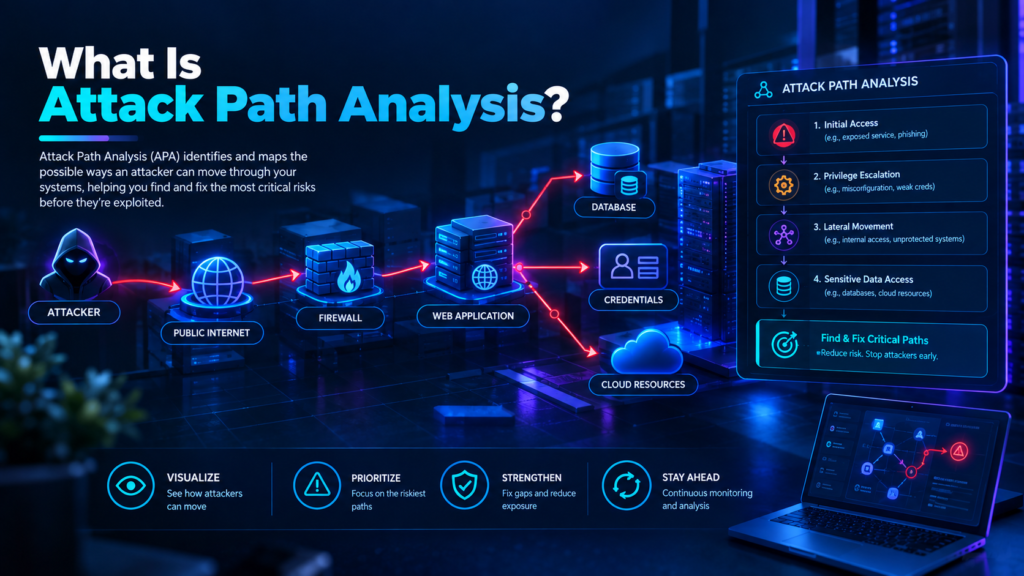
Attack path analysis addresses this by modeling how vulnerabilities, misconfigurations, and access relationships combine into the actual routes an attacker would follow from an initial entry point to a high-value target. Rather than evaluating vulnerabilities individually, it evaluates them as nodes in a network of possible attacker moves and identifies which specific combinations create genuine pathways to the systems and data that matter most.
Key Takeaways
- Attack path analysis models the environment as a graph where vulnerabilities and misconfigurations are nodes and possible attacker moves are edges, identifying the specific sequences that create routes to high-value targets.
- Individual vulnerability severity scores do not capture attack path risk. Three medium-severity findings that chain into a path to a domain controller represent higher actual risk than a critical finding with no forward connectivity to sensitive systems.
- In Bugstrix penetration testing engagements, the attack paths that lead to the most significant compromises almost always involve vulnerabilities that would have been deprioritized in a standard CVSS-based remediation queue because none of them are individually severe.
- Attack path analysis changes the remediation prioritization question from “which vulnerability is most severe?” to “which vulnerability, if removed, eliminates the greatest number of paths to critical targets?”
- A complete exposure management program combines attack path analysis for strategic prioritization with vulnerability assessment for discovery, penetration testing for validation, and breach and attack simulation for detection effectiveness measurement.
What Is Attack Path Analysis?
Attack path analysis is a security methodology that models an organization’s environment as a graph, with assets and access relationships as nodes and possible attacker moves between them as edges, and identifies the specific sequences of vulnerabilities, misconfigurations, and trust relationships that create traversable routes from potential attacker entry points to high-value targets.
The graph model is what makes attack path analysis fundamentally different from conventional vulnerability management. Vulnerability management asks about each node independently: is this node vulnerable, and how severe is the vulnerability? Attack path analysis asks about the edges: can an attacker move from this node to that one, and what sequence of moves creates a complete path from an entry point to a target?
A single critical vulnerability on a system with no meaningful connections to other systems or sensitive data represents limited real-world risk despite its severity score. A chain of low-to-medium findings, each individually unremarkable, that creates a continuous traversable route from an internet-facing web server through a misconfigured service account to a domain controller represents severe actual risk despite no individual finding breaking the critical threshold.
Attack path analysis makes this distinction systematically rather than relying on the intuition of individual penetration testers. It produces a map of which vulnerabilities participate in paths to critical targets and which exist as dead ends, enabling strategic remediation decisions that eliminate the most dangerous connectivity rather than just the most severe individual findings.
Why Is Traditional Vulnerability Management Not Enough?
Traditional vulnerability management is built around individual finding severity, producing a prioritized remediation queue where the highest CVSS scores receive attention first regardless of whether those findings sit on routes to critical targets. This approach is efficient for reducing aggregate vulnerability count and maximum individual severity but systematically misses the risk dimension that matters most for breach prevention: whether the specific combination of what is present creates a traversable path to what the organization most needs to protect.
The gap becomes particularly significant in environments with complex connectivity. A large enterprise network might have thousands of vulnerabilities at any given time. Standard prioritization addresses the most severe first, which makes sense as a triage heuristic. But the most severe vulnerability in the environment might sit on an isolated segment with no network connectivity to critical infrastructure. Meanwhile, three medium-severity findings in a different part of the environment form the exact chain an attacker needs to move from the guest wireless network to the production database server. CVSS-based prioritization would reach the isolated critical long before it reached any of the three medium findings.
The remediation investment that most reduces breach probability is the investment that eliminates attack paths to critical targets, not necessarily the investment that reduces aggregate vulnerability count or maximum severity score. Identifying which specific remediation actions have the highest path-elimination value requires knowing how the vulnerabilities connect, which is exactly what attack path analysis provides.
Our post on vulnerability management covers the vulnerability management lifecycle in detail and how it integrates findings from different sources. Attack path analysis does not replace that lifecycle but changes how findings within it are prioritized based on their connectivity and path participation.
How Does Attack Path Analysis Work?
Attack path analysis works by building a computational model of the environment that captures what assets exist, how they connect, what vulnerabilities are present on each asset, what credentials and trust relationships exist between them, and what the high-value targets are, and then applying graph analysis algorithms to find all possible paths from entry points to targets and identify which nodes sit on the most paths.
Step 1: Environment modelling. The analysis builds a graph of the environment by ingesting asset inventory data, network topology, vulnerability scan results, IAM configuration data, trust relationships between systems, and definitions of what constitutes a high-value target. The quality of the model depends directly on the completeness of the input data. Missing assets, inaccurate network topology, or incomplete vulnerability data create blind spots in the graph that correspond to real attack paths the analysis cannot see.
Step 2: Edge definition. For each pair of connected nodes, the model defines what conditions would allow an attacker to move from one to the other. An exploitable vulnerability on the source node that allows remote code execution to the target defines an edge. A trust relationship where the source has administrative access to the target defines an edge. A misconfigured service account with credentials readable from the source and valid on the target defines an edge. The edge library translates security findings into movement possibilities.
Step 3: Path enumeration. Graph traversal algorithms find all paths from each defined entry point to each defined high-value target, through any combination of intermediate nodes and edges the graph allows. This produces a complete map of what routes exist, not just the obvious direct ones.
Step 4: Path ranking. Paths are ranked by factors including the number of exploitable steps required, the complexity of each step, whether each step requires credentials or just a network connection, the asset value of intermediate nodes, and whether detection tools along the path would be likely to alert. Critical paths that combine feasibility with high-target value are the primary remediation focus.
Step 5: Chokepoint identification. The most strategically valuable output of attack path analysis is identifying which specific nodes appear most frequently across the highest-priority paths. Removing or hardening a chokepoint node eliminates all paths that pass through it simultaneously, which is often a more efficient use of remediation resources than addressing the same number of vulnerabilities that each sit on only one path.
What Does Attack Path Analysis Identify That Vulnerability Scanning Misses?
Attack path analysis identifies two specific dimensions of security risk that vulnerability scanning cannot: multi-step chains where no individual step is critical, and the strategic value of specific vulnerabilities based on their path participation.
Vulnerability scanning identifies what is wrong with each node. It does not know what other nodes are connected, what the combined effect of two or three individually unremarkable findings is when an attacker chains them sequentially, or whether a remediated finding eliminates one attack path or twenty. These are graph-level properties that can only be evaluated with knowledge of the full connectivity model.
| Dimension | Vulnerability Scanning | Attack Path Analysis |
| Unit of analysis | Individual vulnerability | Vulnerability chain |
| Severity basis | CVSS score of single finding | Path feasibility to critical target |
| Remediation value | Single finding resolved | Number of paths eliminated |
| Identity/trust awareness | No | Yes |
| Network topology awareness | No | Yes |
| Lateral movement modelling | No | Yes |
| Chokepoint identification | No | Yes |
The last row, chokepoint identification, is the dimension vulnerability scanning has no equivalent for at all, because it depends entirely on graph-level connectivity rather than anything a scanner evaluates about a single asset. A chokepoint ranking tells a remediation team which specific fix eliminates the most paths at once, a prioritization signal that has no analog in a severity-sorted list regardless of how that list is filtered or re-sorted.
How Does Attack Path Analysis Relate to Attack Surface Management?
Attack surface management and attack path analysis address adjacent dimensions of the same exposure problem. Attack surface management discovers and monitors the assets and services an organization exposes, maintaining continuous visibility into the external and internal exposure footprint. Attack path analysis takes the inventory that attack surface management produces and models how the exposures within it connect into attacker-traversable routes.
The relationship is sequential: attack surface management ensures the model input for attack path analysis is complete and current. An attack path analysis conducted on an incomplete asset inventory produces an incomplete path map, because assets missing from the graph cannot appear as nodes in paths even when real routes run through them. Shadow assets and undiscovered services that attack surface management surfaces are exactly the nodes most likely to create unexpected attack paths, because they tend to have weaker security controls and have never been specifically included in security testing scope.
Continuous attack surface management that maintains a current and complete asset inventory is therefore a prerequisite for attack path analysis that accurately reflects real-world attacker capability rather than only the portion of the environment the security team was already aware of. Our post on attack surface management covers how continuous asset discovery works and why completeness is the most operationally significant challenge. Our attack surface management service provides the continuous discovery layer that keeps the asset graph accurate between assessment cycles.
What Role Does Identity Play in Attack Path Analysis?
Identity configurations are among the most consequential edge-defining data in attack path analysis, because misconfigurations in IAM, Active Directory, and service account permissions create traversal edges between nodes that have no direct network vulnerability connecting them.
A domain account with administrative access to a web server and to a database server creates an edge between those systems that does not require any vulnerability on either to be exploitable. An attacker who compromises any credential stored on the web server can use that administrative relationship to move directly to the database. The edge exists entirely in the identity layer, not in the network or software vulnerability layer, and it is invisible to scanners that do not model identity relationships.
This is why identity data is a required input for accurate attack path analysis, not an optional enrichment. The paths that matter most in real-world compromises routinely involve lateral movement through identity relationships rather than chained software exploits. An analysis that does not model trust relationships, credential reuse, delegated permissions, and group memberships produces a systematically incomplete path map that misses a significant category of realistic attacker capability.
Cloud environments add a specific version of this problem that is easy to underestimate: cross-account IAM roles, assume-role trust policies, and federated identity configurations create traversal edges between cloud accounts that look completely unrelated on a network diagram but are directly connected through a single misconfigured trust policy. Our cloud penetration testing services specifically test these cross-account and cross-service IAM trust relationships, surfacing exactly the kind of identity-layer edges that attack path analysis needs to model accurately in cloud and hybrid environments.
Our post on Identity and Access Management covers how IAM configurations create the access relationships that attack path analysis models as traversal edges, which provides context for why identity data quality directly affects path analysis accuracy.
How Does Attack Path Analysis Fit Into a Complete Security Program?
Attack path analysis sits at the strategic prioritization layer of a complete security program, taking input from vulnerability assessment and asset discovery, informing remediation prioritization, and providing the target list for penetration testing validation and breach and attack simulation coverage verification.
Continuous threat exposure management is the program framework that connects these activities: attack surface management for discovery, vulnerability assessment for finding identification, attack path analysis for prioritization, penetration testing for validation, and breach and attack simulation for detection effectiveness measurement. Attack path analysis is the analytical layer that ties vulnerability discovery to strategic risk reduction by making explicit which specific remediation actions most reduce the probability of a high-consequence breach.
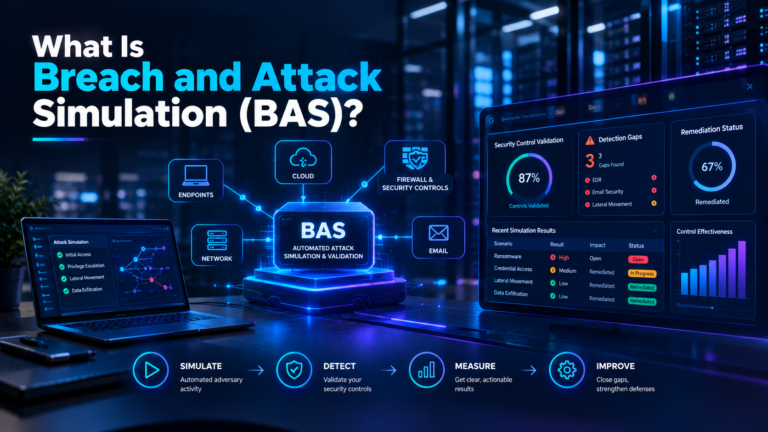
Breach and attack simulation provides a complementary validation function: where attack path analysis identifies the routes that exist theoretically, BAS tests whether security controls would detect and block an attacker following those routes. The combination is powerful because it answers both the “can an attacker get there” question and the “would we know” question.
Penetration testing validates the attack paths that analysis identifies as most critical, confirming through active exploitation whether the modelled paths are genuinely traversable in the real environment and uncovering paths that the model missed due to incomplete input data. Our continuous penetration testing services are built around exactly this ongoing validation need, maintaining a current picture of which modelled paths are genuinely traversable as the environment changes rather than relying on a single point-in-time assessment that goes stale as the network evolves.
Who Should Use Attack Path Analysis?
Attack path analysis provides the most direct value to organizations with large or complex environments where the volume of vulnerabilities makes individual-severity-based prioritization insufficient for strategic security investment decisions. It is particularly relevant for organizations that have mature vulnerability management programs and are finding that CVSS-based prioritization is not producing efficient security improvement relative to remediation investment.
The specific organizational profiles where attack path analysis delivers the most immediate return:
Organizations with hundreds or thousands of active vulnerabilities. When the vulnerability queue is long, and remediation resources are limited, the strategic question is not which individual finding is most severe but which finding, if fixed, most reduces real-world attacker capability. Attack path analysis answers this question directly, whereas severity-based prioritization only approximates it.
Enterprises with complex network topologies. Flat networks with simple connectivity produce relatively few attack paths. Segmented enterprise environments with complex trust relationships, multiple credential stores, and diverse system types produce attack path complexity that requires systematic analysis rather than intuition to navigate.
Organizations preparing for or following up after a penetration test. Attack path analysis and penetration testing are complementary: analysis identifies which paths to prioritize for testing and for remediation, and penetration test results validate or correct the model by revealing which theoretical paths are genuinely traversable and which assumed paths are blocked by controls the model did not capture.
Organizations implementing Zero Trust architecture. Zero Trust reduces attack path feasibility by eliminating implicit trust relationships between systems and requiring explicit authorization for every traversal. Attack path analysis provides visibility into which trust relationships currently exist and which specific ones, if removed, most reduce the feasible path count to critical targets.
Frequently Asked Questions
Is attack path analysis the same as threat modelling?
They are related but address different questions at different stages. Threat modelling is typically conducted during software or system design to identify what threats a system needs to defend against and how the design should address them. Attack path analysis is conducted against live environments to identify the specific routes through existing vulnerabilities and configurations that an attacker could currently traverse. Threat modelling is prospective and design-oriented. Attack path analysis is retrospective and current-state-oriented.
How accurate is attack path analysis?
Accuracy depends directly on the completeness and freshness of the input data. An attack path analysis that has access to a complete and current asset inventory, up-to-date vulnerability scan data, and accurate identity relationship data will produce a model that closely reflects real-world attacker capability. Stale vulnerability data, incomplete asset coverage, or missing identity relationship data all create gaps in the model that correspond to real paths the analysis cannot see. The accuracy of the output is bounded by the quality of the input.
How often should attack path analysis be run?
Attack path analysis is most valuable when run continuously or at high frequency, because the paths that exist depend on the current state of the environment, and the environment changes constantly. A one-time attack path analysis produces a point-in-time map that becomes stale as vulnerabilities are remediated, new assets are added, and configuration changes create new edges. Continuous or monthly analysis maintains a current path map that reflects the real-time security posture rather than a historical snapshot.
Does attack path analysis replace penetration testing?
No. Attack path analysis models which paths exist theoretically based on vulnerability and configuration data. Penetration testing validates which paths are genuinely traversable by an attacker operating in the real environment, discovers paths that the model missed due to input data gaps, and produces the exploitation evidence that compliance frameworks require. The two are complementary: analysis identifies which paths to prioritize for manual validation, and testing confirms or corrects the model while providing depth of investigation that automated analysis cannot replicate.
What is a chokepoint in attack path analysis?
A chokepoint is a node that appears in a disproportionately high number of attack paths to critical targets. Removing or hardening a chokepoint eliminates all paths that pass through it simultaneously. A single node that participates in forty paths to the crown jewels is a higher remediation priority than forty individual nodes each participating in one path, even if each of the forty individual nodes has a higher severity score. Chokepoint identification is one of the most practically useful outputs of attack path analysis because it enables high-leverage remediation decisions that eliminate large numbers of viable attack routes through a single intervention.
The List Is Not Enough
The vulnerability list is a necessary input to security improvement. It is not sufficient on its own for strategic decisions about where to focus remediation resources when not everything can be fixed simultaneously.
Attack path analysis extends the list from a collection of independent findings into a map of how those findings connect. That map answers a different question: not which finding is most severe, but which findings, acting together, create the routes to your most important systems. The answer to that question is frequently not the findings at the top of the severity-sorted queue. It is the specific combination of medium and low findings that collectively constitute a complete traversable route from an attacker entry point to a database, a domain controller, or a cloud management interface.
Prioritizing remediation by path participation rather than by individual severity score produces more efficient security improvement because it directs investment toward the findings that, if unaddressed, most enable a high-consequence breach rather than toward the findings that look worst in isolation.
Contact us to discuss attack path analysis and exposure management for your organization