What Is Continuous Threat Exposure Management (CTEM)?

Written By
Sarwat Iftikhar
Most security programs still run on an annual rhythm: a penetration test here, a vulnerability scan there, a compliance audit that forces a burst of remediation once a year. In between, the environment keeps changing. New assets get deployed. New vulnerabilities get disclosed. New attack techniques become viable against configurations that were fine last year. The point-in-time assessment tells you something true about a single moment, and then the moment passes.
Continuous Threat Exposure Management is the response to that gap. Rather than treating security testing as a periodic event, CTEM treats it as an ongoing program cycle: continuously discovering what exists, continuously determining what actually matters, and continuously validating whether the organization’s defenses would hold against it. It does not replace penetration testing, vulnerability management, or attack surface monitoring. It is the operating model that connects them into a single, repeating cycle aimed at a specific business outcome rather than a stack of disconnected reports.
This post covers what CTEM actually is, the five stages Gartner defined the model around, and how it fits alongside the testing and monitoring disciplines that already exist in most security programs.
Key Takeaways
- CTEM is a continuous, five-stage program cycle, scoping, discovery, prioritization, validation, and mobilization, rather than a single tool or a one-time assessment.
- CTEM does not replace vulnerability management, attack surface management, or penetration testing. It is the operating model that sequences and connects them around business risk rather than a raw finding count.
- The validation stage is where CTEM most clearly extends beyond traditional vulnerability scanning, using breach and attack simulation and manual penetration testing to confirm which exposures are genuinely exploitable rather than theoretically possible.
- In Bugstrix engagements, organizations moving from point-in-time testing to a continuous exposure model consistently discover that their real exposure count is smaller than their raw vulnerability count once prioritization and validation are applied, which is the entire point of the model.
- CTEM works best as a cross-functional program with defined ownership at each stage, not as a tool purchase. Organizations that buy a CTEM platform without building the underlying process end up with more dashboards and the same remediation backlog.
What Is Continuous Threat Exposure Management?
Continuous Threat Exposure Management is a security program model, first defined by Gartner, that organizes an organization’s exposure management activity into a repeating five-stage cycle: scoping, discovery, prioritization, validation, and mobilization. Rather than producing a single point-in-time report, a CTEM program runs continuously, so the organization’s understanding of its exposure stays current as the environment changes.
The word that does the most work in the name is “continuous.” Traditional vulnerability management and periodic penetration testing produce accurate information about a specific moment, and that information degrades as soon as something in the environment changes, a new asset is deployed, a patch is missed, or a new attack technique becomes public. CTEM is built around the assumption that the environment is always changing, so the assessment of exposure needs to run continuously rather than being refreshed on a fixed annual or quarterly schedule.
The second important word is “exposure” rather than “vulnerability.” A vulnerability is a flaw. An exposure is a flaw that is actually reachable, actually exploitable in context, and actually consequential to the business if exploited. CTEM is explicitly designed to narrow a large, noisy vulnerability list down to the smaller set of exposures that genuinely represent risk, using business context and active validation rather than severity scores alone to make that determination.
Why Did CTEM Emerge as a Discipline?
CTEM emerged because most security programs had accumulated a volume of vulnerability findings that far exceeded their capacity to remediate, without a reliable way to determine which findings in that backlog actually mattered. Gartner’s own research cited as the original impetus for the model estimated that organizations prioritizing their remediation efforts through a CTEM approach would be significantly less likely to suffer a breach than those relying on vulnerability scoring alone, precisely because CVSS severity scores do not account for whether a vulnerability is actually reachable by an attacker or protected by a compensating control.
The underlying problem CTEM addresses is a mismatch between finding volume and remediation capacity. Automated scanning tools generate thousands of findings across a modern environment. Development and IT teams can realistically remediate a fraction of that volume in any given cycle. Without a rigorous method for narrowing the list down to what is genuinely exploitable and genuinely consequential, security teams either drown in an unworkable backlog or fall back on generic severity scores that do not reflect real-world exploitability, and both outcomes leave the exposures that matter most sitting unaddressed alongside hundreds of ones that do not.
The second driver is the same one behind attack surface management and API security posture management: environments now change faster than periodic assessment can track. Cloud infrastructure, SaaS integrations, and API endpoints are created and modified continuously, and a security program built around quarterly or annual point-in-time snapshots is structurally unable to keep pace with that rate of change.
What Are the Five Stages of the CTEM Cycle?
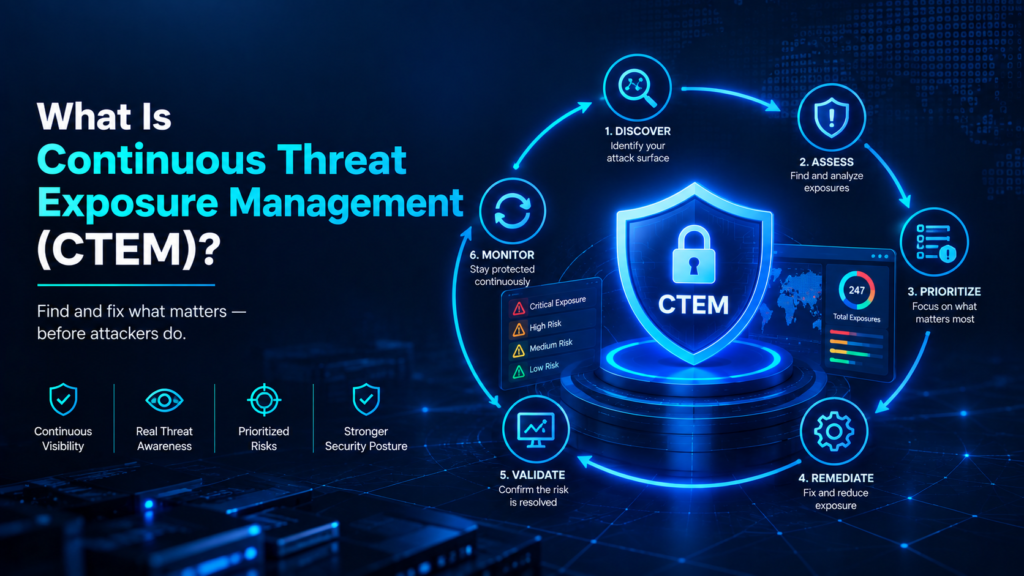
CTEM runs as a repeating five-stage cycle: scoping, discovery, prioritization, validation, and mobilization. Each stage feeds the next, and the cycle repeats continuously rather than concluding with a final report the way a traditional assessment does.
Scoping defines which parts of the business the current cycle addresses. This is a deliberate departure from “scan everything, prioritize later.” CTEM scoping starts from business-critical functions, revenue-generating systems, regulated data, customer-facing services, and defines exposure in terms of what would actually damage the business rather than starting from a technical asset list with no business framing attached.
Discovery identifies the assets, vulnerabilities, and misconfigurations within the defined scope, going beyond the traditional vulnerability scanning that most programs already run to include misconfigurations, exposed credentials, shadow assets, and identity-related exposure paths. This is the stage where continuous attack surface management does its heaviest lifting, since discovering the full scope of what actually exists, including assets the internal team was not tracking, is the prerequisite for everything that follows. Our attack surface management service provides exactly this continuous discovery layer for organizations building the discovery stage of a CTEM program.
Prioritization ranks discovered exposures not by raw severity score but by a combination of exploitability, the presence or absence of compensating controls, and business criticality of the affected asset. This is where CTEM most directly departs from a traditional CVSS-driven remediation queue. A critical CVE on an isolated, non-sensitive test system may rank below a moderate finding on a system that directly touches customer payment data. Our post on vulnerability management covers the operational tracking and remediation lifecycle that CTEM’s prioritization stage feeds into once exposures are ranked.
Validation actively tests whether prioritized exposures are genuinely exploitable and what an attacker could actually achieve through them, rather than accepting a scanner’s theoretical assessment at face value. This is the stage covered in depth in the next section, since it is where CTEM most clearly extends beyond what traditional vulnerability management does.
Mobilization is the remediation and communication stage: getting validated findings to the right owners with the context needed to act quickly, and verifying that remediation actually closed the exposure rather than just marking a ticket resolved. Mobilization is frequently the stage where CTEM programs stall, not because the technical fix is hard, but because the finding lacks a clear owner or the business context needed to get it prioritized against competing engineering work.
How Does Validation Actually Work in a CTEM Program?
Validation is the stage that most clearly separates CTEM from a conventional vulnerability management program, because it requires actively testing whether an exposure can genuinely be exploited rather than relying on a scanner’s assessment of theoretical risk. Two complementary approaches typically make up the validation layer: breach and attack simulation for continuous, automated coverage, and manual penetration testing for the depth and business-logic validation that automation cannot reach.
Breach and attack simulation runs automated, repeatable attack scenarios against the environment on an ongoing basis, testing specific techniques mapped to known threat actor behavior and confirming whether existing security controls would actually detect or block them. Because it runs continuously and safely against production or production-like environments, BAS is well suited to validating a large volume of prioritized exposures on a recurring cycle without the scheduling overhead of a manual engagement for every finding. Our post on breach and attack simulation covers how BAS platforms work and what they can and cannot confirm on their own.
Manual penetration testing provides the depth that automated validation cannot: chaining multiple lower-severity exposures into a realistic attack path, testing business logic and authorization scenarios that require human judgment to design, and confirming exploitability in contexts too specific or too novel for a BAS platform’s predefined scenario library to cover. Our post on manual vs automated penetration testing covers where automated validation genuinely suffices and where human-driven testing remains necessary, which applies directly to deciding how to split validation effort within a CTEM cycle.
The practical validation model most mature CTEM programs converge on uses BAS for continuous, broad-coverage confirmation of well-understood attack techniques, and manual penetration testing for periodic depth validation of the highest-priority exposures and for business-logic scenarios that no automated tool can be pre-configured to test. Our continuous penetration testing services are structured around exactly this model, providing the ongoing manual validation layer that a CTEM program’s validation stage depends on between full assessment cycles.
How Is CTEM Different from Vulnerability Management?
CTEM and vulnerability management are frequently confused because they operate on overlapping data, but each treats a different thing as its core output. A vulnerability management program’s output is a tracked list of vulnerabilities with severity ratings and remediation status. A CTEM program’s output is a prioritized, validated set of exposures framed in terms of business impact, reported in language security leadership can use in a conversation with executives about where the organization’s actual risk sits, not just how many open CVEs exist.
The two are not competing approaches. A CTEM program without an underlying vulnerability management process has nothing to prioritize or validate. A vulnerability management program without CTEM’s prioritization and validation layers produces an accurate but undifferentiated list that leaves the security team guessing which findings genuinely matter.
How Does CTEM Relate to Attack Surface Management and Cloud Security Posture Management?
Attack surface management and cloud security posture management are both continuous discovery and monitoring disciplines that feed directly into CTEM’s discovery stage, but neither one is a substitute for the full CTEM cycle, because each is scoped to a specific asset class rather than the organization’s complete exposure picture.
Attack surface management continuously discovers and monitors an organization’s external-facing assets: domains, subdomains, IP ranges, web applications, and APIs. It answers what the organization exposes to the outside world. Cloud security posture management continuously monitors cloud infrastructure configuration against security best practices, answering whether cloud resources are configured securely regardless of whether they are externally reachable. Our post on cloud security posture management covers how CSPM’s continuous configuration monitoring works, which is directly analogous to what ASM does for the external attack surface.
CTEM sits above both. A mature CTEM discovery stage pulls input from ASM for external exposure, from CSPM for cloud configuration risk, from internal vulnerability scanning for on-premises and internal systems, and from identity and access data for privilege-related exposure paths, combining all of it into a single scoped inventory that the prioritization stage then works from. Running ASM or CSPM in isolation gives an organization strong visibility into one slice of its exposure. CTEM is what turns several slices of visibility into one coherent, continuously prioritized risk picture.
How Does Mobilization Turn Validated Findings Into Closed Risk?
Mobilization is where a validated exposure either gets fixed or quietly becomes next quarter’s repeat finding, and it is consistently the stage where CTEM programs lose momentum even after scoping, discovery, prioritization, and validation have all worked correctly.
The recurring failure pattern is a validated, high-priority finding that reaches a development or IT team without enough context to act on quickly: no clear owner, no explanation of business impact, no reproduction detail beyond a scanner ID. The finding sits in a backlog behind feature work that has a name attached to a deadline, while the security finding has neither. Effective mobilization closes that gap by routing each validated exposure to a specific, named owner with the exploitation evidence and business impact context needed to prioritize it against competing work, not just a severity label.
The remediation itself also matters more than a status change in a tracking tool. A patch or configuration change that addresses the specific exploitable condition validated in the previous stage is different from a fix that resolves the symptom a scanner flagged without addressing the underlying cause. For exposures rooted in application code rather than infrastructure configuration, root-cause remediation often benefits from the same kind of expert review that catches the difference between a surface-level patch and a durable fix. Our cybersecurity code review service supports exactly this: reviewing the affected code alongside validated findings to confirm the remediation addresses the root cause rather than just the symptom a scanner or a penetration tester originally flagged.
Mobilization closes the loop that makes the next scoping cycle meaningful. A CTEM program that validates exposures accurately but cannot get them remediated is producing better information about the same unaddressed risk, not actually reducing it.
Who Needs a CTEM Program?
CTEM delivers the most value to organizations with a large, complex, or fast-changing attack surface, an existing vulnerability and security testing program that is generating more findings than the organization can currently prioritize effectively, and security leadership that needs to communicate exposure in terms the business understands rather than raw technical severity counts.
Organizations with vulnerability backlog fatigue are the clearest CTEM candidates. If the security team already has thousands of open findings and no reliable way to determine which ones actually matter, CTEM’s prioritization and validation stages are specifically designed to solve that exact problem.
Organizations with a rapidly changing attack surface, including SaaS companies, organizations mid-cloud-migration, and businesses that have grown through acquisition, need the continuous discovery that CTEM’s scoping and discovery stages provide, because a periodic assessment schedule cannot keep pace with how quickly their exposure changes.
Organizations reporting security posture to a board or executive audience benefit from CTEM’s business-risk framing. “We have 4,000 open vulnerabilities” is not a useful statement to a board. “We have validated 12 exposures that could plausibly lead to a breach of customer data, and 9 of them are remediated” is.
Organizations that already run mature vulnerability management, attack surface management, and penetration testing programs independently are well positioned to layer CTEM on top as the coordinating model, since the underlying capability already exists and the main work is connecting it into a single continuous cycle with business-risk prioritization applied.
How Often Does the CTEM Cycle Repeat?
CTEM is designed to run continuously rather than on a fixed calendar interval, but in practice most mature programs settle into an overlapping cadence where different stages run at different frequencies rather than the entire cycle restarting from zero on a schedule.
Discovery typically runs continuously or near-continuously through automated tooling, since new assets and configuration changes can appear at any time and the value of discovery depends on catching them quickly. Prioritization re-runs whenever new discovery data or new threat intelligence changes the risk picture, which in an actively monitored program can mean daily or weekly re-ranking rather than a periodic batch process. Validation, particularly the manual penetration testing component, typically runs on a defined cycle, monthly or quarterly for the highest-priority scope, supplemented by continuous automated validation through breach and attack simulation for broader, ongoing coverage. Mobilization is inherently continuous, since remediation happens as findings are validated rather than in scheduled batches.
The practical result is that a mature CTEM program does not have a single “cycle length” the way a traditional annual penetration test does. It has multiple overlapping rhythms, fast for discovery and prioritization, more measured for deep manual validation, continuous for mobilization, all feeding into the same ongoing exposure picture rather than resetting to zero between engagements.
Frequently Asked Questions
Is CTEM a product or a program?
CTEM is a program model, not a single product. Vendors sell platforms that support pieces of the CTEM cycle, particularly discovery and prioritization, and some vendors market full “CTEM platforms,” but no single tool performs all five stages end to end with the business context and human validation the model requires. Organizations implement CTEM as an operating model that connects existing and new tooling, testing services, and internal ownership into a continuous cycle, regardless of how many discrete platforms sit underneath it.
Does CTEM replace penetration testing?
No. CTEM’s validation stage specifically depends on penetration testing, alongside breach and attack simulation, to confirm that prioritized exposures are genuinely exploitable. Penetration testing becomes more targeted within a CTEM program, focused on the highest-priority exposures the earlier stages surfaced, rather than a broad, unscoped annual assessment. It remains essential rather than optional.
How is CTEM different from attack surface management?
Attack surface management is a continuous discovery and monitoring discipline focused specifically on external-facing assets. CTEM is a broader five-stage program that includes discovery, drawing on ASM as one of its inputs, alongside prioritization, validation, and remediation across a wider scope than external assets alone. ASM answers what is exposed. CTEM answers what is exposed, what of that actually matters, whether it is truly exploitable, and whether it has been fixed.
What is the difference between a vulnerability and an exposure in the CTEM model?
A vulnerability is a technical flaw, typically identified through a CVE or a scanner signature, evaluated largely in isolation. An exposure is a vulnerability, misconfiguration, or identity weakness considered in its actual business and technical context: whether it is reachable by an attacker, whether a compensating control mitigates it, and what damage its exploitation would actually cause. CTEM’s prioritization and validation stages exist specifically to convert a raw vulnerability list into a much smaller, business-relevant exposure list.
Can a small or mid-sized organization run a CTEM program?
Yes, though the scale and formality of the program should match the organization’s size and risk profile. A smaller organization does not need five distinct dedicated teams for each stage. A CTEM approach can be implemented with a small security team coordinating existing tools and periodic testing engagements around the same scoping, prioritization, and validation logic. What matters is the discipline of continuously narrowing findings to genuine exposures and validating them, not the size of the program running it.
Fewer Findings, More Signal
The organizations still running annual penetration tests and quarterly vulnerability scans as their only exposure visibility are not wrong that those activities produce useful information. They are working from information that starts going stale the moment the engagement ends, in an environment that keeps changing regardless of the assessment calendar.
CTEM does not ask organizations to run more scans or buy more tools. It asks them to connect what they already have, discovery, prioritization, validation, and remediation, into a continuous cycle scoped around what the business actually needs to protect, so that security effort concentrates on the exposures that are genuinely reachable and genuinely consequential rather than spreading thin across a list ranked by severity score alone.
The result most organizations report after making that shift is not more security activity. It is the same amount of effort, or less, producing a smaller, more accurate list of things that actually need fixing, and clearer evidence that the things getting fixed are the ones that mattered.
Contact us to discuss building a continuous threat exposure management program for your organization