How Much Does Vulnerability Assessment Cost?

Written By
Sarwat Iftikhar
The first quote most organizations receive for a vulnerability assessment sits somewhere between useful and confusingly useful because it confirms a number exists, confusing because there is nothing to evaluate it against. Is $3,500 reasonable for a web application assessment? Is $12,000 for a network assessment a fair price or an inflated one? Without a clear picture of what drives the cost, those numbers are difficult to assess.
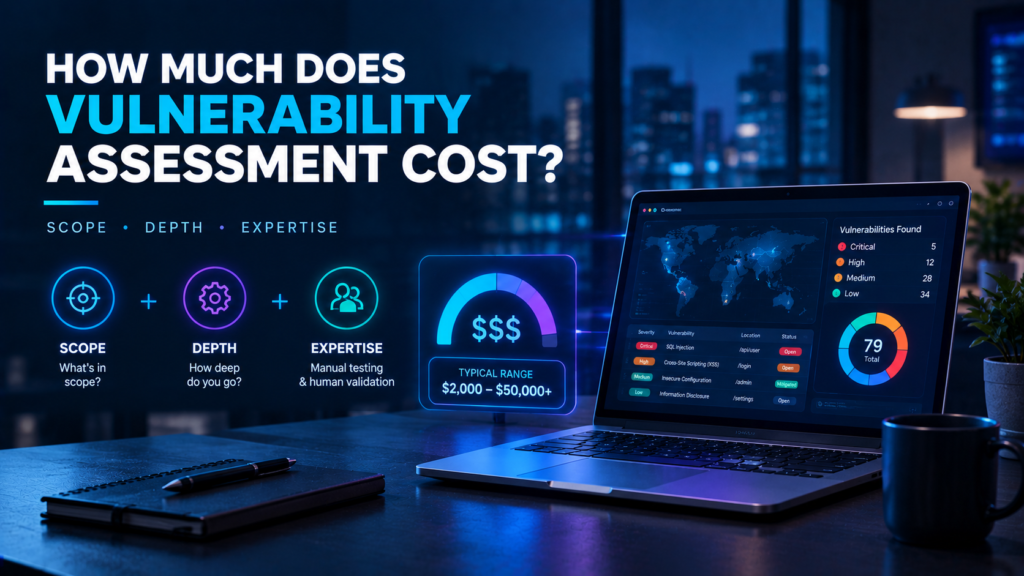
Vulnerability assessment costs in 2026 range from around $1,500 for a focused automated scan of a small environment to $25,000 or more for a comprehensive assessment of a large, multi-system environment with compliance documentation requirements. The wide range reflects genuine differences in scope and methodology, not just vendor margin. Getting the right number for your specific situation requires understanding what moves the price and why.
This post breaks down what vulnerability assessments actually cost, what drives those costs up or down, and how to tell whether a quote reflects the scope your organization actually needs.
Key Takeaways
- Vulnerability assessments in 2026 range from $1,500 to $25,000+, with most mid-market engagements landing between $3,000 and $12,000 depending on scope, assessment type, and compliance requirements.
- Scope is the single largest cost driver. The number of assets, IP addresses, web application endpoints, and cloud accounts in scope determines how much tester time the engagement requires.
- Vulnerability assessments cost significantly less than penetration tests because they identify and catalogue potential weaknesses without actively exploiting them. They answer different questions and serve different compliance purposes.
- Compliance requirements add 15 to 25 percent to the baseline cost of an assessment, primarily due to additional documentation, evidence formatting, and report structure that auditors require.
- In Bugstrix assessments, organizations that clearly define scope before requesting a quote receive more accurate pricing than those that request quotes against vague descriptions. Scope ambiguity almost always results in pricing surprises after kickoff.
What Is a Vulnerability Assessment and What Does It Cover?
A vulnerability assessment is a structured security evaluation that identifies, catalogues, and prioritizes vulnerabilities across a defined set of systems, applications, or infrastructure, using a combination of automated scanning and manual review to produce a prioritized list of security weaknesses the organization should address.
The key distinction from penetration testing is that a vulnerability assessment identifies potential vulnerabilities without actively exploiting them. It answers the question of what weaknesses exist. It does not answer whether those weaknesses are genuinely exploitable in your specific environment or what an attacker could realistically accomplish through them. Both questions matter, but they require different assessments and serve different purposes.
For a detailed breakdown of how the two compare, our post on vulnerability assessment vs penetration testing covers the structural differences and when each is appropriate.
Our vulnerability assessment services are structured to cover the specific asset types and compliance requirements most relevant to mid-market and enterprise organizations.
How Much Does a Vulnerability Assessment Typically Cost?
A vulnerability assessment typically costs between $1,500 and $25,000 for most organizations, with the price driven primarily by the size and complexity of the environment in scope. The table below covers realistic cost ranges by assessment type based on Bugstrix engagement data from mid-market and enterprise clients.
| Assessment Type | Typical Scope | Cost Range |
| External network VA | Up to 50 internet-facing IPs | $1,500 – $5,000 |
| Web application VA | Single web app, standard complexity | $2,500 – $8,000 |
| Internal network VA | Up to 500 internal assets | $4,000 – $12,000 |
| Cloud infrastructure VA | Single provider, single account | $4,000 – $10,000 |
| Full-scope VA (network + web app) | Combined external and internal | $8,000 – $20,000 |
| Enterprise or multi-system VA | Large or complex environment | $15,000 – $25,000+ |
| Compliance-driven VA (PCI, SOC 2) | Compliance scope + documentation | Add 15–25% to baseline |
These ranges reflect mid-market boutique firm pricing. Offshore providers sit 30 to 50 percent lower on average. Large consultancies and Big 4 providers sit significantly higher. The gap in both directions is real and reflects differences in methodology, tester seniority, and report quality rather than just margin.
A quote that sits well below the lower bound for a given scope type warrants scrutiny. In our experience, assessments priced below $1,500 for any meaningful scope almost always reflect automated scanning alone without meaningful manual review, producing a report that catalogues known CVEs but misses the configuration issues, access control gaps, and non-standard vulnerability patterns that manual review surfaces.
What Factors Drive Vulnerability Assessment Cost?
Seven specific factors account for the majority of price variation between quotes for the same type of assessment. Understanding each one makes it easier to interpret quotes and to scope engagements accurately before engaging a provider.
Scope is the dominant cost driver, accounting for more price variation than any other factor. Every additional IP address, web application, cloud account, or internal system adds assessment time. Organizations with well-defined, narrow scopes consistently receive lower quotes than those with broad or undefined environments. Defining scope precisely before requesting quotes is the most reliable way to get accurate pricing.
Manual versus automated ratio determines quality and cost simultaneously. Assessments that rely primarily on automated scanning tools are cheaper and faster but produce higher false positive rates and miss vulnerability classes that require manual review. Assessments with meaningful manual review are more expensive but produce more accurate, actionable findings. A quote without clarity on the manual-to-automated ratio is difficult to evaluate.
Compliance documentation adds to baseline costs because compliance-driven assessments require specific evidence formats, CVSS risk scoring, framework control mapping, and report structures designed for auditors rather than security teams. PCI DSS, SOC 2, ISO 27001, and HIPAA assessments each have their own documentation requirements that add tester time beyond the assessment itself.
Environment complexity covers factors like active directory architecture in internal assessments, multi-account cloud environments, hybrid on-premises and cloud infrastructure, and the presence of custom or legacy systems that automated tools handle less reliably than standard commercial software.
Tester seniority and firm tier affects both the quality of findings and the price. Junior testers working from a defined checklist will find less than senior testers with specialized expertise. Boutique firms with specialist expertise in specific environments command higher rates than generalist providers, and that premium often reflects in finding quality.
Report depth and format matters more for compliance-driven assessments than for security-only ones. Executive-facing reports with risk narrative and business impact context require more writing time than technical finding lists. Some providers charge separately for executive summaries. Others include them at no additional cost.
Retesting is inconsistently handled across the market. Some providers include one partial retest of critical findings. Others charge separately, typically at 15 to 25 percent of the original engagement fee. Clarifying what retesting coverage is included before signing prevents unexpected costs after remediation.
How Does Vulnerability Assessment Cost Compare to Penetration Testing?
A vulnerability assessment typically costs 30 to 60 percent less than a penetration test of equivalent scope because it identifies and catalogues potential weaknesses without the additional tester time required to actively exploit them, develop attack chains, and produce validated exploitation evidence.
That cost difference reflects a genuine difference in what the two assessments produce. A vulnerability assessment tells you what weaknesses exist and how severe they are based on industry classification. A penetration test tells you which of those weaknesses are actually exploitable in your specific environment, what an attacker could realistically accomplish through them, and how multiple moderate findings chain into a critical attack path.
The cheaper assessment is not always the right choice. Organizations that need to demonstrate to auditors, enterprise buyers, or cyber insurers that their security controls are genuinely effective under realistic adversarial conditions need a penetration test. Organizations that need a structured security baseline, ongoing vulnerability tracking, or broad asset coverage between penetration test cycles need a vulnerability assessment.
For a detailed breakdown of what penetration testing costs across different scope types, our post on penetration testing costs covers the full pricing landscape.
What Is the Right Vulnerability Assessment Frequency and How Does That Affect Total Cost?
Vulnerability assessments should be conducted at minimum annually, with additional assessments triggered by significant changes to the environment, and the right frequency directly affects the total annual security spend more than the per-engagement cost.
Most compliance frameworks set the minimum cadence. PCI DSS requires quarterly external vulnerability scanning under Requirement 11.3, conducted by an Approved Scanning Vendor, alongside annual penetration testing. SOC 2 auditors expect evidence of regular vulnerability identification activity. ISO 27001 Annex A.8.8 requires ongoing technical vulnerability management.
For organizations managing their security budget, the per-engagement cost is less important than the total program cost at the frequency their risk profile and compliance obligations require. A $5,000 quarterly external scan is a $20,000 annual program. A $10,000 biannual full-scope assessment is a $20,000 annual program with broader but less frequent coverage. The right answer depends on how fast the environment changes and what the compliance obligations specifically require.
Continuous monitoring approaches change this calculus. Our attack surface management service provides ongoing visibility into the external attack surface between periodic assessment cycles, identifying new exposure as it appears rather than waiting for the next scheduled assessment. For actively changing environments, this continuous layer often provides better security value than increasing the frequency of point-in-time assessments.
How Much Should a Small Business Budget for a Vulnerability Assessment?
A small business with a standard digital footprint, a single web application, and a limited network infrastructure should budget $2,000 to $6,000 for a quality annual vulnerability assessment. Organizations with more complex environments or compliance requirements should budget toward the higher end of the ranges in the cost table above.
The mistake small businesses most commonly make with vulnerability assessment budgets is selecting a provider based on the lowest quote without evaluating what that quote actually includes. A $900 web application vulnerability scan from an offshore provider running automated tools produces a different output than a $3,500 assessment that includes manual review of authentication flows, access control behavior, and configuration issues that automated scanners miss. The cost difference is meaningful. The finding quality difference is typically larger.
For small businesses evaluating how vulnerability assessment cost fits within their overall security budget, our post on how much a small business should spend on cybersecurity provides a practical framework for allocating security investment proportionate to risk.
Does Bundling Assessments Reduce Cost Over Time?
Running vulnerability assessments as a sequence of disconnected, one-off engagements typically costs more over a multi-year period than the same coverage purchased as an ongoing arrangement with a single provider, and the difference is large enough to factor into how a security budget gets structured.
The cost saving comes from three places. First, providers routinely discount recurring or multi-engagement commitments, often 10 to 20 percent off standalone pricing, because a known future revenue stream reduces their own sales and onboarding cost. Second, a provider running repeat assessments against the same environment spends less time on scoping and environment familiarization each cycle, time that gets billed on a first engagement but not repeated on the third or fourth. Third, findings tracked continuously across cycles by the same provider surface recurring or unresolved issues faster, which reduces the wasted spend of re-discovering the same finding in a fresh, disconnected assessment a year later.
This does not mean the cheapest path is always locking into a single vendor indefinitely. Organizations still benefit from periodically re-testing with a different provider to catch blind spots a familiar assessor might develop over time. The practical middle ground most Bugstrix clients land on is a primary ongoing relationship for the majority of cycles, with an independent second assessment every two to three years as a cross-check.
Our vulnerability management post covers how findings get tracked and reconciled across successive assessment cycles, which is the process that makes the cost savings of an ongoing arrangement actually realizable rather than theoretical.
How Do You Get an Accurate Quote for a Vulnerability Assessment?
Getting an accurate quote requires providing clear scope information upfront rather than asking for a general price range. Providers who quote without scope information are producing estimates that will change after kickoff, typically upward. Providers who ask specific questions about your environment before quoting are the ones most likely to deliver accurately scoped work.
Before requesting a quote, have the following information ready:
- Asset inventory: number of IP addresses, web applications, cloud accounts, internal systems, and mobile applications in scope
- Assessment type: external only, internal only, web application, cloud, or full-scope
- Compliance requirements: whether the assessment needs to satisfy a specific framework and what documentation it needs to produce
- Timeline: whether the assessment needs to complete before an audit, a deal close, or another deadline
- Retesting expectations: whether retest of remediated findings is needed and within what timeframe
- Report format: whether the report needs an executive summary, technical findings, or both
A provider who gives an accurate quote without this information is either guessing or working from a fixed-price package that may not match your actual environment. Our vulnerability assessment services page covers what information we use to scope engagements accurately before providing a quote.
Frequently Asked Questions
What is included in a vulnerability assessment report?
A quality vulnerability assessment report includes a scope statement covering what was assessed, a methodology description explaining how the assessment was conducted, an executive summary of overall security posture, detailed findings with severity ratings and CVSS scores, remediation recommendations specific to the affected system and technology stack, and a prioritized remediation roadmap. Compliance-driven assessments add framework control mapping and evidence documentation formatted for auditor review.
Is a vulnerability assessment the same as a security audit?
No. A security audit evaluates whether an organization’s security policies, procedures, and controls comply with a defined standard or framework, typically through document review, interviews, and evidence examination. A vulnerability assessment actively scans systems and applications to identify technical weaknesses. Both are useful, but they address different questions. Many compliance programs require both rather than treating them as alternatives.
How long does a vulnerability assessment take?
A focused external network assessment of a small environment takes two to five business days. A full-scope assessment covering network infrastructure, web applications, and cloud environments in a mid-market organization typically takes one to three weeks. Report writing and delivery add three to five business days on top of the testing phase for most engagements.
Do vulnerability assessments include retesting?
It varies by provider. Some include one partial retest of critical and high findings as part of the base engagement. Others charge separately, typically at 15 to 25 percent of the original cost. Always clarify retesting policy before signing. For compliance-driven assessments, retest evidence is required to demonstrate that identified findings were addressed, which makes retesting a necessary part of the compliance evidence package rather than an optional add-on.
What is the difference between a vulnerability scan and a vulnerability assessment?
A vulnerability scan runs automated tools against a defined scope and returns a list of potential issues based on known vulnerability signatures. A vulnerability assessment combines automated scanning with manual review to validate findings, add business context, eliminate false positives, and produce prioritized remediation recommendations. Scans are cheaper and faster. Assessments produce more accurate, actionable output. Most providers use the terms interchangeably, which makes it important to ask specifically what manual review is included when evaluating quotes.
Cost Is the Starting Point, Not the Ending Point
The right vulnerability assessment is not the cheapest one or the most expensive one. It is the one scoped correctly for your environment, conducted with the right methodology for your risk profile, and structured to produce output that your security team can act on and your auditors can accept.
Most organizations that underspend on vulnerability assessment do not save money. They spend money on an assessment that produces findings they cannot prioritize, misses the issues that actually matter, or fails to satisfy the compliance requirement it was commissioned to address. The cost of rescoping or repeating an assessment is typically higher than the premium for doing it correctly the first time.
The most reliable way to budget accurately is to define scope clearly, ask specific questions about methodology before selecting a provider, and treat the assessment as the first step in an ongoing vulnerability management program rather than a one-time deliverable.
Contact us to discuss a vulnerability assessment scoped for your environment