How Much Should a Small Business Spend on Cybersecurity?

Written By
Sarwat Iftikhar
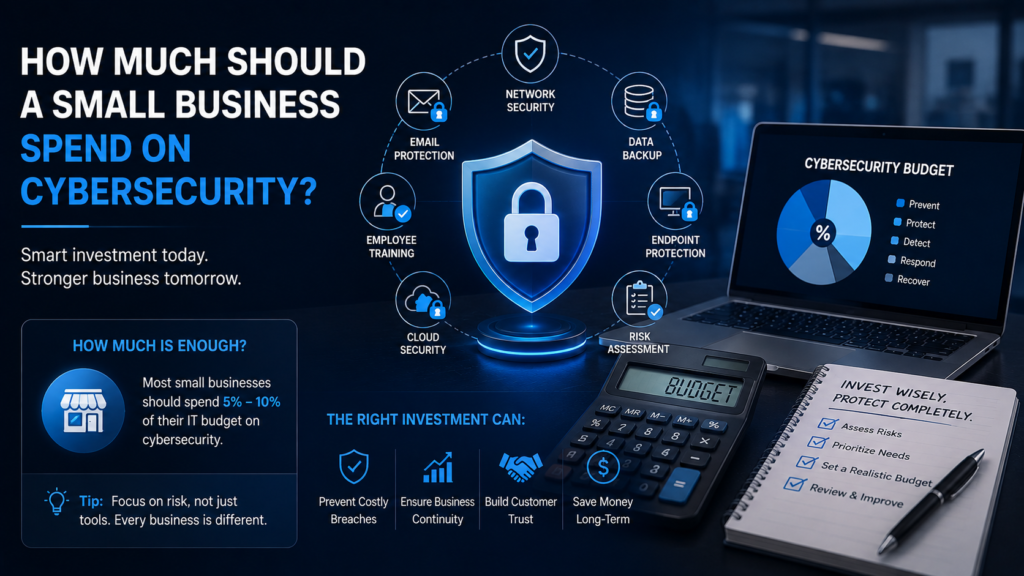
Annual prevention for a typical small business costs between $5,000 and $15,000. A single ransomware incident costs an average of $120,000 in recovery and can reach $1.24 million once you include downtime, legal fees, forensics, and reputational damage. That makes proactive security 50 to 60 times cheaper than reactive recovery, yet 47% of small businesses with fewer than 50 employees still allocate zero cybersecurity budget.
The question of how much to spend is legitimate, and the answer is not the same for every business. Industry, data sensitivity, compliance obligations, and the pace of your technology environment all affect what the right number looks like. What does not vary is the underlying calculation: the cost of the right security controls is always less than the cost of the breach those controls would have prevented.
This guide gives you the benchmark figures, the budget framework, and the specific investment priorities that deliver the most security value for a small business budget in 2026.
Key Takeaways
- The industry benchmark for cybersecurity spending is 7 to 12% of annual IT budget, or roughly 0.69% of total revenue. Businesses spending below this range are almost always underprotected.
- Small businesses with 1 to 50 employees typically spend $5,000 to $25,000 annually. The floor for meaningful protection is around $5,000. Below that figure, coverage gaps are almost always present.
- A single security incident costs small businesses between $120,000 and $1.24 million, including recovery, legal, and downtime costs, making security investment a straightforward risk trade-off.
- Only 1 in 5 small businesses conducts annual penetration testing, yet a tested incident response plan and basic security controls reduce breach costs by an average of $232,000 per incident.
- Three out of four cyber incidents involve small or midsize businesses, specifically because limited security budgets and absent testing programs make SMBs easier targets than larger organizations.
Why Is Cybersecurity Spending So Difficult for Small Businesses to Get Right?
Small businesses consistently underspend on cybersecurity not because they do not understand the risk, but because the threat feels abstract until an incident makes it concrete. Security spending competes with hiring, marketing, and product investment for a limited budget, and security’s value is measured in harms that did not happen rather than in visible results. That dynamic produces systematic underinvestment until a breach provides an expensive and painful correction.
The threat landscape does not accommodate that logic. Three out of four cyber incidents in 2024 involved small or midsize businesses, according to industry breach investigation data. The reason is straightforward: attackers target small businesses specifically because limited security budgets and absent security programs make them more accessible than larger organizations with dedicated security functions. The absence of a security investment is itself a risk factor that increases attack probability.
Global SMB spending on cybersecurity is projected to reach $109 billion in 2026, growing at 10% annually, and 63% of small businesses increased their security budgets year over year in 2025. The growth reflects rising awareness. The challenge is that 66% of SMBs still cite cost as the top obstacle to stronger security, and many are spending more without a clear framework for where the money should go.
The most expensive mistake in small business cybersecurity spending is not spending too much. It is spending inconsistently, buying tools without the controls that make those tools effective, and discovering the gaps during an incident rather than during a security review.
What Is the Industry Benchmark for Cybersecurity Spending?
The industry benchmark for cybersecurity spending is 7 to 12% of the annual IT budget, or approximately 0.69% of total revenue. Businesses in high-risk industries such as healthcare and financial services should target the higher end of that range. Businesses handling sensitive customer data or operating under compliance frameworks should not drop below 8% of IT budget regardless of total revenue.
These ranges reflect the minimum investment required for meaningful protection at each business size. Compliance obligations, industry risk profile, and the sensitivity of handled data can push the right figure significantly above these baselines:
| Business Size | Annual Revenue | Suggested Spend | % of Revenue |
| Micro (1–10 employees) | Under $500K | $3,000 – $10,000 | 0.6–2% of revenue |
| Small (10–50 employees) | $500K – $5M | $10,000 – $25,000 | 0.5–0.7% of revenue |
| Lower Mid (50–100 employees) | $5M – $20M | $25,000 – $75,000 | 0.5–0.6% of revenue |
| Any size, regulated (healthcare, finance, payments) | Any | Add 20–40% above size-based baseline | Compliance drives minimum floor |
Source: Industry security budget benchmarks + Bugstrix client engagement data, 2026
The 0.69% of revenue figure comes from actual spending data across organizations of various sizes. For a business with $2 million in annual revenue, that translates to roughly $13,800 per year on cybersecurity. For a business with $5 million in revenue, it produces $34,500. These are averages across all industries and risk profiles. A healthcare practice or financial services firm should treat them as a floor, not a target.
The more practical benchmark for most small businesses is the IT budget percentage rather than the revenue percentage, because it ties security spending directly to the technology footprint being protected. A business that spends $50,000 per year on IT, including managed services, software subscriptions, and hardware, should allocate $3,500 to $6,000 of that to security-specific controls.
How Much Does a Breach Actually Cost a Small Business?
A breach costs a small business between $120,000 and $1.24 million when all costs are included: immediate incident response, forensic investigation, data recovery, legal fees, regulatory fines, customer notification, and the long-term revenue impact of reputational damage. Ransomware specifically averages $120,000 in direct recovery costs but frequently reaches significantly higher once operational downtime is factored in.
These figures make the return on security investment calculation straightforward. Annual prevention spending of $10,000 to $20,000 that reduces breach probability by even 30 to 40% produces expected savings that justify the investment multiple times over. This is not a theoretical exercise. A tested incident response plan and trained security team reduce average breach costs by $232,000 per incident according to industry research.
The businesses that discover this calculation after a breach consistently say they wish they had understood it before. The pattern at Bugstrix, working with small businesses across various stages of their security maturity, is that the first serious security investment almost always follows a near-miss or an incident rather than preceding one. The organizations that invest before an incident have a measurably different cost structure than those that wait.
What Should a Small Business Cybersecurity Budget Actually Cover?
A small business cybersecurity budget should cover five categories in priority order: endpoint and identity protection, network security controls, security awareness training, regular security testing, and an incident response capability. The weighting between these categories should reflect the specific risk profile of the business rather than following a fixed allocation formula.
Security testing at 20% of the total budget reflects the reality that controls cannot be assumed to work without validation. Most small businesses underinvest in testing relative to tools, which means they have policies and protections whose effectiveness is unverified:
| Budget Category | Allocation |
| Endpoint and identity protection | 30% |
| Network security controls | 20% |
| Security testing | 20% |
| Security awareness training | 15% |
| Incident response planning | 15% |
Source: Bugstrix small business security program framework, 2026. Percentages reflect a baseline allocation; compliance obligations and specific risk factors adjust the weighting.
Endpoint and identity protection (30% of budget): Endpoint detection and response across all devices, phishing-resistant MFA on all accounts with external access, and password management infrastructure. These three controls address the most common attack vectors against small businesses and should be non-negotiable before any other spending.
Network security controls (20%): Firewall management, DNS filtering, secure remote access, and network segmentation where applicable. For businesses that have moved primarily to cloud, network-layer controls become less central, but cloud security posture management becomes more important.
Security testing (20%): Vulnerability scanning, annual penetration testing, and a security assessment that provides an independent view of the control environment. Only 1 in 5 small businesses conducts annual penetration testing. This is precisely why small businesses are disproportionately represented in breach statistics. Controls that are never tested against realistic attack scenarios are controls whose actual effectiveness is unknown.
Security awareness training (15%): Phishing simulation, role-specific security training, and incident reporting procedures. Human error remains the most consistent initial access vector. Training is the control that addresses the attack path that technical tools cannot fully prevent.
Incident response planning (15%): A documented and tested response plan, defined escalation paths, cyber insurance review, and periodic tabletop exercises. The $232,000 breach cost reduction associated with tested incident response plans reflects what this investment produces when an incident actually occurs.
How Much Does Security Testing Cost for a Small Business?
Security testing for a small business costs between $5,000 and $20,000 for a scoped annual penetration test, depending on the size of the environment and what is being tested. A focused web application penetration test for a small business with a defined scope typically runs $8,000 to $15,000. A broader assessment covering both the external network and web application can run $12,000 to $25,000.
For small businesses that have never been tested, a security assessment provides a structured starting point before a full penetration test. Our security assessment services identify known vulnerabilities and control gaps across the environment, giving security and leadership teams a prioritized picture of where the most significant risks exist before investing in deeper manual testing.
For businesses with a web application as their primary attack surface, our web app penetration testing delivers the authentication, authorization, and business logic testing that automated scanning consistently misses. This is the most relevant testing investment for SaaS companies, e-commerce businesses, and any organization whose primary customer interaction happens through a web application.
For businesses with software development in-house, our cybersecurity code review adds a source-level review that surfaces vulnerabilities before they reach production. Code review is substantially less expensive than fixing the same vulnerabilities after deployment and is particularly valuable for businesses that release updates frequently.
For a complete breakdown of what different testing engagements cost and what specific factors drive price variation across engagement types, our penetration test pricing breakdown covers the full range.
How Should You Prioritize Your Cybersecurity Budget When Resources Are Limited?
When security budget is genuinely constrained, prioritization should follow the principle of addressing the highest-probability, highest-impact attack paths first. Most small business breaches follow a small number of consistent patterns: phishing leading to credential compromise, unpatched external services exploited for initial access, and ransomware leveraging both. Budget allocation that addresses these three vectors delivers the most risk reduction per dollar.
The prioritization sequence that works consistently for small businesses with limited budgets:
First: Phishing-resistant MFA on all external access points and privileged accounts. This is the highest-impact control available and one of the least expensive to implement. Most major email and identity platforms include MFA at no additional cost. The configuration cost is the investment.
Second: Endpoint detection and response across all devices. Commodity antivirus is no longer sufficient against modern attack techniques. EDR that provides behavioral detection and response capability addresses the endpoint-level activity that traditional antivirus misses.
Third: Patching of externally exposed systems on a consistent cycle. Unpatched vulnerabilities in internet-facing services are the second most common ransomware entry point after phishing. A defined patching cadence for external systems costs primarily in operational discipline rather than budget.
Fourth: Security testing to understand where controls have gaps. Security awareness training and MFA protect against credential attacks. Penetration testing tells you whether authorization controls, business logic, and access management actually work as intended. Only 13% of small firms conduct proactive security audits, which means most small businesses are operating with an unvalidated assumption that their controls are effective.
When Does a Small Business Need to Spend More on Cybersecurity?
Several factors consistently justify spending above the baseline 7 to 12% of IT budget, and most relate to data sensitivity, compliance obligations, and the rate of technology change in the business. The baseline figures assume a general commercial environment. Businesses that deviate from that assumption need to recalibrate their spending accordingly.
Spend above baseline when any of these apply:
You handle regulated data. Healthcare businesses subject to HIPAA, financial services firms under PCI DSS, and businesses processing EU personal data under GDPR each carry compliance obligations that define minimum security control requirements. Failing those requirements carries fines that can easily exceed the cost of adequate security spending. The compliance investment should be treated as a floor, with risk-based security investment on top.
Your business depends on a web application or SaaS product. Businesses whose primary revenue depends on a web application carry concentrated technical risk. A single authorization failure, data exposure, or extended outage can cost far more than an annual security testing program. The penetration testing investment is proportional to how much the business depends on that application working correctly.
You have a software development function. Businesses that build and deploy code in-house have a dynamic attack surface that changes with every release. Static annual penetration testing of a codebase that updates weekly provides incomplete coverage. More frequent testing, or continuous testing aligned with release cycles, reflects the actual rate of change.
You have had a security incident. The period after an incident is when prevention investments have the strongest organizational support and when the gaps exposed by the incident are clearest. Using that window to close the specific vulnerabilities that enabled the incident, and to validate that the remediation was effective, is the highest-leverage use of post-incident security budget.
For guidance on how to evaluate security providers when the budget justifies deeper testing, our provider selection guide covers the criteria that separate quality firms from commodity ones.
Our penetration testing at Bugstrix is structured to produce security value proportional to the investment at every budget level, with scoping conversations that match the engagement to what the business actually needs rather than defaulting to a fixed package.
Frequently Asked Questions
How much does a small business spend on cybersecurity on average?
Small businesses with 1 to 50 employees typically spend $5,000 to $25,000 annually on cybersecurity, representing roughly 7 to 12% of IT budget or approximately 0.69% of revenue. However, 47% of small businesses with fewer than 50 employees allocate zero cybersecurity budget, and the businesses spending the least are disproportionately represented in breach statistics.
Is $5,000 per year enough for small business cybersecurity?
It depends on what that $5,000 covers. A $5,000 budget that funds phishing-resistant MFA, endpoint detection and response, and basic security awareness training provides meaningful protection for a micro-business with limited external exposure. A $5,000 budget spent entirely on a firewall or antivirus subscription while leaving authentication, endpoint security, and testing uncovered is inadequate regardless of the dollar amount.
Do small businesses need penetration testing?
Small businesses that operate customer-facing web applications, process payment data, handle health information, or store sensitive customer records benefit significantly from annual penetration testing. The test validates whether the controls in place actually work against realistic attack scenarios. Given that only 1 in 5 small businesses currently tests annually, this is also a competitive differentiator when enterprise customers conduct vendor security reviews.
Should a small business outsource cybersecurity or handle it in-house?
Most small businesses benefit from outsourcing the majority of their security functions because maintaining in-house security expertise across the breadth of what a modern security program requires exceeds what a small internal team can sustain. Managed security services for monitoring and detection, external providers for penetration testing and assessment, and a clearly designated internal owner who coordinates the overall program is the model that works at most small business scale and budget levels.
What is the biggest cybersecurity mistake small businesses make?
Treating security as a one-time purchase rather than an ongoing practice. Buying tools without validating they are configured correctly and working as intended. Assuming that because they are a small business, they are not a target. And deferring security spending until after an incident demonstrates the cost of the gap. The pattern is consistent: the businesses that invest before an incident pay a fraction of what the businesses that wait eventually pay.
The Math Is Not Complicated
Annual prevention spending of $10,000 eliminates the probability of a $120,000 to $1.24 million incident. Even if that spending reduces breach probability by only 30%, the expected value calculation justifies the investment by a factor of several times over.
The businesses that struggle with cybersecurity spending are rarely the ones who cannot afford it. They are the ones who have not yet quantified what they cannot afford to lose. That calculation, once made honestly, almost always produces a security budget that is higher than what was being spent before and lower than the cost of the breach it prevents.