How to Choose a Penetration Testing Company in 2026

Written By
Sarwat Iftikhar
The penetration testing market is projected to reach $6.41 billion in 2026. That growth reflects genuine demand from organizations that have decided to test. What it also reflects is a market full of providers ranging from genuine adversarial security firms to companies delivering automated scanner output with a manual testing label on the cover.
Choosing the wrong penetration testing company does not just waste budget. It produces a false sense of security that is, in some ways, worse than not testing at all. A business that knows it has not been tested is appropriately uncertain about its posture. A business that has paid for a test and received a scan report believes it has been validated, and that confidence may persist right through to a breach.
This guide covers the criteria that separate quality providers from commodity ones, the questions to ask before you sign, and the red flags that signal a provider will not deliver genuine security value.
Key Takeaways
- The penetration testing market has a significant quality distribution problem: many providers in the $6.41 billion market deliver automated scan output rather than genuine manual adversarial testing.
- Tester qualifications are the most reliable proxy for testing depth. OSCP, OSWE, OSCE3, CREST CRT, OSEP, and OSED indicate hands-on offensive capability. General security certifications do not.
- The report is the deliverable. A provider that cannot share a redacted sample report before engagement is a provider whose reporting quality cannot be evaluated before it is too late.
- Retesting after remediation should be included in the base engagement, not billed separately. A provider that charges separately for confirming fixes worked has a pricing structure that does not align with the buyer’s interests.
- In Bugstrix engagements, the clients who arrived with the worst security posture were most often the ones who had previously been assessed by a provider running automated scans under a manual testing label.
What Is the Difference Between a Good and a Poor Penetration Testing Company?
A good penetration testing company produces validated, exploitable findings that reflect how an actual attacker would approach your environment. A poor one produces a list of issues generated by automated tools that any attacker already knows about, packaged in a report that satisfies a compliance checkbox but provides no meaningful security insight.
The practical distinction is not always visible from a proposal. Both a genuine manual testing firm and a scan-and-report provider can produce a proposal describing “comprehensive manual penetration testing” with similar scoping language and similar pricing ranges. The difference only becomes visible when you look at three things: who is actually doing the testing, how they approach the engagement, and what the finished report actually contains.
The global average breach cost reached $4.44 million in 2025, the second-highest figure on record. Against that number, the cost of a genuine penetration test is small. The cost of a poor one is the false confidence it creates, which can persist through decisions about infrastructure changes, compliance submissions, and risk management discussions that assume the environment has been properly validated.
The criteria in this guide give you a framework to evaluate the difference before you commit to a provider, not after the report lands in your inbox.
What Qualifications Should You Look for in a Penetration Testing Provider?
Tester qualifications are the most reliable proxy for testing depth available before an engagement begins. Certifications that require demonstrating offensive capability in practical, hands-on environments are meaningfully different from certifications that test knowledge of security concepts through multiple-choice examinations.
The certifications that indicate genuine hands-on offensive capability are OSCP (Offensive Security Certified Professional), OSWE (Offensive Security Web Expert), OSCE3, OSEP, OSED, and CREST CRT or CCT. Each of these requires passing a practical examination under time pressure, not demonstrating knowledge of security frameworks. A tester who holds an OSCP has proven they can compromise systems. A tester who holds a general security certification has proven they understand security concepts.
When evaluating a provider, ask specifically about the certifications held by the testers who will be assigned to your engagement. Not the firm’s most senior technical staff. The actual people who will be working in your environment. A firm that employs one OSCP-certified tester and deploys them selectively to enterprise clients while using less qualified staff for smaller engagements is a different proposition from a firm where your assigned tester’s credentials are clearly documented on the proposal.
The distinction also applies to seniority and experience. A tester with three years of dedicated penetration testing experience and a strong certification portfolio will consistently find more meaningful findings than a junior analyst using the same toolset and methodology. Ask providers about the experience level of the testers who will be assigned to your work, and be appropriately skeptical of firms that cannot answer that question specifically.
Our penetration testing engagements document the specific tester credentials and experience assigned to every engagement, because that information is part of what a client is evaluating when they select a provider.
How Do You Evaluate a Penetration Testing Company’s Methodology?
A credible penetration testing provider can explain precisely how they test: which frameworks they follow, how findings are documented and validated, and how their approach differs based on the type of engagement being conducted. A provider that responds to methodology questions with vague references to “industry best practices” or “comprehensive testing” without specifics is signaling that their process is less defined than what the question requires.
Established methodology frameworks include PTES (Penetration Testing Execution Standard), OWASP WSTG (Web Security Testing Guide) for application testing, NIST SP 800-115 for technical security testing, OSSTMM for network testing, and MITRE ATT&CK for mapping findings to attacker techniques. A provider should be able to name the frameworks they follow and explain how those frameworks shape their engagement approach for your specific scope.
The methodology question that separates genuine manual testers from scan-dependent providers most clearly is this: ask how they handle a web application endpoint that does not produce any findings from automated tooling. A manual tester will explain how they manually examine authentication logic, session management, authorization boundaries, and business logic specific to that endpoint. A scan-dependent provider will struggle to articulate what happens after the automated phase produces no findings.
For web and API testing specifically, methodology matters even more because the most significant web application vulnerabilities (authorization failures, business logic flaws, IDOR) are not discoverable through automated scanning. Our web app penetration testing methodology covers these categories through manual testing precisely because they represent the highest-impact findings and the ones scanners consistently miss.
What Should a Quality Penetration Test Report Actually Contain?
The report is the primary deliverable of a penetration test, and its quality is the clearest indicator of the value the engagement produced. A quality report is readable by both the technical team who needs to fix findings and the business stakeholders who need to understand risk. A poor report is a list of CVEs with generic remediation language that could have been produced without any human tester ever engaging with the environment.
A quality penetration test report contains six elements that distinguish it from scanner output:
Validated exploitation evidence. Every critical and high finding should include screenshots, API responses, or command output demonstrating that the vulnerability was confirmed as genuinely exploitable in your environment, not just theoretically present based on a version number or configuration pattern.
Business impact context. Each finding should answer the question “what does this mean for the business?” A SQL injection in an admin panel has a different real-world impact from a SQL injection in a public-facing search field, even if the CVSS scores are similar. A quality report explains that distinction.
Specific, actionable remediation guidance. Generic remediation guidance (“update the software to the latest version” or “implement input validation”) is not enough for a development team to implement a fix correctly. Quality guidance specifies what to fix and how, at the code or configuration level.
Attack chain narrative. Individual findings do not always communicate the full picture. A quality report shows how findings can be combined, how an attacker would move from initial access to meaningful impact, and which combinations of lower-severity findings produce a high-severity attack path.
Retest results. A finding without a documented retest confirming it was remediated is an open loop. Every provider should include at least one retest of critical and high findings as a standard part of the engagement, and the report should contain the retest results alongside the original findings.
Ask every provider you evaluate for a redacted sample report from a previous engagement. If they cannot or will not provide one, that itself tells you something important about their confidence in their own reporting quality.
Does the Penetration Testing Company Need Industry Experience?
Industry-specific experience matters most in two areas: understanding the compliance framework your test needs to satisfy, and understanding the specific application and infrastructure patterns that are common in your sector. A provider without healthcare experience may not understand which controls HIPAA requires the test to address. A provider without financial services experience may not know how to scope an engagement around a PCI DSS Cardholder Data Environment.
For compliance-driven tests, this matters practically because a provider who does not understand the framework produces a test that may not satisfy the auditor’s evidence requirements, requiring supplemental testing or additional documentation after the fact. The evidence structure, finding mapping, and report format that satisfy a SOC 2 auditor under CC4.1 are different from what satisfies a PCI DSS Qualified Security Assessor under Requirement 11.4. A provider experienced with both knows the difference before the engagement starts.
For environment-specific testing, industry experience is valuable but less critical than the specific technologies being tested. A provider with deep web application and API testing expertise is a stronger choice for a SaaS company’s primary attack surface than a generalist provider with industry-specific credentials but limited web application depth. Match the provider’s technical specialization to your actual scope before weighting industry experience.
What Questions Should You Ask Before Signing with a Penetration Testing Company?
Asking the right questions before an engagement begins separates a well-structured purchasing decision from one based on proposal quality and pricing alone. The answers to these questions reveal how a provider actually operates rather than how they describe their operation in marketing material.
Who specifically will be testing our environment? Ask for the name, certifications, and experience of the tester or testers who will be assigned to the engagement. A firm that responds with general information about their team rather than specific tester credentials is a firm that cannot answer this question because the assignment has not been made, or because the assignment has been made to someone whose credentials would not strengthen the proposal.
Can we speak directly with the tester before and during the engagement? The ability to communicate directly with the person doing the technical work, rather than through account managers or project coordinators, is significant. Questions about scope, unexpected findings, and testing approach decisions are best answered by the tester, not relayed through an intermediary.
What happens if you find something critical during the test? The answer should describe a clear notification process: the tester contacts the client immediately upon confirming a critical finding rather than waiting for the final report. A provider whose process routes all communication through the report delivery date is one whose critical findings may sit unaddressed for the duration of the test.
Is retesting included or billed separately? Included retesting signals that the provider’s business model is aligned with the client’s interest in actually remediating findings. Separately billed retesting creates a structure where the provider’s revenue increases if findings take multiple retest cycles to close.
What methodology does the test follow and how is it documented in the report? The answer should reference specific frameworks and describe how those frameworks translate into the testing activities conducted. Vague answers suggest the methodology is less defined than what the question implies.
Have you worked with organizations in our sector before? If compliance is a driver, the follow-up is: which frameworks have you produced audit-ready reports for, and can you show us how the finding mapping works for our specific auditor expectations?
How Do You Compare Penetration Testing Quotes Accurately?
Comparing penetration testing quotes requires looking past the headline price to understand what each quote actually includes, because the same labeled activity can represent very different scopes and very different quality levels. A $5,000 web application penetration test from a scan-and-report provider and a $15,000 web application penetration test from a manual testing firm are not comparable products at different price points. They are different products.
The specific items to verify before comparing prices:
What does “manual testing” mean in this quote? Some providers describe their approach as manual while using automated tooling for the majority of the engagement and applying human review only to the output. Ask what percentage of testing time is dedicated to manual, human-driven testing versus automated tool execution. The answer will vary, but the question reveals how the provider thinks about the distinction.
How many tester days does the engagement include? Price divided by testing depth is a more useful comparison than price alone. A $12,000 quote that includes eight tester days is different from a $10,000 quote that includes three. The number of tester days provides a rough basis for comparing the actual testing effort included.
Is retesting included and how many rounds? An engagement that includes a full retest of critical and high findings costs less over the full testing cycle than one where retesting is billed at 15 to 25% of the original engagement fee per round.
What does the report format look like? As discussed above, report quality varies significantly and affects what the test actually produces for compliance, remediation, and risk management purposes.
What is the remediation support model? Does the provider offer a consultation with the tester after report delivery to answer questions about findings and remediation approach? Providers that disappear after delivering the report force the client’s development team to work through complex remediation guidance without the tester’s context.
For a detailed breakdown of what different engagement types cost and what drives price variation, our penetration test pricing guide covers the full range.
What Are the Red Flags That Signal a Poor-Quality Provider?
Several patterns consistently appear across providers who deliver poor-quality penetration testing. Recognizing them before engagement avoids the most common version of a bad vendor selection.
Unwillingness to share a sample report. A confident provider shares redacted sample reports as part of the sales process because their reports demonstrate quality. A provider who cannot or will not share one is protecting you from seeing something that would reduce their chances of winning the engagement.
No clarity on who will be testing. If a provider cannot name the tester or describe their qualifications when asked directly, the assignment will be made based on availability rather than fit. This is how junior or less experienced staff end up on engagements where their credentials would not have won the proposal.
Testing timelines that are impossibly fast. A genuine manual web application penetration test covering a complex SaaS platform cannot be completed in two days. Proposals that promise broad scope in very short timelines are almost always describing automated scanning.
Reports built primarily around CVE listings. If the provider’s sample report consists primarily of a list of CVEs identified in software versions found during reconnaissance, that report was produced by a scanner. Genuine manual testing produces findings in authorization logic, business processes, and application behavior that do not map to published CVEs.
Retesting billed as a separate line item. As noted above, this is a structural misalignment of incentives. It does not necessarily mean the testing is poor, but it should prompt questions about what other elements of a complete engagement are considered add-ons.
No clear escalation process for critical findings. A provider that plans to deliver all findings in the final report, including a critical finding that could be causing active damage, is not structured to protect the client during the test itself.
Reluctance to reference the methodology. A provider who deflects methodology questions with language like “we use a proprietary approach” or “industry-standard techniques” without naming specific frameworks is providing no verifiable basis for evaluating their testing rigor.
For context on building a testing program that works over time, not just for a single engagement, our pentesting frequency guide covers how often different types of organizations should test and how to structure the cadence.
Frequently Asked Questions
How do I know if a penetration test was actually manual?
Ask the provider to walk you through a specific finding in your report and explain the manual steps taken to identify and confirm it. A tester who conducted genuine manual testing can describe the process: what they observed, what assumption they tested, how they manipulated the application to confirm the finding, and what the specific impact was. If the explanation describes tool output rather than tester reasoning, the testing was not primarily manual.
Should I choose a large firm or a boutique provider?
Size is not a reliable proxy for quality. Larger firms offer scale and sometimes name recognition that simplifies procurement approvals. Boutique firms often offer more direct tester access, stronger individual tester credentials, and more focused specialization. The better question is which provider’s tester qualifications, methodology, and track record match your specific engagement requirements. For highly specialized work, smaller firms with deep expertise in a specific area often outperform generalist firms with more resources.
Is it necessary to do a penetration test on-site?
Most web application, API, cloud, and external network penetration tests are conducted remotely with no loss of quality relative to on-site testing. Internal network tests and physical security assessments are cases where on-site presence is necessary by definition. For most modern environments where the primary risk is in external-facing applications and cloud infrastructure, the physical location of the testing team is not a quality factor.
How long does a penetration test typically take?
A scoped web application test covering a defined set of features and user roles typically runs one to two weeks for the testing phase. Full-scope assessments covering applications, APIs, network infrastructure, and cloud components run two to four weeks. Timelines shorter than one week for anything described as a thorough web application test should be treated as an indicator that the engagement is primarily automated.
What should I do with the penetration test report after I receive it?
The report should drive three sequential activities: remediation of identified findings prioritized by severity, a retest confirming that critical and high findings were closed, and a documentation cycle that updates your security program based on what the findings revealed about your control environment. If the findings revealed gaps in specific areas, the test results should also inform the scope of the next engagement, ensuring the highest-risk areas receive coverage in subsequent testing cycles.
The Shortest Summary of How to Choose
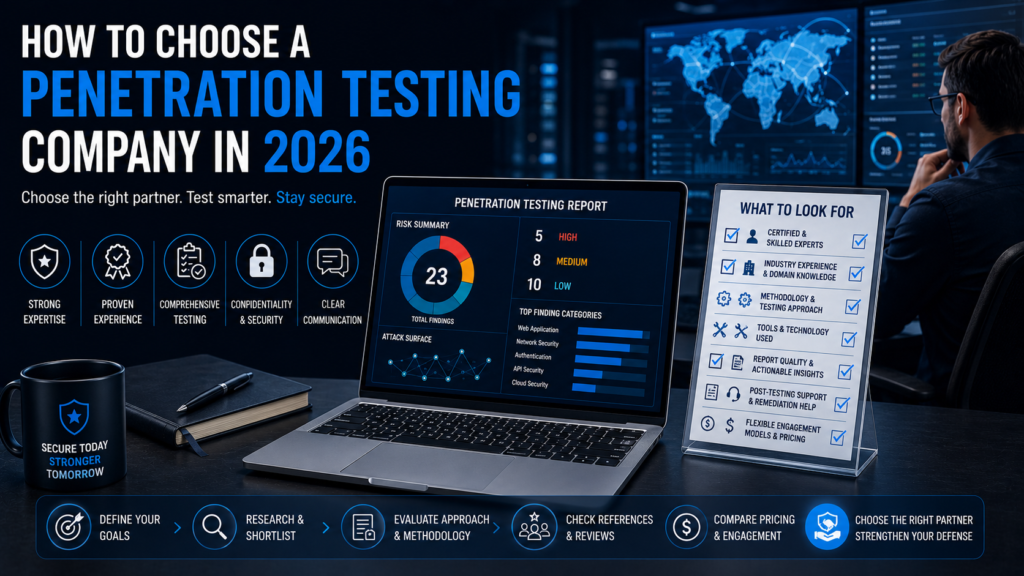
Choose a provider whose testers have hands-on offensive certifications, who can name their methodology, who will share a sample report, who includes retesting without additional charge, who can tell you exactly who will be testing your environment, and who has a clear process for notifying you of critical findings before the engagement ends.
Everything else, brand recognition, proposal quality, pricing, and sales process, is secondary to those six factors. They are the ones that determine whether the engagement produces genuine security value or a document that satisfies a checkbox.