How Often Should a Business Perform a Penetration Test?

Written By
Sarwat Iftikhar

The compliance answer depends on the framework: PCI DSS includes explicit penetration-testing cadence requirements, while other frameworks may take a risk-based or control-evidence approach rather than prescribing one universal annual penetration-test schedule. The practical answer is more nuanced, and for most businesses, annual testing alone is not enough.
Attackers do not operate on an annual calendar. The median attacker dwell time, the gap between initial compromise and detection, rose to 14 days in 2026. That means an attacker who breaches your environment in February and goes undetected could be extracting data long before your annual test in November has a chance to find the vulnerability they used to get in. Annual testing satisfies your auditor. It does not tell you whether your environment is secure today.
The right answer to testing frequency is not a fixed number. It is a framework that combines compliance obligations, risk profile, and the pace of change in your environment. This post breaks down exactly how to think through that calculation, when annual testing is appropriate, when more frequent testing is necessary, and what events should trigger a test regardless of your scheduled cadence.
Key Takeaways
- Annual penetration testing is the compliance minimum under PCI DSS, SOC 2, ISO 27001, and most other major frameworks, not the recommended ceiling.
- Industries with higher testing cadence consistently show lower proportions of critical and high-severity findings, reflecting the compounding risk that accumulates between infrequent test cycles.
- The global average breach cost reached $4.44 million in 2025, with the US average at a record $10.22 million, making the cost of under-testing significantly higher than the cost of testing more frequently.
- Businesses with high-change environments, sensitive data, or customer-facing applications should test quarterly rather than annually.
- In Bugstrix engagements, the most damaging findings are almost always in components that changed since the last test, not in the stable infrastructure that had already been assessed.
Why Is Annual Penetration Testing Not Enough for Most Businesses?
Annual penetration testing is not enough for most businesses because modern environments change continuously, and a test that accurately describes your security posture in January tells you very little about what an attacker can access in September. Every new feature, new integration, infrastructure change, and configuration update introduces potential vulnerabilities that did not exist when your last report was written.
The gap between testing cycles is where risk accumulates. A SaaS company that ships new features every two weeks introduces dozens of code changes between annual tests. A financial services firm that adds a new third-party payment integration in March creates attack surface that did not exist in January’s assessment. A healthcare provider that migrates workloads to a new cloud environment over the summer is operating with a fundamentally different architecture from the one tested last autumn.
The data supports this concern directly. In Bugstrix engagements, the most consistent pattern among organizations that test infrequently is that critical findings cluster around components added or significantly changed since the previous test. The infrastructure that was already tested and remediated is often in reasonable shape. The new API endpoint, the recently onboarded vendor integration, or the feature that shipped quietly in Q3 is where the serious issues live.
Annual testing is the right answer for a static environment where very little changes between cycles. For most businesses in 2026, that description does not apply.
What Is the Minimum Testing Frequency Required for Compliance?
The minimum testing frequency required for compliance depends on which frameworks govern your organization, but annual penetration testing is the baseline requirement across the major standards under which most businesses operate. No major compliance framework treats annual testing as a ceiling, and several require more frequent testing for specific components or higher-risk entity types.
PCI DSS v4.0, fully enforced since March 2025, requires annual penetration testing of the Cardholder Data Environment covering internal and external network layers and the application layer. Additionally, testing is required after any significant infrastructure or application change, and service providers must validate network segmentation controls every six months rather than annually.
SOC 2 Type II requires a penetration test within the audit observation period, typically six to twelve months. Most auditors treat this as an annual requirement given standard observation period lengths, and all critical and high-severity findings must be remediated and retested before the observation window closes.
ISO 27001 requires security testing under Annex A.8.8 as part of the Information Security Management System, mapping to the organization’s documented risk register. Annual testing is the practical standard, with frequency adjustable based on the organization’s own risk assessment.
HIPAA does not prescribe a specific testing interval but requires organizations to implement technical security measures to guard against reasonably anticipated threats. Regular penetration testing is the most widely accepted mechanism for satisfying this obligation, with annual testing as the practical minimum.
How Do You Determine the Right Testing Frequency for Your Business?
The right testing frequency for your business is determined by four variables working together: how fast your environment changes, how sensitive the data you handle is, which compliance frameworks govern your operations, and how significant a breach would be to your business continuity. These variables point to different testing cadences and should be evaluated as a combination rather than individually.
The practical framework most organizations use breaks their environment into tiers and assigns testing frequency by tier rather than applying a single cadence to everything:
High-frequency tier (quarterly or more): Customer-facing applications, payment processing systems, APIs that serve sensitive data, authentication systems, and any component that changes frequently through continuous deployment. These are the components attackers target most consistently and that introduce the most risk when changed. In Bugstrix engagements, critical findings in high-change environments almost always appear in this tier.
Standard-frequency tier (annual): Internal network infrastructure, back-office systems, less frequently updated applications, and components that are not directly exposed to external users or that handle lower-sensitivity data. Annual testing satisfies compliance requirements for this tier and reflects the lower rate of change.
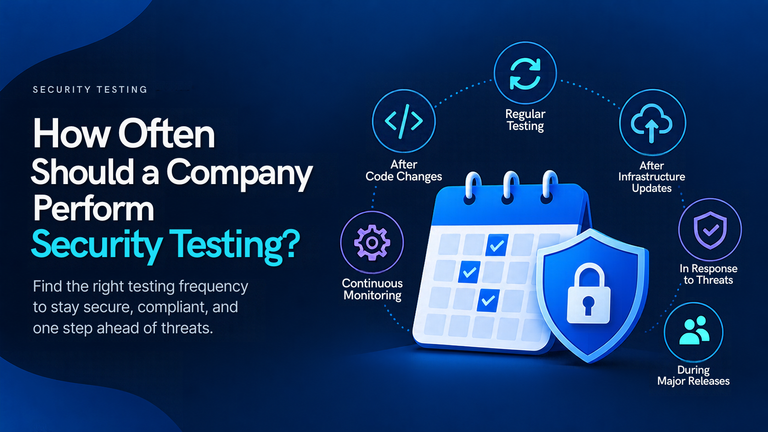
Event-driven testing: Conducted after any significant change regardless of the scheduled cadence. A new cloud migration, a major product release, a new third-party integration, an acquisition, or a significant architecture change each warrants a targeted assessment before the next scheduled test. This is a requirement under PCI DSS and a best practice under every other major framework.
The tiering approach produces a testing calendar that reflects real risk rather than applying a uniform schedule across an environment where risk is not uniform. Most organizations find that their high-frequency tier is smaller than their total environment, which keeps the cost and logistics of more frequent testing manageable.
What Events Should Trigger an Immediate Penetration Test?
An immediate penetration test is warranted by any event that materially changes the attack surface of your environment, introduces a new trust relationship with an external system, or modifies the authentication, authorization, or data access logic of any production system. These events create new risk that your last test did not evaluate, and waiting for the next scheduled assessment means operating with that risk unexamined.
The specific events that consistently warrant immediate testing in Bugstrix engagements:
Major product releases or significant feature additions. Any release that touches authentication flows, payment processing, user authorization logic, or data export functionality introduces risk that needs to be validated before reaching production at scale. Post-release testing is better than nothing. Pre-release security testing is better still.
New third-party integrations. Each vendor integration creates a new trust relationship and data access pathway. An integration that appears bounded from a business perspective frequently receives over-provisioned API access at the technical level. Testing the integration before it handles production data is significantly more efficient than remediating a breach after it does.
Cloud migrations and infrastructure changes. Moving workloads to a new cloud environment, changing network architecture, or modifying segmentation controls all have the potential to introduce misconfigurations that did not exist before the change. These changes rarely receive dedicated security testing as part of the migration process, which is exactly why post-migration assessments generate findings at such a consistent rate.
Mergers and acquisitions. When your business acquires another organization or integrates an acquired technology platform, the inherited attack surface is rarely fully understood at closing. Unknown systems, unfamiliar access control configurations, and undocumented integrations all need assessment before they are treated as part of a trusted internal environment.
After a security incident. An incident that triggered your response process should also trigger a targeted penetration test once the immediate response is complete. The incident may have revealed one vulnerability. There are almost always others in the same area that the initial response did not surface.
Before a major compliance audit. A penetration test six to eight weeks before an audit gives enough lead time to receive findings, remediate critical issues, and complete a retest before the auditor’s review begins. Testing too close to the audit date creates a remediation timeline problem that is entirely avoidable.
Does Industry Affect How Often You Should Test?
Yes, industry is one of the most significant factors affecting testing frequency, both because of the regulatory frameworks that apply in each sector and because of the inherent risk profile that comes with the type of data different industries handle and the sophistication of the threats targeting them.
Industries with higher testing cadence consistently show lower proportions of critical and high-severity findings in independent security data. This pattern reflects what sustained testing actually produces over time: more frequent testing improves remediation discipline, builds institutional knowledge of the attack surface, and surfaces design-level weaknesses that only become visible when the same team tests the same environment repeatedly.
Financial services and fintech face the most prescriptive testing requirements, with PCI DSS, DORA, and national financial regulatory frameworks all creating mandatory cadences. Most mature financial services organizations test quarterly for high-risk components and annually for broader infrastructure, often exceeding compliance minimums based on their own risk assessments.
Healthcare operates under HIPAA’s risk analysis obligations and increasingly under state-level data protection requirements. Given the average breach cost of $10.3 million in the healthcare sector and the operational consequences when clinical systems are compromised, quarterly testing for patient-facing systems and annual broad-scope testing represents the appropriate baseline.
SaaS and technology companies face the highest rate of environment change of any sector, given continuous deployment practices and rapid product development cycles. For SaaS companies specifically, the interaction between multi-tenant architecture and frequent releases creates a risk profile that annual testing consistently underserves. For a detailed breakdown of testing frequency specifically for SaaS businesses, our post on how often a SaaS company should run a penetration test covers the decision framework in full.
E-commerce combines payment processing risk with high-volume customer data handling and consistently high attack interest from financially motivated actors. Annual testing satisfies PCI DSS minimums for most merchants, with more frequent testing warranted for platforms that deploy significant feature changes to their checkout and payment flows regularly.
What Is the Difference Between Penetration Testing Frequency and Vulnerability Scanning Frequency?
Penetration testing and vulnerability scanning serve different purposes, operate on different cadences, and cannot be substituted for each other. Understanding the difference between them prevents the common mistake of believing that frequent scanning eliminates the need for periodic penetration testing.
Vulnerability scanning uses automated tools to identify known issues against a baseline: software versions with published CVEs, common misconfigurations, missing security headers, and similar findings that do not require human judgment to identify. Scanning should happen frequently, monthly at minimum and continuously in mature security programs, because it provides a consistent check against a known set of issues.
Penetration testing uses human testers who actively exploit identified vulnerabilities, chain findings across systems, test business logic, and identify vulnerabilities that automated tools cannot find. Authorization failures, IDOR, business logic flaws, and chained attack paths all require a human tester with context-specific knowledge to find. These findings do not appear in scanner output regardless of how frequently the scanner runs.
The two activities are complementary, not competing. Frequent scanning provides continuous coverage against known issues. Periodic penetration testing validates whether your controls hold under genuine adversarial conditions and surfaces the class of findings that matter most in a real breach scenario. Running one without the other leaves significant gaps in either direction.
For a clear breakdown of how the two activities differ in scope, methodology, and what each produces, our post on vulnerability assessment vs penetration testing explains the distinction in detail.
How Should a Business Build Its Annual Security Testing Calendar?
A business should build its annual security testing calendar around four anchor points: a full-scope annual penetration test aligned to the primary compliance deadline, targeted testing for high-frequency tier components on a quarterly cadence, event-triggered testing built into the change management process, and a retest cycle with enough lead time before each compliance deadline for remediation evidence to be complete.
The calendar structure that works consistently in Bugstrix engagements:
Q1: Full-scope annual penetration test. Conducted early in the year to provide maximum lead time before mid-year compliance reviews. Covers the complete environment as defined by the compliance system boundary, including applications, APIs, network infrastructure, and cloud components. All critical and high findings are remediated and retested before the quarterly review in Q2.
Q2: First quarterly targeted test. Covers high-frequency components that changed since the annual test: new API endpoints, new integrations, major feature releases from Q1. This is where the accumulation of new risk from the first development quarter gets examined before it compounds further.
Q3: Event-driven assessments and mid-year review. Review the testing calendar against what actually changed in the environment during H1. Any significant infrastructure change, new vendor integration, or major release that has not been tested since deployment gets scheduled here. Update the Q4 plan based on the actual state of the environment.
Q4: Pre-audit test and retest cycle. For organizations whose primary compliance audit falls in Q1 of the following year, a Q4 penetration test ensures findings are remediated and retested with audit-ready documentation before the assessment window opens.
The discipline that makes this calendar work is treating event-triggered testing as a firm process rather than an optional supplement. When a significant change happens, and testing is deferred to the next scheduled slot, the window between the change and the next assessment is exactly the period when that change creates risk.
Our penetration testing services are structured to support this kind of ongoing testing program, with engagement models that make quarterly and event-triggered testing practical rather than a separate procurement exercise each time.
Frequently Asked Questions
Is annual penetration testing enough for a small business?
For a small business with a stable environment, limited external-facing systems, no sensitive regulated data, and a slow pace of infrastructure change, annual testing may be sufficient to satisfy both compliance requirements and practical security needs. For a small business that handles payment data, processes healthcare information, runs a customer-facing web application, or deploys updates frequently, annual testing is typically the minimum rather than the appropriate cadence. The question is not size but risk profile and rate of change.
How much does more frequent penetration testing cost?
More frequent testing costs less per engagement than the first full-scope annual test, because subsequent tests can be scoped narrowly to the components that changed since the last assessment rather than re-testing the entire environment from scratch. A full-scope annual test might run $15,000 to $30,000. A quarterly targeted test of specific high-risk components might run $5,000 to $10,000. The total annual investment in a combined annual plus quarterly program is higher than annual-only, but the per-engagement cost decreases as the scope becomes more focused.
Does a penetration test need to happen at the same time every year?
No. The timing should be aligned to your compliance deadlines and change calendar rather than to a fixed anniversary date. What matters for compliance is that the test falls within the required period, usually the audit observation window, with enough lead time for remediation and retesting before the deadline. Aligning the test timing to your actual development and deployment calendar produces better results than a fixed date that may not reflect when your environment actually changes most.
Can we use the results of one penetration test for multiple compliance frameworks?
Often yes, with proper scoping. A test designed to cover the requirements of both PCI DSS and SOC 2 simultaneously, with findings mapped to both sets of criteria in the report, can satisfy multiple audit evidence requirements in a single engagement. This requires coordination between your testing provider and your compliance program during scoping, not after the report is delivered. Many organizations running multiple compliance programs find combined-scope testing to be the most efficient approach to their annual testing obligation.
What happens if we skip a scheduled penetration test?
Skipping a scheduled penetration test creates an evidence gap for compliance purposes and a real security gap in terms of what is actually known about your current posture. For compliance, a missing test results in an open requirement that auditors will identify, typically requiring a remediation plan and sometimes affecting the audit outcome. For security, it means the vulnerabilities introduced by every change made since the last test remain undiscovered until the next test, an attacker finds them first, or a security incident surfaces them.
Build a Testing Cadence That Matches Your Risk, Not Just Your Audit
The most useful way to think about penetration testing frequency is not “how often do we have to test” but “how long are we comfortable operating with unexamined risk in our environment.” That question produces a different, usually more rigorous answer than the compliance minimum, and it reflects the actual decision your testing cadence represents.
The businesses that handle security testing well in 2026 are the ones that have moved beyond the once-a-year report that satisfies the auditor and disappeared into a folder. They test their highest-risk components more frequently, they build testing into their change management process rather than treating it as a separate calendar event, and they use the findings from each test to make concrete improvements before the next cycle.
That approach requires more coordination than annual testing and modestly more budget. What it produces is an accurate, current picture of your security posture rather than an accurate picture of what your security posture looked like twelve months ago.
Contact us to discuss the right testing cadence for your environment