What Should You Expect From a Penetration Testing Report?

Written By
Sarwat Iftikhar
A penetration testing report is the deliverable you pay for. The test itself produces findings; the report determines whether those findings translate into remediated vulnerabilities or sit unread in an inbox. Organizations that receive a weak report often have no clear picture of what was tested, what was found, or what to fix first. Organizations that receive a strong report have a prioritized action plan tied to real business risk.
Understanding what a quality report should contain helps you evaluate the work before the engagement begins, ask the right questions during scoping, and hold the testing team accountable for the deliverable. It also tells you, after the fact, whether what you received was worth what you paid.
Key Takeaways
- A penetration testing report serves two audiences: executives who need to understand business risk and technical teams who need specific remediation steps. Quality reports address both without conflating them.
- Findings should be presented with severity ratings, reproduction steps, proof-of-concept evidence, and specific remediation guidance, not just a description of what was found.
- The methodology used (black box, white box, or grey box) directly shapes what the report contains and what it can confirm about the security posture.
- A penetration testing report is a point-in-time document. Its value lies in what gets remediated, not in the report itself. Testing should be followed by a retesting cycle to confirm fixes hold.
- Bugstrix engagement data shows that organizations making the least progress on security posture improvement are those that receive findings lists without remediation context, leaving technical teams without a clear path from finding to fix.
What Is a Penetration Testing Report?
A penetration testing report is a formal document delivered at the conclusion of a penetration testing engagement that records what was tested, how it was tested, what vulnerabilities were found, what risk those vulnerabilities present to the organization, and how each one should be remediated.
Unlike a vulnerability assessment, which generates a list of detected weaknesses through automated scanning, a penetration testing report reflects active exploitation. The tester confirmed whether each vulnerability is genuinely exploitable in the context of that specific environment, demonstrated the impact by chaining findings into attack paths where possible, and documented the results with enough detail for the technical team to reproduce and remediate what was found. Our vulnerability assessment services provide the systematic scanning layer that identifies the full vulnerability inventory; a penetration test provides the exploitation confirmation and business impact layer on top of it.
The report is not a pass or fail document. It is an evidence record of the security posture at the time of the test, with a prioritized list of what needs to change. In a Bugstrix engagement, the report is the primary vehicle for translating exploitation evidence into a remediation roadmap the client can act on without additional interpretation from the testing team.
What Sections Does a Quality Penetration Testing Report Include?
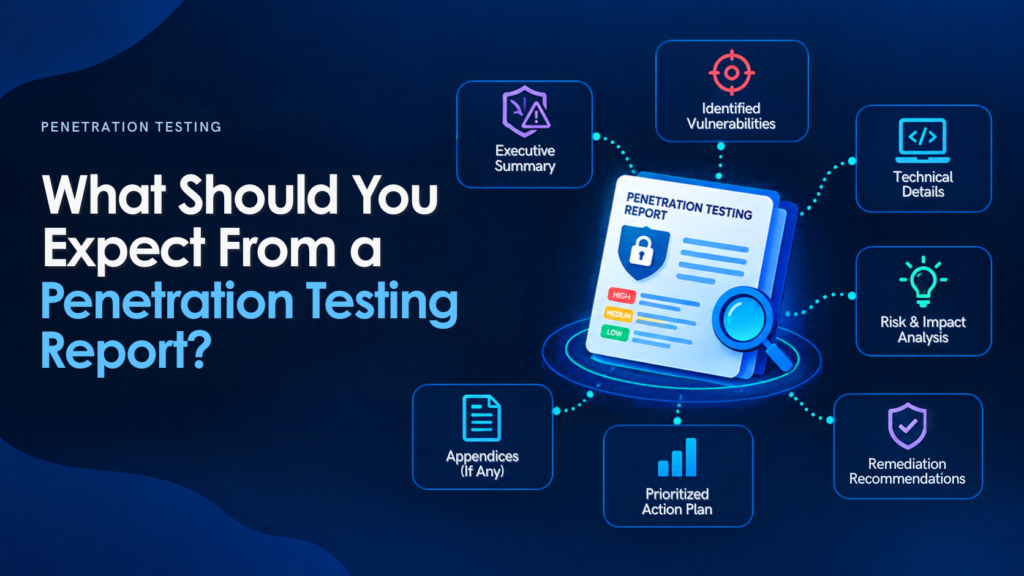
A quality penetration testing report is structured so that different readers can extract what they need without reading the entire document. Each section serves a distinct purpose and audience.
Executive summary. A two- to four-page overview written for a non-technical audience. It describes the scope of the engagement, the overall risk picture, the most significant findings in business terms, and the recommended remediation priorities. A board member or business owner should be able to read this section and understand the material risk to the organization without reading the technical findings.
Scope and methodology. A precise description of what was included in the test: the IP ranges, domains, applications, and systems that were in scope; the timeframe; the tools used; and the methodology applied. This section is important for understanding what the report does and does not cover. A vulnerability outside the tested scope would not appear in the findings, which is a limitation the reader needs to understand before drawing conclusions about the security posture.
Findings summary. A table listing all findings with their severity rating, a one-line description, and the affected system. This gives the remediation team a single reference for tracking which items have been addressed and which remain open across the remediation cycle.
Detailed findings. The core technical section. Each finding gets its own entry documenting: the title, severity rating, affected asset, description of the vulnerability, step-by-step reproduction instructions, proof-of-concept evidence including screenshots and tool output, business impact statement, and specific remediation guidance. This is the section the development or infrastructure team works from directly.
Remediation roadmap. A prioritized remediation plan that sequences the findings by severity and urgency rather than leaving the technical team to triage the full findings list independently.
Appendix. Supporting material including raw tool output, configuration extracts, and reference links that would clutter the findings section but provide evidence of the testing methodology and completeness.
What Is the Difference Between an Executive Summary and Technical Findings?
The executive summary and the technical findings section serve different readers, operate at different levels of detail, and should be written independently of each other rather than as a condensed version of the same content.
The executive summary is a business document. It describes risk in terms of potential business impact: what data is at risk, what systems could be compromised, what the likelihood of exploitation is in the current threat environment, and what remediation investment is warranted given that risk. It avoids technical terminology where possible and uses language that a CFO or legal counsel can evaluate. A quality executive summary tells the reader what the organization needs to do at the strategic level without requiring any technical background to understand it.
The technical findings section is an engineering reference. Each finding entry must contain enough detail for a developer or infrastructure engineer to reproduce the issue, understand why it exists, and implement a fix without requiring additional information from the testing team. A finding entry that says “SQL injection found in login form, fix input validation” is not technically sufficient. A quality entry documents the exact endpoint, the vulnerable parameter, the payload used to confirm exploitation, the evidence, and the specific remediation: parameterized queries, prepared statements, or an ORM change, depending on the stack.
Bugstrix structures both sections to stand independently. The executive summary should be readable and actionable to someone who never opens the technical section. The detailed findings should contain everything a developer needs without reference to the executive summary.
How Are Vulnerabilities Scored and Prioritized in a Penetration Testing Report?
Severity ratings in a penetration testing report communicate both the technical severity of the vulnerability and its real-world exploitability in the context of the tested environment. Most quality reports use a five-tier rating system.
The severity rating should reflect the environment, not just the CVE score. A medium-severity vulnerability in an internet-facing authentication endpoint may carry higher business risk than a high-severity finding on an internal system with no lateral access path. In Bugstrix engagements, the contextual risk adjustment in the severity assignment is one of the elements that most frequently changes how clients prioritize their remediation queue compared to what a raw CVSS score would suggest.
How Does the Testing Methodology Affect What the Report Contains?
The testing methodology determines the starting knowledge and access conditions of the engagement, which directly shapes what the report can confirm about the security posture.
In a black box engagement, the tester begins with no internal knowledge of the system: no credentials, no architecture documentation, no source code access. The report reflects an external attacker’s perspective, covering what is discoverable and exploitable from outside the perimeter. This methodology is effective for testing external attack surface hardness but may miss vulnerabilities only visible with authenticated or internal access.
In a white box engagement, the tester has full access to source code, architecture documentation, and credentials. The report reflects a comprehensive audit perspective, and findings can include deeper logic flaws, insecure design patterns, and vulnerabilities that external testing would never reach. This methodology produces the most thorough findings but requires more engagement time and produces a technically denser report with a larger surface of analyzed code and configuration.
In a grey box engagement, the tester begins with partial knowledge: typically user-level credentials and some documentation but not source code or administrative access. The report reflects a perspective between the two extremes and is often the most practical methodology for testing internal attack surface and authenticated application functionality.
Our post on black box, white box, and grey box penetration testing covers how each methodology affects scope, timeline, and findings depth. Understanding which methodology was used is essential for interpreting what the report does and does not cover before drawing conclusions from the findings.
What Does Good Remediation Guidance Look Like in a Report?
Remediation guidance is where many penetration testing reports fall short. A finding described without actionable remediation transfers the burden of determining the fix entirely to the engineering team, which adds friction and increases the time findings remain open and exploitable.
Quality remediation guidance is specific, not generic. “Update dependencies” is not remediation guidance. “Update the jackson-databind library from version 2.9.8 to 2.14.0 or later and validate deserialization behavior in the staging environment before deploying to production” is remediation guidance. The distinction matters because a developer reading a vague remediation note must research the fix independently, which introduces error and delay into the remediation cycle.
Quality remediation guidance also distinguishes between immediate mitigations and permanent fixes. For a critical finding, the immediate mitigation might be disabling a specific endpoint or blocking a request parameter while the permanent fix is developed and tested. Both should be documented separately so the team can act immediately while the longer fix is in progress.
Bugstrix reports include remediation guidance at two levels: a technical specification written for the engineering or infrastructure team and a remediation priority note written for the project or security manager tracking the cycle. This separates the “what to fix and how” question from the “when to fix it relative to everything else” question, which makes it easier to track remediation status across both technical and non-technical stakeholders.
What Should You Do After Receiving a Penetration Testing Report?
Receiving the report is the beginning of the work, not the end of the engagement. The document has value only in proportion to how effectively its findings are remediated.
Triage findings by severity and exploitability. Start with critical and high findings on internet-facing systems. These represent the highest probability of near-term exploitation and should enter the remediation queue immediately. Medium findings should be scheduled for the next sprint or infrastructure cycle. Low and informational findings can be tracked in the standard patching workflow alongside routine maintenance.
Assign ownership. Each finding should have a named owner responsible for the fix. Without explicit ownership, findings accumulate without action. The findings summary table in the report is the natural basis for this assignment, with each row mapped to a team or individual.
Request a retest. A quality penetration testing engagement includes a remediation verification cycle where the testing team confirms that the fixes applied to critical and high findings are effective. A retest is not a full re-engagement: it specifically retests the addressed findings to confirm the vulnerability has been closed and the fix has not introduced new issues. Our penetration testing services include remediation verification as a standard component of the engagement.
Feed findings into your vulnerability management program. The findings from a penetration test should flow into whatever system the organization uses to track security issues over time. This ensures that medium and low findings do not fall off the radar after initial triage and that remediation progress is tracked systematically. Our post on vulnerability management covers how organizations structure that tracking process to keep findings moving through the remediation cycle rather than stalling.
Plan the next testing cycle. A penetration testing report describes the security posture at the time of the test. As the environment changes, that picture becomes less accurate. Organizations with active development and cloud infrastructure benefit from continuous penetration testing that maintains ongoing coverage as the attack surface evolves, rather than relying on a single point-in-time assessment until the next annual engagement.
Get a free quote to discuss your penetration testing engagement
Frequently Asked Questions
How long should a penetration testing report be?
Report length should match engagement scope, not serve as a proxy for quality. A focused test of a single web application might produce a 30-page report. A full-scope internal and external assessment of a complex environment might produce 100 pages or more. What matters is that every section contains substantive content: a report padded with raw tool output in the findings section or a boilerplate executive summary that does not reflect the specific engagement is a weak deliverable regardless of page count.
Should you share a penetration testing report with third parties?
A penetration testing report contains a detailed map of the organization’s exploitable vulnerabilities. It should be treated as highly sensitive and shared only on a need-to-know basis. If compliance requirements or customer due diligence requests require evidence of security testing, the executive summary can often serve that purpose without requiring disclosure of the full technical findings section.
What is the difference between a penetration testing report and a vulnerability scan report?
A vulnerability scan report lists what a scanner detected by matching software versions and configurations against a known vulnerability database. It does not confirm exploitability, does not chain findings into attack paths, and does not reflect an adversarial test of the environment. A penetration testing report reflects active exploitation: findings were confirmed exploitable, business impact was demonstrated, and remediation guidance was developed from an understanding of the specific environment. Our post on manual vs automated penetration testing covers this distinction and where each approach is most effective.
How much does report quality vary by provider?
Significantly. Report quality is one of the most variable elements across penetration testing providers. Common weaknesses include generic remediation guidance, findings copied from automated scanner output without manual verification, missing proof-of-concept evidence, executive summaries that do not address business impact, and no remediation verification cycle. Understanding what a quality report should contain before selecting a provider gives you a basis for evaluating proposals and asking specific questions about the deliverable. Our post on penetration test cost in 2026 covers what factors drive pricing and what to expect at different investment levels.
What should you do if you disagree with a finding’s severity rating?
Contact the testing team and ask for the rationale behind the severity assignment. A quality testing team can explain exactly why a finding received its rating, including which environmental factors were considered. If the rating reflects a genuine misunderstanding of the business context, for example, a finding rated high on an asset the organization already has compensating controls for, that context can be documented in the report as a risk acceptance note alongside the finding.
Does a penetration testing report expire?
Practically, yes. A report describes the security posture as of the testing date. Every deployment, configuration change, or new integration after that date changes the accuracy of the report as a current security picture. Organizations typically treat a penetration testing report as valid for the period between testing cycles. The faster the environment changes, the shorter that validity window is. A company deploying weekly should not treat an 18-month-old report as a current security assessment.
A Report Is a Roadmap, Not a Receipt
The purpose of a penetration testing report is not to document that testing occurred. It is to give the security and engineering teams an actionable path from the current security posture to an improved one. A report that contains that path clearly, with specific findings, exploitation evidence, severity context, and remediation guidance precise enough to implement, is the deliverable that justifies the engagement investment.
Organizations that treat the report as a receipt have tested their security. Organizations that treat it as a roadmap have improved it. The difference between those two outcomes is almost entirely a function of what happens in the weeks after the report is delivered. Bugstrix’s most effective engagements are the ones where the report enters a structured remediation cycle within days of delivery, with ownership assigned and retest scheduled before the initial triage meeting ends.