How Often Should a Company Perform Security Testing?

Written By
Sarwat Iftikhar
Most organizations know they should perform security testing. Fewer have a clear answer to how often, beyond “at least once a year” or “before an audit.” Those answers are not wrong, but they are incomplete.
The right security testing cadence is not a single number. It is a layered schedule that combines different types of testing at different frequencies: continuous automated scanning, periodic targeted assessments, and annual full-scope penetration tests calibrated to the speed at which an organization’s environment changes and the consequences of a breach in that specific environment.
A company that deploys application updates weekly has a different testing frequency requirement than one running a stable legacy system. A company handling financial transactions has a different risk profile than one running a marketing website. A company with 200 employees has different resources than one with 2,000. The right cadence accounts for all three dimensions: how fast the environment changes, what is at risk if something goes wrong, and what the organization can realistically sustain.
This post provides a practical framework for answering that question for your specific situation.
Key Takeaways
- Security testing is not a single activity performed at one interval. A complete program combines continuous automated scanning, periodic targeted assessments, and annual full-scope penetration testing at different cadences.
- The most important driver of testing frequency is the rate of change in the environment. Fast-moving environments, continuous deployment, cloud infrastructure, and growing attack surfaces require more frequent testing than stable, unchanging ones.
- Compliance requirements set a minimum floor, not an optimal ceiling. Organizations that test only as often as required by their compliance framework typically test less often than their risk profile warrants.
- In Bugstrix engagement data, the organizations most frequently compromised through undetected vulnerabilities are those whose testing cadence has not kept pace with how quickly their environment is changing.
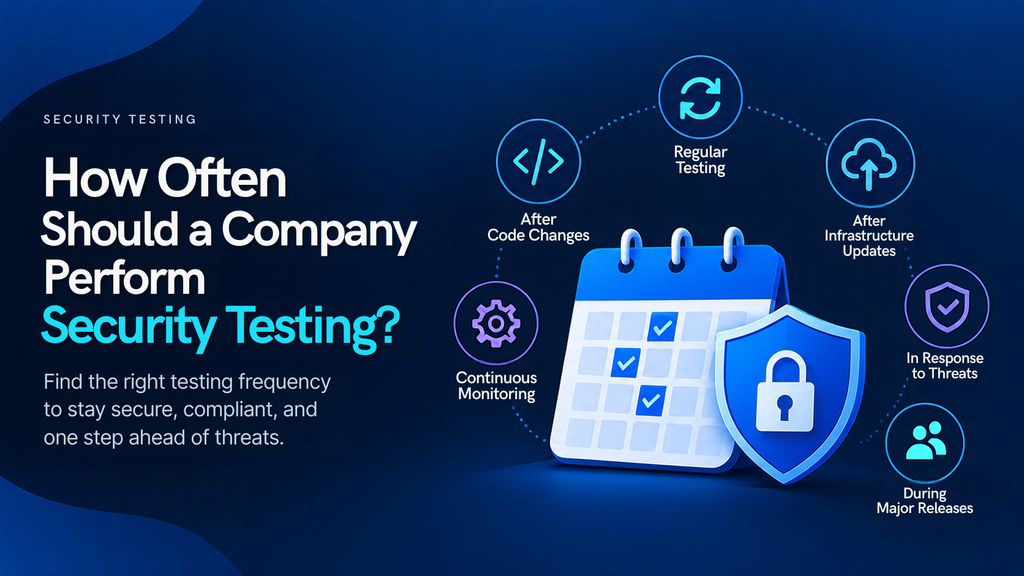
- Event-driven triggers, such as major releases, infrastructure changes, and acquisitions, should prompt security testing outside the regular schedule regardless of when the last test occurred.
Why Does Security Testing Frequency Matter?
Security testing is useful only if it reflects the current state of the environment. An organization that performed a thorough penetration test eighteen months ago has a security finding history, not a current security posture. Every deployment since that test may have introduced new vulnerabilities. Every infrastructure change may have created new attack paths. Every new employee may have introduced credential risk. The test result describes the organization as it was, not as it is.
This gap between the tested state and the current state is the core problem that testing frequency addresses. The faster an environment changes, the faster the test result becomes stale. A company deploying new code weekly operating on an annual testing cadence may have introduced and left undetected dozens of new vulnerabilities between tests. The security program is running on outdated information for most of the year.
The second dimension frequency addresses is time-to-detection. A vulnerability introduced today in an organization that tests annually may go undetected for up to twelve months. In that time, an attacker who discovers the same vulnerability has twelve months of undetected access. An organization testing quarterly reduces that window to three months. Continuous automated scanning with periodic manual validation compresses it further. The testing cadence directly determines the maximum period an undetected vulnerability can be exploited before discovery.
Bugstrix cloud security assessments consistently find that the highest-impact vulnerabilities in production environments are not recent discoveries but findings that have been present for extended periods, often because the testing cadence did not catch them before they were exploited or before they expanded in scope through configuration drift and lateral attack surface growth.
What Factors Determine How Often You Should Test?
No single testing frequency applies to all organizations. The right cadence emerges from evaluating four specific factors: rate of environment change, data and asset sensitivity, regulatory requirements, and previous security testing maturity.
Rate of environment change is the most important factor. An organization deploying application updates continuously, adding new cloud services regularly, onboarding new staff frequently, and expanding its attack surface through new integrations needs a testing cadence that tracks those changes. A stable environment with infrequent changes can sustain longer intervals between full-scope tests without accumulating significant undetected risk. The practical question is: since the last test, how much of the attack surface has changed?
Data and asset sensitivity determines the consequence of a missed vulnerability. An organization handling healthcare records, payment card data, or personally identifiable information faces regulatory penalties and significant breach costs if a vulnerability is exploited. The higher the cost of a breach, the more frequently it is worth testing to reduce the probability of one. A breach that costs several million dollars to remediate justifies a testing investment that would be disproportionate for an organization whose worst-case breach scenario is limited.
Regulatory requirements establish the minimum testing frequency for organizations in regulated industries. PCI DSS requires penetration testing at least annually and after significant changes. SOC 2 does not mandate a specific frequency but expects regular security testing as part of a functioning security program. ISO 27001 requires periodic testing as part of the information security management system. These requirements create a compliance floor, but organizations that test only to the floor are accepting more risk than the framework assumes because the frameworks were written for minimum adequacy, not optimal security.
Security program maturity affects what is achievable. An organization building its first formal security program will have different starting points than one that has been running quarterly assessments for three years. A realistic cadence is one the organization can actually execute, staff for, and act on. A testing program that produces more findings than the security team can remediate in the testing interval is generating noise rather than improving security posture.
What Is the Right Security Testing Frequency by Company Type?
Different organizational profiles require different testing cadences. The following are Bugstrix’s recommended minimums based on engagement patterns across the client portfolio.
Early-stage companies (under 50 employees, limited external attack surface). Quarterly vulnerability assessments combined with an annual penetration test covering the full external attack surface and critical internal systems. This baseline provides a structured finding review cycle and a compliance-ready annual test result without requiring a security operations team to manage continuous tooling. As the attack surface grows, the cadence should grow with it.
Growth-stage companies (50–500 employees, cloud infrastructure, active product development). Continuous vulnerability scanning, an annual full-scope penetration test, and targeted penetration tests after significant changes such as major feature releases, new integrations, or infrastructure migrations. Companies handling sensitive customer data at this stage should move to biannual full-scope tests rather than waiting for the annual cycle.
Mid-market companies (500–5,000 employees, multiple product lines, complex cloud environments). Continuous vulnerability scanning, biannual full-scope penetration tests, quarterly targeted assessments on high-change areas, and breach and attack simulation to validate that security controls are detecting what they should. At this scale, the attack surface changes fast enough that annual full-scope tests leave meaningful gaps between cycles.
Enterprise (5,000+ employees, distributed infrastructure, continuous deployment). Continuous penetration testing that maintains an ongoing testing program rather than point-in-time assessments, combined with breach and attack simulation, continuous vulnerability management, and periodic red team exercises for the highest-value systems. The environment changes too fast for periodic testing alone to provide meaningful assurance. Our continuous penetration testing services are designed specifically for this profile, maintaining active testing coverage as the environment evolves rather than treating security assessment as a periodic project.
What Events Should Trigger Security Testing Outside the Schedule?
Regular testing intervals address known change cadence. Event-driven testing addresses the changes that happen between scheduled cycles. Several specific events should trigger a security assessment regardless of when the last test occurred.
Major product releases. A significant new feature, a new API, a new authentication flow, or a new third-party integration changes the application’s attack surface. Releasing without testing the new surface means the security posture of the new functionality is unknown from the day it ships.
Infrastructure migrations. Moving to a new cloud provider, migrating from on-premises to cloud, adopting containerization, or significantly restructuring the network topology creates new configurations with new security implications. Infrastructure changes that are not validated through testing may introduce misconfigurations that differ substantially from the previous environment’s security posture.
After a security incident. A breach, a near-miss, or a security alert that indicates active attacker interest is the clearest possible signal that the current security posture has gaps. Testing after an incident validates that the incident was fully contained, that the attacker’s access path has been closed, and that similar paths have been identified and addressed.
Acquisitions and integrations. Acquiring a company or integrating a new business unit’s systems introduces an unknown attack surface with unknown security history. The acquired systems may have vulnerabilities, misconfigurations, or access control issues that the acquiring organization does not know about until testing reveals them. Integrating those systems before testing them extends any existing vulnerabilities into the acquiring organization’s environment.
Significant personnel changes. A new CTO or head of engineering changes who has administrative access to production systems. Departing employees may retain access that has not been revoked. Access review combined with targeted testing on identity and authentication systems is appropriate after significant changes to the team with elevated system access.
Compliance renewals. PCI DSS, SOC 2, ISO 27001, and other frameworks have testing requirements tied to certification cycles. Planning testing to align with those cycles rather than scrambling before an audit produces better results and leaves time to remediate findings before the auditor reviews them.
How Do Different Security Testing Types Work Together?
A complete security testing program is not a single activity. It combines several types of testing at different frequencies, with each type covering what the others cannot.
Vulnerability assessment provides systematic discovery of known vulnerabilities across the asset inventory. It is fast, automated, and scalable across large environments. It identifies vulnerabilities by matching software versions and configurations against known vulnerability databases. What it cannot do is determine whether any discovered vulnerability is genuinely exploitable in the specific production context, or how individual findings combine into attack chains.
Penetration testing provides active exploitation and attack chain development. A penetration tester does not just identify that a vulnerability exists; they confirm whether it is exploitable, chain it with other findings to demonstrate the real-world impact, and surface the business logic and authorization issues that automated scanning cannot detect. The tradeoff is that penetration testing is time-intensive and expensive relative to automated scanning, which is why it is used for periodic deep validation rather than continuous coverage. Our penetration testing services cover the full external and internal attack surface with active exploitation and chained attack path demonstration.
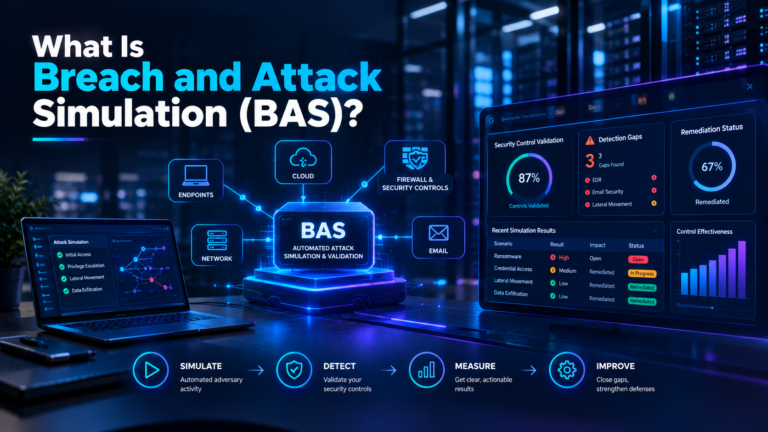
Breach and attack simulation validates whether security controls are detecting and blocking threats effectively. BAS platforms continuously simulate attacker techniques against the environment’s actual deployed security controls endpoint detection, network monitoring, SIEM alerting and report on which simulations succeed. This provides ongoing assurance that the detection layer is working between manual penetration test cycles.
The choice between manual and automated testing is not either-or. Each type addresses a different part of the risk picture. Our post on manual vs automated penetration testing covers where each approach is most effective and what the tradeoffs are for different testing scenarios.
Continuous threat exposure management is the framework that connects all of these activities into a unified program. Rather than treating vulnerability assessment, penetration testing, and BAS as separate projects, CTEM treats exposure reduction as a continuous operational discipline with defined cycles of scoping, discovery, prioritization, validation, and remediation.
How Does Security Testing Cost Factor Into Frequency Decisions?
Budget is a real constraint, and security testing frequency decisions are made in the context of what an organization can afford. The relevant framing is not the cost of testing but the cost of not testing frequently enough.
A penetration test that identifies a critical vulnerability before it is exploited costs the price of the test. The same vulnerability discovered through a breach costs the breach remediation, the incident response engagement, the regulatory notification process, potential fines, and the customer trust impact. For most organizations in regulated industries or handling sensitive data, the cost of a single breach significantly exceeds the cost of the security testing program that could have prevented it.
The cost of penetration testing also scales with scope and methodology. A targeted assessment on a specific new feature costs considerably less than a full-scope annual engagement. Organizations that feel full-scope testing cannot be done more than once a year can often run more frequent targeted tests on high-risk areas at a cost that is manageable within an annual security budget. Our post on penetration test cost in 2026 covers how penetration test pricing is structured and what factors drive cost up or down for different engagement types.
Frequently Asked Questions
Is annual penetration testing enough?
For most organizations, annual penetration testing is the minimum, not the optimal frequency. It satisfies compliance requirements for frameworks like PCI DSS and SOC 2, and it provides a structured annual security review. But for organizations with active development, cloud infrastructure, or high-value data, the environment changes fast enough that a once-a-year test leaves meaningful gaps in security visibility. Annual testing is the floor; the right frequency for most growth-stage and above organizations is higher.
How often should vulnerability scanning run?
Vulnerability scanning should run continuously or at minimum weekly. Unlike penetration testing, vulnerability scanning is automated and low-cost per run once the tooling is in place. Running it weekly means new vulnerabilities in deployed software are identified within days of the CVE being published. Running it monthly means a new critical vulnerability in widely-deployed software may exist in the environment for weeks before it is detected. Continuous scanning is the standard for any organization with a defined security program.
Does more frequent testing mean more findings?
More frequent testing means findings are discovered closer to when they are introduced, which makes them easier to remediate and reduces the window during which they are exploitable. Whether it produces more total findings depends on the environment. A fast-changing environment with frequent deployments will generate more findings in more frequent tests because the attack surface is genuinely changing. A stable environment will see diminishing returns from increasing frequency beyond what the rate of change warrants.
Should small companies test as frequently as large ones?
Frequency should match the rate of change and the consequences of a breach, not the size of the organization. A small company handling payment card data has the same PCI DSS testing requirements as a large one. A small company whose entire product is a cloud API with continuous deployment and customer data has a higher frequency requirement than a large company running a stable on-premises system with infrequent changes. Size correlates with frequency in some cases but is not the primary driver.
What is the difference between a vulnerability assessment and a penetration test for frequency purposes?
Vulnerability assessments can and should run far more frequently than penetration tests because they are automated, fast, and low-cost per run. Weekly or continuous vulnerability scanning is standard. Penetration tests are manual, time-intensive, and require skilled engagement management; they are used for the periodic deep validation that scanning cannot provide. The two are complementary at different cadences, not alternatives to each other.
Security Testing Is Not a Calendar Event
The instinct to put security testing on a calendar annual penetration tests, quarterly vulnerability scans is correct as far as it goes. A regular cadence ensures testing happens rather than being deferred indefinitely. But a calendar-only approach treats security testing as an administrative task rather than a response to actual risk.
The question is not just “when was the last test?” but “how much has the environment changed since then, and how much risk has that change introduced?” An organization that deployed a new cloud environment last month and integrated a new payment processor last week has a higher testing priority than one that changed nothing in the past six months, regardless of where each sits on the testing calendar.
The most effective security testing programs combine a regular schedule with triggers that prompt testing outside the cycle when the environment changes in ways that matter. They treat testing frequency as a function of exposure, not just of time elapsed. They use continuous automated coverage to fill the gaps between manual assessments so that the picture of the current security posture is never more than days old. Our post on continuous threat exposure management covers how CTEM structures all of these activities into a unified, ongoing program.
Contact us to build a security testing program for your organization