How Much Does API Penetration Testing Cost?

Written By
Sarwat Iftikhar
APIs are now the primary attack surface for most modern applications. They power SaaS platforms, mobile apps, third-party integrations, and microservice architectures. They also expose business logic, authentication mechanisms, and data access in ways that traditional web application security testing was never specifically designed to evaluate. The result is a growing demand for dedicated API penetration testing and, with it, a lot of questions about what it actually costs.
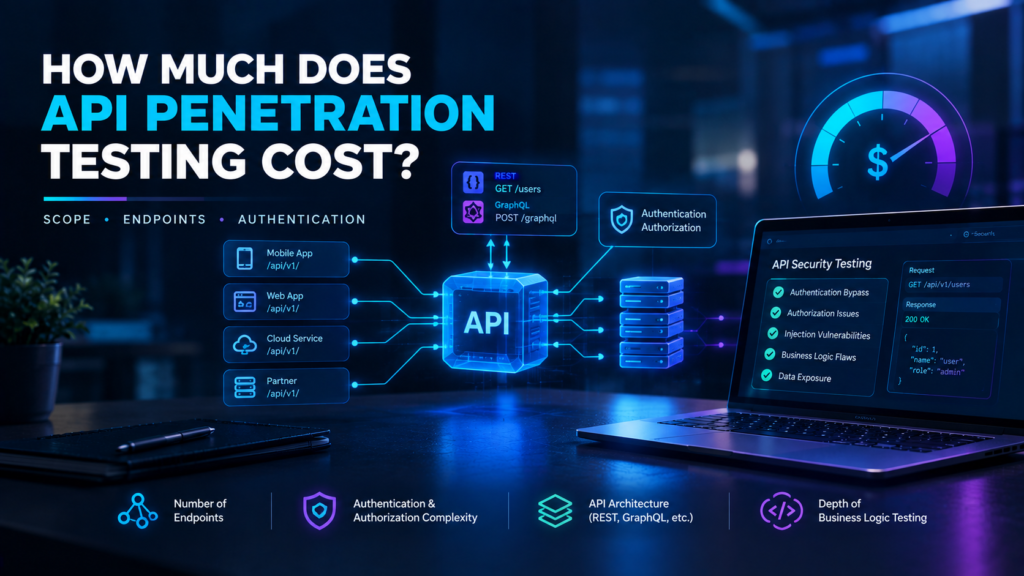
API penetration testing in 2026 ranges from $4,000 to $25,000 for most engagements, with the price driven primarily by the number of endpoints in scope, the complexity of the authentication mechanisms involved, and the depth of manual testing applied to business logic and authorization. Understanding what moves that number is the prerequisite for evaluating a quote accurately.
Key Takeaways
- API penetration testing costs range from $4,000 for a focused engagement on a simple REST API to $25,000 or more for a complex GraphQL or multi-authentication API with business logic testing requirements.
- Endpoint count is the single largest cost driver in API testing. Every unique endpoint represents a distinct attack surface that requires individual testing time, and both the raw count and the functional diversity between endpoints affect pricing.
- API penetration testing is distinct from web application penetration testing. While the two are often bundled, APIs require specialized techniques for authorization testing, business logic validation, and authentication mechanism evaluation that web application testing methodology does not fully cover.
- In Bugstrix API assessments, authorization failures and business logic flaws are the most consistently critical findings. Both require manual testing designed around the specific permission model and intended behavior of the API, and neither appears in automated scanning output.
- Documentation availability significantly affects cost. An API with a complete and accurate OpenAPI specification reduces reconnaissance time and allows testers to begin security testing faster, lowering the total engagement cost for equivalent depth.
What Does an API Penetration Test Cover?
An API penetration test evaluates the security of an application’s programming interfaces by testing authentication mechanisms, authorization enforcement across all endpoints and user roles, input validation, business logic, rate limiting, data exposure, and the integrity of how the API handles edge cases an attacker would deliberately trigger.
APIs are the layer where business logic is most directly exposed and where the consequences of a security failure are often most immediate. A misconfigured authorization check on an API endpoint can allow one user to access another’s data, modify records they should not be able to reach, or trigger business-critical actions without the privileges required. These failures require a tester who understands both the technical mechanism and the intended behavior of the API, not just a scanner that checks for known vulnerability signatures.
Our post on API security testing covers what a thorough API security assessment evaluates and how it differs from general application security testing, which is useful context before evaluating cost against scope.
How Much Does API Penetration Testing Typically Cost?
API penetration testing costs between $4,000 and $25,000 for most mid-market engagements, with pricing driven primarily by endpoint count, authentication complexity, and whether the engagement is standalone or bundled with web application testing.
| API Scope | Typical Endpoint Count | Cost Range |
| Simple REST API | Under 20 endpoints, single auth mechanism | $4,000 – $8,000 |
| Standard REST or GraphQL API | 20–100 endpoints, moderate complexity | $6,000 – $15,000 |
| Complex API | 100+ endpoints, multiple auth mechanisms | $12,000 – $25,000 |
| Mobile app backend API | Depends on endpoint count | $5,000 – $15,000 |
| Microservice architecture | Per-service or aggregate scope | $10,000 – $30,000+ |
| Compliance-driven API test | Any scope + compliance documentation | Add 15–25% to baseline |
These ranges reflect mid-market boutique firm pricing. Offshore providers typically sit 30 to 50 percent lower, and that gap reflects differences in tester seniority, methodology depth, and manual testing coverage. Automated API scanning tools that flag potential issues without human-driven authorization and business logic testing sit at the low end of any range and produce a different output from genuine manual penetration testing.
When API testing is bundled with full web application penetration testing, the combined engagement typically costs 20 to 35 percent less than running both as separate engagements, because reconnaissance, scoping, and report production costs are shared. For organizations whose API is tightly integrated with a web application, bundling is usually the better value.
What Factors Drive API Penetration Testing Cost?
Six specific factors account for most of the price variation between quotes for the same type of API engagement. Knowing which factors apply to your environment is the starting point for evaluating whether a quote is accurate or under-scoped.
Endpoint count and diversity are the primary cost drivers. Each unique API endpoint represents a distinct attack surface requiring individual testing, including authentication validation, authorization testing across applicable user roles, input validation, and business logic evaluation. An API with 10 endpoints that each perform distinct functions is not proportionally cheaper to test than one with 50 endpoints; the functional diversity between endpoints matters as much as the raw count, because each distinct function requires test cases designed around its specific behavior.
Authentication complexity is the second major driver. A simple API with a single API key authentication mechanism is faster to test than one with OAuth 2.0 flows, JWT validation, role-based scoping, multi-factor authentication on sensitive operations, and service-to-service authentication between microservices. Each authentication mechanism adds testing time because authorization bypass scenarios multiply with the number of authentication paths.
Business logic complexity directly determines how much manual testing time the engagement requires. API business logic testing, checking whether a discount can be applied multiple times, whether an order quantity field accepts negative values, whether a transfer operation can be executed out of sequence, requires test cases designed around the specific intended behavior of each operation. Automated tools cannot generate these test cases. Manual testers need time to understand the business context and design appropriate test scenarios.
API type affects testing methodology and tooling requirements. REST APIs are the most straightforward to test with standard tooling. GraphQL APIs present specific challenges around introspection, query depth attacks, and the flexibility of the query language to extract unintended data. SOAP APIs and gRPC interfaces require different tooling configurations. Legacy SOAP APIs in enterprise environments are often the most time-intensive to test per endpoint.
Documentation availability affects the reconnaissance phase of the engagement. An API with a complete, accurate OpenAPI or Swagger specification allows testers to begin security testing immediately with a full picture of the endpoint inventory, parameter types, and expected behavior. An undocumented or inaccurately documented API requires testers to invest time in discovery before security testing can begin. That discovery time adds directly to the engagement cost.
Compliance documentation adds to baseline costs in the same way it does for all security testing. API penetration tests that need to satisfy PCI DSS, SOC 2, or ISO 27001 require specific evidence formats, severity scoring, and report structures for auditors that add documentation time on top of the testing itself.
How Does API Penetration Testing Cost Compare to Web Application Testing?
API penetration testing and web application penetration testing overlap significantly in scope for many modern applications, but they address different layers of the same product and carry different pricing depending on how they are scoped.
A web application penetration test covers the browser-facing user interface: authentication flows in the web UI, client-side controls, session management, and the behavior of the application as a user experiences it. An API penetration test focuses on the programmatic interfaces that the web UI calls internally and that external consumers interact with directly: endpoint authorization, data exposure at the API layer, business logic in the API rather than the UI, and authentication mechanisms specific to API consumers.
For applications where the web UI and the API share the same authentication and authorization implementation, bundling both into a single engagement produces more complete coverage and better value. For platforms that expose a public API with different consumers and different security requirements from the web UI, separate testing engagements may be appropriate.
The cost relationship in practice: a standalone web application penetration test for a standard SaaS platform typically costs $6,000 to $20,000. A standalone API test for the same platform’s API layer typically costs $5,000 to $15,000. A combined engagement covering both typically costs 20 to 30 percent less than the sum of both as separate engagements.
Our web application penetration testing services are often structured to include API coverage for the endpoints the web application interacts with. For platforms where the API is the primary product rather than the backend of a web UI, a dedicated API engagement scoped specifically around the API architecture is typically the right approach.
For broader context on how penetration testing is priced across all engagement types, our post on penetration testing costs covers the full pricing landscape by test type and scope.
Does the Type of API Affect What It Costs to Test?
Yes. The API type, whether REST, GraphQL, SOAP, gRPC, or a proprietary format, affects both the testing methodology and the time required for a thorough assessment, which in turn affects price.
REST APIs are the most commonly tested API type and the most tooling-supported. Testing methodology is well-established, standard security tooling covers most of the attack surface efficiently, and the predictable structure of REST endpoints makes both discovery and testing faster than less structured API types for equivalent endpoint counts.
GraphQL APIs are more complex to test because the flexibility of the query language creates a larger and less predictable attack surface than fixed REST endpoints. A single GraphQL endpoint can expose vastly different data depending on how the query is structured. Testers need to evaluate introspection exposure, query depth and complexity limits, batching attack potential, and whether the flexible query structure allows extracting data that should be restricted by the requesting user’s permissions. GraphQL testing typically costs 20 to 40 percent more than REST API testing for equivalent functional scope.
SOAP and XML-based APIs are most common in enterprise and financial services environments. They require specific tooling and carry their own vulnerability classes, including XML injection, XXE (XML external entity) attacks, and weaknesses in WS-Security implementations. Testing cost is comparable to REST APIs for equivalent scope but may be higher for poorly documented legacy SOAP services.
Mobile app backend APIs deserve specific attention because they are frequently tested less thoroughly than web-facing APIs despite handling the same business logic and data. Mobile apps interact with APIs over authenticated channels, and the assumption that mobile APIs are less exposed because they are harder to reach from a browser is incorrect: any attacker who captures the mobile app’s API traffic has full access to test the same endpoints the app uses. Our mobile app penetration testing services cover both the device-side and the API-side attack surface together, which is typically more efficient than testing either in isolation.
When Should an Organization Prioritize API Penetration Testing?
An organization should prioritize API penetration testing when its API is customer-facing or externally accessible, when it handles sensitive data or financial transactions, when it is the primary product interface rather than just an internal integration layer, or when compliance obligations specifically require it.
The use cases where API penetration testing provides the clearest security return:
SaaS platforms whose product is delivered through an API are the highest-priority candidates. The API is the product, the primary attack surface, and the component whose security failure has the most direct business consequence. For SaaS companies, the question of how often to run penetration tests on the API is as important as the cost question. Our post on how often SaaS companies should run penetration tests covers the right cadence for different development and risk profiles.
Financial services and payment platforms have both high data sensitivity and regulatory requirements that typically mandate security testing of payment-handling APIs. APIs that handle payment initiation, account access, or financial data transmission carry PCI DSS and DORA obligations that make regular penetration testing non-negotiable.
Organizations pursuing enterprise sales encounter security questionnaires from enterprise procurement teams that ask specifically about API security testing. A current API penetration test report covers a question that web application security testing alone does not address for API-first products.
Applications after major releases that added new API endpoints, changed authentication mechanisms, modified authorization logic, or integrated new third-party API consumers warrant a fresh assessment regardless of when the last test occurred. Changes to the API surface introduce new risk that prior testing did not cover.
For organizations that need broader context on what penetration testing covers before scoping an API-specific engagement, our guide on penetration testing covers the methodology landscape.
What Should a Quality API Penetration Test Report Include?
A quality API penetration test report provides enough detail for both the development team to remediate findings and the security or compliance team to demonstrate that the assessment was thorough. The two audiences have different needs, and a good report addresses both.
For the development team, the report needs specific technical detail: the exact endpoint affected, the request that demonstrates the vulnerability, the response that confirms it, reproduction steps that allow the developer to verify the issue themselves before beginning remediation, and remediation guidance specific to the API framework and authentication mechanism in use rather than generic advice.
For the security or compliance team, the report needs an executive summary of overall API security posture, a severity-prioritized finding list with business impact context, a coverage statement confirming what was tested, and for compliance-driven engagements a mapping of findings to the relevant framework controls.
The finding categories that should always be explicitly addressed in an API penetration test report, regardless of whether vulnerabilities in each category were found:
- Authentication and token validation across all authentication mechanisms in scope
- Authorization testing across all user roles and permission levels
- Business logic for key API operations, including edge cases and out-of-sequence flows
- Input validation and injection testing across all parameterized endpoints
- Rate limiting and abuse prevention on sensitive operations
- Data exposure at the response level, checking for fields that return more data than the requesting user should have access to
- Error handling, checking whether error responses reveal internal implementation details
Our penetration testing services include structured API testing as part of web application engagements, with the same report structure applied to API-specific findings as to the broader application assessment.
How Do You Get an Accurate API Penetration Testing Quote?
Getting an accurate quote for API penetration testing requires providing specific scope information rather than a general description. Providers who quote without scope specifics produce estimates that change after kickoff, almost always upward.
Before requesting a quote, prepare the following:
- Endpoint inventory: a count of unique endpoints or a link to API documentation such as an OpenAPI specification. If documentation does not exist, note this; it affects discovery time.
- API type: REST, GraphQL, SOAP, gRPC, or mixed
- Authentication mechanisms: API keys, OAuth 2.0 flows, JWT, session-based, service-to-service, or multi-mechanism
- User roles: how many distinct roles exist and whether cross-role authorization testing is required
- Sensitive operations: which endpoints handle payments, data modification, account management, or other high-value business logic
- Compliance requirements: whether the test needs to satisfy a specific framework and what evidence format it needs to produce
- Timeline: whether there is a compliance deadline, product launch, or audit window the test needs to fit
A provider who gives an accurate fixed-price quote without these details either has a very constrained scope assumption or is planning to discover mid-engagement that the scope is larger than quoted. Providers who ask specific questions before quoting are the ones most likely to deliver accurately scoped work.
For guidance on evaluating providers before committing to an engagement, our post on how to choose a penetration testing company covers the specific questions that reveal whether a provider has genuine API testing expertise.
Our vulnerability assessment services are also available for organizations that need broad vulnerability coverage of the API surface at a lower cost than full manual penetration testing, particularly for initial baseline assessments before committing to a full engagement.
Frequently Asked Questions
Is API penetration testing the same as web application penetration testing?
Not exactly. Web application penetration testing focuses on the browser-facing user interface, including UI-level authentication, client-side controls, and the user experience layer. API penetration testing focuses on the programmatic interfaces, including endpoint authorization, API-specific authentication mechanisms, business logic at the API layer, and data exposure through API responses. Many engagements cover both, but they address different attack surfaces and require different test case design. An API-first product should be tested with dedicated API methodology rather than web application methodology alone.
Can an API penetration test be run against a staging environment?
Yes, and for most organizations, a staging environment is the preferred target for API penetration testing. Testing in staging avoids the risk of disrupting production services and allows more aggressive testing of edge cases and error conditions without customer impact. The staging environment should mirror production as closely as possible in terms of API behavior, data structure, and authentication configuration. Significant differences between staging and production limit the validity of findings as evidence of production security posture.
How long does an API penetration test take?
A focused engagement on a simple REST API of under 20 endpoints typically takes three to five business days for testing. A standard API with 20 to 100 endpoints and moderate authentication complexity takes five to ten business days. Complex GraphQL or microservice API assessments with 100+ endpoints or multiple authentication mechanisms take two to four weeks. Report writing and delivery add two to four business days on top of the testing phase.
Does a vulnerability scan cover the same ground as API penetration testing?
No. Automated vulnerability scanning against an API identifies known vulnerability signatures, outdated component versions, and configuration issues that match defined patterns. API penetration testing includes manual testing designed around the specific authorization model, business logic, and authentication mechanisms of the API being tested. The findings that matter most in real API breaches, authorization failures and business logic flaws, require manual testing designed around the specific application context that automated scanning cannot supply.
What is GraphQL-specific about testing a GraphQL API?
GraphQL APIs present specific security concerns that REST API testing methodology does not fully address. Introspection queries that expose the full API schema to any caller, batching attacks that aggregate many operations in a single request to bypass rate limiting, deeply nested query structures that cause excessive server load, and the flexibility of the query language to extract fields the requesting user should not have access to are all GraphQL-specific attack vectors. A provider who does not specifically address introspection exposure and query depth limits in a GraphQL engagement is not applying GraphQL-appropriate methodology.
The API Is the Product Test It Like One
For most modern software businesses, the API is not a supporting component of the product. It is the product, or at minimum the layer through which the product’s most sensitive operations happen. Customer data is read and written through it. Financial transactions are initiated through it. Third-party integrations access core business functions through it.
Testing that layer with the same rigor applied to any other critical business system is not an advanced security practice. It is a baseline requirement for any organization that relies on an API to deliver its product, handle customer data, or connect to external systems.
The cost of testing is not the relevant comparison. The relevant comparison is the cost of finding a critical API authorization failure after a breach versus finding it before one.
Contact us to discuss an API penetration test scoped for your environment