What Is External Penetration Testing?

Written By
Sarwat Iftikhar
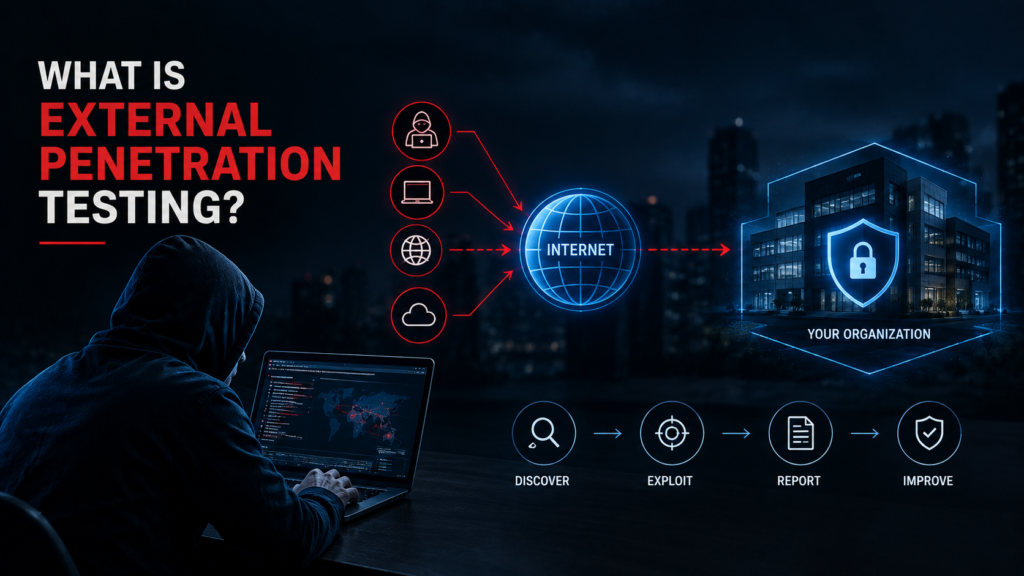
Every business with an internet connection has an external attack surface. The domain names your organization owns, the web applications your customers interact with, the APIs your products expose, the email infrastructure your team uses, the VPNs your remote workforce connects through, and every other internet-facing system and service your business operates can be reached by anyone on the internet, including attackers specifically looking for weaknesses to exploit.
External penetration testing simulates exactly that scenario. A qualified security tester approaches your public-facing infrastructure from the outside, with no prior access or insider knowledge, and attempts to find and exploit the vulnerabilities a real external attacker would target. The findings reflect the real risk your organization faces from any threat actor with internet access and the motivation to get in.
This post covers what external penetration testing is, what it examines, how it works, and why it belongs in every security program regardless of organizational size.
Key Takeaways
- External penetration testing simulates an attacker approaching from the internet with no prior access, targeting everything your organization exposes to the public-facing network.
- The external attack surface of most organizations is larger than their security team realizes. Forgotten subdomains, legacy services, and recently added integrations consistently appear in Bugstrix external assessments that were not on the client’s own asset inventory.
- External penetration testing covers web applications, APIs, network services, email infrastructure, VPNs, remote access gateways, and cloud-exposed management interfaces.
- PCI DSS v4.0 Requirement 11.4 mandates annual external penetration testing for all organizations processing cardholder data. SOC 2 and ISO 27001 auditors expect it as standard evidence.
- In Bugstrix external assessments, exposed management interfaces with default credentials, subdomain takeover vulnerabilities, and misconfigured cloud storage accessible from the internet are the three most consistently discovered critical findings.
What Is External Penetration Testing?
External penetration testing is a security assessment in which a qualified tester simulates an internet-based attacker attempting to compromise an organization’s public-facing infrastructure with no prior access, no insider knowledge, and no assistance from the organization’s internal team. It evaluates every system, service, and application the organization exposes to the internet for vulnerabilities that a real external attacker could exploit.
The starting position of an external penetration test, an attacker on the internet with only publicly available information about the target, is what gives the assessment its unique value. It does not assume prior access, insider knowledge, or cooperation from the organization’s team. It begins where a real attacker begins: with a domain name and the open internet, and works outward from there.
External penetration testing is distinct from internal penetration testing, which simulates an attacker who already has a foothold inside the network. External testing answers whether an attacker can gain initial access through the internet-facing perimeter. Internal testing answers what an attacker can do once inside. Both are necessary for a complete security picture. External testing is typically the starting point because without a way in, an internal compromise cannot begin.
For a broader understanding of penetration testing methodology across all engagement types, our complete guide to what penetration testing is covers the full scope from scoping through to deliverables.
What Does an External Penetration Test Cover?
An external penetration test covers everything an organization exposes to the internet: web applications, public-facing APIs, network services on exposed IP addresses, email infrastructure, remote access systems including VPNs and RDP gateways, DNS configuration, cloud storage and management interfaces reachable from the internet, and the full subdomain footprint of every domain the organization owns.
Web applications are the highest-priority target in most external assessments because they are the most complex and most commonly vulnerable component of the external attack surface. Customer portals, login pages, admin panels accessible from the internet, e-commerce platforms, and any custom application with a public-facing interface all fall within scope. The OWASP Top 10 vulnerability categories, particularly broken access control and injection, are systematically tested across every web application in scope. For organizations whose external attack surface centers on one or more complex applications, our web application penetration testing services provide the deeper, application-focused testing depth that a broader external assessment scopes at a higher level.
Public APIs are increasingly the primary attack surface for organizations with modern architectures. REST APIs, GraphQL endpoints, and mobile application backends that expose functionality to the internet are tested for authentication bypass, authorization failures, injection vulnerabilities, and rate limiting weaknesses. APIs frequently expose more functionality than the organization realizes, because API endpoints added during development are often not tracked with the same rigor as user-facing application features.
Network services and exposed ports are catalogued across all in-scope IP addresses, with each open service examined for known vulnerabilities, default credentials, and misconfigurations. Services that should not be publicly accessible, database ports, internal admin interfaces, and management services that appear in internet-facing IP ranges are consistently among the most impactful findings in external assessments.
Remote access infrastructure, including VPNs, RDP gateways, SSH services, and Citrix environments, is tested for authentication weaknesses, credential brute force susceptibility, and known vulnerabilities in the specific software versions deployed. Remote access services are high-value targets because successfully compromising them grants direct access to the internal network.
Email infrastructure is examined for misconfigured SPF, DKIM, and DMARC records that would allow an attacker to send emails that appear to originate from the organization’s domain. This is a direct enabler of phishing attacks against the organization’s customers and partners.
Subdomains and DNS footprint analysis identifies every subdomain associated with the organization’s domains through enumeration techniques, certificate transparency log analysis, and passive DNS data. Forgotten subdomains running outdated software, development environments accidentally left accessible, and staging instances with weaker security than production are consistently among the most valuable findings in external assessments.
How Does an External Penetration Test Work?
An external penetration test works through four sequential phases: reconnaissance and attack surface discovery, vulnerability identification, exploitation and validation, and reporting with remediation guidance. Each phase builds on the previous one, with the reconnaissance phase being particularly important in external testing because the tester begins with no information beyond publicly available data.
Phase 1: Reconnaissance and attack surface discovery. The test begins with open-source intelligence gathering and active discovery of the organization’s internet-facing assets. This includes enumerating all subdomains across every domain the organization owns, mapping internet-facing IP addresses, identifying technology stacks from HTTP headers and error responses, gathering email addresses and employee information from public sources for social engineering risk assessment, and analyzing certificate transparency logs for infrastructure the organization may have forgotten existed. In our external assessments at Bugstrix, this phase consistently identifies assets the client’s team was not aware were publicly accessible.
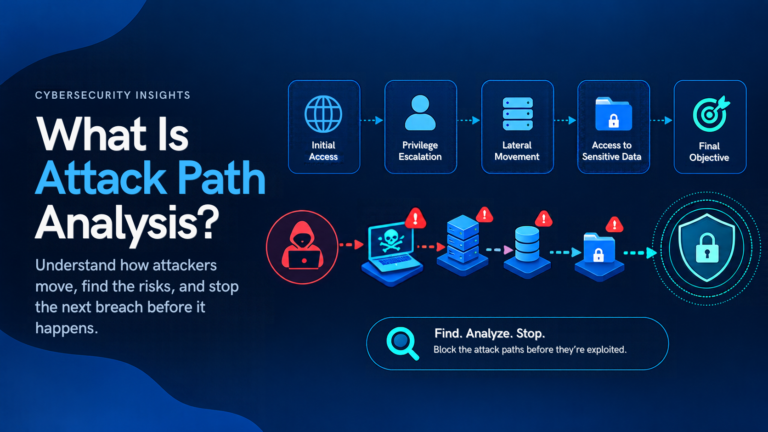
Phase 2: Vulnerability identification. Each identified asset is examined for vulnerabilities using a combination of automated scanning and manual testing. Automated tools efficiently cover the known CVE landscape across identified software versions. Manual testing addresses the vulnerability classes that automated tools cannot reliably detect: authentication logic weaknesses, business logic flaws in web applications, authorization gaps in APIs, and chained vulnerabilities that individually appear low-severity but combine into a meaningful attack path.
Phase 3: Exploitation and validation. Identified vulnerabilities are actively exploited to confirm they are genuinely exploitable in the specific environment rather than theoretically possible based on software version alone. This step is what distinguishes a penetration test from a vulnerability scan. A scanner flags a potential vulnerability. A penetration tester confirms whether it is actually exploitable, demonstrates the real-world impact of exploitation, and where possible, chains multiple findings into a realistic attack path.
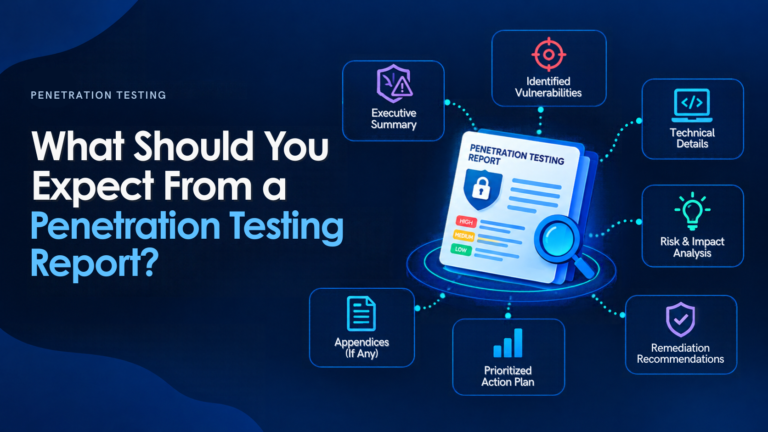
Phase 4: Reporting. The final report documents the testing methodology, the complete scope of assets discovered and tested, all confirmed findings with severity ratings, CVSS scores, exploitation evidence, business impact context, and specific remediation guidance tailored to the organization’s technology stack. Critical and high findings are followed by a retest confirming successful remediation.
What Is the Difference Between External and Internal Penetration Testing?
External and internal penetration testing simulate different adversary positions and answer different questions about security posture. External testing starts from the internet and asks whether an unauthenticated attacker can break in. Internal testing starts from a position already inside the network and asks what an attacker who has gained initial access can do from there.
The two assessments are complementary rather than competing. External testing validates whether the perimeter can withstand attack from outside. Internal testing validates whether the internal environment would limit the damage once a perimeter breach occurs. Most compliance frameworks, including PCI DSS and SOC 2, require both because each addresses a distinct and necessary question.
The findings from each type also differ meaningfully. External testing typically surfaces web application vulnerabilities, exposed services with known CVEs, authentication weaknesses in remote access systems, and misconfigured DNS and email infrastructure. Internal testing typically reveals Active Directory misconfigurations, lateral movement paths, privilege escalation opportunities, and network segmentation failures. Both categories are significant but require different expertise and different remediation approaches.
For organizations choosing where to start, external penetration testing is typically the right first engagement because the external attack surface is where an unaided attacker must begin. An internal test assumes the attacker already has a foothold. Understanding whether that foothold can be gained at all is the prerequisite for evaluating what happens afterward.
What Vulnerabilities Does External Penetration Testing Find?
External penetration testing finds the specific vulnerability classes that exist in internet-facing systems and that an attacker approaching from the outside would encounter. The most consistently discovered findings combine known technical vulnerabilities with the configuration gaps and forgotten assets that tend to accumulate in external attack surfaces over time.
The findings that appear most consistently in Bugstrix external assessments:
Subdomain takeover vulnerabilities. When a subdomain is pointed via DNS to a cloud service, CDN, or third-party platform that the organization no longer uses, an attacker can claim that service and serve content from the organization’s subdomain. This allows phishing pages to operate under a legitimate organizational domain, which is significantly more convincing to potential victims than an unrelated domain.
Exposed management and admin interfaces. Development tools, admin panels, database management interfaces, and cloud management consoles accessible from the internet without adequate authentication protection. These appear frequently because developers add internet access to management tools for convenience during development, and the configuration is never reverted before the system moves to production.
Authentication weaknesses on remote access systems. VPN portals, RDP gateways, and SSH services without multi-factor authentication, with weak password policies, or running outdated software versions with known authentication bypass vulnerabilities. Remote access services are among the highest-value targets in any external assessment because successful compromise gives an attacker direct network access.
Web application vulnerabilities. SQL injection, cross-site scripting, broken access control, authentication bypass, and business logic flaws across public-facing web applications. These findings are more common in custom-built applications than in major commercial platforms, which is relevant for any organization that has developed internal tools, customer portals, or product applications.
Email spoofing enablers. Missing or incorrectly configured SPF, DKIM, and DMARC records that allow spoofing of the organization’s email domain. This does not represent a breach of the organization’s systems but enables a class of social engineering attack against customers, partners, and employees that is significantly more convincing when it appears to originate from the legitimate organizational domain.
Publicly accessible cloud storage. Cloud storage buckets, blob containers, and object storage services configured for public access that contain sensitive data, internal documents, or credentials that were never intended to be publicly accessible.
Who Should Get an External Penetration Test?
Any organization with internet-facing systems, which in 2026 describes every organization that operates a website, hosts an application, sends email through their own domain, or allows remote access to their network, has an external attack surface that should be tested. The scale and complexity of the test scales with the size of that attack surface, but the need exists regardless of organizational size.
The organizations for whom external penetration testing is most critical:
Organizations processing payment card data are required by PCI DSS v4.0 Requirement 11.4 to conduct annual external penetration testing of their Cardholder Data Environment. For most organizations, this includes the web applications and APIs that handle payment data, the network infrastructure that connects to payment processors, and the remote access systems used to administer those environments.
SaaS companies pursuing enterprise sales will encounter security questionnaires from enterprise prospects that specifically ask about penetration testing. A current external penetration test report, covering the application and infrastructure their customers interact with, is the standard evidence those questionnaires expect.
Any organization that has never had an external assessment has no systematic evidence of what their external attack surface looks like from an attacker’s perspective. For these organizations, external penetration testing is the highest-priority security investment regardless of other security spending, because it provides the baseline understanding that all other security decisions should be informed by.
Organizations with active development teams deploy new features, add integrations, and change infrastructure regularly. Each change potentially introduces new external vulnerabilities. Annual external testing at minimum is appropriate for these organizations, with targeted assessments after significant changes.
For small and mid-market businesses evaluating where external penetration testing fits within an overall cybersecurity budget, our post on how much a small business should spend on cybersecurity provides a practical framework for prioritizing security investment.
Our penetration testing services cover external network and application testing across the full scope of internet-facing infrastructure.
How Often Should an Organization Run an External Penetration Test?
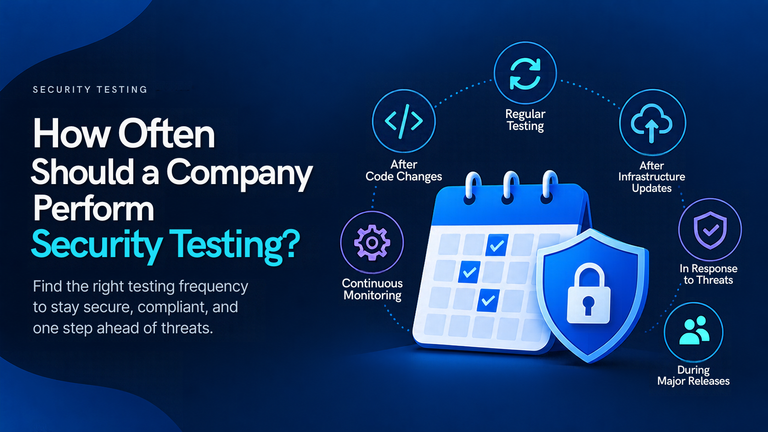
An organization should run a full-scope external penetration test at minimum annually, with targeted assessments triggered by significant changes to the external attack surface, including major application releases, new domain registrations, new remote access infrastructure, significant cloud migrations, and any event that meaningfully changes what the organization exposes to the internet.
The annual minimum is driven by compliance requirements for most organizations under regulatory frameworks: PCI DSS requires it annually under Requirement 11.4, SOC 2 auditors expect it within the audit observation period, and ISO 27001 requires periodic technical vulnerability testing under Annex A.8.8.
Beyond compliance, the right cadence is driven by how frequently the external attack surface changes. An organization that ships new application features monthly, adds new cloud infrastructure quarterly, and regularly onboards new third-party integrations has an attack surface that changes faster than an annual test cycle can track. The vulnerabilities introduced by those changes accumulate between test cycles and represent genuine exposure that is not captured until the next annual assessment.
A practical approach for actively developing organizations is a comprehensive annual test supplemented by lighter-touch quarterly assessments focused on the components of the external attack surface that change most frequently: web applications and APIs. This maintains coverage without the cost of a full annual assessment every quarter.
Does External Penetration Testing Cover Mobile Applications?
External penetration testing covers the server-side infrastructure that mobile applications communicate with, including the APIs, backends, and web services that mobile apps connect to over the internet. The mobile application itself, the code running on a user’s device, requires a separate mobile application penetration test because it is a distinct attack surface with different vulnerabilities and a different testing methodology.
This distinction matters practically because the most significant vulnerabilities in mobile ecosystems are often split between the two layers. The mobile app itself might have insecure data storage, certificate pinning that can be bypassed, or hardcoded credentials embedded in the application code. The mobile app backend might have authorization failures, insecure API design, or insufficient rate limiting that allows credential stuffing. Both layers need to be tested, but through different approaches.
For organizations with mobile applications that handle sensitive data, a combined external penetration test covering the server-side infrastructure alongside a dedicated mobile application assessment produces the most complete picture of the mobile security posture. Our mobile app penetration testing services cover the device-side attack surface that external network and application testing does not reach.
How Much Does an External Penetration Test Cost?
An external penetration test for a typical mid-market organization with a moderate number of internet-facing applications and a defined IP range costs $5,000 to $20,000. Smaller organizations with a limited external footprint, such as a single web application and a small IP range, sit at the lower end. Organizations with complex external surfaces, including multiple web applications, extensive API layers, cloud infrastructure, and numerous subdomains, sit at the higher end.
The primary cost drivers in an external penetration test are the number of web applications in scope, the number of in-scope IP addresses and the services exposed on them, the complexity of the authentication mechanisms and business logic in web applications, and whether compliance-specific reporting is required.
The cost should be evaluated against the alternative. An external vulnerability that goes undetected until an attacker finds it triggers breach response, regulatory investigation, customer notification, and reputational damage that are orders of magnitude more expensive than the test that would have found it first. For a complete breakdown of penetration testing costs across all scope types and the factors that drive pricing, our post on penetration test costs in 2026 covers the full pricing landscape.
How Do You Choose the Right External Penetration Testing Provider?
Choosing the right external penetration testing provider requires confirming that they conduct genuine manual testing rather than presenting scanner output as a penetration test, that they can demonstrate specific experience with the technology stack and application types in scope, and that their report will satisfy the compliance or business purpose the engagement is meant to address.
The questions that reveal the difference between a genuine external penetration testing provider and one running automated scans with a manual label:
How do they test web application business logic? Business logic flaws in web applications require understanding what the application is supposed to do and then testing whether it actually enforces those rules. A provider who can describe their approach to business logic testing in specific terms is conducting manual testing. A provider who describes their methodology entirely in terms of automated tools is running a scanner.
What is their approach to subdomain and asset discovery? The reconnaissance phase of an external assessment often discovers the most impactful findings. A provider who describes their discovery methodology in detail, covering passive DNS, certificate transparency logs, and active enumeration techniques, is conducting the reconnaissance that a real attacker would conduct. A provider who only tests what the client provides them is not doing a realistic external assessment.
Does the report include exploitation evidence? Every critical and high finding should be accompanied by proof that it was genuinely exploited, not just identified. Screenshots, request and response captures, and working proof-of-concept output distinguish a validated finding from a scanner flag that may or may not represent a real vulnerability in the specific environment.
For a comprehensive evaluation framework covering all penetration testing provider selection criteria, our post on how to choose a penetration testing company in 2026 covers the specific questions to ask before committing to any engagement.
Frequently Asked Questions
Is an external penetration test the same as a vulnerability scan?
No. A vulnerability scan uses automated tools to identify potential weaknesses based on known signatures and runs without active exploitation. An external penetration test uses a human tester who actively exploits confirmed vulnerabilities, chains findings into realistic attack paths, and validates real-world impact. Vulnerability scanning is faster and cheaper. Penetration testing produces findings that reflect how an actual attacker would approach the same environment.
Does an external penetration test require any access to the organization’s systems?
No. An external penetration test begins with no access to the organization’s systems or internal information. The tester starts from the same position as an attacker on the internet, using only publicly available information and the organization’s internet-facing assets. Some organizations choose grey-box external testing, where the tester is given a list of in-scope domains and IP ranges, but even this does not involve access to internal systems or credentials.
How disruptive is an external penetration test to normal business operations?
A properly conducted external penetration test has minimal impact on normal operations. Testers avoid techniques that could cause service disruption, such as denial-of-service testing, unless explicitly scoped and agreed in advance. Exploitation of vulnerabilities is conducted to demonstrate impact, not to cause damage. Organizations should have a point of contact available during the test to respond quickly if anything unexpected occurs, but the test itself should not cause noticeable disruption to end users or business processes.
What is the difference between black box and grey box external testing?
In black box external testing, the tester is given only the organization’s company name and conducts all asset discovery independently. This most closely simulates an unknown attacker. In grey box external testing, the tester is provided with a defined scope of domains and IP addresses and possibly technology stack information. Grey box testing is more efficient because less time is spent on discovery, allowing more testing depth on the known scope. Both approaches are valid. Grey box is generally preferred when the scope is well-defined, and the objective is thorough testing of known assets rather than realistic attacker simulation.
What happens after an external penetration test?
After the test, the organization receives a report documenting all findings with severity ratings, exploitation evidence, and remediation guidance. The security or engineering team remediates critical and high-severity findings, typically within thirty to sixty days. A retest is then conducted to confirm that remediations were successful. The retest evidence is included in the final compliance evidence package if the test is compliance-driven.
The Starting Point for Every Security Program
An attacker who wants to breach your organization starts at the same place every time: the internet-facing edge of your environment. They look for exposed services with known vulnerabilities. They enumerate subdomains. They probe web applications for authorization gaps. They test remote access systems for weak credentials. They do all of this before they ever get close to your internal environment.
External penetration testing answers a specific, critical question: if a motivated, capable attacker started from the internet and tried to get in, would they succeed? The answer to that question, validated through realistic adversarial testing rather than theoretical assessment, is the foundation every other security decision should be built on. You cannot defend what you do not understand, and you cannot understand your external exposure without testing it.
Contact us to discuss an external penetration test for your organization.