What Is Digital Risk Protection and Why Does It Matter?

Written By
Sarwat Iftikhar
Most security programs are built around a clear idea of what they are protecting: servers, applications, endpoints, and the data that lives on them. They define a perimeter, test what is inside it, and monitor what crosses it. That model describes security well when the most significant risks to an organization live within or immediately adjacent to its technical environment.
It describes it poorly when the risks live somewhere else entirely.
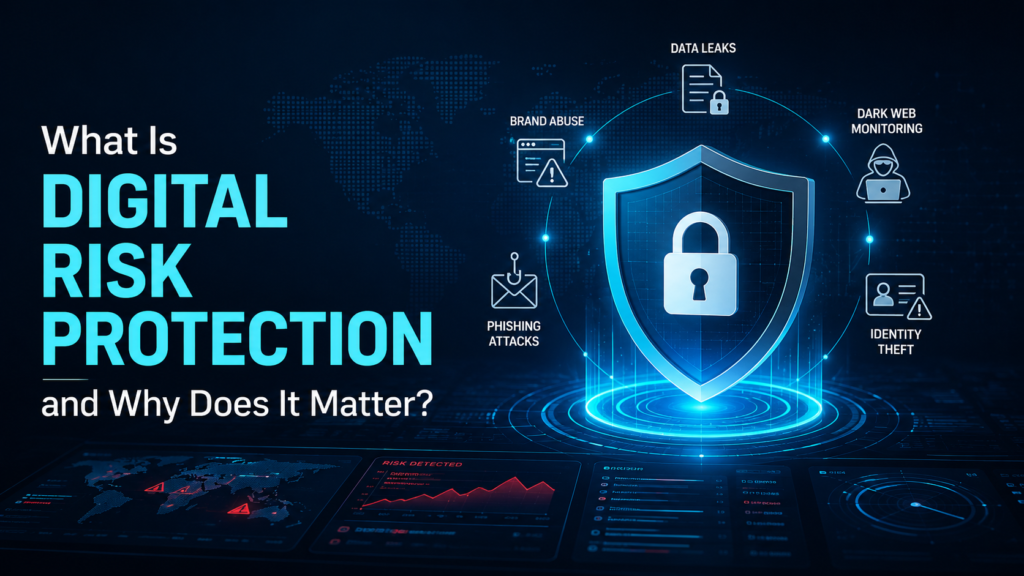
A database of your employees’ credentials appears on a dark web marketplace. A convincing phishing site impersonating your brand is collecting customer login details. A leaked code repository contains API keys to your production environment. A threat actor is discussing your specific infrastructure in a criminal forum. None of these risks exist within your perimeter. None of them would show up in a penetration test or vulnerability assessment. All of them represent real, active threats to your organization that are generating damage or building toward it right now.
Digital risk protection is the discipline of monitoring, identifying, and responding to the threats that exist outside your technical perimeter but target your organization, your brand, your customers, and your data. It is not a replacement for perimeter security and internal testing. It extends your security visibility to the parts of the digital landscape where modern threats actually live.
Key Takeaways
- Digital risk protection monitors external threats targeting your organization outside your technical perimeter, including credential exposure, brand impersonation, data leakage, and dark web threat intelligence.
- Credential exposure on dark web marketplaces is one of the most consistent findings in Bugstrix digital risk assessments, with most organizations having active credential exposure they were unaware of before the assessment.
- Brand impersonation through lookalike domains and phishing sites is growing rapidly, with automated domain registration tools making it trivially cheap for attackers to spin up convincing copies of legitimate business domains.
- Digital risk protection is not the same as attack surface management, though the two are closely related. ASM discovers your exposed technical assets. DRP monitors the external threat landscape targeting those assets and your broader digital presence.
- A complete security program addresses both the internal attack surface and the external digital risk landscape. Organizations that only test what is inside their perimeter are blind to a significant category of active threats.
What Is Digital Risk Protection?
Digital risk protection is the practice of continuously monitoring the external digital environment, including the dark web, criminal forums, social media, domain registrations, paste sites, and public code repositories, to identify threats targeting an organization’s brand, credentials, data, and infrastructure before those threats cause damage.
The core distinction that defines digital risk protection as a discipline is where it addresses risks. Most security practices protect assets inside the organization’s environment or on its perimeter. Digital risk protection monitors what happens outside that environment because it targets the organization.
Digital risk protection covers four primary threat categories: data risks including credential exposure and data leakage, brand risks including impersonation, lookalike domains, and phishing infrastructure, third-party risks including supplier exposure and supply chain threats, and threat intelligence risks including specific mentions of the organization in criminal forums and dark web marketplaces. In practice, each of these four categories is monitored through one or more of the seven specific domains covered later in this article, which break the categories into the discrete monitoring activities a digital risk protection program performs day-to-day.
Each category requires different monitoring capabilities, different response processes, and different organizational ownership. Credential exposure monitoring sits closest to security operations. Brand protection sits closest to marketing and legal. Threat intelligence feeds into strategic security decision-making. Together, they address the external threat landscape as a coherent program rather than a collection of disconnected monitoring activities.
Why Does Digital Risk Protection Matter in 2026?
Digital risk protection matters because a modern organization’s attack surface extends far beyond the systems it owns and operates, and the threats targeting that extended surface have become significantly more sophisticated, more automated, and harder to detect through perimeter-focused security alone.
The scale of external threat activity has increased substantially. Attackers use automated tools to continuously scan the internet for exposed data, register lookalike domains before organizations notice them, harvest credentials from breached databases and make them available on criminal marketplaces, and monitor target organizations for changes that create new attack opportunities. An organization that doesn’t monitor these external threats operates blind to a significant portion of its risk.
The business consequences of undetected external threats are also expanding. A credential exposure that goes undetected for weeks or months allows attackers to conduct account takeovers, escalate access, and extract value before the breach is identified. A phishing site impersonating the company’s login page damages customer trust whether or not the organization was directly involved in the attack. A threat actor’s discussion of the organization’s infrastructure in a criminal forum may indicate planning of an attack that could be disrupted if detected early enough.
In our security assessments at Bugstrix, organizations consistently underestimate the volume of external digital risk activity that directly pertains to them. Most businesses that haven’t conducted a dedicated external threat assessment are surprised to discover the number of active credential exposures, lookalike domains, and references to their brand in external threat infrastructure that exist before any internal security team notices them.
What Does Digital Risk Protection Actually Cover?
Digital risk protection covers seven core monitoring domains: dark web and criminal forum intelligence, credential and data leakage monitoring, brand impersonation and lookalike domain detection, phishing infrastructure targeting the organization, social media impersonation and account abuse, third-party and supply chain digital risk, and executive and VIP exposure monitoring.
Dark web and criminal forum intelligence monitors underground marketplaces, paste sites, closed forums, and criminal communication channels for references to the organization’s infrastructure, brand, credentials, or data. This monitoring layer identifies when an organization is being discussed, when its data is being traded, or when threat actors are planning an attack targeting it. The value of dark web intelligence is in the early warning it provides: information about an upcoming attack, a new exploit targeting specific infrastructure, or a recently advertised data set gives defenders time to respond before the threat reaches its operational phase.
Credential and data leakage monitoring tracks breached credential databases, public paste sites, code repositories, and data dump sites for employee credentials, customer data, and sensitive internal information. Credential exposure is the most consistently discovered finding in Bugstrix external assessments. Most organizations that have existed for more than a few years have active credential exposure they are not aware of, either from historical breaches of third-party services their employees used or from targeted attacks that extracted credentials without triggering internal detection.
Brand impersonation and lookalike domain detection monitors newly registered domain names for patterns that indicate spoofing of the organization’s brand, automated registration of typosquatting variants, and deployment of phishing infrastructure using the organization’s visual identity. The barrier to creating a convincing lookalike domain has dropped significantly in 2026. Automated tools allow a threat actor to register dozens of plausible variations of a target organization’s domain, deploy a convincing clone of their login page, and have a functional phishing site live within hours of deciding to target them.
Phishing infrastructure monitoring specifically identifies active phishing sites that are using the organization’s branding to collect customer credentials, active email spoofing campaigns being conducted against employees or customers, and phishing kits distributed in criminal marketplaces that are configured to target the organization. This monitoring enables takedown requests before the phishing infrastructure claims significant victim volume.
Social media impersonation monitors major platforms for fake accounts impersonating the organization’s brand, executives, or support channels, fraudulent pages soliciting customer information under the organization’s identity, and coordinated inauthentic behavior targeting the organization’s reputation.
Third-party and supply chain digital risk monitors the external exposure of suppliers, vendors, and partners whose security posture directly affects the organization even though it sits outside the organization’s own control. This includes tracking whether a critical vendor appears in breach disclosures, whether a supplier’s credentials or systems show up in the same dark web channels being monitored for the organization itself, and whether a widely used software dependency is being actively targeted or discussed by threat actors. Third-party risk is frequently the least visible category because the organization has no direct line of sight into the vendor’s security posture until an external signal surfaces it.
Executive and VIP exposure monitoring tracks the personal digital footprint of senior leadership: credentials tied to personal or corporate accounts appearing in breach data, personal information available through data aggregation and people-search sites, and mentions of specific executives in contexts that suggest they are being researched for a targeted attack. Executives are disproportionately targeted because their access and authority make them high-value entry points for both credential-based attacks and social engineering, and because their public visibility, through conference appearances, press coverage, and social media, makes the reconnaissance phase of an attack against them far easier than against a typical employee.
How Does Digital Risk Protection Work?
Digital risk protection works through continuous automated monitoring of external sources combined with human analyst review of alerts that require context, attribution, or action that automation cannot provide alone. The automated layer provides the coverage breadth that the external threat landscape requires. The human layer provides the judgment that distinguishes actionable intelligence from noise.
Collection. Automated monitoring systems continuously collect data from external sources: dark web forums and marketplaces, public breach databases, domain registration feeds, certificate transparency logs, social media monitoring APIs, and paste sites. The collection infrastructure needs to cover a broad range of sources because threats do not confine themselves to predictable channels.
Detection and alerting. Collected data is analyzed against the organization’s monitored asset list: domain names, IP ranges, executive names, brand terms, credential patterns, and product names. Matches trigger alerts that are categorized by threat type, severity, and confidence level. High-confidence alerts indicating active credential exposure or a live phishing site are escalated immediately. Lower-confidence signals that require further analysis go into analyst review queues.
Analyst review and enrichment. Human analysts review alerts to add context that automated systems cannot provide: whether a newly registered lookalike domain is actively serving phishing content or is a legitimate registration, whether a dark web mention represents a specific threat or generic discussion, and whether a credential set is current or historical. This enrichment step is what transforms raw alerts into actionable intelligence.
Response. Depending on the threat type, response options include credential resets and notifications for exposed accounts, takedown requests to hosting providers and domain registrars for phishing sites and lookalike domains, notifications to affected customers or employees, and integration of threat intelligence into defensive controls to block known-bad infrastructure.
What Is the Difference Between Digital Risk Protection and Attack Surface Management?
Digital risk protection and attack surface management are closely related disciplines that address adjacent parts of the same problem, but they answer different questions and require different tooling and processes.
Attack surface management discovers and monitors the organization’s own exposed assets: internet-facing systems, applications, cloud infrastructure, and third-party services that create entry points into the environment. It answers what the organization exposes to potential attackers. Our post on what attack surface management is covers this discipline in detail, including how it identifies unknown exposure that traditional asset inventories miss.
Digital risk protection monitors the external threat landscape for activity targeting the organization, whether or not that activity involves the organization’s own assets. It answers what threat actors are doing with or against the organization in parts of the digital environment the organization does not control. A phishing site impersonating the organization’s brand does not involve the organization’s infrastructure. A credential exposure from a third-party breach does not involve the organization’s systems at all. Both are digital risks that affect the organization and require response.
The practical relationship is that both programs inform each other. Attack surface management findings tell digital risk protection teams what assets to prioritize in external monitoring. Digital risk protection intelligence tells attack surface management teams what external actors know about the organization’s infrastructure and what they are planning to do with it.
Our attack surface management service is designed to work alongside digital risk protection as complementary external visibility capabilities rather than competing alternatives.
How Digital Risk Protection Findings Actually Get Resolved?
An external finding is rarely actionable on its own. A leaked API key discovered in a public code repository is only useful information once someone determines which internal system that key authenticates to, whether that system is still active, and what breaks if the key is rotated. A credential exposure is only worth an urgent reset once someone confirms the account is real, still in use, and understands what access it grants. Digital risk protection generates the external signal. Resolving that signal requires internal context that the monitoring itself does not have.
This is the practical reason digital risk protection findings almost always route through the same teams that manage the organization’s internal vulnerability and asset inventory. A security team that already runs regular vulnerability assessments and periodic penetration testing maintains an accurate, current picture of its systems, so it can look up a leaked credential or API key and immediately know what it touches and how urgent the response is. A team without that internal visibility has to spend the first several hours of any external threat response just establishing whether the asset in question is even real, still in use, or already decommissioned, before they can decide how seriously to treat it.
In practice, this means a digital risk protection program’s value is partly determined by how well it matches internal asset data. A leaked credential for a system that was retired two years ago is noise. The same finding for a production system in active use is a same-day incident. Digital risk protection cannot tell the difference between those two cases on its own. Internal asset and vulnerability records can. Organizations that keep both functions current, rather than treating external monitoring as a standalone tool, close the gap between an alert and a resolved finding significantly faster.
What Are the Most Common Digital Risks Businesses Face in 2026?
Credential exposure, lookalike domain registration, and dark web mentions of organizational infrastructure, covered in detail above, remain the three most consistently discovered findings in Bugstrix external assessments and appear across the overwhelming majority of businesses that have not implemented formal digital risk monitoring. Two additional risk categories round out the picture and are worth calling out specifically, since they are less commonly monitored even at organizations that have addressed the first three.
Third-party exposure reflects the fact that an organization’s digital risk is not bounded by its own security practices. A supplier with a data breach that included the organization’s information, a software vendor whose product is being actively discussed as an attack target, or a cloud provider experiencing an incident that affects the organization’s data all represent third-party digital risks that the organization has no direct control over but needs to monitor and respond to.
Social engineering targeting at the organizational level includes specific individuals being researched for targeted attacks, executive personal information appearing in data aggregation sites that facilitate pretexting, and coordinated intelligence gathering activities suggesting an upcoming targeted campaign. Our post on social engineering testing explains how these external targeting activities translate into real attack attempts.
Who Needs Digital Risk Protection?
Digital risk protection is relevant to any organization with a meaningful online presence, a recognizable brand, customers who interact with it digitally, or employees whose credentials could be valuable to attackers. That describes the overwhelming majority of businesses operating in 2026. The scale and sophistication of the digital risk monitoring program scale with organizational size and risk profile, but the need exists regardless of size.
Financial services organizations face the highest concentration of credential-targeted attacks and the most active phishing infrastructure deployment because the value of compromised financial accounts justifies significant attacker investment. Regulatory frameworks in financial services increasingly expect external threat monitoring as part of a complete security program.
Healthcare organizations hold extensive personal data that remains highly valuable in criminal marketplaces, and a successful phishing campaign against patients can severely damage brand trust. Healthcare is simultaneously one of the most targeted sectors and one where brand impersonation causes the most direct harm to real people.
SaaS and technology companies have brand assets, customer credentials, and code repositories that are attractive targets. Source code exposure through public repositories is a specific risk category for technology companies that is directly addressed by digital risk protection monitoring.
Any organization with a recognizable consumer brand faces brand impersonation risk proportional to the strength and visibility of their brand. The more recognizable the brand, the more convincing a phishing site impersonating it will be to potential victims, which makes monitoring and takedown more urgent.
Organizations with high-value executive teams are specifically targeted by threat actors using personal information about executives gathered from public sources to enable spear phishing, pretexting, and social engineering attacks. Executive exposure monitoring is a specific component of digital risk protection designed for this threat.
How Should Organizations Prioritize Digital Risk Protection Alerts?
A running digital risk protection program generates a continuous stream of alerts, and not every alert carries the same urgency. A newly registered lookalike domain that has not yet resolved to a live website is a different priority than one already hosting a cloned login page collecting credentials. A dark web forum post that mentions the organization’s name in passing, as part of a broader industry discussion, is different from a specific listing offering the organization’s data for sale. Treating every alert with the same urgency, or the same indifference, wastes the value of the monitoring.
Two questions determine how quickly an alert needs a response: is the finding confirmed rather than speculative, and does it specifically involve the organization’s own assets, brand, or people rather than generic chatter that happens to mention them? A confirmed, specific finding, such as a verified credential set for a real employee account or an active phishing site already collecting customer data, warrants an immediate response. A low-confidence or generic signal, such as a domain registration that hasn’t been weaponized yet or a forum thread discussing the organization’s industry broadly, warrants monitoring rather than immediate escalation.
Organizations new to digital risk protection commonly make one of two mistakes when they start receiving alerts. Some treat every signal as an emergency, which burns out the team responsible for triage and makes the program unsustainable. Others dismiss the alert queue as noise after the first few low-severity findings turn out to be non-issues, which means the genuinely urgent alert eventually gets missed in the backlog. A consistent triage framework built around confirmed severity and direct organizational relevance turns a raw alert feed into a program that delivers measurable security value rather than an unmanageable queue.
Frequently Asked Questions
Is digital risk protection the same as dark web monitoring?
Dark web monitoring is one component of digital risk protection, not the same thing. Digital risk protection encompasses dark web monitoring alongside brand impersonation detection, phishing infrastructure monitoring, social media abuse detection, third-party risk intelligence, and executive exposure tracking. Dark web monitoring specifically covers criminal forums, marketplaces, and underground channels. A complete digital risk protection program extends well beyond dark web coverage to address all the external channels where threats to the organization originate.
How does an organization know if its credentials are exposed?
Without active monitoring, an organization typically discovers credential exposure after an account takeover, during a security incident investigation, or when someone alerts them to a specific listing. Active digital risk protection monitoring continuously scans breach databases, paste sites, and criminal marketplaces for the organization’s email domain patterns, specific executive email addresses, and credential formats. Alerts are generated when new exposures are identified, allowing the organization to reset credentials and investigate before exploitation occurs.
Can digital risk protection prevent phishing attacks against customers?
Not entirely, but it can significantly reduce the window during which an active phishing campaign operates. Phishing infrastructure monitoring identifies active phishing sites impersonating the organization’s brand, typically within hours of deployment. This enables takedown requests to hosting providers and domain registrars that remove the phishing site before it claims significant victim volume. Without monitoring, phishing sites targeting customers may operate for days or weeks before being reported and taken down.
How is digital risk protection different from threat intelligence?
Threat intelligence is the broader discipline of collecting, analyzing, and applying information about the threat landscape to security decision-making. Digital risk protection is a more targeted application of threat intelligence specifically focused on risks and threats that directly pertain to the organization being monitored. Threat intelligence may cover general threat actor activity, global attack trends, and sector-wide risks. Digital risk protection monitors specifically for the organization’s name, brand, credentials, infrastructure, and personnel in the same external sources.
Does digital risk protection require technical expertise to implement?
A meaningful digital risk protection program requires both technical capabilities for monitoring and collection and analyst expertise to evaluate alerts, distinguish genuine threats from noise, and manage response workflows. Implementing digital risk protection purely through automated tooling without analyst review produces high alert volumes with low actionability. Effective programs combine automated collection breadth with human analysis for the alerts that require judgment, attribution, and decision-making about response priority.
The Threats That Live Outside Your Perimeter Are Real
The perimeter security model assumes that what matters most is what is inside your environment and what is trying to get through the boundary. That assumption has always been incomplete. It is significantly more incomplete in 2026, when the threat actors targeting your organization actively monitor your external exposure, trade your employees’ credentials, impersonate your brand to attack your customers, and discuss your infrastructure in criminal forums, all before they attempt a single connection to anything you own.
Digital risk protection does not replace the security work happening inside the perimeter. It extends the visibility of your security program to cover the external digital landscape where those threats are building. The organizations that know their external exposure, that monitor what threat actors know about them and what they are doing with that knowledge, are in a meaningfully better position to prevent the attacks that originate from that external activity.
The ones that only look inward are not protecting themselves from the threats that start outside. They are simply not aware of them until those threats arrive.
Contact us to discuss digital risk protection for your organization