How Much Does a Managed Bug Bounty Program Cost?

Written By
Sarwat Iftikhar
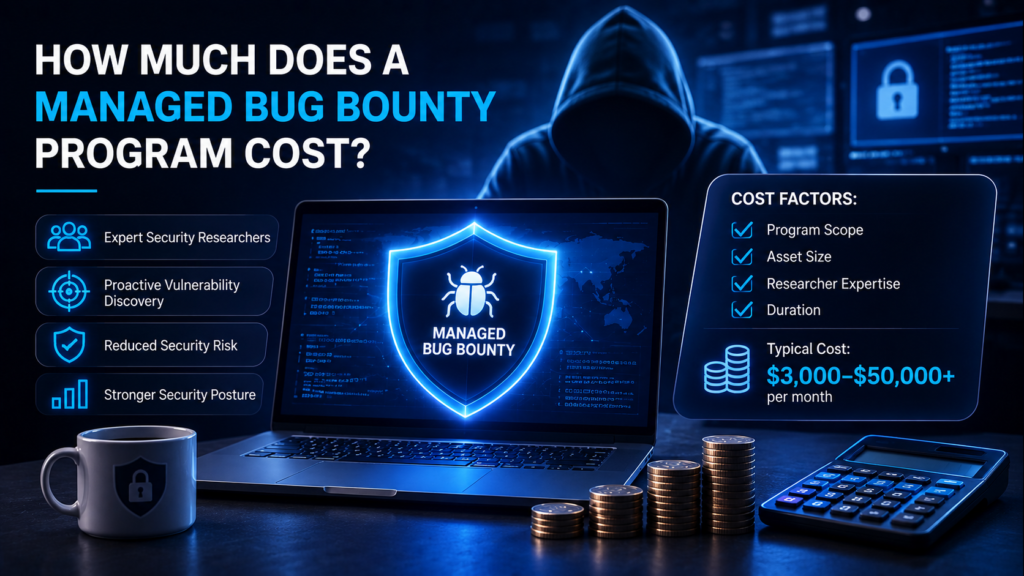
A managed bug bounty program costs between $30,000 and $500,000 or more per year when platform fees, triage services, and researcher bounty payouts are combined. Small business programs with a limited scope can be structured for $10,000 to $50,000 annually. Enterprise programs at major technology companies run into the millions once year-round management, dedicated triage teams, and high researcher engagement are factored in.
The wide range is not arbitrary. Bug bounty costs are genuinely variable because the three main cost components, platform access, triage services, and bounty payouts, each scale differently based on program scope, how many vulnerabilities researchers submit, and how much of the operational work the organization handles internally versus outsourcing. Understanding what drives each component is what separates a well-structured program from one that runs over budget without producing proportional security value.
Today, 81% of Fortune 500 companies run active bug bounty programs. But bug bounties are no longer only for large organizations. Small and mid-sized businesses are increasingly launching scoped programs because paying a researcher $5,000 for a critical vulnerability is structurally cheaper than managing the aftermath of a breach that costs the same organization $120,000 or more to recover from.
Key Takeaways
- Managed bug bounty programs cost $30,000 to $500,000+ annually, combining platform fees, triage services, and researcher payouts. Small business programs can start at $10,000 to $50,000 per year.
- Three separate cost components determine total program spend: platform access fees ($20,000 to $200,000), triage and management services (often 20-30% of total budget), and researcher bounty payouts ($50,000 to $500,000+ depending on scope).
- Bounty payouts are tiered by severity: Low ($100 to $500), Medium ($500 to $5,000), High ($5,000 to $25,000), Critical ($25,000 and above). Blockchain and AI systems can reach $1 million for critical findings.
- A managed program handles researcher communication, vulnerability triage, duplicate filtering, and reporting on your behalf. An unmanaged program requires significant internal security staff time that most organizations do not budget for.
- Bug bounty programs are most effective when combined with regular penetration testing rather than used as a substitute, because they serve fundamentally different purposes and catch different vulnerability categories.
What Is a Managed Bug Bounty Program and How Is It Different From Running One In-House?
A managed bug bounty program outsources the operational complexity of running a researcher-driven vulnerability disclosure program to a specialized provider. The provider handles researcher vetting, vulnerability triage, duplicate filtering, severity classification, communication, and reporting, allowing the organization to receive clean, validated, actionable vulnerability reports rather than raw, unfiltered submissions.
To understand the foundation of these programs, it is important to first know what a bug bounty program is and how organizations leverage ethical security researchers to identify vulnerabilities. Bugstrix’s guide on what is a bug bounty program explains the basics of vulnerability discovery and the role these programs play in modern cybersecurity strategies.
The distinction matters practically because unmanaged bug bounty programs consume substantial internal staff time. A public program with active researcher engagement can receive dozens of submissions weekly, a significant portion of which are duplicates, out-of-scope reports, or low-quality findings that require triage before the security team can act on anything. Organizations that launch programs without a plan for handling submission volume frequently find the program creates more work than it eliminates.
Managed programs address this by placing triage and communication work with the provider. The security team receives a curated stream of validated findings rather than the raw submission volume. That operational model is what justifies the management fee component of a managed program’s cost and what makes the total investment worthwhile for organizations without a large dedicated security team.
Bugstrix approaches bug bounty program management specifically to deliver high-signal programs that reward real findings, filter noise, and keep the organization’s attack surface continuously covered rather than generating a reporting burden that diverts security team capacity from remediation.
What Are the Three Cost Components of a Managed Bug Bounty Program?
A managed bug bounty program has three distinct cost components that combine to produce the total annual investment: platform or provider fees covering access, infrastructure, and management services; triage and operational services for processing and validating researcher submissions; and researcher bounty payouts for valid vulnerability reports.
Total annual program cost is the sum of all three components. Platform fees are relatively fixed. Triage costs scale with submission volume. Bounty payouts are the most variable component and the hardest to forecast accurately in the first program year:
| Component | Typical Range | What It Covers |
| Platform and provider fees | $20K – $200K / year | Access to researcher network, program infrastructure, and management tools |
| Triage and operations | 20–30% of total budget | Duplicate filtering, severity validation, researcher comms, and reporting |
| Researcher bounty payouts | $50K – $500K+ / year | Paid per valid report by severity tier. Scales with scope and program activity |
Source: Industry bug bounty program cost data + Bugstrix program management observations, 2026
Platform and provider fees cover access to the researcher network, the submission and triage infrastructure, program management tooling, and the vendor’s operational overhead. These fees are the most predictable component of total program cost because they are typically fixed annually at contract signature. Depending on program type and scope, these fees range from $20,000 for a limited private program to $200,000 or more for an enterprise-scale managed engagement with dedicated program management staff.
Triage and operations represent the labor cost of processing incoming researcher submissions. In a managed program, the provider handles this. In an unmanaged program, internal security staff absorbs the workload. Triage services typically add 20 to 30% to the total program budget but save proportionally more in internal staff time, especially for programs with high submission volumes.
Researcher bounty payouts are the most variable component and the least predictable in a program’s first year. Payouts scale with the number of valid vulnerabilities found, the severity of those findings, and the scope of the program. A larger scope and a higher researcher engagement rate produce more submissions and more payouts. A first-year program with a limited scope might spend $20,000 to $50,000 on researcher payouts. A mature public program at an active technology company can pay $500,000 or more annually.
How Much Does a Managed Bug Bounty Program Cost by Organization Size?
Program costs scale with organization size primarily because scope, researcher engagement, and bounty payout levels all increase with the size and complexity of the environment being covered. A small business running a limited bug bounty on one web application faces fundamentally different economics than an enterprise organization covering hundreds of applications, APIs, and cloud services.
First-year managed program costs are typically higher than steady-state costs because they include program setup, scope definition, researcher onboarding, and the initial bounty pool. Second-year costs stabilize as the program matures:
| Organization Size | Typical Annual Cost |
| Small business | $10K – $50K |
| Mid-size | $50K – $250K |
| Enterprise | $500K – $2M+ |
| Any size, first-year managed program | $100K – $400K |
Source: Industry bug bounty market data, 2026. First-year managed cost includes setup, triage onboarding, and initial bounty pool establishment.
Small businesses ($10,000 to $50,000 per year): A focused bug bounty program covering one or two web applications with a capped bounty pool and defined researcher limits is achievable at this range. The program typically runs privately, meaning only invited researchers participate rather than the general public. This limits submission volume, keeps triage workload manageable, and produces findings without the noise of a public program. Capped bounty pools with defined payout maximums per severity tier allow predictable annual spend.
Mid-size companies ($50,000 to $250,000 per year): A broader scope covering multiple applications and APIs, higher bounty tiers to attract more experienced researchers, and dedicated triage support to handle increased submission volume. Programs at this scale often run as private programs with a larger researcher pool, or as limited public programs with specific asset categories open to the broader community.
Enterprise organizations ($500,000 and above): Large-scale programs covering extensive application portfolios, public programs open to the global researcher community, and dedicated program management staff either embedded at the provider or allocated internally. Enterprise programs generate significant researcher engagement and corresponding submission volume, require robust triage infrastructure, and often include supplemental services like researcher community management and executive reporting.
First-year managed program ($100,000 to $400,000): The first year of a fully managed program typically costs more than subsequent years because it includes program setup, scope definition, bounty table calibration, researcher onboarding, and the initial pool of payouts before the program stabilizes into a predictable annual run rate.
How Much Should You Pay Researchers Per Vulnerability?
Researcher bounty amounts should be tiered by vulnerability severity using CVSS or equivalent scoring, with payout ranges calibrated to attract and retain motivated researchers while remaining proportionate to the actual business impact of the finding categories in scope.
Industry standard bounty tiers in 2026:
Low severity ($100 to $500): Minor issues with limited direct exploitability, informational findings with some security relevance, and low-impact misconfigurations. Low bounties acknowledge the report without creating a strong financial incentive for this finding category.
Medium severity ($500 to $5,000): Exploitable but limited-impact findings such as non-critical injection vulnerabilities, some authentication weaknesses, and configuration issues with real but bounded risk. This tier drives meaningful researcher engagement because the payout justifies the research time.
High severity ($5,000 to $25,000): Significant vulnerabilities with clear exploitability and meaningful business impact, including authentication bypass, cross-tenant data access, server-side request forgery with internal network access, and similar findings. High bounties in this range attract experienced researchers who invest substantial time in the program.
Critical severity ($25,000 and above): Remote code execution, complete authentication bypass, mass data exposure affecting large numbers of users, and similar findings with immediate and significant business impact. Critical bounties should be large enough to represent the finding’s actual value to the organization’s security posture.
For specialized environments handling financial data or sensitive infrastructure, critical payouts should scale accordingly. Blockchain and AI systems with critical vulnerabilities can command payouts up to $1 million on major platforms because the potential loss from exploitation at that scale is proportional.
Setting bounty tables too low relative to the effort required to find the relevant vulnerabilities produces poor researcher engagement and low program activity. Programs that set competitive bounties and pay promptly build positive reputations in the researcher community that compound over time into higher-quality, higher-volume submissions.
Our bug bounty program management services include bounty table calibration as a standard part of program setup, because correctly pricing findings for your specific scope and researcher pool is one of the highest-leverage decisions in program design.
What Factors Push Bug Bounty Program Costs Higher?
Several variables consistently drive managed bug bounty program costs above baseline estimates, and most relate to scope complexity, researcher engagement levels, and the operational sophistication of the triage and management layer.
Scope breadth is the primary cost driver beyond base platform fees. Every application, API endpoint, cloud service, and mobile app added to scope increases the number of attack surfaces researchers can probe, and therefore the volume of valid submissions and associated payouts. Programs that start with narrow scope and expand gradually can control cost more effectively than those that open broad scope from launch.
Public versus private programs produce substantially different economics. A public program accessible to the global researcher community generates far higher submission volumes than a private program with a defined researcher pool. Higher volume means more triage work, more valid findings, and more bounty payouts. Public programs are appropriate for organizations with mature security programs and the internal or external triage capacity to handle volume. Private programs with an invited researcher pool are more predictable and more appropriate for organizations launching their first program.
High-value assets attract more skilled researchers who invest more time, produce more sophisticated findings, and expect proportionally higher payouts. An organization whose program covers payment infrastructure, medical record systems, or financial trading platforms will face higher payout expectations and more active researcher engagement than one covering a standard marketing website.
Triage outsourcing requirements add predictable cost but reduce unpredictable internal time. Organizations without dedicated internal triage capacity should budget for managed triage as a non-optional component rather than treating it as an upgrade.
AI-assisted vulnerability research is changing researcher productivity in 2026. AI tools help researchers identify patterns and generate test cases faster than was previously possible. Our post on how AI is changing bug bounty covers how this shift affects program dynamics, researcher behavior, and the types of findings programs should expect.
How Does Bug Bounty Program Cost Compare to Penetration Testing?
Bug bounty programs and penetration testing serve different purposes, produce different finding categories, and have fundamentally different cost structures. They are most accurately understood as complementary approaches rather than alternatives competing for the same budget line.
Penetration testing provides a time-boxed, scoped assessment with a defined cost, a fixed team of testers, and comprehensive coverage of a specific environment within the engagement window. The cost is predictable because it is set at contract signature regardless of how many findings result. For a detailed breakdown of what different penetration test engagement types cost, our penetration test pricing guide covers the full range.
Bug bounty programs provide continuous, ongoing coverage where costs are pay-for-results on the researcher payout side. If researchers find many vulnerabilities, payouts increase. If a program has low activity, payout costs decrease. Platform and triage fees remain relatively fixed, but the total program cost can vary significantly based on findings volume.
The finding categories differ as well. Penetration testing is particularly effective at business logic testing, authorization failures, and chained multi-step exploits because the tester has context about how the application is supposed to work and actively pursues those categories. Bug bounty programs generate broader coverage of publicly accessible attack surfaces, with researchers self-selecting which vulnerabilities to pursue based on what they find most interesting and what the bounty table incentivizes.
Most high-performing security programs use both. Annual penetration testing validates the security of the full application stack with a structured, methodology-driven approach. Continuous bug bounty coverage maintains ongoing visibility into the public attack surface between test cycles, catching vulnerabilities introduced by new releases before attackers find them.
Is a Managed Bug Bounty Program Worth the Cost?
A managed bug bounty program is worth the cost when the organization has a defined external attack surface, sufficient security maturity to process and remediate incoming findings, and the expectation that ongoing researcher coverage will surface vulnerabilities that a point-in-time penetration test would miss between annual cycles. For organizations that meet those criteria, the ROI is measurable and consistent.
The return calculation is straightforward. A typical fintech organization spending $75,000 on their first year of bug bounty can find critical vulnerabilities that would have been exploitable by any attacker who tried. Paying a researcher $5,000 to $25,000 to find and report a critical SQL injection that could have exposed hundreds of thousands of customer records costs a fraction of what remediating that breach would have cost after exploitation.
The programs that do not generate strong returns share common characteristics: overly narrow scope that does not cover the assets where significant vulnerabilities are likely to exist, bounty tables too low to attract skilled researcher engagement, and insufficient triage capacity to process and act on submissions promptly. Researchers deprioritize programs with slow response times, and program activity drops accordingly.
A managed program run by a provider with direct program management expertise addresses these failure modes. The Bugstrix bug bounty program management approach focuses on building high-signal programs that produce findings worth paying for, rather than high-volume programs with significant noise that consumes triage capacity without delivering proportional security value.
Frequently Asked Questions
Can a small business run a bug bounty program?
Yes. Small businesses with even one customer-facing web application can launch a private bug bounty program with a capped bounty pool of $10,000 to $25,000 and a limited researcher pool. The program does not need to be public to produce value. A private program with five to ten vetted researchers produces meaningful findings without the submission volume that requires dedicated triage staff.
What is the difference between a bug bounty program and a vulnerability disclosure program?
A vulnerability disclosure program (VDP) allows researchers to report vulnerabilities without financial rewards. A bug bounty program pays researchers for valid findings. VDPs are appropriate for organizations that want to open a responsible disclosure channel without committing to bounty payouts. Bug bounty programs are appropriate when the goal is actively incentivizing researcher engagement and generating findings in proportion to the attack surface complexity.
How long does it take to see results from a bug bounty program?
Most programs see their first valid submissions within one to two weeks of launch, assuming the scope is adequately defined and the bounty table is competitive for the finding categories in scope. However, a program’s first year is typically a calibration period where scope adjustments, bounty table refinements, and researcher community building are as important as the findings themselves. Programs generally reach their full productivity in the second year.
Should bug bounty payouts be treated as a variable or fixed cost?
Bounty payouts should be treated as a variable cost with a defined annual maximum cap. Setting a cap allows predictable budgeting while maintaining the pay-for-results incentive that makes bug bounties effective. Most organizations set their bounty pool cap at the start of the year and adjust it based on program activity and finding value in subsequent budget cycles.
Is it necessary to hire additional security staff to run a managed bug bounty program?
For a managed program, no. The management provider handles triage, researcher communication, severity validation, and reporting. The internal security team’s role is to review validated findings and manage remediation. For an unmanaged program, the answer is usually yes, because the triage workload of a moderately active program exceeds what an existing security team can absorb alongside their regular responsibilities.
The Right Program Structure Matters More Than the Budget
The cost of a managed bug bounty program is determined primarily by scope and design decisions rather than by market pricing alone. A well-scoped program with a correctly calibrated bounty table and adequate triage support produces consistent, actionable findings at a predictable cost. A poorly structured program at the same budget level generates noise, frustrates researchers, and delivers findings that do not reflect the organization’s actual risk.
Getting those structural decisions right at program launch, specifically scope definition, bounty table calibration, researcher pool selection, and triage planning, determines whether the program is an efficient security investment or an expensive subscription that underdelivers. That is the value of working with a provider that has managed programs across different organization sizes and has the data to know what works.