What Is Software Supply Chain Security?

Written By
Sarwat Iftikhar
Modern software is not written from scratch. A typical application ships with hundreds of open-source libraries, built through a CI/CD pipeline that integrates a dozen or more third-party tools, deployed on infrastructure managed through platforms the development team did not build, and connected to external services that handle everything from authentication to payment processing. Every one of those components comes from somewhere outside the organization, and every one of them represents a part of the software supply chain.
Software supply chain security is the discipline of managing the security risk introduced by every external component, dependency, tool, and service that becomes part of your software before it reaches production. The application code your team writes is one piece of what ships. The supply chain is everything else, and in 2026 it is consistently the most exploited attack vector in the application security landscape.
Key Takeaways
- The software supply chain includes every open-source library, build tool, CI/CD platform, container image, and third-party service that contributes to software before and after it ships, not just the first-party code the development team writes.
- Dependency vulnerabilities, compromised build pipelines, and malicious package injection are the three most consistently exploited supply chain attack vectors. All three target the trusted components that most security programs inspect least rigorously.
- In Bugstrix code review and application security engagements, dependency-level vulnerabilities account for a significant and growing share of critical findings, many in components the development team considered stable and well-maintained.
- Software Bills of Materials (SBOMs) are becoming a baseline governance requirement for organizations with compliance obligations or enterprise customer security reviews, providing the component inventory that supply chain risk management depends on.
- A complete supply chain security program requires controls at four distinct points: development (dependency management and code review), build (pipeline integrity), deployment (artifact verification), and runtime (monitoring for component compromise).
What Is a Software Supply Chain?
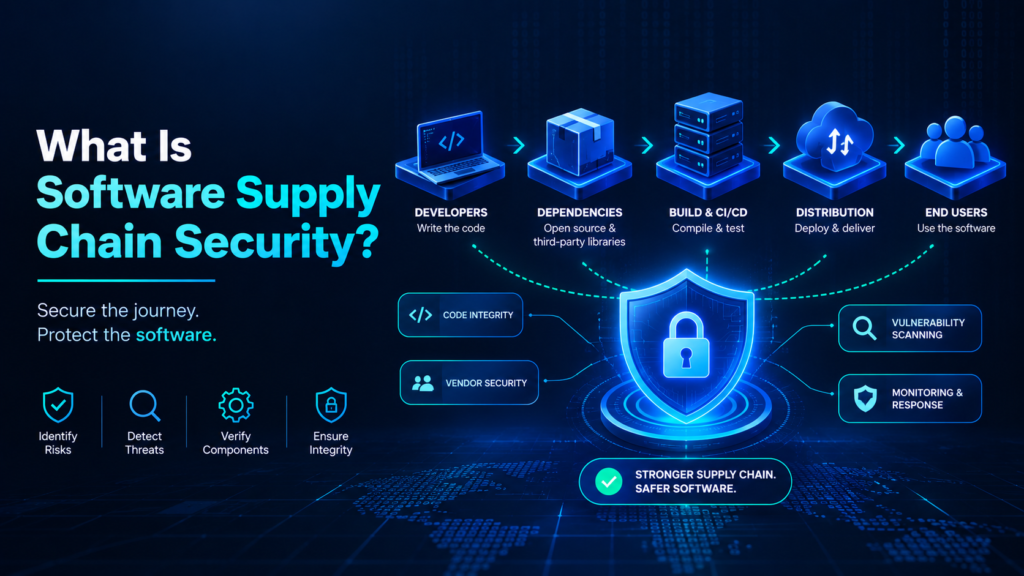
A software supply chain is the complete set of components, tools, services, and processes that contribute to the creation and delivery of software, spanning from the open-source libraries imported during development through the build systems that compile and package the code, the registries where artifacts are stored, and the deployment infrastructure that delivers the final product to users.
The term supply chain is borrowed from manufacturing logistics and applies accurately: just as a physical product depends on a chain of suppliers each contributing components that the manufacturer assembles, a software product depends on a chain of external contributors whose code, tools, and services the development team integrates into the final deliverable. A vulnerability or compromise anywhere in that chain can affect the security of the final product regardless of how carefully the first-party code was written.
The scope of the typical modern software supply chain is broader than most development teams appreciate when they think about it. It includes the open-source packages imported as application dependencies, which themselves have their own dependency trees extending several layers deep. It includes the package registries and content delivery networks those dependencies are pulled from during build. It includes the build tools, compilers, linters, and CI/CD pipeline components that process the code. It includes the container base images that application code runs inside. And it includes the third-party services that the deployed application integrates with at runtime.
Security applied only to the first-party code layer addresses a fraction of the total attack surface that shipped software actually presents.
What Makes the Software Supply Chain a Security Risk?
The software supply chain is a security risk because it combines the trust that developers extend to external components with the scale at which those components are used and the limited visibility most organizations have into the security of what they are importing.
When a developer adds an open-source library to a project, that library’s code runs with the same permissions as the application itself. Its security posture becomes part of the application’s security posture. If the library contains a vulnerability, the application inherits it. If the library is compromised after the developer imported a trusted version, and the compromised version propagates through an update, the application receives the malicious code through a channel it had previously trusted.
The scale compounds the risk. A single popular open-source library can be imported by millions of projects. A vulnerability in one widely-used component exposes an enormous surface area simultaneously. Attackers understand this arithmetic: compromising a single trusted component reaches far more targets than attacking individual applications directly.
The visibility problem is what makes this particularly difficult to defend. Most development teams can describe their first-party code in detail. Significantly fewer can enumerate their full dependency tree to the transitive level, name every component in their build pipeline, or identify what base images their containers run on and whether those images contain known vulnerabilities. The components that present the highest supply chain risk are frequently the ones the team is least actively monitoring.
What Are the Most Common Software Supply Chain Attack Types?
Supply chain attacks target the trusted components that security programs inspect least rigorously, exploiting the assumption that external components are safe because they were once vetted or because they come from recognized sources.
Dependency confusion exploits how package managers resolve dependencies when both internal private packages and public registries are configured. An attacker publishes a malicious package to a public registry using the same name as an organization’s internal private package. When the package manager queries available versions and finds a higher version number on the public registry, it may pull the malicious public version instead of the intended internal one. This attack requires no access to the target organization’s systems and no vulnerability in the target application.
Typosquatting places malicious packages in public registries under names that are one character different from widely-used legitimate packages. Developers who mistype a package name during installation pull the attacker’s version rather than the legitimate one. The malicious package may appear functional and even re-export the legitimate package’s API to avoid detection.
Compromised package maintainer accounts are one of the highest-impact supply chain attack vectors because they require no technical exploit of the package itself. An attacker who gains access to a legitimate package maintainer’s registry credentials can push a new version containing malicious code that will be distributed to every downstream consumer on their next dependency update cycle.
Build pipeline compromise targets the CI/CD infrastructure that builds, tests, and packages software. A compromised build system can inject malicious code into build artifacts after they have passed all pre-deployment security scans, because the injection happens at the build layer rather than in the source code that was scanned.
Vulnerable base container images affect any application deployed in containers that inherit unpatched vulnerabilities from the base image layer. Container base images from public registries may contain vulnerabilities that are not tracked in the consuming organization’s vulnerability management program because the organization’s team did not create the image and may not be monitoring it.
What Does Software Supply Chain Security Cover?
Software supply chain security covers four distinct control layers: dependency governance, build integrity, artifact verification, and runtime monitoring. Controls at each layer address different entry points for supply chain risk, and weaknesses at any one layer represent a gap that the others cannot fully compensate for.
Dependency governance is the first-party control layer that directly manages what external components enter the codebase. It covers maintaining an accurate Software Bill of Materials that inventories every direct and transitive dependency with version, license, and known vulnerability status. It includes software composition analysis tooling that scans the dependency tree against vulnerability databases and flags components with known CVEs. It includes dependency pinning practices that lock specific versions rather than accepting updates automatically, preventing a compromised new version from entering the build without explicit developer action.
Build integrity governs the security of the pipeline that transforms source code into deployable artifacts. It covers securing the CI/CD platform itself, including access controls on pipeline configuration, protecting build secrets, and ensuring pipeline execution environment integrity. It includes signing build artifacts so that downstream systems can verify that what they are deploying matches what the build system produced and has not been tampered with in the artifact registry.
Artifact verification ensures that the components consumed at each stage of the build and deployment process are what they claim to be. This covers verifying signatures on third-party packages before installation, checking checksums on downloaded build tools and base images, and maintaining internal artifact registries that serve as controlled mirrors rather than pulling directly from public registries at build time.
Runtime monitoring observes deployed software for behavioral indicators of supply chain compromise that were not detectable before deployment. A component that exfiltrates data, establishes unexpected network connections, or accesses system resources outside its expected profile may have been compromised through a post-deployment update or may represent a backdoor that static scanning missed.
How Does Code Review and SAST Address Supply Chain Risk?
Code review and static analysis address the first-party code layer of supply chain security and contribute to identifying security issues in dependencies that have visible source code, but they do not provide complete coverage of the broader supply chain risk that comes from the build pipeline, artifact integrity, and runtime monitoring layers.
For first-party code, Static Application Security Testing analyzes the codebase during development to identify how dependencies are imported, whether dependency pinning is applied, whether package manager configuration files are present in a state that could facilitate dependency confusion attacks, and whether the code handles third-party library failures in ways that could be exploited through a compromised dependency. SAST that includes software composition analysis components extends this to scanning the dependency manifest files for known-vulnerable component versions.
Expert secure code review adds the human judgment layer that automated static analysis cannot supply: evaluating whether the selection of specific dependencies introduces risk beyond documented CVEs, assessing whether the code’s use of third-party libraries exposes sensitive operations to the component in ways that would be exploitable through a compromised update, and reviewing whether the dependency governance practices in the repository configuration are implemented correctly.
The combination of SAST and expert code review addresses the code-layer supply chain controls. It does not address build pipeline integrity, artifact signing, or the runtime monitoring of deployed components for post-deployment compromise. Our cybersecurity code review service covers both SAST-assisted and manual expert review for organizations that need the depth of analysis the automated-only approach misses.
What Role Does Vulnerability Management Play in Supply Chain Security?
Vulnerability management is the operational backbone of dependency security, providing the continuous tracking and remediation workflow that keeps known-vulnerable dependencies from remaining in production indefinitely after their CVEs are published.
The dependency layer of software supply chain security generates a continuous stream of new vulnerability disclosures. Every new CVE published against a library your application uses is a new finding that requires triage and remediation. Without a structured vulnerability management process that connects software composition analysis output to remediation tracking and prioritization, those findings accumulate faster than development teams can address them and the mean time to remediation extends to months or years for components that are technically in scope.
An effective supply chain vulnerability management program covers the dependency inventory as a first-class input alongside network and application vulnerability findings, treats dependency CVEs with the same severity-based prioritization used for other vulnerability classes, and establishes clear SLAs for remediation based on severity and exploitability rather than treating all dependency findings as low-priority technical debt.
Our post on vulnerability management covers how a structured vulnerability management lifecycle applies across all finding sources, including dependencies, which provides the operational framework that makes software composition analysis output actionable. Our vulnerability assessment services extend this to systematic vulnerability identification across the broader environment, including the dependency layer.
How Does Digital Risk Protection Contribute to Supply Chain Security?
Digital risk protection contributes to software supply chain security by monitoring the external threat landscape for signals that a dependency, build tool, or third-party service your organization uses has been compromised, is being actively targeted, or has appeared in criminal discussion forums as a planned attack vector.
The intelligence value of digital risk protection for supply chain security is in early warning. A dependency compromise that is discovered through active exploitation, when affected applications are already running malicious code, is far more damaging than one discovered through external threat intelligence before the compromised version propagates to production. Dark web monitoring that surfaces discussion of a specific library being targeted, threat intelligence that identifies a compromised maintainer account before a malicious update is published, or signals that a package registry attack is being planned all provide the lead time that reactive detection cannot.
Supply chain attacks specifically benefit from external threat intelligence because the attacks often begin with reconnaissance and planning that is observable in external threat channels before they materialize as published malicious packages or compromised components. Organizations monitoring those channels as part of a digital risk protection program receive warning signals that purely technical scanning would not surface.
Our post on digital risk protection covers how external threat intelligence monitoring addresses the risk categories that originate outside the organization’s own environment, which maps directly to the external component risk that supply chain security addresses. Our attack surface management service provides the continuous external visibility layer that includes monitoring for exposure through supply chain components alongside the broader external attack surface.
How Do You Build a Software Supply Chain Security Program?
A software supply chain security program is built in four sequential stages that address the control layers in order of foundational priority: first establish the inventory, then apply controls at the dependency layer, then secure the build pipeline, and finally extend to runtime monitoring of deployed components.
Stage 1: Build the inventory. Generate a Software Bill of Materials for every application in the portfolio. An SBOM is the foundational artifact that makes every subsequent supply chain security activity possible: vulnerability scanning against the dependency list, license compliance review, and the impact assessment needed when a new CVE affects a component. Without an accurate SBOM, supply chain security measures apply to an incomplete picture of what is actually in production.
Stage 2: Apply dependency controls. Implement software composition analysis in the CI/CD pipeline that scans the dependency manifest against known vulnerability databases on every build. Configure dependency pinning to prevent automatic consumption of updated versions without explicit developer action. Establish an internal artifact registry that controls what package versions are available to build processes rather than pulling directly from public registries at build time. Define and enforce a dependency vulnerability SLA that specifies remediation timelines by severity.
Stage 3: Secure the build pipeline. Apply access controls to CI/CD configuration, restrict who can modify pipeline definitions, protect build secrets using secrets management rather than environment variables, and implement artifact signing so that every artifact produced by the build system carries a verifiable signature. Review the security posture of CI/CD platform integrations and third-party build tools with the same rigor applied to application dependencies.
Stage 4: Extend to runtime monitoring. Deploy runtime application monitoring that can detect behavioral anomalies in running components, including unexpected network connections, unusual file system access, and data exfiltration patterns. Integrate threat intelligence feeds that surface supply chain attack indicators, including newly compromised packages in registries your build system pulls from.
Frequently Asked Questions
What is a Software Bill of Materials (SBOM)?
A Software Bill of Materials is a structured inventory of every component, library, and dependency included in a software artifact, including the version of each component, its license, and its known vulnerability status. An SBOM is the foundational governance document for supply chain security: without it, organizations cannot systematically know what they are running, what vulnerabilities their dependencies carry, or what the blast radius of a new CVE is across their portfolio.
How is software supply chain security different from application security?
Application security focuses on the security of the first-party code an organization writes: the logic, authentication, authorization, and data handling in the application itself. Software supply chain security focuses on the security of every external component that the application incorporates, including open-source dependencies, build tools, base images, and third-party services. Both are necessary. An application with perfect first-party code but with a compromised dependency remains vulnerable through the supply chain.
Do open-source dependencies create more risk than commercial components?
Not inherently, but the risk profile is different. Open-source dependencies are visible and well-studied, with CVEs published and tracked in public databases. Commercial components may have less public vulnerability disclosure. The risk factor with open-source dependencies is the dependency tree depth: a popular library may have dozens of transitive dependencies, each of which is a separate risk surface. The depth of the open-source dependency tree is typically much greater than commercial equivalents, which expands the attack surface proportionally.
What compliance frameworks address software supply chain security?
Several frameworks and regulatory guidance documents now specifically address software supply chain security. In the United States, executive orders and CISA guidance have established SBOM requirements and secure software development practices for federal suppliers. NIST SP 800-204D addresses supply chain security for microservices and containerized applications. The EU Cyber Resilience Act, in force in 2026, imposes supply chain security requirements on software vendors selling in European markets. SOC 2 and ISO 27001 address supplier risk management controls that extend to the software supply chain.
Is software composition analysis the same as software supply chain security?
Software composition analysis is one component of software supply chain security, specifically the practice of scanning application dependencies for known vulnerabilities and license compliance issues. Supply chain security is a broader discipline that includes SCA alongside build pipeline integrity, artifact verification, third-party vendor risk management, threat intelligence for supply chain attacks, and runtime monitoring for component compromise. SCA addresses the known-vulnerability layer of supply chain risk. The full program addresses the broader range of attack vectors that the known-vulnerability layer does not cover.
The Code You Import Is Part of the Code You Ship
The most consequential shift in how application security risk is distributed in 2026 is the migration of attack surface from first-party application code to the supply chain layer. The development team’s code receives security testing, code review, and ongoing monitoring. The open-source libraries, build tools, and third-party integrations that make up the bulk of what actually ships receive a fraction of the same attention.
Attackers understand this asymmetry and exploit it consistently. A compromised maintainer account, a dependency confusion attack on an internal package name, a malicious update pushed through a build tool each of these reaches production through a trusted channel that the security program was treating as safe precisely because it was trusted.
Software supply chain security does not ask development teams to stop using open-source components or third-party services. It asks that the same security discipline applied to first-party code be extended to the full chain of components that contribute to what ships. That means building the inventory, scanning the dependencies, securing the pipeline, and monitoring what runs in production. Each layer addresses what the others cannot see, and together they close the gap that supply chain attacks consistently exploit.