What Is Static Application Security Testing (SAST)?

Written By
Sarwat Iftikhar
The cheapest vulnerability to fix is the one that never reaches production. A security issue caught while a developer is still writing the code costs a few minutes to correct. The same issue caught after deployment costs a patch cycle, a retest, and in some cases an incident response process, all to fix something that existed as a few lines of code long before it became a live risk.
Static Application Security Testing is the discipline built around catching vulnerabilities at that earliest, cheapest point. Rather than testing a running application from the outside, SAST examines the source code itself, without executing it, looking for patterns that indicate a security weakness before the code is ever deployed. It is the shift-left counterpart to runtime testing: analysis performed on what the application is built from, not on how it behaves once it is live.
This post explains what SAST actually does, how it works, what it reliably finds and what it consistently misses, and how it fits alongside the other testing approaches that make up a complete application security program.
Key Takeaways
- SAST analyzes source code, bytecode, or binaries without executing the application, finding vulnerabilities at the earliest and cheapest point in the development lifecycle.
- It reliably finds hardcoded secrets, insecure cryptographic usage, injection sinks reachable from untrusted input, and unsafe deserialization patterns directly in the code.
- SAST cannot evaluate runtime behavior, deployment configuration, or business logic, and it produces a meaningfully higher false positive rate than testing approaches that observe an actual running application.
- In Bugstrix application security engagements, SAST output that is routed to development teams without security triage consistently gets deprioritized or ignored, because unvalidated findings erode trust in the tool faster than almost anything else.
- The most effective application security programs use SAST for early, code-level breadth, and pair it with manual code review and runtime testing to cover what static analysis structurally cannot see.
What Is Static Application Security Testing?
Static Application Security Testing is an automated analysis technique that examines an application’s source code, bytecode, or compiled binary for security vulnerabilities without executing the application, identifying insecure coding patterns, dangerous function usage, and data flow paths that could lead to exploitation once the code is running in production.
The defining characteristic of SAST is that it operates on the code itself rather than on a running instance of the application. This gives it a perspective no runtime testing approach can offer: full visibility into every code path, including the ones that are difficult or impossible to reach through the application’s external interface, along with the ability to trace exactly how untrusted data moves through the application from input to potentially dangerous functions.
That same characteristic is also SAST’s fundamental limitation. Because it never actually runs the application, it has no way to confirm whether a flagged pattern is genuinely exploitable in the deployed environment, whether a mitigating control elsewhere in the system prevents exploitation, or whether the business logic surrounding the code makes the flagged pattern harmless in practice. This is the core trade-off that shapes everything else about how SAST should be used: complete code visibility in exchange for no runtime confirmation.
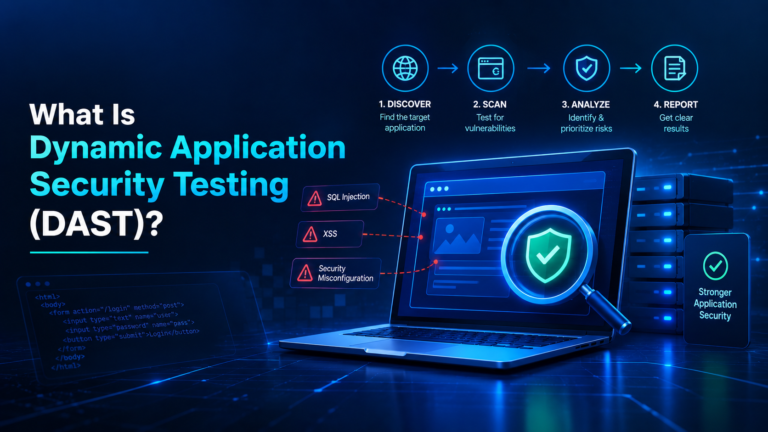
SAST is one of three primary automated application security testing approaches, alongside Dynamic Application Security Testing and Interactive Application Security Testing. Our post on Dynamic Application Security Testing (DAST) covers the runtime counterpart to SAST in detail, including how the two approaches find different, largely non-overlapping vulnerability classes.
How Does SAST Work?
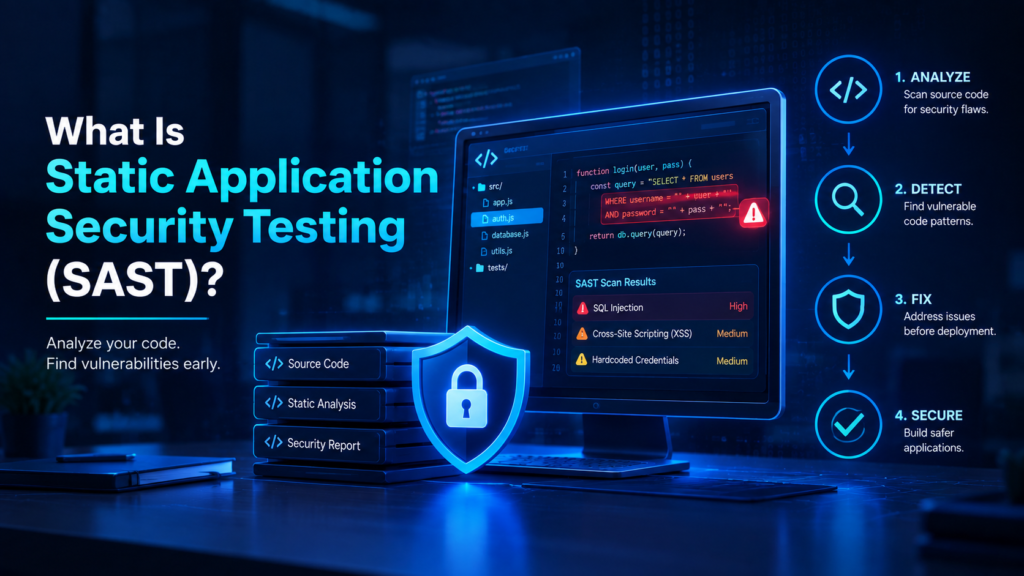
SAST works through three core phases: parsing the codebase into an analyzable model, scanning that model against a library of insecure patterns and data flow rules, and reporting findings mapped back to specific lines of source code.
Phase 1: Parsing and model construction. The SAST tool parses the source code into an abstract syntax tree or a similar intermediate representation that captures the code’s structure, control flow, and data flow independent of surface-level syntax. This model is what allows the tool to trace how data moves through the application rather than just matching text patterns against a checklist. The accuracy of this parsing step directly determines the accuracy of everything the tool finds afterward, which is why SAST tools vary significantly in quality depending on how well they support the specific language, framework, and coding patterns in use.
Phase 2: Pattern matching and taint analysis. Against the parsed model, the tool runs two complementary types of analysis. Pattern matching flags known dangerous function calls and coding constructs directly, such as the use of a deprecated cryptographic function or a raw SQL query built through string concatenation. Taint analysis goes further, tracing untrusted input from its entry point, a user-submitted form field or an API parameter, through the application’s logic to determine whether it reaches a sensitive function, a database query, a file system call, or a command execution without adequate sanitization along the way. Taint analysis is what allows SAST to find injection vulnerabilities that span multiple functions or files rather than only the ones visible in a single line of code.
Phase 3: Reporting and prioritization. Findings are reported with the specific file, line number, and code path that triggered them, along with a severity rating and, in mature tools, a confidence score reflecting how certain the tool is that the finding represents a genuine vulnerability rather than a false positive. This direct mapping to source code location is one of SAST’s most practical advantages: a developer can go straight to the flagged line rather than having to reverse-engineer a runtime finding back into the codebase, as is often necessary with DAST output.
What Vulnerabilities Does SAST Find?
SAST reliably finds vulnerabilities that are visible directly in the code’s structure, syntax, and data flow, independent of how the application is deployed or configured at runtime. What it cannot see is anything that only becomes apparent once the code is actually running in a specific environment, interacting with real data, and being used by real people.
Hardcoded secrets and credentials are among the most reliably caught findings, since SAST tools can scan for API keys, passwords, and tokens embedded directly in source files using pattern matching against known credential formats and entropy analysis for unlabeled secrets.
Insecure cryptographic usage including deprecated hashing algorithms, weak key lengths, and improperly implemented encryption routines, is directly visible in the function calls and parameters used, making them straightforward for SAST to flag without needing to observe the application running.
Injection vulnerabilities reachable through tainted data flow are where SAST’s taint analysis capability adds the most value beyond simple pattern matching. Tracing a user-controlled input from an API parameter through several intermediate functions to a raw SQL query is exactly the kind of multi-step, cross-file vulnerability that a human reviewer skimming individual files could plausibly miss and that static analysis tooling is specifically built to trace.
Unsafe deserialization of untrusted data, a vulnerability class responsible for some of the more severe remote code execution issues in modern application frameworks, is detectable through SAST by identifying deserialization calls operating on data that originates from an untrusted source.
Known-vulnerable dependencies are flagged by SAST tools that incorporate software composition analysis, cross-referencing the specific versions of third-party libraries in use against public vulnerability databases.
What SAST consistently cannot see is anything that only exists once the application is deployed and running. Business logic flaws that require understanding what the application is supposed to enforce, authorization gaps that depend on how roles and permissions are actually configured in production, misconfigurations introduced during deployment rather than in the code itself, and vulnerabilities in third-party services the application calls at runtime all fall outside what static code analysis can evaluate, because none of them exist as a pattern in the source code.
What Is the Difference Between SAST and DAST?
SAST and DAST are the two most commonly deployed automated application security testing approaches, and they are frequently discussed together because they are genuinely complementary rather than competing tools that happen to overlap. The distinction between them comes down to what each one actually examines.
SAST examines source code without executing the application. It can be run before deployment, giving it the earliest possible detection point in the development lifecycle, and it has full visibility into every code path regardless of whether that path is easily reachable through the application’s external interface. Its structural weakness is a higher false positive rate, because the tool is reasoning about what the code could theoretically do without any confirmation of how the application actually behaves once deployed and configured.
DAST examines the running application from the outside, sending crafted inputs and analyzing responses without any visibility into the underlying code. Its findings tend to carry a lower false positive rate, because a DAST finding reflects the application’s confirmed runtime behavior rather than a theoretical code pattern, but its coverage is limited to whatever the tool can actually discover and reach through the application’s external interface. Our complete post on Dynamic Application Security Testing (DAST) covers how runtime testing works and what it finds that SAST structurally cannot.
The practical relationship between the two is additive rather than substitutive. SAST catches issues early, before deployment, across code paths DAST may never reach through crawling. DAST confirms which vulnerabilities are genuinely exploitable in the deployed environment and finds runtime issues that never existed as a distinct pattern in the source. A mature application security program runs both, using each to compensate for what the other cannot see.
Where Does SAST Fit in the Software Development Lifecycle?
SAST fits earliest in the software development lifecycle among the major automated testing approaches, which is the entire basis of its value proposition: shifting vulnerability detection as far left as possible, toward the point where a fix costs a few minutes of a developer’s time rather than a post-deployment patch cycle.
The most effective SAST integration runs directly in the developer’s workflow, either as an IDE plugin that flags issues as code is written or as a pre-commit and pull-request check that catches issues before code merges into the main branch. This positioning matters because the cost of fixing a vulnerability rises sharply the further it travels through the pipeline: a flagged issue in an open pull request is nearly free to fix, while the same issue discovered in production requires a full remediation cycle, a retest, and in regulated environments, potentially a compliance disclosure.
Beyond the individual developer workflow, SAST commonly runs as a required check in the CI/CD pipeline, scanning every build and, in a well-tuned configuration, blocking merges on findings above a defined severity threshold while logging lower-severity findings for tracking without stopping the pipeline. Getting that threshold right requires the same calibration DAST needs in a pipeline context: too aggressive a blocking policy produces alert fatigue and developer frustration as false positives repeatedly stop builds; too permissive a policy lets genuine findings slip through without meaningful friction.
Our continuous penetration testing services integrate this kind of automated, pipeline-embedded testing with ongoing manual oversight, providing the continuous coverage model that a SAST-in-CI/CD setup is built to support alongside periodic manual validation of what the automated layer alone cannot confirm.
What Are the Limitations of SAST?
SAST has structural limitations that shape how it should be used and what needs to supplement it. Understanding these limitations is what prevents a security program from treating SAST coverage as equivalent to complete application security assurance.
High false positive rates. Because SAST reasons about code without confirming runtime behavior, it frequently flags patterns that are technically present but not actually exploitable, whether due to a mitigating control elsewhere in the application, a framework-level protection the tool does not account for, or simply a misjudged severity based on incomplete context. Unvalidated SAST output routed directly to developers erodes trust in the tool quickly, which is why security review of findings before they reach a development team’s backlog matters as much as the scan itself.
No runtime or deployment visibility. SAST cannot evaluate how the application is actually configured once deployed, what network controls sit in front of it, or how a specific production environment might mitigate or amplify a flagged code pattern. A vulnerability that looks identical in the code can be catastrophic in one deployment context and effectively unreachable in another, a distinction SAST has no way to make.
Business logic and authorization blindness. SAST cannot evaluate whether the application’s access control logic correctly enforces the specific business rules it is meant to enforce, because doing so requires understanding what the application is supposed to do, not just what the code technically executes. This is the same fundamental gap that runtime testing tools face, and it is why manual review remains essential regardless of how sophisticated static analysis tooling becomes. Our web application penetration testing services provide the manual, business-context-aware testing that neither SAST nor DAST can substitute for.
Language and framework coverage gaps. SAST tool quality varies significantly by language and framework, and a tool with strong support for one ecosystem may produce noisy, low-quality results, or simply fail to parse correctly, against a codebase built on a less mainstream stack. Organizations using multiple languages or frameworks across their codebase should expect uneven SAST coverage rather than assuming a single tool handles everything equally well.
How Does SAST Relate to Manual Code Review?
SAST and manual code review both examine source code directly, but they differ in exactly the way SAST and DAST differ in the runtime testing world: automated breadth against known patterns versus human judgment applied to what the code is actually trying to accomplish.
A SAST tool evaluates code against a defined rule set: known-dangerous functions, known taint paths, known insecure patterns. It cannot evaluate whether an access control check is logically correct for the specific business rule it is meant to enforce, whether an architectural decision creates a security weakness that no individual line of code reveals on its own, or whether a subtle logic error in how two otherwise-secure functions interact creates an exploitable condition. These require a reviewer who understands what the application is supposed to do, not just what the code technically does.
A human reviewer examining the same codebase reads it the way a developer building an exploit would: following the logic of a specific feature end to end, questioning whether an assumption embedded in the code actually holds in every case, and recognizing when a pattern that looks safe in isolation becomes dangerous in combination with something several files away. This is precisely the kind of judgment that a rule-based tool, however sophisticated its taint analysis, is not built to exercise.
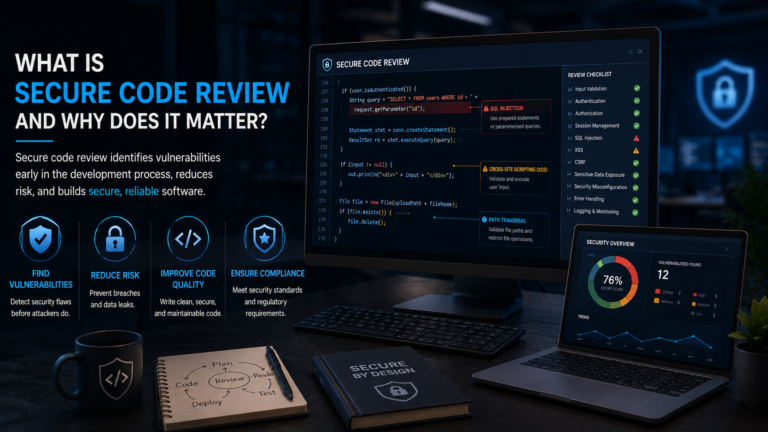
Our complete guide to secure code review covers this manual discipline in depth, including how it is structured and what it finds that automated static analysis consistently misses. Our cybersecurity code review service provides that expert manual layer for organizations whose SAST output needs the validation and depth that only a human reviewer can add.
Is SAST a Form of White-Box Testing?
SAST is, by definition, a white-box testing technique: it operates with full access to the source code, which is the defining characteristic that separates white-box approaches from the black-box position of external testing that has no visibility into how the application is built.
This distinction matters for understanding where SAST sits relative to other testing methodologies that vary by how much information the tester has access to. A black-box approach, testing the application with no source code visibility, mirrors what an external attacker actually experiences and is the position DAST and most external penetration testing operate from. A white-box approach, testing with complete source code access, is what SAST and internal code review operate from, trading the attacker’s-eye realism of black-box testing for the complete visibility that only comes from seeing exactly how the application is built. Grey-box testing sits between the two, combining partial information with external testing techniques.
Our post on black-box, white-box, and grey-box penetration testing covers how this information-access spectrum shapes methodology across manual testing approaches, which provides useful context for understanding why SAST, as an inherently white-box technique, finds a structurally different set of vulnerabilities than black-box approaches like DAST ever could, regardless of how mature either tool becomes.
How Should SAST Findings Be Triaged and Remediated?
A SAST scan against a codebase that has never been analyzed before typically produces a large volume of findings, and how an organization triages that initial output determines whether the tool becomes a genuine part of the development process or gets quietly ignored after the first overwhelming report.
The first triage pass should separate findings by confidence and severity rather than routing the entire raw output to developers. High-confidence, high-severity findings, hardcoded credentials, clear injection sinks, and unsafe deserialization warrant immediate attention regardless of volume. Lower-confidence findings benefit from a security reviewer’s validation pass before they reach a development backlog, both to filter out false positives and to add the business context that helps a developer understand why a flagged pattern actually matters in this specific application.
Once validated, SAST findings should enter the same remediation tracking process as every other vulnerability the organization identifies, rather than living in a separate, lower-visibility queue specific to the scanning tool. Treating code-level findings with the same rigor as externally discovered ones is what prevents a SAST program from quietly accumulating a backlog of known, unaddressed issues. Our post on Vulnerability Management covers the broader lifecycle that SAST findings should feed into: consistent tracking, prioritization, and remediation verification regardless of which tool or testing method originally surfaced the issue.
Frequently Asked Questions
Does SAST require access to the full source code?
Yes, in the vast majority of implementations. SAST needs access to the codebase to parse it into an analyzable model and trace data flow through it. Some tools can operate against compiled bytecode or binaries when source is unavailable, but this typically reduces analysis accuracy compared to working directly against source, since bytecode analysis loses some of the structural and naming context that helps a tool reason about intent.
How long does a SAST scan take to run?
Scan duration depends heavily on codebase size and the depth of the taint analysis being performed, ranging from seconds for a small, incremental scan of recently changed code to hours for a full, deep scan of a large legacy codebase. Most CI/CD integrations run an incremental scan against changed code on every build, reserving full deep scans for scheduled intervals, which keeps pipeline feedback fast without sacrificing periodic comprehensive coverage.
Can SAST replace manual code review?
No. SAST provides fast, repeatable coverage of known insecure patterns across an entire codebase, which manual review at that scale is not practical to match. Manual review provides the architectural and business-logic judgment that a rule-based tool cannot exercise. Organizations that rely on SAST alone consistently miss the authorization and logic-level vulnerabilities that account for a disproportionate share of serious real-world findings in application security assessments.
Why does SAST have a reputation for high false positive rates?
Because SAST reasons about what code could theoretically do without confirming how the application actually behaves once deployed. A flagged pattern might be mitigated by a framework-level protection the tool does not recognize, guarded by a check the tool’s analysis did not trace correctly, or simply unreachable in practice due to how the application is actually used. Tuning a SAST tool to the specific codebase and framework in use, and adding a human validation step before findings reach developers, meaningfully reduces this problem but does not eliminate it entirely.
Is open-source SAST tooling good enough, or is a commercial tool necessary?
It depends on the codebase and the organization’s risk tolerance. Open-source SAST tools can provide solid coverage for common languages and well-known vulnerability patterns, and are a reasonable starting point for organizations building their first static analysis practice. Commercial tools typically offer broader language and framework support, more sophisticated taint analysis, and lower false positive rates through more mature rule tuning, which becomes more valuable as codebase size and complexity grow.
Catching the Vulnerability Before It Ships
The value of SAST is not that it finds vulnerabilities other tools cannot. It is that it finds them earlier, before the code is deployed, before an attacker could ever reach it, and before a fix costs anything more than a few minutes of a developer’s attention. That timing advantage is real and worth building into any serious development process.
What SAST is not is a complete application security program on its own. It cannot see how the application behaves once it is actually running, it cannot evaluate whether the business logic correctly enforces what it is supposed to enforce, and it generates enough false positives that unfiltered output erodes developer trust faster than almost any other security tool. Those gaps are not flaws to be patched in the next tool release. They are the structural boundary of what static analysis, by its very nature, can ever see.
The programs that get real value from SAST are the ones that use it for exactly what it is good at: early, code-level, breadth coverage of known insecure patterns, and pair it deliberately with manual code review, runtime testing, and disciplined triage to cover everything static analysis alone cannot reach.