What Is Secure Code Review and Why Does It Matter?

Written By
Sarwat Iftikhar
Most security testing looks at an application from the outside, the way an attacker would. A penetration tester finds what they can reach, exploit, and chain together across the attack surface they can see. That approach finds a great deal. It does not find everything.
The vulnerabilities most difficult to find from the outside are often the most dangerous ones: logic flaws buried deep in business-critical workflows, insecure cryptographic implementations that look correct from the outside but fail under specific conditions, authentication bypass paths that only exist in edge cases no external test would naturally trigger, and authorization gaps in functions that are not directly exposed through the user interface. These live in the code itself, and the only reliable way to find them is to read the code.
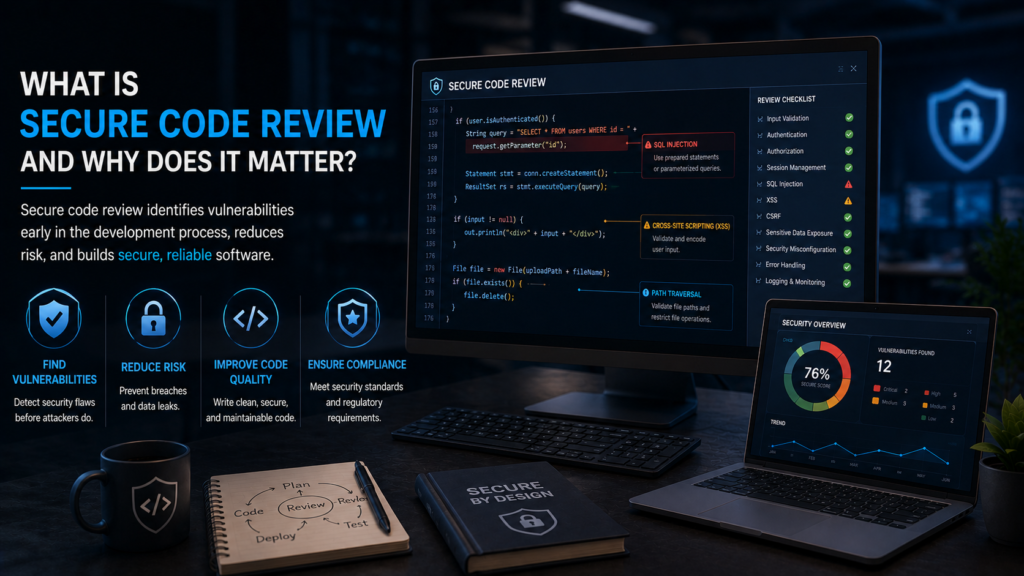
Secure code review is a structured, security-focused examination of application source code conducted by experienced security engineers, using a combination of manual analysis and specialized tooling, with the explicit goal of identifying vulnerabilities before they reach production. It is not a code quality review. It is not a performance audit. It is a security-specific analysis of how the code handles data, enforces trust boundaries, validates inputs, manages credentials, and implements the business rules the application is supposed to enforce.
This post explains what secure code review covers, why it matters, how it complements penetration testing, and when your business actually needs it.
Key Takeaways
- Secure code review identifies vulnerabilities in source code that external penetration testing cannot reliably find, including cryptographic implementation errors, hardcoded secrets, and complex business logic flaws.
- Finding and fixing a vulnerability during code review costs a fraction of finding it in production. Industry research consistently shows that the cost of fixing a security defect increases by a factor of 10 to 30 as it progresses from development to production to post-breach remediation.
- In Bugstrix code review engagements, hardcoded credentials, insecure deserialization, and broken authorization logic in non-UI-exposed functions are the finding categories that appear most consistently and that external testing misses most often.
- Secure code review is not a substitute for penetration testing. The two approaches address different attack surfaces and find different vulnerability classes. Both belong in a complete application security program.
- SaaS companies launching a new product or major feature update are the highest-value candidates for code review, because the window between launch and first exploitation is shrinking as automated tooling makes attacker reconnaissance faster.
What Is Secure Code Review?
Secure code review is a structured, security-focused analysis of application source code conducted by qualified security engineers to identify vulnerabilities, insecure patterns, and design weaknesses before the code reaches production. It combines manual line-by-line review of security-critical components with automated static analysis tooling, with the human review providing context and judgment that automated tools alone cannot supply.
The scope of a secure code review is defined by the codebase itself rather than by an external attack surface. The reviewer examines how the code handles user-supplied input, how it enforces authorization decisions, how it manages credentials and secrets, how it implements cryptographic operations, how it handles errors and exceptions, and whether the business logic the code is supposed to enforce is actually enforced consistently across all code paths.
This is fundamentally different from what a penetration tester can do with black-box or grey-box access to a running application. A penetration tester can identify that an API endpoint returns data it should not, but may not be able to determine why without source access. A code reviewer can trace exactly which function is responsible, identify every other location in the codebase where the same pattern appears, and flag all of them in a single review engagement rather than hoping the penetration tester exercised every code path during testing.
The practical result is a more complete picture of the application’s security posture than either approach produces alone. At Bugstrix, we recommend source-assisted penetration testing for organizations that have the code available, combining access to the running application with source review to maximize coverage across both the external attack surface and the internal implementation.
Why Does Secure Code Review Matter for Application Security?
Secure code review matters because vulnerabilities found in source code before deployment are dramatically cheaper and faster to fix than vulnerabilities found by a penetration tester after deployment. Both are vastly less expensive than vulnerabilities discovered by an attacker exploiting a live production system. The security value of finding issues earlier is not incremental. It is exponential.
Industry research across software development consistently shows that the cost of remediating a security defect increases by a factor of ten to thirty as it moves through the development lifecycle. A vulnerability caught during code review costs developer time to fix and re-review. The same vulnerability caught during a penetration test requires the same fix plus incident management, report documentation, and a retest engagement to confirm the fix works. Caught in production after exploitation, the same vulnerability adds breach response, customer notification, regulatory reporting, potential legal liability, and reputational damage to all of that.
The argument for secure code review is not that it replaces penetration testing. It is that it catches a different class of vulnerabilities earlier, which reduces both the total risk exposure and the total cost of maintaining a secure application over time. These are not competing investments. They are complementary ones that together produce better coverage than either achieves alone.
For SaaS companies and software businesses where the application is the product, this matters particularly acutely. The codebase is the business. A critical vulnerability in the core product does not just create a breach risk. It creates a customer trust risk, a compliance risk, and in some cases an existential business risk if the vulnerability is severe enough and the customer base is enterprise-scale.
What Does Secure Code Review Find That Penetration Testing Misses?
Secure code review finds vulnerabilities that penetration testing cannot reliably identify because they require visibility into the source code to detect. The most significant categories are hardcoded credentials and secrets, cryptographic implementation errors, authorization logic gaps in non-exposed functions, insecure deserialization, and race conditions.
Hardcoded credentials and secrets are the finding category that surprises organizations most consistently. API keys, database passwords, encryption keys, and service account credentials embedded directly in source code are invisible from the outside of a running application but immediately visible to anyone with source access, including any attacker who finds a path to the repository or any disgruntled insider. In our code review engagements at Bugstrix, hardcoded secrets appear in a majority of codebases we review, most commonly in configuration files and test code that was never cleaned before being committed.
Cryptographic implementation errors are among the highest-severity findings in secure code review because they can undermine security controls that appear to be working correctly from the outside. A developer who implements their own encryption routine, uses a deprecated algorithm, generates initialization vectors incorrectly, or mismanages key storage has created a vulnerability that a penetration tester interacting with an encrypted output cannot detect. The output looks encrypted. Only a reviewer who reads the implementation knows it is broken.
Authorization gaps in non-exposed functions are the code-level equivalent of the authorization failures that penetration testers find in exposed endpoints, but in functions that are called internally rather than directly from user interfaces or APIs. A payment processing function that enforces authorization correctly when called from the main checkout flow may be callable without authorization checks from an internal administrative function that a penetration tester never exercises during testing. Code review maps every call path to security-critical functions, not just the ones that are directly exposed.
Race conditions and time-of-check to time-of-use (TOCTOU) flaws require reading the code to find reliably. These vulnerabilities exist when an application performs a security check and then performs an action based on the result, with a window between the check and the action that an attacker can exploit to change the conditions the check evaluated. They are timing-dependent and often require specific concurrent access patterns to trigger, making them difficult to find through dynamic testing.
How Does Secure Code Review Work in Practice?
Secure code review works through a structured combination of automated static analysis and manual expert review, with the manual phase providing context and judgment that automated tools alone cannot supply. The two phases are complementary: automation covers the codebase for broad pattern-based detection, and manual review focuses on the security-critical logic that requires human understanding to evaluate correctly.
Phase 1: Scoping and threat modelling. Before review begins, the scope is defined based on the security sensitivity of different codebase components. Authentication systems, authorization logic, cryptographic operations, payment processing, data access layers, and third-party integration points are the highest-priority targets. A threat model of how the application is supposed to work, and what the most valuable attack targets would be, guides which components receive the most intensive manual attention.
Phase 2: Automated static analysis. Static analysis tooling scans the codebase for known vulnerability patterns, insecure function calls, dependency vulnerabilities, and configuration issues at speed across the entire codebase. The output of this phase is a broad set of potential findings that require human validation to distinguish genuine vulnerabilities from false positives and to understand business context the tool cannot evaluate.
Phase 3: Manual expert review. Security engineers review the highest-priority components identified during scoping, trace data flows from user input through business logic to storage and transmission, evaluate authorization logic across all code paths, and assess cryptographic implementations for correctness. This is the phase where the findings that automated tooling misses are found: complex logic flaws, subtle authorization gaps, and implementation-specific weaknesses that only make sense in context.
Phase 4: Findings documentation and remediation guidance. Every confirmed finding is documented with the vulnerable code location, an explanation of the vulnerability and its exploitability, a severity rating, and specific remediation guidance tailored to the codebase and technology stack rather than generic advice. Good remediation guidance is what makes the difference between a code review that results in better security and one that produces a report the development team struggles to act on.
Our cybersecurity code review service covers all four phases across web application backends, APIs, mobile application code, and cloud infrastructure as code, with remediation guidance written for the specific framework and language the codebase uses.
When Does a Business Actually Need Secure Code Review?
A business needs secure code review when the risk of vulnerabilities in its source code is high enough that external testing alone is insufficient evidence that the code is secure. That describes most software companies, most SaaS platforms, and any organization that handles sensitive data through custom-developed application code. The timing question is less about whether and more about when in the development cycle.
The highest-value moments for secure code review:
Before a product launch. A vulnerability in production code begins accumulating risk the moment the product goes live. A code review before launch finds issues while they are still in development, when they cost a fraction of the effort to fix compared to post-launch remediation. For SaaS companies launching a new product, our security checklist on what to test before launching your product covers what a pre-launch security assessment should include, with code review as a central component.
After a significant feature release touching security-critical components. Any new feature that touches authentication, authorization, payment processing, data access, or cryptographic operations introduces risk that a previous code review did not cover. Security-critical changes warrant review before they reach production rather than after.
As part of an ongoing secure development lifecycle. Organizations with active development teams ship code continuously. A one-time code review quickly becomes stale as the codebase evolves. Periodic reviews, either at release milestones or on a cadence aligned with the development cycle, maintain security assurance across a living codebase rather than producing a point-in-time snapshot that ages out of relevance.
Before a compliance audit. SOC 2 auditors, enterprise security questionnaires, and PCI DSS assessors increasingly ask about secure development practices. Code review evidence demonstrates that security was considered at the implementation level rather than only at the perimeter.
After acquiring or integrating a third-party codebase. An acquired company’s code carries the security debt of its entire development history. Reviewing it before integrating it into production systems identifies the inherited vulnerabilities before they become your organization’s problem.
How Does Secure Code Review Relate to Vulnerability Management?
Secure code review and vulnerability management address different phases of the security lifecycle and work best when they are integrated rather than treated as separate programs. Code review is a proactive activity that prevents vulnerabilities from reaching production. Vulnerability management is an ongoing operational activity that identifies and tracks vulnerabilities across the entire technology environment, including those that were not caught during development.
The relationship is circular. Code review reduces the number of vulnerabilities that enter production. Vulnerability management, including vulnerability assessments and penetration testing, identifies the vulnerabilities that make it through. Remediation of those findings closes the gaps. And updated development practices informed by the types of findings that keep appearing reduce the rate at which new vulnerabilities enter the codebase in future development cycles.
Organizations that treat these as separate concerns, running code reviews in isolation from their broader vulnerability management program, miss the feedback loop that makes both more effective over time. The findings from a penetration test should inform what the next code review pays particular attention to. The patterns identified in a code review should inform what the vulnerability assessment focuses on in the next cycle.
Our vulnerability assessment services complement code review in exactly this way, and our post on what vulnerability management is explains how to build an integrated program that connects proactive development-phase security with ongoing production monitoring.
How Much Does Secure Code Review Cost?
Secure code review costs vary based on the size of the codebase being reviewed, the number of languages and frameworks involved, and the depth of manual review required for security-critical components. A focused review of a specific module or feature set, such as an authentication system or payment processing flow, typically runs $5,000 to $15,000. A comprehensive review of a full application codebase runs $15,000 to $50,000+ depending on the codebase size and complexity.
The cost is best understood in comparison to the alternative. A vulnerability found during code review is typically fixed in hours or days by the development team that built the code. The same vulnerability found during a penetration test requires a retest engagement after remediation. Found in production after exploitation, it requires breach response, regulatory notification, and remediation under the time pressure of an active incident. Each stage multiplies the cost of the original finding by a significant factor.
For small and mid-market businesses evaluating where secure code review fits in their overall security budget, our post on how much a small business should spend on cybersecurity provides a practical framework for allocating security investment across testing, tooling, and operational controls based on organizational size and risk profile.
How Do You Choose the Right Secure Code Review Provider?
Choosing the right secure code review provider requires evaluating security engineering expertise over general development experience. Code review for security purposes requires a different skill set than code review for quality or correctness. A provider who reviews code for performance or maintainability is not necessarily equipped to identify authorization gaps, cryptographic weaknesses, or the subtle logic flaws that lead to real exploits.
The qualities that distinguish a genuine secure code review provider:
Security-specific expertise in the relevant technology stack. The reviewer needs to understand not just what the code is doing but what it should be doing from a security perspective, and specifically how common vulnerability classes manifest in the specific language and framework the codebase uses. SQL injection in a raw query context looks different from injection risk in an ORM context, and both require different review approaches.
A methodology that covers both automated and manual phases. Providers who rely exclusively on automated static analysis tools produce findings that miss the most dangerous vulnerability classes. Providers who only do manual review miss the broad coverage that automated tooling provides efficiently. The right answer combines both phases with human judgment applied where it matters most.
Remediation guidance specific to your codebase. Generic guidance such as “validate all user inputs” is not actionable for a development team working in a specific framework. Good secure code review produces remediation guidance that references the specific libraries, patterns, and practices available in the technology stack being reviewed, so developers can act on findings without requiring additional research.
For a comprehensive guide to evaluating security providers across all testing disciplines, our post on how to choose the right website security company covers the evaluation criteria that matter most before committing to a security engagement.
How Does Secure Code Review Complement Penetration Testing?
Secure code review and penetration testing find different vulnerability classes and address different threat scenarios, making them complementary rather than substitutable. Penetration testing reveals what an attacker can find and exploit from the outside. Secure code review reveals what an attacker with source access, an insider, a repository breach, or an acquired codebase would find inside the implementation.
Together, the two approaches produce coverage that neither achieves alone. External penetration testing confirms which vulnerabilities are reachable and exploitable from the attacker’s perspective and produces the remediation evidence that compliance frameworks, auditors, and enterprise buyers require. Secure code review finds the implementation-level vulnerabilities that external testing cannot reach and produces developer-facing remediation guidance that can be acted on before any external exposure exists.
The most complete application security programs use both: code review as a proactive development-phase activity, and penetration testing as a validation layer that confirms the deployed application behaves securely under adversarial conditions. Our web application penetration testing services are designed to work alongside code review in exactly this way, with findings from both disciplines cross-referenced to produce the most complete picture of application security posture.
Frequently Asked Questions
Is secure code review the same as a code audit?
The terms are sometimes used interchangeably, but they describe different objectives. A code audit typically evaluates code quality, correctness, compliance with coding standards, and maintainability. A secure code review specifically focuses on security vulnerabilities: how the code handles trust, enforces authorization, manages credentials, validates input, and implements security-critical operations. The skills, methodology, and output of a security-focused review are different from a general quality audit.
Does secure code review require access to the entire codebase?
Not always. Focused reviews that target specific high-risk components, such as an authentication system, payment processing flow, or cryptographic implementation, can be scoped to a subset of the codebase and still produce high-value findings. Full codebase reviews produce broader coverage but take longer and cost more. The right scope depends on what the highest-risk components are and what budget and timeline constraints exist. Focused reviews of specific components before a launch or release are often the most efficient use of code review investment for teams with limited budget.
How long does a secure code review take?
A focused review of a specific security-critical component typically takes three to seven days. A comprehensive review of a full application codebase takes two to four weeks depending on codebase size, the number of languages and frameworks involved, and the depth of manual review applied to high-risk components. Remediation guidance and report production add several days on top of the review itself.
Can automated tools replace manual secure code review?
Automated static analysis tools cover the codebase efficiently for known vulnerability patterns and are a valuable first phase of any code review engagement. They cannot evaluate business logic, understand the security intent behind authorization decisions, or identify subtle implementation flaws that are only dangerous in a specific application context. Manual expert review is what finds the vulnerability classes that automated tools consistently miss, which are often the most severe ones.
Should a startup get a secure code review before launch?
Yes, if the product handles sensitive data, user accounts, payments, or any data type with compliance implications. The cost of fixing a vulnerability before launch is a fraction of the cost of fixing it after, and the window between launch and first exploitation attempt is shorter in 2026 than at any previous point. A pre-launch code review combined with a penetration test of the staging environment is the most effective investment a software company can make in the security of a new product before it goes live.
Security Built In Is Cheaper Than Security Bolted On
The foundational argument for secure code review is not complicated. Vulnerabilities in source code that are not found before deployment become vulnerabilities in production, where they accumulate risk until they are either found by a security team or exploited by an attacker. Finding them in the code is faster and cheaper than finding them anywhere else.
Penetration testing is essential and cannot be replaced. It validates that the deployed application behaves securely under adversarial conditions and produces the evidence that compliance frameworks and enterprise buyers require. But it operates on the surface of the application. Secure code review operates on the implementation itself, which is where the most dangerous vulnerabilities live and where the most efficient remediation is possible.
The businesses that handle application security most effectively in 2026 are the ones that test from both directions: from the outside in through penetration testing, and from the inside out through code review. Neither approach alone produces a complete picture. Together, they do.
Contact us to discuss a secure code review for your application