What Is Network Penetration Testing and Why Does It Matter?

Written By
Sarwat Iftikhar

Every business that runs a network, which in 2026 means every business, has infrastructure that an attacker could use as a pathway to their most sensitive systems. Firewalls, routers, switches, servers, Active Directory environments, VPNs, wireless networks, and cloud infrastructure all represent components that an attacker could exploit if they contain vulnerabilities or misconfigurations. Network penetration testing is how you find out whether they do, before someone else does.
The share of breaches involving infrastructure and network-layer vulnerabilities remains consistently high year after year, and the consequences of a successful network compromise are typically more severe than an application-layer breach. Once an attacker has a foothold inside a network, lateral movement, privilege escalation, and access to every system that network connects to become the primary risk, not just the single initially compromised host.
This post explains what network penetration testing is, what it covers, why it matters for businesses of every size, and what you need to know to do it effectively in 2026.
Key Takeaways
- Network penetration testing simulates real attacker behavior against your infrastructure to identify and validate vulnerabilities before they are exploited.
- External network testing evaluates what an attacker can reach from the internet. Internal network testing simulates what an attacker who already has a foothold can do from inside.
- In Bugstrix network assessments, misconfigured services and over-permissive firewall rules are the most consistently present critical findings, and both are almost entirely invisible to automated scanning tools alone.
- Network penetration testing and vulnerability assessment are not the same activity and cannot substitute for each other. Both have a distinct role in a complete infrastructure security program.
- The most dangerous network vulnerabilities are not the newest or most exotic ones. They are well-understood weaknesses in default configurations, legacy services, and trust relationships between systems that have never been tested under adversarial conditions.
What Is Network Penetration Testing?
Network penetration testing is a structured security assessment in which a qualified tester actively simulates real-world attacks against an organization’s network infrastructure to identify vulnerabilities that could be exploited, validate their real-world exploitability, and demonstrate the impact an attacker would achieve by chaining them together. Unlike a vulnerability scan, which identifies potential issues, a network penetration test confirms which ones are genuinely dangerous in your specific environment.
The scope of a network penetration test depends on what type of assessment is being conducted. External network testing targets the internet-facing attack surface: everything an attacker can reach and interact with from outside your network perimeter. Internal network testing simulates an attacker who has already established a foothold inside, attempting lateral movement, privilege escalation, and access to high-value targets. Both serve different purposes and address different threat scenarios.
The defining characteristic of a penetration test, as distinct from automated scanning, is the human judgment applied at every stage. A tester interprets what they find, decides what to test next based on what previous findings revealed, chains vulnerabilities together into realistic attack paths, and assesses the actual impact in the context of your specific environment. That reasoning and adaptability is what produces findings that reflect how a real attacker would operate, rather than a list of potential issues generated by a tool running a fixed check sequence.
For a complete overview of penetration testing as a practice across all test types, our guide on what penetration testing is covers the full methodology, from scoping through to deliverables.
Why Does Network Penetration Testing Matter for Businesses?
Network penetration testing matters because networks are the connective tissue between every system, application, and data store a business runs, and a compromised network gives an attacker access to all of them. A web application breach is typically scoped to the data that application handles. A network breach is scoped to everything the network connects to, which in most organizations means everything.
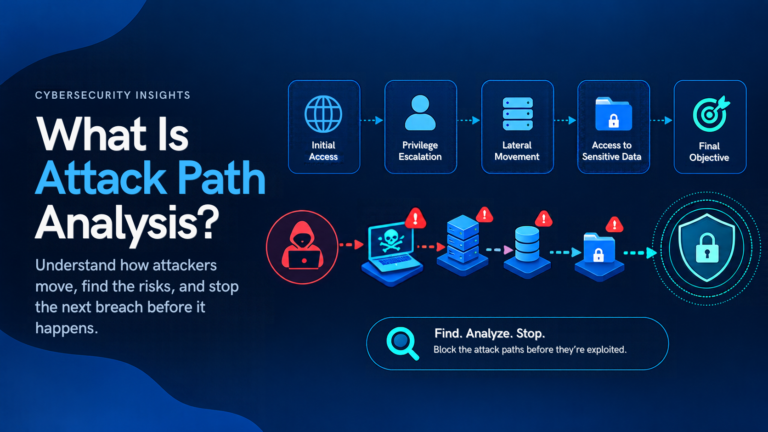
The risk compounds specifically around lateral movement. An attacker who gains initial access through a single vulnerable service on the network perimeter does not stop there. They enumerate what other systems are reachable, identify credentials they can harvest or reuse, escalate privileges where possible, and move toward the highest-value targets in the environment, such as domain controllers, database servers, backup infrastructure, and cloud management interfaces.
In our network assessments at Bugstrix, the most damaging scenarios are almost never about a single spectacular vulnerability. They are about chains of modest weaknesses: an exposed management interface here, a default credential there, an overly permissive firewall rule connecting a low-trust segment to a high-trust one, that combine into an attack path no single automated scan would have flagged as critical because no individual finding looks dangerous in isolation.
Businesses also face a growing regulatory and commercial expectation for network security evidence in 2026. PCI DSS v4.0 mandates annual internal and external network penetration testing of the Cardholder Data Environment. SOC 2 auditors treat it as standard evidence for CC4.1. Cyber insurers increasingly require it as part of underwriting. And enterprise buyers are asking for it in vendor security questionnaires with growing frequency. The expectation has moved from large enterprises to mid-market and even early-stage companies as the questionnaire requirement cascades down the supply chain.
What Are the Different Types of Network Penetration Testing?
Network penetration testing covers four distinct assessment types that address different parts of the infrastructure attack surface: external network testing, internal network testing, wireless network testing, and cloud infrastructure testing. Each addresses a different threat scenario and requires a different testing approach. A complete network security program typically uses all four, though not necessarily at the same frequency.
External network penetration testing evaluates everything an attacker can see and interact with from the internet without any prior access. This includes internet-facing IP addresses, exposed services on non-standard ports, VPN and remote access gateways, firewall configurations, and edge devices. The objective is to answer whether an external attacker can gain initial access to the internal environment and how.
Internal network penetration testing starts from a position of already being inside the network, simulating an attacker who gained access through a phishing email, a compromised credential, a contractor with network access, or any other initial access method. From that starting position, the test explores what is reachable, which systems can be compromised, what privileges can be escalated, and whether the most sensitive parts of the environment, domain controllers, database servers, backup systems, are actually protected from an attacker who is already on the inside.
Wireless network testing examines the security of WiFi infrastructure, including corporate and guest networks, checking for weak encryption, rogue access points, and whether the guest network is genuinely isolated from the corporate environment. In most office environments, the guest WiFi provides a path that, if not properly segmented, can be used to reach internal systems.
Cloud infrastructure testing focuses on the network-layer security of cloud environments: IAM permissions, exposed storage buckets, VPC configurations, security group rules, and management interface access. As workloads have migrated to cloud providers, the network perimeter has shifted, and cloud misconfigurations now represent some of the most consistently exploitable network-layer vulnerabilities in modern environments.
What Does a Network Penetration Test Actually Cover?
A network penetration test covers the full attack chain from initial reconnaissance through to validated impact: discovering the attack surface, identifying exploitable vulnerabilities, confirming exploitability through active testing, chaining findings into realistic attack paths, and demonstrating what an attacker would achieve at the end of those paths. Each phase builds on the previous one and cannot be substituted by automated tooling alone.
Reconnaissance and attack surface mapping identifies what is exposed, what services are running on which ports, what software versions are in use, and what the network topology looks like from an attacker’s perspective. Modern reconnaissance using automated tooling covers significantly more surface area than manual approaches, but interpretation, prioritization, and deciding what to investigate further requires human judgment.
Service and vulnerability identification examines identified services for known vulnerabilities, default credentials, insecure configurations, and outdated software versions with available exploits. This phase uses a combination of automated scanning and manual verification, with particular attention to services that commonly appear in real-world breach reports: RDP, SMB, SSH, database management interfaces, and web-based admin consoles.
Exploitation and privilege escalation actively attempt to exploit confirmed vulnerabilities to establish access, then work to escalate privileges from that initial foothold. In internal network tests, this typically involves Active Directory attack paths: Kerberoasting, AS-REP roasting, Pass-the-Hash, and misconfigured delegation settings that can be abused to move from a standard user to a domain administrator.
Lateral movement and objective achievement demonstrate what an attacker with escalated privileges could actually access. This might mean reaching domain controllers, accessing databases containing customer data, recovering credentials from password managers or browsers on compromised workstations, or demonstrating access to cloud management interfaces from the internal network.
Segmentation validation confirms whether network segments that are supposed to be isolated from each other actually are. This is particularly important for environments with PCI DSS scope reduction based on network segmentation, where a failed segmentation test has direct compliance implications.
Our penetration testing services cover all of these phases across external, internal, and cloud network environments, structured around the compliance evidence and methodology documentation that auditors and enterprise buyers expect.
How Is Network Penetration Testing Different from a Vulnerability Assessment?
Network penetration testing and vulnerability assessment address different questions about infrastructure security and cannot be used interchangeably, though both belong in a complete security program. A vulnerability assessment asks what weaknesses exist. A network penetration test asks which of those weaknesses are actually exploitable and what the real-world impact of exploiting them would be.
A vulnerability assessment uses automated tools and manual review to identify and catalogue potential weaknesses across the network, producing a prioritized list of issues based on known vulnerability databases and configuration standards. It is efficient, broad, and repeatable, making it well-suited to regular scanning cycles between penetration tests. Its limitation is that it identifies potential issues, not confirmed ones. A service flagged as potentially vulnerable in a scan may not actually be exploitable in your specific environment due to compensating controls, network-layer restrictions, or deployment configuration.
A penetration test goes further by confirming which findings are genuinely exploitable under real conditions, chaining them together to demonstrate realistic attack paths, and producing exploitation evidence showing what an attacker would actually achieve. This is the evidence that compliance auditors, enterprise customers, and cyber insurers are looking for, because it demonstrates security posture rather than listing potential vulnerabilities.
The two approaches work best together: vulnerability assessments running on a regular quarterly cadence to maintain visibility across the infrastructure, with penetration testing annually and after significant changes to confirm that the findings are real and to validate that existing controls actually work under adversarial pressure. Our vulnerability assessment services are designed to work alongside penetration testing in exactly this way, and our post on what vulnerability management is explains how to build an ongoing program around both.
What Are the Most Common Network Vulnerabilities Found During Penetration Testing?
The most common network vulnerabilities found during penetration testing are not the newest or most sophisticated ones. They are well-understood weaknesses that persist because they have never been tested under adversarial conditions, default configurations that were never hardened, and trust relationships between systems that were established for convenience and never revisited from a security perspective.
The findings that appear most consistently in Bugstrix network assessments:
Overly permissive firewall rules. Rules added for a specific short-term purpose that were never removed, rules that allow broad access where narrow access would have been sufficient, and rules that create pathways between network segments that should be isolated. These are invisible to an outside observer and often unknown to the current infrastructure team because they were configured by someone who has since left the organization.
Exposed management interfaces. RDP, SSH, database management interfaces, and router admin consoles accessible from the internet or from network segments where they should not be reachable. Management interfaces are high-value targets because successfully accessing them typically provides privileged access to the systems they manage.
Default and weak credentials. Network devices, servers, and services running on default manufacturer credentials that were never changed during deployment. In internal network assessments, credential reuse is one of the most reliable pathways to lateral movement because the same password used on a low-privilege workstation is often reused on a higher-privilege server or domain account.
Unpatched services with known exploits. Software running versions with public exploits available, particularly on services that are not part of a standard operating system patch cycle: network devices, embedded systems, and third-party appliances that require manual update processes.
Active Directory misconfigurations. Kerberoastable service accounts with weak passwords, accounts with unconstrained delegation, excessive AD group memberships, and legacy protocols like NTLM still enabled in environments where they should have been disabled. These configuration weaknesses give attackers well-documented attack paths to domain-level compromise from a standard user starting position.
Missing or broken segmentation. Networks where the guest WiFi, contractor access, or lower-trust environment can actually reach the corporate network or internal servers because segmentation controls were configured incorrectly or because they were bypassed by a misconfigured rule.
How Often Should a Business Run a Network Penetration Test?
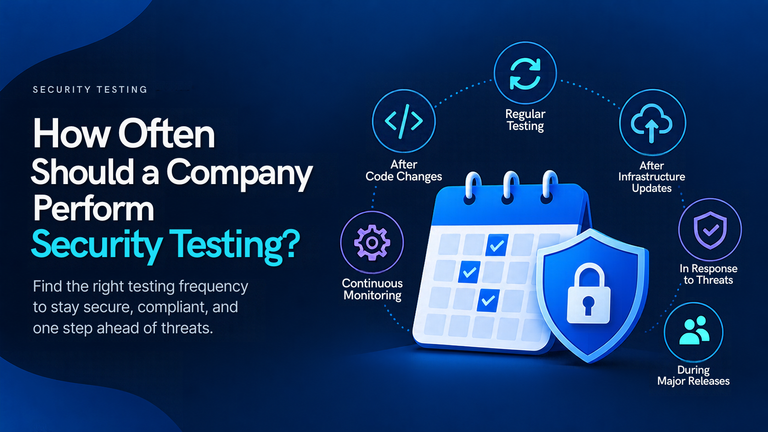
A business should run a network penetration test at minimum annually, with additional tests triggered by significant infrastructure changes including new office locations, cloud migrations, new remote access infrastructure, firewall rule changes, and Active Directory restructuring. Compliance frameworks provide the floor for frequency, and risk profile determines how far above that floor an organization needs to operate.
For compliance purposes, PCI DSS v4.0 Requirement 11.4 mandates annual internal and external network penetration testing of the Cardholder Data Environment, plus testing after any significant change. SOC 2 Type II auditors expect penetration testing within the audit observation period. ISO 27001 Annex A.8.8 requires technical vulnerability management that in practice includes regular penetration testing.
Beyond compliance, the right cadence depends on how frequently the network environment changes. An organization with a stable, well-documented network architecture that changes slowly can operate effectively on an annual testing cycle. An organization that adds new offices, cloud infrastructure, VPN configurations, or network segments regularly needs testing more frequently to catch the misconfigurations those changes introduce before attackers find them.
The lowest-cost approach to network security is not infrequent testing. It is testing frequently enough that vulnerabilities are found and closed before they are exploited rather than after. The cost of discovering a misconfigured firewall rule during a penetration test is trivially small compared to the cost of discovering it after it was used as a pivot point in a breach.
How Do You Choose the Right Network Penetration Testing Provider?
Choosing the right network penetration testing provider requires evaluating methodology depth, tester credentials and hands-on experience, and report quality rather than price alone. A network penetration test from a provider who runs automated tools and calls it manual testing produces a different, and significantly less useful, result than one from a provider whose testers actively pursue attack paths using the same techniques real adversaries use.
The questions that separate genuine network penetration testing providers from scanner-report resellers:
Can they describe their internal network testing methodology in detail? Ask specifically how they test Active Directory environments, how they handle credential harvesting, and what their approach is to privilege escalation from a standard domain user starting position. A provider who cannot describe this methodology at a technical level is not doing genuine internal network penetration testing.
Are their testers certified in offensive security? Credentials like OSCP, CRTO, CRTE, and GPEN indicate testers who have demonstrated hands-on capability in realistic attack environments, not just theoretical knowledge. Network penetration testing, particularly internal AD testing, requires practical skills that certifications specifically validate.
Does the report include exploitation evidence and attack chain narrative? A good network penetration test report demonstrates the attack path from initial access through to the final objective, with evidence at each step. This is what allows your infrastructure team to understand not just what was vulnerable but how the findings connected and what the real-world consequence was.
Our post on how to choose a penetration testing company in 2026 covers the full evaluation framework for any type of penetration testing engagement, including the specific questions to ask before signing.
How Much Does Network Penetration Testing Cost?
Network penetration testing costs between $5,000 and $35,000 for most mid-market organizations, with external network tests at the lower end of that range and comprehensive internal network tests covering large Active Directory environments at the higher end. The primary cost drivers are the number of in-scope IP addresses, the complexity of the internal environment, and whether compliance-specific reporting is required.
External network testing for a typical business with a defined perimeter typically runs $5,000 to $15,000. Internal network testing, which requires more tester time due to the complexity of Active Directory environments and lateral movement testing, runs $8,000 to $25,000 for most mid-market environments. Combined external and internal assessments run $12,000 to $35,000 depending on scope.
Compliance-driven tests add cost through the documentation and evidence standards required. PCI DSS-compliant network testing needs specific methodology documentation, segmentation validation evidence, and retest documentation that adds to both engagement scope and report production time.
The cost of a network penetration test is most usefully framed against the cost of a breach. The average breach costs millions in direct remediation, regulatory penalties, and business disruption. An annual network penetration test at any point in that cost range represents a straightforward return on investment when it finds and closes vulnerabilities before they are exploited. For a full breakdown of what penetration testing costs across all test types and scopes, our post on penetration test costs in 2026 covers the full range with the specific factors that drive pricing.
Does Network Penetration Testing Cover Web Applications Too?
Network penetration testing and web application penetration testing are distinct disciplines that cover different attack surfaces, and both are needed for a complete security picture. Network testing covers infrastructure components: firewalls, servers, network services, Active Directory, and the pathways between systems. Web application testing covers the application logic running on top of that infrastructure: authentication, authorization, business logic, and API security.
The distinction matters practically because the skills, techniques, and tools required for each are different. A network penetration tester who is expert at Active Directory attack paths and firewall bypass may not be the right person to test the authorization logic in a complex SaaS application. And a web application tester who is expert at finding IDOR vulnerabilities and business logic flaws may not be the right person to test whether your internal segmentation actually works under adversarial conditions.
For organizations that need both, which describes most mid-market and enterprise businesses, running network and web application testing in the same annual engagement window produces more efficient evidence collection for compliance purposes and a more complete security picture than running them separately. Our web application penetration testing services complement network testing in exactly this way, covering the application layer that network testing does not reach.
Frequently Asked Questions
What is the difference between external and internal network penetration testing?
External network penetration testing simulates an attacker outside your perimeter attempting to gain initial access through internet-facing systems. Internal network penetration testing simulates an attacker who already has a foothold inside the network, testing what they can reach through lateral movement and privilege escalation. Both are required under most compliance frameworks and address fundamentally different threat scenarios that the other cannot cover.
How long does a network penetration test take?
External network penetration testing typically takes three to seven days for a standard business perimeter. Internal network testing takes five to fourteen days depending on the size and complexity of the Active Directory environment, the number of network segments, and the scope of lateral movement testing. Combined external and internal assessments run one to three weeks in total. Compliance documentation and retest cycles add additional time after the testing phase.
Is a vulnerability scan the same as a network penetration test?
No. A vulnerability scan uses automated tools to identify potential weaknesses against known signatures and runs without active exploitation. A network penetration test uses a human tester who actively attempts to exploit identified vulnerabilities, chains findings into attack paths, and demonstrates real-world impact. Vulnerability scans are faster and cheaper but cannot confirm which findings are genuinely exploitable or what an attacker could achieve by combining multiple findings.
Does network penetration testing cause downtime?
Not in a properly conducted assessment. Experienced penetration testers scope testing to avoid disruptive techniques on production systems during business hours, and communicate actively with the infrastructure team throughout the engagement to flag anything that could affect system stability before proceeding. Testing is designed to identify vulnerabilities without triggering the destructive payloads that would actually cause downtime. However, the client team should be available to respond quickly if an unexpected issue occurs.
What should a network penetration test report include?
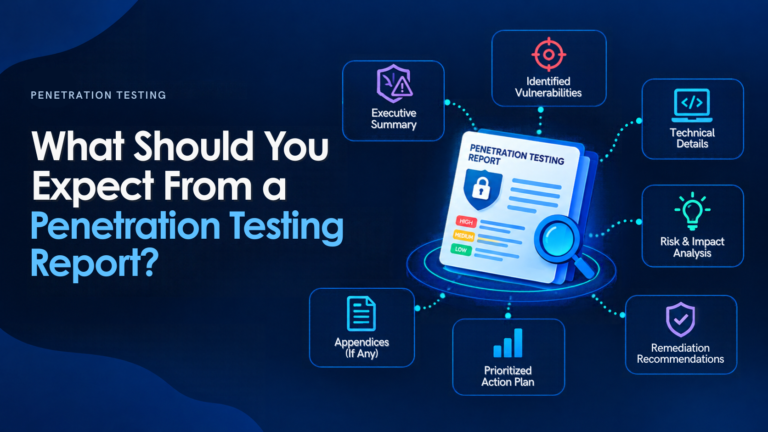
A network penetration test report should include a clearly defined scope, the testing methodology used, an executive summary of overall network security posture, detailed findings with severity ratings and CVSS scores, exploitation evidence for each confirmed vulnerability including network captures and screenshots, an attack chain narrative showing how findings connect, remediation recommendations specific to your environment, and retest results confirming successful remediation of critical and high findings.
The Network Is the Attack Surface That Everything Else Depends On
Web applications get significant security attention in 2026 because they are visible, user-facing, and increasingly tested as part of compliance and sales cycles. Networks are less visible and often tested less frequently, despite the fact that a compromised network gives an attacker access to everything those applications connect to.
The misconfigurations, default credentials, and legacy services that network penetration testing consistently finds are not glamorous findings. They are the unsexy, persistent weaknesses that have existed for years in most environments and that automated scanning tools flag but never validate. Finding one overly permissive firewall rule that connects a low-trust segment directly to a domain controller is worth more to a business’s actual security posture than discovering ten theoretical application-layer issues that require specific conditions to exploit.
Network penetration testing is how you find out what is actually in your network, what is actually reachable, and what an attacker who found their way in would actually be able to do. That knowledge is the prerequisite for every other security decision that follows.
Contact us to discuss a network security assessment for your organization