What Is Vulnerability Validation?

Written By
Sarwat Iftikhar
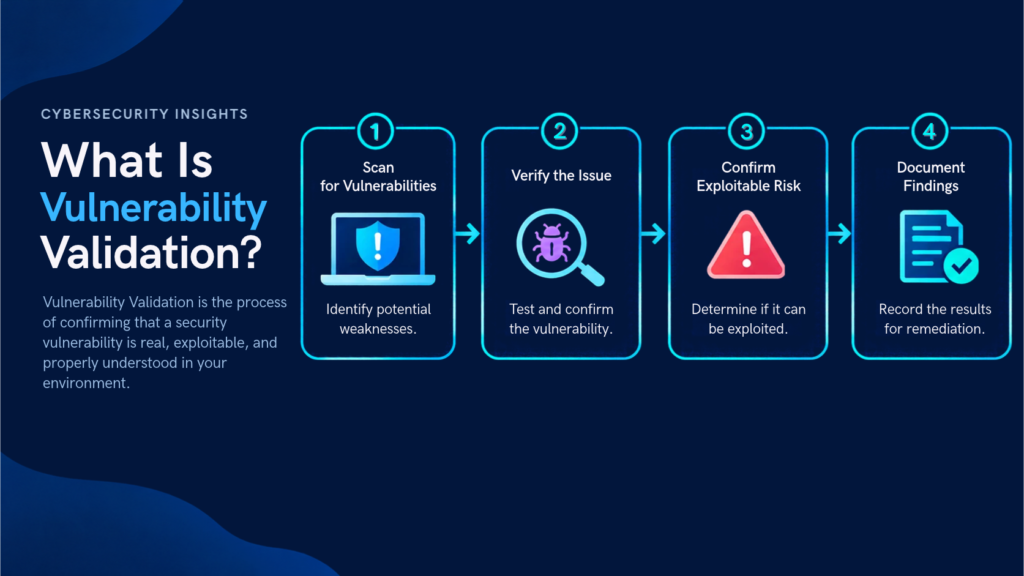
Vulnerability validation is the process of confirming that a reported security weakness is real, exploitable, and accurately understood before remediation begins, and that it is fully resolved after a fix has been applied. It sits at two critical points in the security lifecycle: before a finding enters the remediation queue, to ensure resources are not spent on false positives or mischaracterized issues, and after a fix is deployed, to confirm that the vulnerability no longer represents exploitable risk.
Without validation, security programs operate on assumptions. A scanner reports a vulnerability. It is assumed to be real, assumed to be correctly categorized, and assumed to be fixed when the ticket is closed. Each assumption introduces the possibility of error. A false positive consumes remediation effort that could address a real risk. A mischaracterized severity leads to incorrect prioritization. A fix that does not fully close the vulnerability leaves the organization exposed despite a closed finding.
Validation replaces those assumptions with confirmed facts. It is not a redundant step. It is the checkpoint that makes the rest of the security process reliable.
Key Takeaways
- Vulnerability validation confirms a reported finding is genuine and exploitable, not a scanner artifact or miscategorized result
- Validation before remediation prevents wasted effort on false positives and ensures severity ratings reflect actual exploitability
- Post-remediation validation confirms a fix was effective and did not introduce new weaknesses
- Penetration testing is the most thorough form of validation because it confirms exploitability through actual exploitation attempts
- Validation data feeds root cause analysis and improves the accuracy of future assessments over time
What Is Vulnerability Validation in Cybersecurity?
In cybersecurity, vulnerability validation is the technical confirmation that a reported vulnerability exists as described, can be exploited under realistic conditions, and represents the risk that has been assigned to it. It transforms a reported finding into a verified finding.
The distinction between reported and verified matters because not every reported vulnerability is what it appears to be. Automated scanners identify potential vulnerabilities based on version signatures, configuration patterns, and behavioral indicators. They report what they observe, but observation is not exploitation. A scanner may flag a component version as vulnerable to a known CVE, but validation determines whether that CVE is actually exploitable in the specific deployment configuration, whether a compensating control already blocks the exploit path, or whether the scanner has produced a false positive.
Validation also applies to the severity assigned to a finding. A vulnerability may carry a high CVSS base score for the theoretical worst-case scenario, but environmental factors in the specific deployment may reduce the realistic impact significantly. A remote code execution vulnerability on a system not accessible from untrusted networks is less severe in practice than its base score suggests. Validation surfaces these contextual factors and ensures that remediation priority reflects actual risk rather than theoretical maximum impact.
Vulnerability validation is a defined component of a structured vulnerability management program. Programs that lack a validation step produce finding queues that mix confirmed vulnerabilities with false positives, mischaracterized severities with actual risk, and closed tickets with unresolved exposures.
Why Is Vulnerability Validation Necessary?
Three problems arise consistently in security programs that skip or underinvest in validation. Each has a direct cost in security outcome.
False positives consume remediation capacity. Automated scanning at any meaningful scale produces false positives. Development teams that receive unvalidated scanner output spend significant time investigating findings that turn out to be non-issues. Each false positive investigation consumes time that could be applied to actual vulnerabilities. In high-volume scanning environments, false positive rates of 20 to 40 percent are not uncommon. A validation step applied to scanner output before findings enter the remediation queue eliminates that wasted effort.
Unvalidated severity leads to incorrect prioritization. CVSS base scores rate vulnerabilities in isolation from deployment context. A Critical CVSS score on a vulnerability that is not actually exploitable in the target environment, due to compensating controls or network restrictions, does not represent Critical risk in that environment. An organization that prioritizes remediation purely by base score will escalate findings that present low actual risk while lower-scored findings with high environmental exposure wait in the queue. Validation calibrates severity to the actual deployment context.
Unverified fixes create a false sense of closure. A remediation ticket marked closed does not mean a vulnerability is closed. It means someone reported that a fix was applied. Without validation, it is unknown whether the fix was complete, whether it introduced a bypass path, or whether the patch was deployed to all affected instances. Security programs that rely on developer self-attestation for fix verification routinely discover, in subsequent assessments, that findings marked closed remain exploitable. Validation converts a reported fix into a confirmed fix.
How Is Vulnerability Validation Performed?
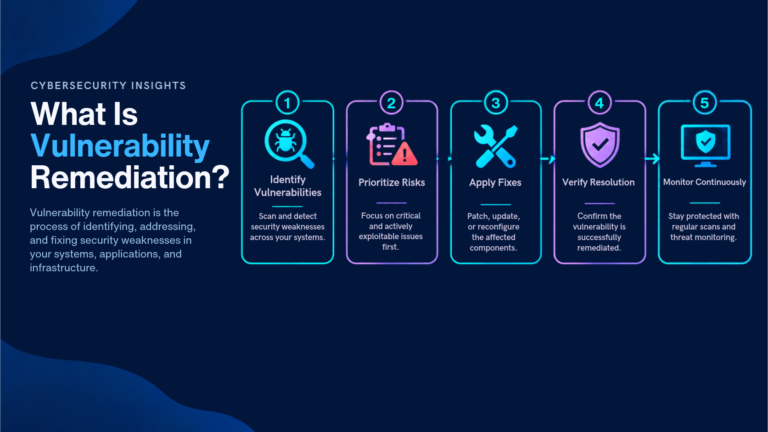
Vulnerability validation uses different methods depending on the type of finding, the severity, and the stage of the security lifecycle at which validation is being performed. Choosing the right method for the context determines how thorough and reliable the validation outcome is.
Manual exploitation testing is the most definitive form of validation. A security tester attempts to exploit the reported vulnerability using the same techniques and tools an attacker would use. Successful exploitation confirms the vulnerability is real and exploitable as described. Unsuccessful exploitation against a finding that appears technically present may reveal a compensating control, a configuration factor that limits exploitability, or a scanner false positive. Bugstrix vulnerability assessment engagements include manual validation for findings above a defined severity threshold, ensuring that what enters the remediation queue has been confirmed rather than simply detected.
Automated scanner verification is appropriate for known CVEs in identifiable software components where version-based detection is reliable. Scanners cross-reference installed component versions against known vulnerability databases and flag matches. This method scales well across large asset inventories but produces confirmation at the detection level rather than the exploitation level. It is a starting point for validation, not a conclusion.
Proof-of-concept reproduction applies to novel, complex, or chained vulnerabilities where scanner detection is insufficient and manual exploitation requires a custom exploit path. The security tester constructs a working proof-of-concept that demonstrates the specific attack scenario, confirms that the vulnerability is triggerable under realistic conditions, and documents the exploit chain for the remediation team. This method is used for findings that carry high business risk and require definitive confirmation before escalation.
Remediation retest is post-fix validation: the security tester who confirmed the original vulnerability returns after a fix has been deployed and attempts exploitation again. A successful retest confirms the fix is effective. A failed retest reveals that the fix was incomplete, incorrectly applied, or bypassed through an adjacent path. Retest validation is the only reliable confirmation that a remediation is complete.
Configuration audit review validates infrastructure findings by examining the actual configuration state against the expected security baseline. It is appropriate for misconfigurations, access control findings, and control gaps where the validation question is whether a specific setting is correctly applied rather than whether an exploit succeeds.
How Is Remediation Validated After a Fix?
Post-remediation validation is a distinct phase from the initial finding validation. Its purpose is not to confirm that a vulnerability exists, which was confirmed at discovery, but to confirm that the fix applied has fully closed the vulnerability and has not introduced new weaknesses in the process.
The standard for post-remediation validation is that the specific exploit path used to confirm the original finding no longer works, and that reasonably obvious alternative paths to the same impact have also been attempted and blocked. A fix that closes the exact reported attack vector but leaves an adjacent bypass path open is an incomplete fix, even if the original finding is no longer technically reproducible.
Vulnerability remediation tracking should reflect the distinction between remediation reported and remediation validated. A finding should not be marked closed in the tracking system until post-remediation validation has been completed by an independent tester, not by the team that deployed the fix. Self-attestation, where the developer confirms their own fix is effective, is not validation. It is a reporting step that must be followed by independent technical verification.
Understanding how penetration testing works makes clear why independent validation is structurally important: the person who wrote the fix has an inherent blind spot about the fix they wrote. They know what they changed, so they will test whether that change works. They are less likely to test whether a different path to the same outcome still exists. An independent tester approaches the post-fix environment without that framing and applies broader validation coverage.
Bugstrix penetration testing retests are conducted by the same testers who confirmed the original findings, providing continuity between the initial exploit confirmation and the post-remediation validation. This continuity ensures the retest covers the same ground as the original test and that fix effectiveness is assessed against the same confirmed attack path.
How Does Root Cause Analysis Connect to Validation?
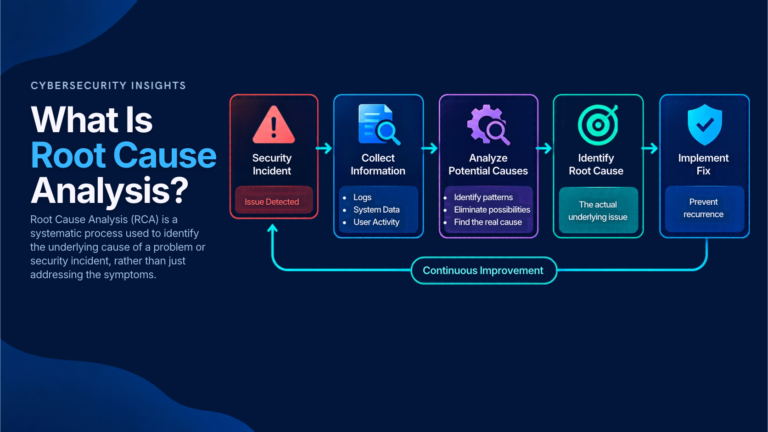
Validation confirms that a vulnerability exists and that a fix is effective. Root cause analysis determines why the vulnerability existed in the first place. The two are sequential but distinct: validation produces the confirmed finding data that makes root cause analysis accurate, and root cause analysis produces the systemic fix that prevents recurrence.
When validation confirms a finding, it also characterizes the finding precisely: the attack vector, the conditions required for exploitation, the affected component, and the impact achieved. That characterization is the input to root cause analysis. An RCA performed on a vaguely described unconfirmed finding produces vague conclusions. An RCA performed on a validated finding with a confirmed exploit path produces specific, actionable conclusions about why the vulnerable condition existed and what change would prevent it from recurring.
Validation also provides the data that makes RCA patterns visible. When multiple independently validated findings share the same exploit type across different components or teams, that pattern is evidence of a systemic root cause. Without validation, findings of the same type may include false positives that blur the pattern or mischaracterized findings that attribute the wrong cause. Validated findings produce clean input to the pattern analysis that RCA depends on.
For Critical and High severity findings, Bugstrix engagement workflows integrate validation output directly into the root cause analysis phase: the confirmed exploit path, the conditions that made it possible, and the component involved feed the RCA process rather than being documented separately. This integration ensures that remediation addresses both the instance and the systemic cause in a single remediation cycle.
How Does Continuous Validation Fit Into a Mature Security Program?
Point-in-time validation, performed at a fixed assessment interval, confirms the security state at the moment of testing. It does not confirm that the security state remains stable between tests. Organizations with active development pipelines introduce new code, new configurations, and new components continuously. New vulnerabilities can be introduced in the gap between assessments and remain undetected until the next scheduled test.
Continuous validation addresses the temporal gap by shifting validation from a periodic event to an ongoing process. Rather than confirming the security state once a year or once a quarter, continuous validation monitors the attack surface and validates findings on the cadence that new code and configurations are deployed.
Continuous penetration testing is the operational model for continuous validation at the exploitation level. Bugstrix continuous penetration testing provides ongoing manual and automated validation across the attack surface, confirming that previously remediated findings remain closed, that newly introduced code does not contain exploitable weaknesses, and that the security posture validated at the last assessment point has not degraded. The result is a persistent validation loop rather than a periodic snapshot, giving security and development teams confirmation of security state that reflects the current environment rather than the environment as it was at the last scheduled test.
The metrics produced by continuous validation also improve the effectiveness of the broader security program over time. Validation failure rates, the proportion of reported findings confirmed as genuine, and retest failure rates, the proportion of remediated findings that fail post-fix validation, are signals about program quality that only become visible when validation is performed consistently and at sufficient volume.
Get your free quote for a penetration testing or vulnerability assessment engagement
Frequently Asked Questions
What is the difference between vulnerability scanning and vulnerability validation?
Vulnerability scanning is automated detection: tools inspect systems for indicators of known vulnerabilities, such as component versions, open ports, and configuration patterns, and report potential issues. Vulnerability validation is the confirmation step that follows: a security tester examines the reported findings, attempts exploitation, and determines which are genuine vulnerabilities, which are false positives, and whether the severity assigned accurately reflects the actual risk in the deployment context. Scanning produces candidates. Validation produces confirmed findings.
How does validation differ for application vulnerabilities versus infrastructure vulnerabilities?
Application vulnerability validation typically requires active exploitation attempts: injecting payloads, manipulating request parameters, testing authentication logic, or chaining findings to demonstrate impact. It confirms that the vulnerable code path is reachable and that the exploitation succeeds under the application’s actual runtime conditions. Infrastructure vulnerability validation often combines exploitation attempts with configuration review: confirming that a service version is vulnerable, testing whether the exploit path is accessible, and verifying whether network controls limit reachability. Both ultimately require confirming exploitability, but the methods reflect the different attack surfaces.
Should all vulnerability findings be validated before remediation?
Validation effort should be proportional to finding severity. Critical and High severity findings should always be validated before entering the remediation queue, because the cost of remediating a false positive or a mischaracterized finding at those severity levels is significant. Medium severity findings benefit from validation but may be triaged using lighter methods. Low and Informational findings can often proceed to remediation without full exploitation-based validation, since the remediation cost is low and the risk of a false positive consuming excessive resources is less material.
What is a validation false negative?
A validation false negative occurs when a genuine vulnerability is present but the validation attempt fails to confirm it. This can happen when a validation method is too narrow, when the exploit path requires a combination of conditions not present during testing, or when a compensating control active during the validation window is not present in normal operation. False negatives in validation are more dangerous than false positives because they cause a real vulnerability to be treated as a non-issue. Thorough validation methods, including manual exploitation by experienced testers, reduce the false negative rate compared to automated verification alone.
How is post-remediation validation different from a full reassessment?
Post-remediation validation is targeted: it focuses on confirming that specific previously identified findings are no longer exploitable. It attempts the same exploit paths used to confirm the original findings and checks for obvious bypass paths. A full reassessment covers the entire attack surface without prior knowledge of specific findings, aiming to discover new vulnerabilities as well as confirm the status of known ones. Post-remediation validation is faster and more focused. A full reassessment is more comprehensive. Both serve distinct purposes and complement each other in a mature security program.
How often should vulnerability validation be performed?
Validation frequency depends on the rate of change in the environment. For organizations with active development pipelines, validation should occur at every release cycle for application changes and at every infrastructure change event for configuration and deployment changes. Point-in-time validation through periodic assessments should run at minimum annually, with quarterly assessments appropriate for higher-risk environments. Continuous penetration testing removes the frequency question by providing validation as an ongoing process rather than a scheduled event.
Validation Is What Makes Security Testing Count
Security testing produces value only when its findings are accurate, its severities reflect actual risk, and its remediation outcomes are verified. Validation is the mechanism that ensures all three.
An assessment program without validation produces a finding list of unknown reliability. Some findings are real. Some are false positives. Some severities are accurate. Some are inflated or deflated by the absence of environmental context. Some remediations are complete. Some are partial. None of this is distinguishable without validation, which means none of the security decisions made on the basis of unvalidated findings can be trusted.
Bugstrix builds validation into every phase of its security testing engagements: confirmed exploitation at discovery, severity calibrated to the actual deployment environment, post-remediation retest at closure, and continuous validation for clients who need security confirmation at deployment cadence rather than assessment cadence. The result is security testing output that can be relied on to drive accurate prioritization, effective remediation, and measurable improvement in security posture over time.