What Is Network Segmentation Testing?

Written By
Sarwat Iftikhar
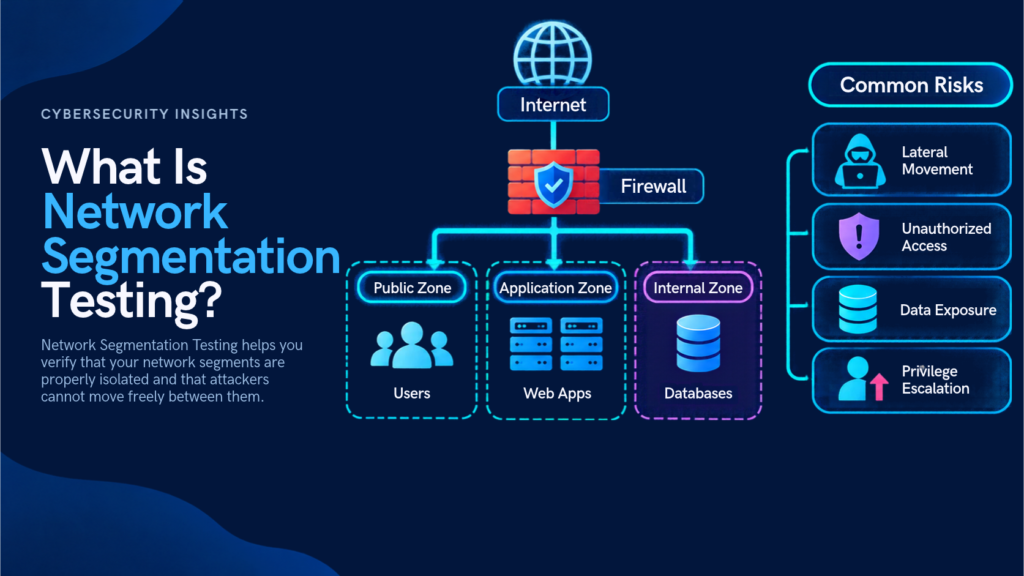
Network segmentation testing is a structured assessment that verifies whether the boundaries between network zones actually prevent lateral movement under real attack conditions. Organizations implement segmentation to limit how far an attacker can move after gaining initial access: a compromised workstation should not be able to reach a database server in a production zone, a guest Wi-Fi network should not be able to route to internal infrastructure, and a payment processing environment should be isolated enough to satisfy compliance requirements. Segmentation testing determines whether those controls hold when tested the way an attacker would test them.
The gap between declared segmentation policy and what the network actually enforces is where most of the risk lives. Firewall rules accumulate over years of infrastructure changes, and rules that were added for a specific business requirement often persist long after that requirement disappears. VLANs that were intended as logical separation can be circumvented when trunk ports are not configured correctly. Management channels that cross segment boundaries create implicit paths that never appear in the network diagram but are entirely accessible to anyone who finds them. Network segmentation testing is the process of finding those gaps before attackers find them first.
Key Takeaways
- Network segmentation testing verifies whether the boundaries between network zones prevent lateral movement under realistic attack conditions, not just under the assumptions made when the firewall rules were written
- The most exploitable failures are not design flaws but drift: firewall rules that were added for a specific purpose and never removed, management interfaces accessible across zone boundaries, and implicit trust between adjacent segments
- VLAN separation testing examines logical boundaries that do not appear in physical topology, including trunk link exploitation and double-tagging techniques that bypass VLAN enforcement
- PCI DSS segmentation verification is a distinct testing scope that must demonstrate the cardholder data environment is isolated from all other systems
- Findings from segmentation testing map directly to attack paths: Bugstrix engineers document each bypass as a reachable path from an attacker’s starting position rather than as an abstract configuration issue
Why Does Network Segmentation Fail Under Real Attack Conditions?
Network segmentation is designed by administrators who know their environment, but it is tested by attackers who do not respect the assumptions built into that design. The result is a persistent gap between how segmentation is documented and how it performs under adversarial probing. Understanding where that gap consistently appears is the starting point for understanding what segmentation testing is actually looking for.
Firewall rule accumulation is the most common source of segmentation failure in production environments. Rules are added in response to specific business requirements and are almost never removed when that requirement changes. Over several years, a firewall policy that was originally tightly scoped becomes a list of hundreds of rules, some of which allow broad traffic between zones that the current network policy declares should not communicate. The effective segmentation boundary is not what the network diagram shows. It is the union of every rule that has ever been added, minus the ones that have been explicitly removed, which in most environments is very few.
Management channels spanning multiple segments create pathways that bypass segmentation entirely. Network management protocols, monitoring agents, backup systems, and administrative interfaces are often configured to cross segment boundaries because that is the most convenient way to operate them centrally. Each of those management channels is a potential pivot path for an attacker who gains access to the management network, regardless of how tightly the production segments are separated from each other.
Attack surface management programs that map the network from the outside miss the internal pivot paths that segmentation testing surfaces. The reachability of a service from outside the perimeter is a different question from whether that service can be reached from an adjacent internal segment, and the two assessments require different testing approaches.
Implicit trust between adjacent segments is a design assumption that rarely holds in practice. Segments that are organizationally related, that share services, or that were once part of the same flat network are often configured with permissive rules between them under the assumption that traffic between those zones is inherently trusted. Those rules become the most direct pivot paths available to an attacker who establishes a foothold in any one of the adjacent zones.
What Does Network Segmentation Testing Examine?
Bugstrix network segmentation testing engagements cover the full control set that determines whether segment boundaries hold: firewall rule enforcement, VLAN separation, lateral movement paths, management interface exposure, and compliance boundary verification. Each category requires a distinct testing approach and surfaces a different class of segmentation failure.
Firewall rule validation tests whether the firewall policy as deployed matches the segmentation policy as declared, and whether the rules that exist permit or block traffic consistently with what the organization intends. Bugstrix engineers probe each declared segment boundary from both sides, testing whether traffic types and protocols that should be blocked are actually blocked, and whether rules that exist on paper for a specific purpose have been correctly implemented in the actual device configuration. Permit rules that apply to broader traffic than intended, rules that are ordered incorrectly relative to deny rules, and rules that use overly broad address ranges are the most common findings in this category. Network penetration testing engagements at Bugstrix consistently find firewall rule sets where the effective policy allows significantly more cross-zone traffic than the network architecture documentation indicates.
VLAN separation testing examines whether logical network boundaries enforced at the switching layer hold under techniques designed to circumvent them. VLANs provide separation through logical tagging rather than physical isolation, and the security of that separation depends entirely on how trunk ports, access ports, and the native VLAN are configured across every switch in the path. VLAN hopping through double-tagging exploits environments where the native VLAN on a trunk port matches the VLAN tag of a target segment, allowing frames to be delivered to a different VLAN than the access port assignment suggests. Trunk link exploitation targets switch ports configured as trunks that should be access ports, allowing an attacker who can interact with the switching layer to negotiate trunk mode and access all VLANs carried on that link.
Lateral movement path testing maps the actual pivot paths available to an attacker starting from each testable segment, working outward to determine how many other segments are reachable through combinations of permitted traffic, shared services, and trust relationships. This testing phase moves beyond individual firewall rules to model what an attacker can reach after establishing a foothold, accounting for multi-hop paths through intermediate segments, service dependencies that create implicit connectivity, and the cumulative effect of individually permissive rules across a path. Each reachable segment is documented as an attack path with the specific steps required to traverse it.
Management interface exposure testing identifies network management services, remote administration protocols, monitoring agents, backup systems, and out-of-band management networks that are reachable from segments they should not be accessible from. Management interfaces represent a category of pivot path that is frequently overlooked in firewall rule reviews because the rules that allow them were written by network operations rather than security teams, with availability rather than lateral movement as the primary consideration. An attacker who reaches the management network through any exposed interface can often reach every device on that network regardless of how the production segments are separated from each other.
PCI DSS boundary testing verifies that the cardholder data environment (CDE) is isolated from all other systems and networks to the degree required by the Payment Card Industry Data Security Standard. PCI DSS segmentation is a specific compliance requirement with defined testing criteria: the CDE must be demonstrably isolated such that no path exists from out-of-scope systems to CDE systems, and that isolation must be tested at minimum once per year. Bugstrix PCI DSS segmentation testing documents the full boundary, tests each defined path for exploitability, and produces the evidence documentation required for a Qualified Security Assessor to validate the segmentation claim.
Which Segmentation Failures Are Most Commonly Exploited?
Bugstrix engineers encounter the same categories of segmentation failure repeatedly across network testing engagements, regardless of the size of the organization or the maturity of the network operations team.
Over-permissive firewall rules on internal zones are present in the majority of assessments. The most common form is a rule that was written to allow a specific service between two specific hosts but uses subnet ranges or any/any that extends the permission to far broader traffic. Organizations often apply tight controls at the external perimeter while treating internal zone boundaries as lower-priority, with the result that internal segmentation provides far less lateral movement restriction than the architecture diagram implies.
Management VLAN accessible from user segments is a recurring finding in organizations that have deployed VLAN-based segmentation. The management VLAN is typically configured to allow access to network device administrative interfaces, which may include SSH, SNMP, and web-based management. When trunk ports carry the management VLAN without appropriate access restrictions, or when the native VLAN alignment creates a double-tagging opportunity, users in a standard workstation segment can reach management interfaces without any privilege escalation.
Shared service pivot paths are created when services that multiple segments rely on, DNS resolvers, NTP servers, patch management systems, monitoring platforms, are deployed in a segment that has routing rules allowing it to initiate connections to other segments. An attacker who compromises a shared service server can use the routing permissions granted to that server to reach segments that are otherwise isolated from the initial foothold. Internal penetration testing engagements at Bugstrix consistently identify shared service servers as the highest-value pivot points in segmented environments, because a single compromise unlocks routing permissions that the design intended to be scoped to specific infrastructure functions.
Legacy rules for decommissioned systems persist in firewall policies as fully exploitable paths long after the systems they were written for have been removed. A rule that allowed a specific server to communicate with a database segment does not disappear when that server is decommissioned. The address range the rule was written for becomes available for reassignment, and any new system that receives that address inherits all the permissions that were granted to its predecessor.
How Does Network Segmentation Testing Work in Practice?
Network segmentation testing combines network architecture review, active probing from each segment, pivot simulation, and compliance boundary documentation into a structured engagement that covers both the control plane and the data plane of the segmentation implementation.
Architecture and policy review establishes what the segmentation is supposed to do before testing what it actually does. Bugstrix engineers review the network architecture documentation, firewall policy exports, VLAN assignments, and routing tables to build an accurate model of the declared segmentation state. This review identifies discrepancies between documentation layers before active testing begins, and it provides the baseline against which active findings are measured. Firewall rules that appear in the policy but are shadowed by earlier rules, routes that exist in the routing table but are not reflected in the architecture documentation, and VLAN assignments that differ from the switch configuration are all surfaced before any probe is sent.
Active boundary probing tests each declared segment boundary from every accessible starting position, sending traffic of the types and protocols that the policy declares should be blocked and recording what the network actually permits. Bugstrix engineers test from each segment in scope rather than testing only from an external position, because the most impactful findings in segmented environments are discovered from internal starting positions that reflect realistic post-compromise scenarios. Attack path analysis from each segment maps not just whether individual rules block specific traffic, but which combinations of permitted paths create viable routes from an attacker’s starting position to high-value targets.
Pivot simulation extends the boundary probing into multi-hop sequences that model what an attacker would do after establishing a foothold. Bugstrix engineers test whether traffic blocked by a direct rule between two segments can be routed through an intermediate segment that has permissive rules with both. Pivot testing through shared services, management networks, and dual-homed servers identifies paths that do not appear in a point-to-point analysis of individual rules.
Perimeter boundary testing examines the boundary between the external network and the internal segments that are intended to be protected from direct external access. External penetration testing of the DMZ establishes which services are exposed, and segmentation testing from the DMZ determines whether a compromise of a DMZ-resident service provides pivot paths into internal segments that the perimeter architecture intends to protect.
Privileged segment access testing focuses on the segments that contain the most valuable targets in the environment: domain controllers, database servers, security management systems, and backup infrastructure. Active Directory penetration testing specifically examines whether an attacker operating in a standard workstation segment can traverse the segment boundaries that are intended to restrict access to the domain controller tier, because access to domain controllers effectively negates every other segmentation control in a Windows environment.
Adversarial segmentation validation through red team exercises tests whether the full combination of segmentation controls holds when an attacker attempts to achieve a specific objective across the network, rather than testing individual boundaries in isolation. A red team engagement that includes segmentation validation tests multi-stage scenarios: initial access through an exposed service, lateral movement attempts across declared boundaries, escalation toward high-value targets in protected segments, and exfiltration from behind the segmentation controls that are supposed to prevent it.
Bugstrix penetration testing services cover network segmentation testing as a standard scope component for internal network assessments, with dedicated segmentation testing engagements available for organizations that need to validate specific compliance boundaries or test a segmentation architecture following infrastructure changes. Security assessment services include segmentation architecture review as part of a broader network security assessment when the goal is to evaluate the design before active exploitation testing begins.
Get a free quote for a network segmentation testing engagement
Frequently Asked Questions
What is the difference between network segmentation testing and a standard network penetration test?
A standard network penetration test focuses on finding vulnerabilities that allow initial access or privilege escalation across the network. Network segmentation testing specifically validates whether the boundaries between declared segments prevent lateral movement under adversarial conditions. The two assessments overlap: a network penetration test will identify some segmentation failures, but a dedicated segmentation test covers every boundary systematically and documents reachable paths from each segment rather than stopping when access to a high-value target is established.
How is PCI DSS segmentation testing different from general segmentation testing?
PCI DSS segmentation testing is conducted against a specific documented scope: the cardholder data environment boundary. The testing must demonstrate that no path exists from out-of-scope systems to CDE systems and must produce evidence documentation suitable for a Qualified Security Assessor review. The testing methodology overlaps with general segmentation testing, but the scope, documentation requirements, and specific boundary definition are governed by PCI DSS requirements rather than the organization’s internal architecture documentation.
Can network segmentation testing be conducted without access to the firewall configuration?
Yes. Active boundary probing from each segment in scope tests what the network actually enforces, regardless of what the firewall policy says. Configuration access is valuable for the architecture review phase and for correlating active findings with specific rules, but the core testing methodology works from a black-box starting position that reflects the access an attacker would have. Black-box and configuration-assisted testing are frequently combined in the same engagement.
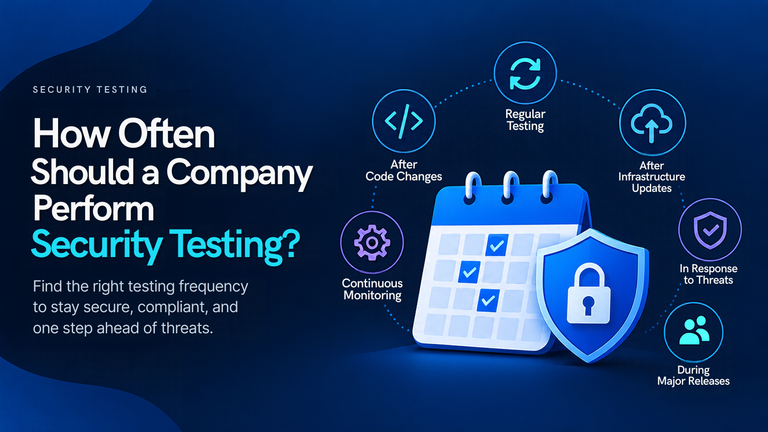
How often should network segmentation be tested?
After initial implementation before production reliance, after any significant firewall policy change, after infrastructure additions that introduce new segments or modify routing, and at minimum annually for any environment with compliance requirements. Environments where the firewall policy changes frequently, such as organizations that add rules in response to individual application requirements without a formal change review, benefit from more frequent testing because rule accumulation is an ongoing process rather than a one-time event.
What deliverables does a network segmentation testing engagement produce?
A network segmentation testing engagement produces a findings report that documents each boundary tested, each finding as a specific reachable path with the steps required to traverse it, the firewall rule or configuration condition that enabled it, and remediation guidance targeted at the specific rule or configuration change that closes the path. For PCI DSS engagements, the report also includes the boundary documentation and testing evidence that the QSA review process requires. The finding format maps to individual network controls rather than to generic vulnerability categories, so remediation work can be directly targeted.
Segmentation That Is Declared Is Not the Same as Segmentation That Is Enforced
Network segmentation appears on every architecture diagram as an authoritative statement about how the network is divided. The firewall is configured, the VLANs are assigned, the routing policies are documented. What those documents describe is the intent of the segmentation design. What network segmentation testing determines is whether the network as deployed enforces those intentions against an attacker who is not bound by the assumptions under which the rules were written.
Bugstrix network segmentation testing engagements start from the realistic post-compromise positions an attacker would occupy and map every pivot path available from those starting points to every segment in scope. Each finding is a specific, demonstrated path with the exact combination of rules and configurations that enables it, so remediation targets the actual control failure rather than a category of risk. The result is a documented and tested segmentation boundary, not an architectural claim, that the organization can rely on as a genuine lateral movement control.
Contact us to discuss a network segmentation testing engagement for your environment