What Is LLM Security Testing?

Written By
Sarwat Iftikhar
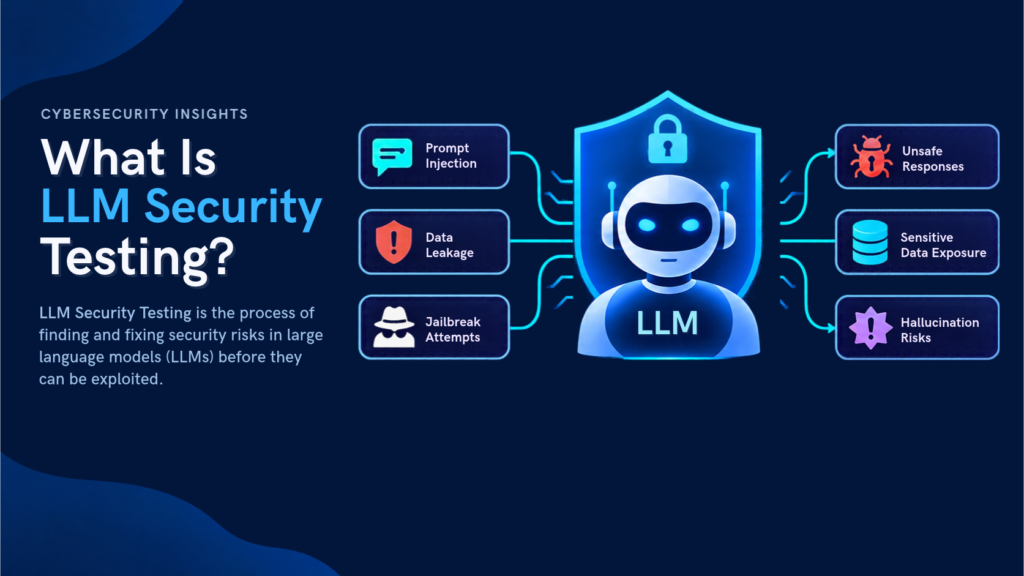
LLM security testing is the process of assessing the security of applications that integrate large language models, with the goal of identifying how those integrations can be manipulated, abused, or exploited. As organizations deploy AI-powered features across customer-facing products, internal tools, and automated workflows, the attack surface expands in ways that conventional application security testing was not designed to address.
A large language model is a probabilistic system. Its behavior can be influenced by crafted inputs, the content of documents it processes, and the structure of the instructions that govern it. That flexibility is what makes these models useful. It is also what makes them exploitable. LLM security testing examines whether those inputs and contexts can be used to make the model behave in ways the application did not intend and the organization did not authorize.
Key Takeaways
- LLM security testing assesses how AI-integrated applications can be manipulated, exploited, or abused through the model’s input and output channels
- Prompt injection, both direct and indirect, is the highest-frequency LLM attack class and does not require any technical vulnerability in the underlying code
- LLMs with access to tools, APIs, or external data sources introduce privilege and integration risks that extend far beyond the model itself
- Full coverage requires a combination of adversarial prompting, API security assessment, code review, and infrastructure testing
- Conventional application security tools do not catch LLM-specific attack patterns; dedicated testing methodology is required
Why Do LLM Integrations Create a Distinct Security Target?
Traditional application security testing is built around predictable input/output behavior. An SQL injection payload either works or it does not. A cross-site scripting vector either executes or it is blocked. The test has a binary outcome, and the attack surface has defined boundaries.
LLM integrations change both of those properties. The model’s behavior in response to any given input is probabilistic, context-dependent, and shaped by the entire prompt, including system instructions, conversation history, retrieved documents, and the user’s message. An attack does not need to exploit a vulnerability in the conventional sense. It needs to influence the model’s behavior through inputs that the application was not designed to filter or block.
The second distinction is scope. When a model has access to tools, the attack surface extends to everything those tools can reach. A model granted access to a file system, an internal API, or a database can be directed, through a successful prompt injection, to read, write, or transmit data well beyond what the requesting user was authorized to access. The identity and access management controls that govern traditional application authorization do not automatically apply to actions taken by a model acting on behalf of a user.
The third is the supply chain dimension. The model weights, fine-tuning datasets, retrieval corpora, and third-party plugins that compose an LLM application are each components that can be compromised, manipulated, or substituted. Software supply chain security for AI-integrated applications extends the same principles that apply to code dependencies to model components that most organizations have never inventoried or audited.
What Does LLM Security Testing Examine?
LLM security testing covers a range of attack surfaces that span the model interface, the application layer, the integration points, and the underlying infrastructure. Bugstrix assessments examine each layer systematically, beginning with the model’s direct input channels and working outward to the systems the model can reach.
Direct prompt injection occurs when an attacker submits a crafted user message that overrides the model’s governing instructions and causes it to behave outside its intended parameters. The attacker is not exploiting a code vulnerability. They are exploiting the model’s tendency to follow instructions embedded in its input. Successful direct injection can produce unauthorized responses, bypass content controls, and expose system configuration that the application treats as confidential.
Indirect prompt injection is structurally more dangerous because the attacker does not need direct access to the model. When an application retrieves external content, such as a webpage, an email, a document, or an API response, and passes that content to the model as part of its context, any instructions embedded in that content are processed by the model alongside its governing prompt. An attacker who controls or can influence the external content can inject instructions that the model will follow on the next retrieval, without the user or the application having any visibility into what was embedded.
Sensitive data disclosure testing examines whether the model can be induced to reveal information from its context window that was not intended to be accessible to the requesting user. This includes the contents of system prompts, documents retrieved from restricted data sources, and in retrieval-augmented generation architectures, content from other users’ sessions that may have been inadvertently indexed or cached. API security testing for LLM-integrated applications must cover the retrieval layer specifically, because the API endpoints that populate the model’s context are frequently the most direct route to cross-user data exposure.
Insecure output handling covers scenarios where the model’s response is passed without sanitization to a downstream system. When model output is rendered in a web interface without encoding, it becomes a cross-site scripting vector. When model output is passed to a database query or an operating system command, it becomes a code injection vector. The model is not the target. The model is the delivery mechanism, and web application security controls must account for the possibility that the model’s output is adversarially crafted rather than benign.
Excessive agency abuse applies to agentic applications where the model has been granted capabilities beyond text generation, including tool calls, file operations, external API requests, and email or messaging access. Bugstrix tests whether those capabilities can be triggered through adversarial prompting to perform actions outside the user’s authorized scope, and whether the permissions granted to the model are proportionate to its actual function.
How Does LLM Security Testing Fit Into the Development Lifecycle?
LLM security risks do not emerge only at deployment. They are introduced at every stage of development where AI components are integrated, configured, or granted capabilities. Effective LLM security testing addresses each of those stages rather than treating security as a single pre-launch gate.
During development, the most critical testing activities are code review and architecture review. The integration code that constructs prompts, processes model outputs, calls external tools, and manages context determines the attack surface of the finished application. A secure code review of LLM integration code examines whether prompt construction is resistant to injection, whether output processing sanitizes model responses before they reach downstream systems, and whether tool permissions are scoped to the minimum necessary function. Bugstrix cybersecurity code review engagements cover LLM integration patterns as part of the broader review scope, identifying the classes of error that lead to the attack surfaces described above.
Before major releases, functional security testing against the deployed application confirms that the theoretical risks identified in code review are or are not exploitable in the specific deployment configuration. This includes adversarial prompting exercises against the actual model and system prompt, injection testing through every content ingestion path, and privilege boundary testing for every tool the model has access to.
In production, the attack surface for an LLM application changes continuously as new documents enter the retrieval corpus, new users interact with the system, and new tool integrations are added. Point-in-time security testing establishes a baseline. Ongoing monitoring for anomalous model behavior and periodic reassessment as the application evolves are both necessary to maintain that baseline.
Cloud security practices apply directly to the infrastructure layer of LLM deployments. The API gateway through which the model is accessed, the storage layer for retrieval corpora, the logging infrastructure for model interactions, and the secrets management for integration credentials are all cloud components that standard LLM security testing must include in scope alongside the model interface itself.
How Is LLM Security Testing Different from Standard Application Security Testing?
Standard application security testing tools, including dynamic application security testing scanners, static analysis tools, and conventional penetration testing methodologies, were built for deterministic systems. They work by sending known payloads to known endpoints and observing binary outcomes. That approach does not translate to LLM-integrated applications.
A DAST scanner cannot evaluate whether a model is susceptible to prompt injection because prompt injection is not a payload with a known signature. It is a technique that exploits the model’s instruction-following behavior, and whether an injection succeeds depends on the model’s configuration, the structure of its system prompt, the content of the conversation history, and the specific phrasing of the injected instruction. These factors produce different outcomes on different runs with the same payload.
The same gap applies to output handling risks. A conventional scanner testing a web endpoint that renders model output has no way to determine that the model could be prompted to produce a payload in that output. It sees a clean response and reports no vulnerability. The vulnerability only becomes visible when testing methodology accounts for the adversarial generation capability of the model itself.
LLM security testing also requires expertise that is not part of conventional application security skill sets. Understanding which prompt structures are most likely to succeed against different model configurations, how retrieval architectures create indirect injection surfaces, and how agentic permission scopes interact with tool access requires both security testing experience and working knowledge of how large language models process context. Bugstrix penetration testing for AI-integrated applications combines both, applying adversarial prompting methodology alongside standard application security techniques to cover the full attack surface.
Frequently Asked Questions
What is prompt injection and why is it the most common LLM vulnerability?
Prompt injection occurs when an attacker crafts input that causes the model to override its governing instructions and behave in unintended ways. It is the most common LLM vulnerability because it does not require any flaw in the application’s code. The model’s core capability of following natural language instructions is exactly what the attack exploits. Every LLM-integrated application that accepts user input is potentially susceptible unless specific defensive measures are in place.
Can existing application security tools test for LLM vulnerabilities?
Existing tools address the conventional attack surface of an LLM application: injection in the application code, authentication weaknesses in the API layer, misconfigurations in the cloud infrastructure. They cannot test for LLM-specific vulnerabilities like prompt injection, indirect context manipulation, or excessive agency abuse. These require manual adversarial testing by testers with a dedicated LLM security methodology.
Does LLM security testing cover the model itself or only the application?
LLM security testing for applications focuses on the integration: how the application uses the model, what data it exposes to the model’s context, what tools the model can access, and how the model’s output is processed. It does not typically involve testing the model weights or training process, which is a separate discipline. The attack surface that matters for most organizations is the application layer, where their configuration decisions determine what an attacker can achieve through the model interface.
How should system prompt confidentiality be handled?
System prompts should be treated as sensitive configuration, not as a security control. A security design that relies on the system prompt remaining secret is fragile because system prompt extraction is a common first step in LLM attack chains. Bugstrix recommends designing LLM applications to be secure even if the system prompt is fully known to an attacker, using access controls and output validation rather than prompt confidentiality as the primary security mechanism.
How often should LLM-integrated applications be tested?
Testing should occur at every significant integration change: when a new model is deployed, when tool access is added or expanded, when the retrieval corpus changes materially, and when the system prompt is restructured. At minimum, a full LLM security assessment should be performed before initial production deployment and annually thereafter. Applications in regulated industries or those handling sensitive data should follow a more frequent cadence.
LLM Security Testing Is Not Optional for AI-Powered Products
Every organization deploying AI-powered applications is making a decision about whether the attack surface those applications create has been assessed. The model’s input channels, the content it retrieves, the tools it can access, and the downstream systems that consume its output are all exploitable. The question is not whether that is true. The question is whether those attack paths have been found and addressed before an attacker finds them.
Bugstrix brings the same adversarial methodology used in application and infrastructure penetration testing to LLM-integrated systems, applying it to the specific attack surfaces that large language model integrations create. The result is a clear picture of what an attacker can do through the model interface and what changes are needed to close those paths before they are exploited.
Contact us to discuss an LLM security assessment for your AI-powered application