What Is Extended Detection and Response (XDR)?

Written By
Sarwat Iftikhar
Modern attackers do not operate within a single layer of your environment. A phishing email delivers initial access. An endpoint becomes the staging ground for credential theft. Stolen credentials enable lateral movement through identity systems. Cloud workloads become the final target. Each of these events generates signals, but in most security environments those signals live in separate tools that do not talk to each other.
Extended Detection and Response (XDR) is the platform category built to solve this specific problem. It ingests telemetry from across the security stack (endpoints, networks, identity systems, cloud workloads, and email) and correlates events across those layers into unified detections that reflect actual attack chains rather than collections of isolated alerts. The result is that attack techniques deliberately designed to stay below the threshold of individual tools become visible when viewed as a sequence across layers.
This post covers what XDR is, how it differs from EDR, SIEM, and SOAR, where it delivers genuine detection value, and where its limitations require additional controls.
What Is Extended Detection and Response (XDR)?
Extended Detection and Response is a security platform that collects telemetry from multiple security controls across an organization’s environment and applies correlation logic to detect threats that span more than one layer. Unlike endpoint-only detection tools, XDR extends its reach across the endpoint, network, identity, cloud, and email layers simultaneously, then correlates events across all of them to produce unified detections.
The “extended” in the name refers to this multi-layer scope, in deliberate contrast with Endpoint Detection and Response (EDR), which covers endpoint telemetry only. The “response” refers to XDR’s ability to trigger automated or orchestrated remediation actions across connected security controls when a detection fires, rather than requiring manual handoff to a separate response workflow.
XDR operates on the premise that attackers are multi-vector by design. A Bugstrix red team engagement that begins with a phishing simulation and ends with access to production data will touch email, endpoint, identity, and network layers in sequence. In each individual tool, the activity looks benign or low-confidence. Correlated as a sequence in XDR, it maps to a recognizable attack pattern and produces a single, high-priority alert.
How Does XDR Differ From EDR, SIEM, and SOAR?
XDR is frequently confused with the tools it evolved from or integrates with. The distinctions matter because they determine what XDR replaces, what it complements, and what gaps remain.
EDR covers endpoint telemetry only: process execution, file system activity, memory behavior, and network connections at the host level. XDR extends that scope to additional layers without requiring a separate tool for each.
SIEM aggregates logs from across the environment and provides search, alerting, and reporting capabilities, but is built primarily for compliance logging, long-term retention, and analyst-driven investigation rather than automated detection. SIEM requires significant analyst effort to tune, produces high alert volumes, and does not natively correlate events across layers into unified attack chain detections. Organizations with regulatory log retention requirements typically retain both SIEM and XDR rather than replacing one with the other.
SOAR handles response workflow: receiving alerts from detection tools and running automated remediation playbooks. SOAR does not perform detection. XDR integrates detection and initial response within a single platform, though SOAR remains relevant for organizations with complex, multi-system response workflows that XDR cannot fully orchestrate.
What Data Sources Does XDR Correlate?
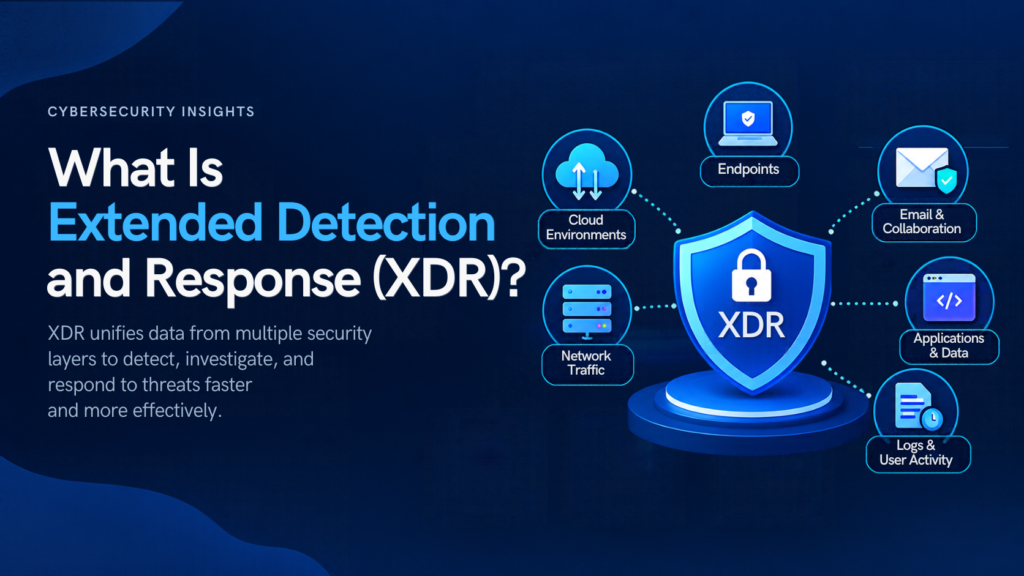
XDR’s detection capability is bounded by the telemetry it receives. The broader the instrumentation, the larger the cross-layer attack chains it can surface. XDR platforms typically correlate across these layers:
Endpoint layer. Process execution, file creation and modification, memory activity, and network connections at the host level, the same data an EDR collects, serving as the XDR’s endpoint foundation.
Network layer. East-west traffic between internal systems and north-south traffic at the perimeter. Network telemetry allows XDR to detect lateral movement patterns that appear normal in isolation at the endpoint but reveal themselves as anomalous when correlated with authentication events.
Identity and authentication layer. Authentication logs from Active Directory, Azure AD, Okta, or similar identity providers. This layer is critical for detecting credential-based attacks: an attacker using stolen credentials generates valid authentication events that look normal in isolation but correlate with suspicious endpoint or network activity. This layer typically requires dedicated detection logic beyond what standard authentication logging provides, since valid credentials used by an attacker look identical to valid credentials used by the account owner.
Cloud workload layer. API calls, resource creation and deletion, permission changes, and workload activity in AWS, Azure, or GCP environments. Cloud telemetry enables XDR to detect cloud-targeted attack techniques such as IAM privilege escalation, resource enumeration, and cross-account lateral movement.
Email layer. Phishing delivery events, malicious attachment detections, and link click activity. Email is a common initial access vector, and correlating email events with subsequent endpoint activity surfaces the full attack chain from initial delivery to execution.
What Does XDR Detect That Siloed Tools Miss?
The specific advantage of XDR is in detecting attack techniques deliberately designed to stay below the detection threshold of individual tools. These techniques are common in targeted attacks precisely because they evade single-layer detection:
Lateral movement via legitimate credentials. An attacker who compromises a service account and uses it to authenticate across multiple internal systems generates valid authentication events in the identity logs and normal-looking connections in the network tool. Neither triggers an alert independently. XDR correlates the authentication pattern against the network connections and endpoint activity, surfacing the anomalous movement pattern as a single high-priority detection.
Living-off-the-land execution. Attackers who use built-in operating system tools, including PowerShell, WMI, certutil, and mshta, generate legitimate process executions that do not match malware signatures. Each individual event is normal. XDR’s cross-layer correlation connects the process execution on the endpoint with outbound network connections and subsequent authentication events, producing a detection based on the combination rather than any single event.
Slow exfiltration. Data transfers below the threshold for individual egress alerts accumulate across time into a significant exfiltration event. XDR can correlate file access events on the endpoint with network transfer events and cloud storage API calls to surface exfiltration that would remain invisible to tools monitoring any single layer.
Credential theft followed by cloud escalation. An attacker who harvests credentials from an endpoint and uses them to escalate privileges in a connected cloud environment generates an endpoint event (credential access) and a cloud event (privilege escalation) that are causally connected but appear in separate tools. XDR correlates the sequence and identifies the attack chain.
What Are the Limitations of XDR?
XDR’s detection capability is bounded by two factors: the quality of its detection logic and the completeness of its telemetry. Both are failure modes in practice.
Detection logic coverage. XDR platforms detect what their detection libraries cover. Attack techniques that have not been incorporated, including novel techniques, modified payloads, and attacker-specific tradecraft adapted to evade known detections, do not produce alerts. This gap between claimed coverage and actual detection is the most significant operational risk in XDR deployments.
Breach and attack simulation is the direct method for measuring this gap: BAS platforms execute real attack techniques against the live environment and measure whether the XDR detects, alerts on, and responds to each one. Organizations that deploy XDR without running this validation are operating on the assumption that the detection library covers the techniques being used against their environment, an assumption that fails consistently in Bugstrix red team engagements, where techniques modified to avoid known signatures routinely bypass XDR detections.
Telemetry gaps. An asset that does not feed telemetry into the XDR is invisible to it. A single endpoint without an EDR agent, a cloud workload with logging disabled, or an identity system not integrated with the XDR platform each represents a layer of the environment where the XDR has no visibility. Attackers who identify these gaps can operate within them without generating any detections. Maintaining accurate telemetry coverage requires ongoing tracking of which assets are instrumented and validation that telemetry is actually flowing from all expected sources.
Alert fatigue and tuning debt. XDR reduces alert volume compared to SIEM through higher-confidence correlation-based detections, but it does not eliminate false positives. An XDR deployment that has not been tuned to the specific environment’s behavioral baseline will generate detections on normal activity, eroding analyst confidence in the platform’s output.
The only way to know whether a detection library actually covers the techniques an attacker would use against your environment is to test it directly. Get a free quote for a penetration testing engagement that validates what your XDR deployment catches and what it misses.
How Does XDR Fit Into a Broader Security Program?
XDR provides detection and response capability for the environment it monitors. It does not address the external attack surface, the exposure of assets the security team does not know exist, or the attack paths that exist within the environment before detection becomes necessary.
External attack surface visibility. XDR monitors the inside of the environment. Attack surface management addresses the outside: identifying internet-exposed assets, discovering shadow IT infrastructure, and mapping external exposure that never generates internal telemetry because it sits outside the monitored perimeter. An asset that is not in the XDR’s telemetry scope is not protected by it, and XDR’s coverage map is limited to what has been explicitly instrumented. Our security assessment services cover this external exposure layer that XDR cannot see.
Attack path awareness. XDR detects movement through the environment once an attack begins. Attack path analysis maps the routes that exist within the environment before they are used: identifying which combinations of misconfigurations, overpermissive roles, and trust relationships create viable paths from initial access to high-value targets. This preemptive mapping allows security teams to eliminate attack paths before exploitation rather than detecting movement along them after the fact.
Offensive validation of detection coverage. Knowing that XDR is deployed is not the same as knowing that XDR will detect the techniques being used against the environment. Our continuous penetration testing validates the detection layer by executing real attack techniques in the environment and confirming which ones produce XDR detections, which ones do not, and which detection gaps represent the highest remediation priority.
Frequently Asked Questions
Is XDR the same as MDR?
No. MDR (Managed Detection and Response) is a service delivery model: a team of analysts who operate detection and response tooling on a client’s behalf. XDR is a platform category. An MDR provider may use XDR as the underlying technology, but the terms describe different things: one is who does the work, the other is the tool doing it.
Does XDR replace a SIEM?
For detection and response functions, XDR can handle what SIEM previously attempted with better signal-to-noise through correlation-based detection. However, SIEM serves compliance logging and long-term log retention requirements that XDR does not address. Organizations with regulatory obligations for log retention or compliance-specific reporting typically run both rather than replacing SIEM entirely.
How is XDR different from NDR?
NDR (Network Detection and Response) covers only the network layer. XDR extends detection across endpoint, network, identity, and cloud layers and correlates events across all of them. NDR addresses one component of what XDR aims to cover.
Can XDR detect insider threats?
XDR can detect behavioral patterns consistent with insider threat activity: anomalous data access volumes, off-hours authentication, bulk data movement. Effective insider threat detection requires behavioral baselines and deep identity context that most XDR platforms do not provide out of the box. Tools that focus specifically on identity behavior analysis are often better suited for this use case.
What is the difference between native XDR and open XDR?
Native XDR integrates tools from a single vendor across all telemetry layers, providing tighter integration and simpler deployment. Open XDR (or hybrid XDR) ingests telemetry from third-party tools across layers, preserving existing tool investments at the cost of more complex integration and maintenance. The choice depends primarily on whether the organization can consolidate around a single vendor’s security stack.
The Bottom Line on XDR
XDR solves a real problem in security operations: the inability to connect signals across isolated tools into coherent attack chain detections. Cross-layer correlation is genuinely more effective than attempting to correlate between separate tools through analyst effort, and the platform category has matured to the point where deployments are operationally viable for organizations of meaningful scale.
What XDR cannot do is replace the offensive perspective. Detection platforms tell you what they caught. They do not tell you what they missed, and the techniques that evade detection are precisely the ones being used in targeted attacks. Bugstrix works with organizations deploying or validating XDR to identify detection coverage gaps, test detection logic against real attack techniques, and eliminate the attack paths within the environment that XDR monitors but cannot prevent.