How Much Does a Cloud Security Assessment Cost?

Written By
Sarwat Iftikhar
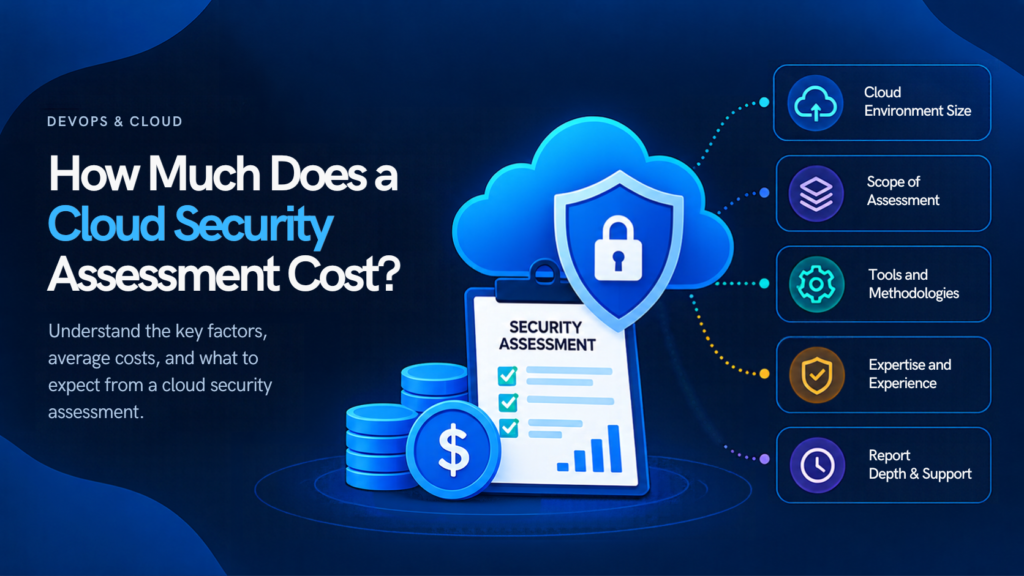
Cloud security assessment pricing ranges from a few thousand dollars for a basic configuration review to tens of thousands for a full-scope cloud penetration test across a complex multi-cloud environment. The range is wide because “cloud security assessment” covers several distinct types of work, and the scope, methodology, and cloud complexity each drive cost independently.
Understanding what you are buying before you receive a proposal is the most effective way to evaluate whether a price is appropriate. A proposal for a cloud configuration review and a proposal for a cloud penetration test may use similar language but describe fundamentally different engagements. The price difference between them is not a markup it reflects a difference in the depth of analysis, the methodology applied, and what the report can confirm about your security posture.
This post covers the factors that drive cloud security assessment cost, what different assessment types typically include, and how to evaluate whether a quote reflects the scope your environment requires.
Key Takeaways
- Cloud security assessment costs range from approximately $3,000 for a baseline configuration review to $50,000 or more for a full-scope enterprise cloud penetration test. The variation reflects genuine differences in scope and methodology, not just provider markup.
- The primary cost drivers are cloud environment size and complexity, the number of accounts and services in scope, the assessment methodology (configuration review versus active exploitation), and the provider’s engagement model.
- A cloud penetration test costs more than a configuration review because it involves active exploitation, not just analysis. Both serve different purposes and are not substitutes for each other.
- Bugstrix engagement data consistently shows that organizations that scope the assessment to match their actual cloud footprint get more actionable findings than those who purchase a fixed-tier package that was not designed for their environment.
- The cost of a cloud security assessment should be evaluated against the cost of a cloud breach in your environment, not against the cost of skipping assessment.
What Is a Cloud Security Assessment?
A cloud security assessment is an evaluation of the security posture of an organization’s cloud infrastructure, covering the configuration, access controls, network architecture, data exposure, and vulnerability profile of cloud-hosted assets and services.
Unlike a traditional network penetration test, a cloud security assessment must account for the configuration layer: cloud environments can be technically uncompromised but materially insecure through misconfigured storage buckets, overpermissive IAM roles, disabled logging, or publicly exposed services. These configuration risks exist independently of vulnerabilities in deployed software and require a different evaluation methodology to surface. Our post on what a cloud security assessment involves covers the full scope of what a thorough assessment addresses and how findings differ from traditional penetration test output.
A cloud security assessment typically covers some combination of: infrastructure configuration review, IAM policy analysis, network segmentation review, data exposure analysis, vulnerability assessment of cloud-hosted assets, and active penetration testing of the cloud attack surface. Which components are included determines both the depth of the findings and the cost of the engagement.
What Factors Determine the Cost of a Cloud Security Assessment?
No single factor determines cloud security assessment cost in isolation. Pricing is a function of several variables that interact with each other, and a meaningful estimate requires understanding all of them.
Cloud environment size and complexity. The number of accounts, projects, subscriptions, regions, and services in scope is the primary volume driver. A single-account AWS environment hosting one application is assessed in far less time than a multi-account, multi-region environment with dozens of services, cross-account roles, and a mix of IaaS and managed services. Bugstrix cloud security assessment scoping begins with an environment inventory specifically because this variable has more impact on engagement cost than any other.
Assessment methodology. Configuration review and active penetration testing are different methodologies requiring different skills, tools, and time investment. A configuration review analyzes how the environment is set up, whether IAM policies follow least privilege, whether storage is publicly accessible, and whether logging is enabled. A cloud penetration test does all of that and then attempts to exploit what it finds: escalating privileges, moving laterally between accounts, accessing data, and demonstrating the real-world impact of identified weaknesses. Penetration testing takes more time, requires more experienced testers, and produces a deeper class of findings.
Number of services in scope. Cloud environments often use dozens of services with distinct security considerations: compute instances, managed databases, object storage, serverless functions, container orchestration, API gateways, identity services, and more. Each service category has its own configuration risk profile and requires specific assessment coverage. A scope that covers only compute and storage will miss significant risk in serverless and IAM layers.
Compliance requirements. Organizations testing to meet PCI DSS, SOC 2, HIPAA, or ISO 27001 requirements often need specific deliverables, documentation, and testing coverage that go beyond a standard engagement. Compliance-scoped assessments typically cost more because the documentation, evidence collection, and remediation guidance format must align with auditor expectations rather than just producing technically useful findings.
Provider engagement model. Fixed-scope packages, custom-scoped engagements, and retainer-based continuous assessments are priced differently. A fixed-scope package may be cheaper but may not match your environment’s actual risk profile. A custom engagement costs more to scope but is designed for what you have, which typically produces more actionable findings. Our security assessment services are scoped to the specific environment rather than sold as a fixed package.
What Do Different Types of Cloud Security Assessments Cost?
Cloud security assessment pricing varies significantly by assessment type. The following ranges reflect Bugstrix’s engagement data across client environments of varying size and complexity.
The ranges above assume a custom-scoped engagement. Fixed-tier packages may undercut these prices but typically do so by limiting account coverage, excluding specific service categories, or applying a configuration review methodology where a penetration test methodology would produce more actionable findings for the environment in question.
What Is the Difference Between a Cloud Configuration Review and a Cloud Penetration Test in Cost and Scope?
The configuration review and the cloud penetration test are the two most commonly purchased cloud security assessment types, and they are frequently confused because proposals for both use similar language around “cloud security assessment.” The difference in cost reflects a genuine difference in what each engagement does.
A cloud configuration review analyzes how the environment is set up. The assessor reviews IAM policies for overpermissive roles, checks storage configurations for public exposure, verifies that logging and monitoring services are enabled and correctly configured, reviews network security group rules, and validates that encryption is applied to data at rest and in transit. This work is primarily analytical: the assessor is evaluating configuration against a security baseline, not attempting to exploit what they find. Cloud Security Posture Management tools provide automated coverage for the same configuration layer our post on CSPM covers how automated configuration monitoring works and where manual review adds findings that tooling misses.
A cloud penetration test does everything a configuration review does and then goes further: the tester attempts to exploit identified weaknesses, escalate privileges within and across accounts, move laterally through the environment, access data, and demonstrate the actual business impact of the configuration issues found. This active exploitation phase requires more time, more skilled testers, and produces a different class of findings; specifically, it confirms which configuration issues are genuinely exploitable and how severe the consequences of exploitation are in the real environment. Our cloud penetration testing services cover the full cloud attack surface, including IAM privilege escalation, lateral movement between accounts, and data exfiltration path analysis.
The price difference between the two is not arbitrary. An organization that purchases a configuration review when they need a penetration test will receive a useful analysis of how the environment is configured but will not learn whether those configurations can be chained into a meaningful attack path. An organization that purchases a penetration test when a configuration review would suffice pays more than necessary for their current risk profile.
What Should You Budget for Beyond the Initial Assessment?
The engagement fee covers the assessment and the report. Organizations that plan for only that cost typically encounter budget friction when it comes time to act on the findings.
Remediation work. Cloud security assessment findings frequently require engineering time to address: revising IAM policies, reconfiguring network rules, enabling logging, rotating credentials, or restructuring account hierarchies. Depending on the severity profile of findings, remediation work can range from a few hours to several weeks of engineering time. Organizations running lean cloud teams should account for this capacity requirement in the planning phase rather than discovering the constraint after the report arrives.
Retesting. A quality cloud security assessment engagement includes a remediation verification cycle in which the testing team confirms that critical and high findings have been effectively addressed. If the initial engagement does not include retesting, budget separately for a follow-up engagement. Unverified remediation may not fully close the identified vulnerabilities, particularly for IAM and privilege escalation findings where the fix involves complex policy changes.
Vulnerability assessment for cloud-hosted assets. A cloud penetration test focuses on the cloud attack surface: IAM, configuration, access controls, and architecture. It does not systematically cover known CVEs in the software running on cloud infrastructure. Pairing the cloud assessment with a vulnerability assessment of cloud-hosted assets ensures that both the configuration layer and the software vulnerability layer are covered in the same assessment cycle.
Tooling for ongoing coverage. A point-in-time cloud security assessment describes the posture at the time of testing. Cloud environments change continuously, and a configuration that was compliant at the time of assessment may drift within weeks of the engagement. Organizations that want ongoing visibility between assessment cycles typically invest in cloud security posture management tooling, automated configuration monitoring, or a continuous assessment engagement to maintain assurance between point-in-time tests.
Is the Cost of a Cloud Security Assessment Justified?
Cloud breaches have a structural characteristic that traditional network breaches do not: the blast radius is rarely contained. In a traditional environment, a compromised server is a compromised server. In a cloud environment, a single overpermissive IAM role can give an attacker the ability to create new accounts, enumerate all resources, exfiltrate data from every storage service, and establish persistence across the environment before a single alert fires. The compromise is not a server; it is the control plane. Bugstrix cloud penetration testing engagements find at least one IAM path to full environment takeover in a significant portion of assessed environments.
Storage misconfiguration follows a different pattern but an equally serious one. A misconfigured S3 bucket or Azure Blob container is not a latent risk; it is active exposure from the moment the misconfiguration was introduced. The data is accessible from the public internet while the organization is unaware. The cost of that exposure is not hypothetical; it is ongoing. The remediation cost after discovery (forensic investigation to determine what was accessed, breach notification to affected parties, regulatory response if the data falls under a compliance regime, and potential rebuilding of downstream processes that relied on access controls that no longer existed) is orders of magnitude higher than the engineer time required to correct the configuration before exposure.
The cost comparison is not abstract. Correcting an overpermissive IAM role before exploitation is an engineer making a policy change. Responding to an IAM-based environment takeover is forensic investigation, credential rotation across every account, audit of all actions taken during unauthorized access, and in most cases breach notification. Correcting a misconfigured storage policy before data access is a single configuration change. Responding to a storage exposure is data classification, affected-party notification, and regulatory response for every record that was accessible. The assessment cost is a fraction of either response scenario, applied before the scenario occurs.
Frequently Asked Questions
How does cloud security assessment cost compare to a traditional penetration test?
Cloud security assessments typically cost more than equivalently scoped traditional penetration tests because cloud environments require specialized assessment methodology that covers both the vulnerability and configuration layers. A traditional network penetration test does not address cloud IAM, misconfigured storage, or cross-account privilege escalation paths. The expanded scope requires additional skills and more assessment time. Our post on penetration test cost in 2026 covers traditional penetration testing pricing in detail for comparison.
Does cloud provider choice affect assessment cost?
Yes, in two ways. First, different cloud providers have different service architectures, IAM models, and configuration surface areas, which affects how much specialist knowledge the assessment requires. Second, environments using a single cloud provider are simpler to assess than multi-cloud environments, where the assessor must cover multiple control planes, IAM models, and configuration risk profiles. A single-provider AWS environment is assessed more efficiently than an AWS plus Azure plus GCP environment of equivalent size.
Is a cheaper cloud security assessment less thorough?
Not always, but scope reduction is the most common way providers reduce price. A lower-cost engagement may cover fewer accounts, fewer service categories, or use a configuration review methodology where a penetration test methodology would produce more actionable findings. Before accepting a lower-cost proposal, ask specifically what is excluded from scope and whether active exploitation is included or only configuration analysis.
How long does a cloud security assessment take?
Timeline varies by scope. A focused configuration review of a single-account environment can be completed in three to five business days. A full-scope cloud penetration test of a complex multi-account environment may take two to four weeks for the assessment phase, with additional time for remediation verification. Organizations with compliance deadlines should factor timeline into the scoping conversation, as rushing an assessment to meet an audit date typically reduces coverage.
How do I know if a cloud security assessment proposal is scoped correctly?
A well-scoped proposal explicitly states the number of cloud accounts in scope by name, specifies whether the engagement includes active exploitation or configuration review only, and lists the service categories covered. If a proposal says “cloud security assessment” without specifying which accounts are included, it cannot be evaluated for completeness; the pricing may be built for a simpler environment than yours. Ask specifically: are all accounts in scope or only production? Does active exploitation of IAM and privilege escalation paths fall within the engagement? Which service categories are covered: compute only, or also serverless, managed databases, container workloads, and API gateways? A provider that cannot answer these questions before proposal acceptance is likely quoting a fixed-scope package that may not fit your environment.
How often should a cloud security assessment be conducted?
Cloud environments change frequently, which means assessment results become stale faster than traditional network assessment results. Organizations with active cloud development should conduct a full cloud security assessment at least annually, with targeted assessments after significant infrastructure changes, new account additions, or major architecture changes. The faster the environment changes, the shorter the valid window of a point-in-time assessment.
The Right Assessment for the Right Environment
Cloud security assessment cost is determined by what the assessment needs to cover to give you an accurate picture of your cloud security posture. A price that is lower than the market range typically reflects scope that does not match the environment, not a better deal. A price that is higher than expected for the scope described warrants detailed questions about what is driving the premium.
Bugstrix’s approach to cloud security assessment pricing starts with an environment inventory and a scoping conversation before a proposal is issued, because an accurate price requires an accurate picture of what needs to be assessed. An organization with a single-account environment should not pay for enterprise multi-cloud coverage. An organization with a complex, multi-account environment should not receive a price built for a simpler scope.
The assessment that fits your environment is the one that surfaces the findings your cloud configuration actually contains and at a cost that reflects the work required to find them.