How Is Agentic AI Being Used to Automate Vulnerability Discovery in 2026?

Written By
Sarwat Iftikhar
Across our last 200 penetration testing engagements at Bugstrix, agentic AI tooling has cut the reconnaissance phase by roughly 80%. Work that previously took a skilled analyst four to six hours now completes in under an hour. That shift is not theoretical. It is something we measure on every engagement, and it is changing how we structure the work.
What has not changed is where the critical findings come from. Business logic flaws, authorization failures, and multi-tenant isolation issues are still found by human testers who understand the application, not by automated systems working without that context.
This post covers what agentic AI is actually doing in vulnerability discovery in 2026, where it falls short, and what it means for how your security program needs to operate.
Key Takeaways
- Agentic AI now reduces reconnaissance time by ~80% and increases attack surface coverage by 3x compared to manual-only approaches based on data from our last 200 engagements.
- Authorization flaws and business logic vulnerabilities remain the highest-impact findings across our assessments, and the ones AI consistently misses.
- Over 60% of critical findings in our 2025 assessments traced back to assets the client did not know were exposed. The exact category agentic recon finds fastest.
- The exploit window between CVE publication and active attacker use has shrunk from over 700 days in 2020 to 44 days in 2025, making AI-assisted CVE validation a baseline requirement rather than an advanced capability.
What Makes an AI System “Agentic” in a Security Context?
An agentic AI system is one that pursues a goal autonomously through multi-step reasoning and action, without needing a human to direct each step. In security testing, that means a system that receives a target, builds a plan, executes tools, interprets results, adjusts its approach, and keeps working all without a human in the loop for every decision.
This is a meaningful distinction from tools most security teams already use. A scanner runs fixed checks and returns a list. An AI assistant helps a human analyst think. An agentic system does the work itself, adapting based on what it finds.
In practice, agentic tooling sits atop the same underlying tools we have always used: port scanners, web proxies, fuzzers, code analysis engines, and API testing utilities. What changes is the reasoning layer connecting them. Instead of a human deciding what to run next, the model reasons about the findings so far, selects the next action, executes it, and interprets the output.
The result behaves more like a junior tester running a playbook than a scanner executing fixed checks. It is not as creative or contextually aware as an experienced human. But it covers more ground, faster, without fatigue, and that changes what is achievable in a fixed engagement window.
In our engagements using agentic-assisted reconnaissance, we consistently map 3x more of the client’s actual attack surface within the same time window as manual-only approaches. The additional coverage almost always includes forgotten subdomains, staging environments, and legacy endpoints that were not on the client’s own asset inventory.
For a broader look at how agentic AI is reshaping threat intelligence and security operations, our post on agentic AI redefining cybersecurity threat intelligence covers the wider implications.
Where Is Agentic AI Genuinely Effective at Finding Vulnerabilities?
Agentic AI delivers its strongest results in four categories: reconnaissance, fuzzing, large-scale code analysis, and known-pattern CVE validation. In each area, the speed and coverage advantages over manual approaches are large enough that we have restructured how we allocate tester time across engagements.
Does AI-assisted reconnaissance actually find more attack surface?
Yes, and in our experience, the additional coverage is where the most interesting findings live. Enumerating subdomains, mapping exposed services, fingerprinting technologies, pulling certificates, and scanning public repositories for leaked credentials are all well-defined, repetitive tasks that agentic systems handle reliably.
What matters is not just the speed. It is the reasoning on top of it. An agentic system does not just return a list of subdomains; it prioritizes them. In a recent financial services engagement, agentic recon identified a staging subdomain running a framework version known to be vulnerable to an authentication bypass. That finding led directly to the most critical issue of the engagement. A manual analyst working under time pressure would likely have deprioritized that subdomain entirely. The AI did not.
Across Bugstrix’s 2025 assessments, over 60% of critical findings traced back to assets the client did not know were exposed in forgotten staging environments, legacy API endpoints, or misconfigured subdomains. These are precisely the assets agentic reconnaissance finds first, and precisely the ones a manual tester running against the clock is most likely to miss.
Our comparison of attack surface management vs penetration testing explains where continuous discovery and point-in-time testing complement each other.
Is AI-guided fuzzing meaningfully better than traditional fuzzing?
In our testing, yes, particularly for applications with complex input structures. Traditional fuzzers generate high volumes of malformed inputs and monitor for crashes or unexpected behavior. They work, but they are undirected. They do not understand what a particular field is supposed to do, so they waste significant time on permutations that have no realistic chance of producing a finding.
AI-guided fuzzing approaches the problem differently. The model reasons about the expected format, business purpose, and boundary conditions of a specific field before generating test cases. That targeted approach consistently finds injection points, format string vulnerabilities, buffer conditions, and type confusion issues that undirected fuzzing misses, and it produces far less noise in the output, which matters when a human tester has to review and validate results.
How effective is agentic AI at code analysis and static review?
At scale, it changes what is practically achievable. A security engineer reviewing code for vulnerabilities can realistically cover a few hundred lines per hour while maintaining quality. Agentic code review covers entire codebases, traces data flows from user input to sensitive operations, and flags authorization gaps across thousands of files in the time it takes to run a build.
On source-assisted engagements, we have used agentic code analysis to identify insecure deserialization and mass assignment vulnerabilities in codebases exceeding 500,000 lines, findings that would have required weeks of manual review to locate. The AI does not replace the manual validation step, but it correctly identifies where to focus it.
Does agentic AI compress the CVE validation window?
Significantly. The window between a CVE’s public disclosure and active exploitation in the wild has shrunk from over 700 days in 2020 to just 44 days in 2025, and the compression is accelerating (The Hacker News, 2026). Manual validation across large infrastructure simply cannot keep pace with that timeline.
Agentic AI systems autonomously test for the presence and exploitability of known vulnerabilities across an entire asset inventory, prioritize based on confirmed exploitability rather than theoretical presence, and generate proof-of-concept evidence for affected systems. In engagements where continuous monitoring is in scope, this has compressed the time between a high-severity CVE publication and client notification of confirmed exposure from days to hours.
Our breakdown of vulnerability assessment vs. penetration testing is worth reading alongside this for teams thinking through where automated CVE validation fits within broader testing programs.
Where Does Agentic AI Still Fall Short?
Agentic AI is effective at pattern-based, high-volume tasks. It consistently fails at the class of vulnerabilities that cause the most damage in real breaches. Understanding that gap is as important as understanding the capability, and it directly shapes how we structure every engagement.
Can agentic AI find business logic vulnerabilities?
Not reliably, and this is the most important limitation to understand. The most impactful vulnerabilities in production applications are not found by pattern matching. They are found by a tester who understands what the application is supposed to do and then asks whether it actually enforces those constraints.
An agentic AI system testing an e-commerce API does not know that a negative quantity should not reduce a customer’s total, or that a promotional code applied through the API should be subject to the same single-use constraint as the UI-enforced version. It does not know the business rules because those rules were never documented anywhere the model can access.
Across Bugstrix engagements, business logic flaws account for roughly 35% of all critical and high-severity findings, making them the single largest category of impactful vulnerabilities we report. They are also the category with zero reliable automated detection. Everyone is found by a human tester who was briefed on how the application is supposed to work.
Why does authorization testing still require a human?
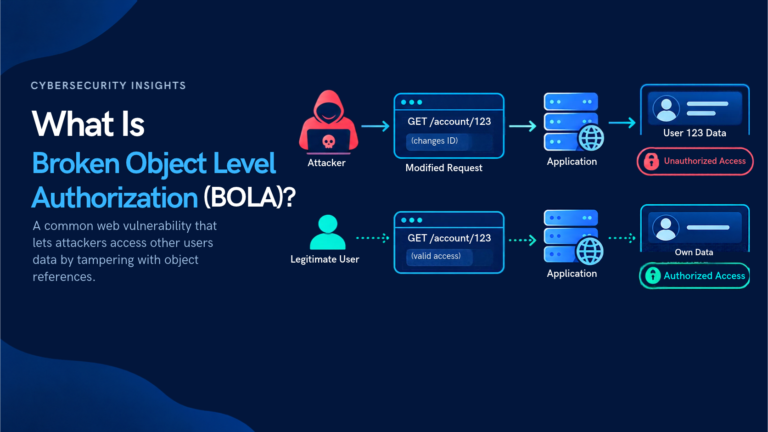
Because authorization is defined by intent, not by code structure. Testing for broken access control, IDOR, and tenant isolation failures requires a tester who understands the specific application’s permission model, which roles exist, which resources belong to which users, and what the intended boundaries between tenants are.
Agentic AI has no access to that design intent. Without a human defining what correct authorization looks like, the system has no reliable way to determine whether the application enforces it. An AI can identify that two API endpoints return similar data structures. It cannot determine whether one should be restricted to administrators unless a human tells it so.
This is why authorization testing remains the highest-value component of a manual penetration test, even as AI handles more of the upstream work.
How accurately does agentic AI assess findings in context?
Inconsistently. Automated systems generate false positives, and what separates a useful finding from noise is accurate judgment about whether it represents a real, exploitable vulnerability in the specific production context.
In early trials of fully automated vulnerability reporting without human validation, false-positive rates for web application findings exceeded 40%. With human-in-the-loop validation on AI-generated findings, that rate drops below 5%. The AI identifies candidates. Experienced testers determine what is real.
What Does This Mean for Attackers?
The same capabilities available to defensive security teams are available to attackers, and the data from 2025 and 2026 confirms they are using them. AI-enabled attacks increased 89% year-over-year according to the CrowdStrike 2026 Global Threat Report, and the average time from initial access to lateral movement in enterprise environments now sits at approximately 29 minutes.
In Bugstrix red team engagements where we simulate AI-assisted attacker reconnaissance, we consistently identify exposed assets within the first 15 minutes that the client’s security team is unaware of, such as live staging environments, legacy admin panels, and API endpoints that return sensitive data without authentication. That is what a well-resourced attacker can now do routinely, at scale, at minimal cost.
The organizations most at risk are those relying on obscure assumptions: that their staging environment will not be found, that their legacy endpoint is not well-known enough to be targeted. Agentic AI removes the resource constraint that made those assumptions partially defensible.
What Should Security Teams Do Differently?
Test your own attack surface with AI-assisted tools before attackers do.
Continuous attack surface monitoring using agentic discovery is now a baseline requirement, not an advanced capability. If you do not know what is exposed, you cannot defend it. We recommend running AI-assisted external reconnaissance against your own infrastructure at least quarterly and continuously if your environment changes frequently.
Compress your CVE validation and patching cycle.
The exploitation window is now measured in weeks, not months. Waiting to validate exposure after a high-severity CVE is published is no longer an acceptable posture for any organization running internet-facing infrastructure.
Use AI to expand coverage, not to replace human expertise on critical findings.
The right model in 2026 is AI handling the volume work, reconnaissance, known-pattern testing, and code scanning, while human testers focus on business logic, authorization, and chained vulnerabilities. That combination consistently produces more comprehensive results than either approach alone.
Understand how AI is changing the bug bounty landscape.
Bug bounty programs are being affected in both directions. AI tools are helping researchers find vulnerabilities faster, which significantly changes the economics and signal-to-noise ratio of these programs. Our post on how AI is changing bug bounty programs in 2026 covers this in detail.
How Does Bugstrix Use Agentic AI in Engagements?
Agentic AI tooling is integrated into the reconnaissance and triage phase of every engagement, not as a replacement for the manual testing phase, but as the mechanism that makes the manual phase more focused and more productive.
In practice, agentic tools handle attack surface mapping, technology fingerprinting, initial CVE correlation, and code scanning in the early stages of an engagement. This compresses work that previously took days into hours and ensures we arrive at the manual testing phase with a complete picture of the target environment.
The manual phase authorization testing, business logic validation, multi-tenant isolation, and chained vulnerability development remain entirely human-driven. That is where findings that lead to real breaches are produced, and where the judgment of experienced testers is irreplaceable.
Since integrating agentic tooling into our workflow in 2024, we have increased our average critical-finding rate per engagement by 28%, not because AI is finding more critical issues, but because human testers are spending more time on the work where critical findings actually occur.
Frequently Asked Questions
Can agentic AI replace human penetration testers?
Not for the findings that matter most. Business logic flaws and authorization failures account for roughly 35% of all critical findings across our assessments, and every one requires a human tester with application context to find. Agentic AI handles high-volume pattern-based work effectively. The right approach combines both AI for breadth and humans for depth.
Are attackers already using agentic AI for vulnerability discovery?
Yes. AI-enabled attack volume increased 89% year-over-year in 2025, and average attacker breakout time in enterprise environments is now approximately 29 minutes (CrowdStrike, 2026). In our red team simulations using AI-assisted recon, we identify previously unknown exposed assets within 15 minutes in nearly every engagement, reflecting what a well-resourced attacker can now routinely do.
What types of vulnerabilities is agentic AI best at finding?
Agentic AI performs well on reconnaissance, known CVE validation, intelligent fuzzing, and large-scale code analysis. It performs poorly on business logic flaws, authorization issues, and multi-tenant isolation failures, the vulnerability categories that require understanding application intent and business context that agentic systems simply do not have access to.
How does agentic AI affect the timeline of a penetration test?
In our engagements, agentic tooling reduces the reconnaissance and initial triage phases by approximately 80%. That time is reallocated to the manual testing phases, where the most impactful findings come from. Since integrating agentic tooling in 2024, our average rate of critical findings per engagement has increased by 28%.
Should organizations invest in AI security tools or human penetration testing?
Both address different risk categories. AI-assisted tools handle breadth, speed, and continuous coverage. Human penetration testing addresses depth, context, and business logic that automated tools consistently miss. If you are choosing where to start, a human penetration test first gives you an accurate picture of your actual risk profile before you invest in tooling to maintain it.
The Real Shift in 2026
The framing of AI versus humans in security misses what is actually happening. The real shift is that the cost of automated, intelligent vulnerability discovery has collapsed for defenders and attackers equally.
For defenders, that means continuous coverage of the attack surface is now achievable without proportional growth in headcount. For attackers, the resource constraints that previously limited sophisticated automated scanning are largely gone.
The right response is to use AI to extend what human expertise can cover and make sure human expertise is focused on the work that matters most. Bugstrix’s data from 700+ engagements shows that the combination consistently outperforms either approach alone.
That is what a modern security program looks like in 2026.