When Should a Startup Start SOC 2 Compliance?

Written By
Sarwat Iftikhar
The most common mistake startups make with SOC 2 is not starting too early. It is starting too late, at the moment an enterprise prospect asks for the report during a deal, and the company realizes it does not have one.
SOC 2 compliance is not something you can sprint through in four weeks. The Type II report that most enterprise buyers actually require covers a six to twelve-month observation period of sustained security controls, which means the earliest you can hold a completed Type II report is six to twelve months after you start. If you begin when a deal demands it, you are already almost a year behind.
This post covers when actually to start, what signals tell you the time is right, what needs to be in place before you begin, and how long the realistic process takes from kickoff to a completed report.
Key Takeaways
- Most startups should begin SOC 2 preparation at their first enterprise sales conversation, not when the deal closes or when a prospect makes it a hard requirement.
- SOC 2 Type II evaluates control operating effectiveness over a defined review period, so startups should agree the audit timeline and evidence period with their CPA well before customers require the report.
- Starting at the point when a deal demands it means the earliest a Type II report can exist is a year later, which is usually too late for the deal that prompted it.
- Penetration testing can support SOC 2 control evidence, but the expected testing scope and timing should be confirmed with the auditor based on the organization’s environment and risk profile.
- In Bugstrix engagements with early-stage startups, the companies that begin security program work six months before their first enterprise sales process have a dramatically smoother certification experience than those reacting to a deal.
What Is SOC 2 and Why Do Startups Need It?
SOC 2 is an attestation framework used by CPAs to evaluate and report on controls at service organizations relevant to security, availability, processing integrity, confidentiality, or privacy. For a startup, it is the security credential that enterprise buyers, regulated industry customers, and investors increasingly require before signing a contract or closing a funding round. Without it, the question of security trust becomes a manual negotiation on every deal rather than a credentialed answer.
The framework evaluates five Trust Services Criteria: Security, Availability, Processing Integrity, Confidentiality, and Privacy. Security is mandatory. The others are selected based on what your product commits to. What the framework actually requires is evidence that your security controls are suitably designed and operating effectively, not a checklist of specific tools or configurations.
For an early-stage startup, SOC 2 matters because the buyers willing to pay the highest contract values are also the ones most likely to conduct a security review as part of their procurement process. Enterprise buyers have legal and regulatory obligations that make them unwilling to sign contracts with vendors who cannot demonstrate security maturity. SOC 2 is the most widely recognized way for a software company to demonstrate that maturity in a standardized, auditor-verified format.
When Should a Startup Actually Start SOC 2?
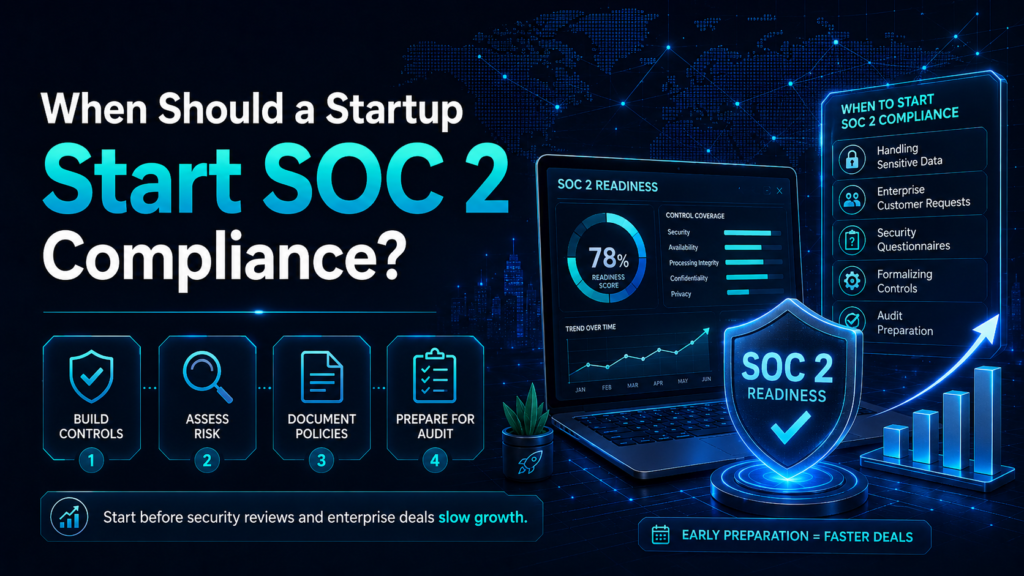
A startup should begin SOC 2 preparation when it has its first serious enterprise sales conversation, which, in most cases, is well before a deal requires the report and before the startup thinks it is ready. The trigger should be the direction the sales pipeline is heading, not a hard requirement from a specific deal that is already in progress.
The reasoning is straightforward. A completed SOC 2 Type II report requires a six- to twelve-month audit observation period after controls are in place. Before that, you need a readiness period to implement controls, fix gaps, and commission a penetration test. Realistically, from a standing start, a startup is looking at nine to eighteen months before holding a completed Type II report. If an enterprise deal needs it in three months, that timeline is impossible to meet.
Starting with the signal of enterprise pipeline activity, rather than the moment of enterprise deal pressure, means the report is in place before it becomes an obstacle. That is the position a startup wants to be in.
There is also a business case argument beyond just having the report ready. SOC 2 preparation forces a startup to formalize its security policies, access controls, incident response procedures, and vendor management practices. These are things a growing startup needs in place, regardless of compliance requirements. Beginning SOC 2 positions compliance as the organizational structure that formalizes what good security practice already requires rather than a separate project layered on top.
What Are the Signs a Startup Is Ready to Begin?
A startup is ready to begin SOC 2 when it has a defined product in production, a stable infrastructure environment, enterprise prospects in the pipeline or actively being pursued, and an internal owner who can drive the compliance process without it sitting on no one’s desk. None of these require a specific revenue threshold or team size.
The signs that indicate the timing is right:
Enterprise sales conversations are starting. When prospects representing meaningful contract values begin asking security questions, requesting security questionnaires, or mentioning compliance certifications as part of their evaluation criteria, the signal is clear. The pipeline is moving toward the customer tier that will eventually require SOC 2.
Customer security questionnaires are taking a significant amount of time to complete. Early-stage companies answer security questionnaires manually for each enterprise prospect. When the time and repetition of that process becomes painful, it is a sign the volume of enterprise interest justifies a credential that replaces the manual process.
Infrastructure has stabilized. SOC 2 requires a defined system boundary covering the systems that handle customer data. If the infrastructure is changing significantly every month and the product architecture is still being actively redesigned, beginning SOC 2 prematurely results in documentation that must be rewritten constantly. A reasonable degree of infrastructure stability makes the process far more efficient.
An investor or partner has flagged it. Investors in enterprise SaaS sometimes include SOC 2 as a condition or expectation at Series A or beyond. If it has come up in an investor conversation, the timeline for starting should be immediate.
A pilot customer has asked for it. If a pilot customer or a customer already under a paid contract has asked about SOC 2 timing, that is the clearest possible signal. The expectation is already present in the existing customer relationship, which means the pipeline ahead will carry the same expectation at higher volume.
What Does a Startup Need to Have in Place Before Starting SOC 2?
Before starting SOC 2, a startup needs a defined system boundary describing which systems handle customer data, a documented set of core security policies, basic access controls and user management in place, and an internal person or team responsible for driving the process. SOC 2 auditors evaluate evidence of controls operating over time, not a promise that controls will be implemented before the audit.
The practical checklist of what needs to exist before the observation period begins:
Defined system boundary. This is the foundational document that describes which systems, applications, and infrastructure components are in scope for the audit. Controls are then designed around that boundary. Starting without a defined boundary means rebuilding the control structure every time the boundary changes.
Core security policies. An information security policy, an access control policy, an incident response plan, and a business continuity plan constitute the minimum required documentation. These do not need to be elaborate, but they need to exist, be adopted by the relevant team members, and be enforceable. Policies created the week before an audit do not constitute controls operating over an observation period.
Access controls in production. Role-based access to production systems, audit logging of administrative actions, and a process for onboarding and offboarding user access need to be in place and generating evidence before the observation period starts. These are the controls most commonly evaluated under CC6.1, and they require time-stamped access logs to demonstrate consistent operation.
A vendor risk process. SOC 2 requires that third-party vendors handling customer data are reviewed for security. This does not require a complex formal program at the startup stage. Still, it does require a documented process and evidence that vendor security reviews are conducted before new vendors are onboarded with access to production data.
An internal compliance owner. SOC 2 cannot succeed as a background task with no single accountable person. At the startup stage, this is often a CTO, VP of Engineering, or Head of Security who owns the process, coordinates with the auditor, manages evidence collection, and ensures that controls operate consistently throughout the observation period. Without one person clearly responsible, the process stalls.
How Long Does SOC 2 Take for a Startup?
For most startups, the realistic timeline from kickoff to a completed SOC 2 Type II report is twelve to eighteen months. A Type I report, which covers a single point in time rather than a sustained observation period, can be achieved in three to six months if the foundational security controls are already in place.
The timeline breaks down across four phases:
Readiness assessment and gap remediation (four to eight weeks). Before the observation period formally begins, it is worth conducting a gap assessment against the Trust Services Criteria to identify which controls exist, which need to be built, and which need to be documented. Fixing those gaps before starting the observation clock prevents the observation period from being used to remediate issues that should have been addressed first.
Observation period (six to twelve months). This is the core of the Type II process. Controls must operate consistently throughout this entire period, which means any control gap discovered mid-period creates an evidence problem for the audit. The observation period should not begin until the control environment is stable.
Penetration testing and remediation (six to eight weeks, within the observation period). A penetration test must fall within the observation period, be followed by remediation of any critical or high-severity findings, and be preceded by a documented retest before the observation window closes. Scheduling this too close to the end of the observation period leaves no time for remediation. Our penetration testing services are structured to produce the audit-ready evidence and criteria mapping SOC 2 auditors expect.
Audit and report (four to eight weeks). The auditor conducts their review, requests evidence across the observation period, and issues the report. For a first-time SOC 2, this phase often takes longer than expected because evidence requests surface gaps in documentation that must be resolved before the report can be finalized.
Does SOC 2 Require a Penetration Test at the Startup Stage?
Practically speaking, yes. SOC 2 does not contain the term “penetration test” anywhere in its written criteria. Still, in 2026, auditors consistently require evidence of independent security testing to satisfy CC4.1, the criterion covering monitoring activities and control evaluation. Every startup-stage SOC 2 engagement Bugstrix has supported has included a penetration test as part of the evidence package before the auditor signed off.
The specific implication for startups is timing. A penetration test scheduled at the wrong point, either too close to the audit or outside the observation period, creates a complication rather than resolving one. The test needs to fall within the observation period, findings need to be remediated, and a retest confirming remediation needs to be completed before the audit review begins.
For early-stage startups, a scoped web application penetration test is usually sufficient as the primary technical testing component. As the product grows and the infrastructure footprint expands, the scope of testing grows with it. Starting with a scope that matches the current system boundary, rather than gold-plating the test to cover things that are not yet in scope, is the practical approach for a startup committing to an annual compliance cycle.
What the test specifically needs to cover for SOC 2 purposes, what the report should include, and how findings map to the relevant Trust Services Criteria are topics worth discussing with your testing provider before the engagement starts, not after the report is delivered. Understanding this context upfront is what makes the difference between a penetration test that satisfies an auditor and one that requires supplemental evidence requests to close the gap.
What Is the Right Order of Operations for SOC 2?
The right order of operations for a startup pursuing SOC 2 is to define the system boundary first, implement and document the core security controls second, begin the formal observation period third, commission the penetration test within the first third of the observation period fourth, remediate and retest, and then enter the audit with a complete evidence package covering the full observation window.
Getting that sequence right prevents the most common sources of delay: starting the observation period before controls are stable, scheduling the penetration test too late to remediate findings, and entering the audit with gaps in evidence that auditors request before issuing the report.
The sequence that consistently works for startups in our engagements:
Month 1 to 2: Gap assessment, boundary definition, policy documentation, and control implementation. Fix what is missing before starting the clock.
Month 3: Begin the formal observation period. Controls are in place, documented, and being consistently operated.
Month 4 to 5: Commission and complete the penetration test. This leaves time to remediate findings and complete a retest while still within the first half of the observation period.
Month 6 to 8: Remediation of penetration test findings, retest, and mid-observation period evidence review to confirm the control environment is clean.
Month 9 to 12: Continue operating controls consistently through the remainder of the observation period. Collect evidence of consistent operation.
Month 12 to 14: Audit fieldwork, evidence submission, and report issuance.
For startups under time pressure from a specific deal or investor deadline, a Type I audit offers a faster path to a credential. In contrast, the Type II observation period runs in parallel. Enterprise prospects who specifically require Type II will still need to wait, but having a Type I report in hand addresses most of the early-stage buyer questions while the more rigorous credential is in progress.
Understanding whether a penetration test is actually required for SOC 2 is one of the most common questions startups have when they begin this process. Our post on whether you need a penetration test to get SOC 2 certified answers that directly, including what happens if you skip it and how to time it correctly within your observation period.
For a deeper look at what a SOC 2 penetration test actually needs to cover, what auditors expect from the report, and how to structure the engagement to produce clean audit evidence, our post on why SOC 2 penetration testing matters in 2026 covers the full process specifically for companies going through this for the first time.
Frequently Asked Questions
Can a startup get SOC 2 Type II in less than six months?
No. SOC 2 Type II requires a minimum six-month observation period during which controls must be demonstrably operating. This is a structural requirement, not a timeline that can be compressed by working faster. If a startup needs a credential sooner than six months, the practical path is a Type I audit, a point-in-time assessment that can be completed in three to four months if controls are already in place.
Is SOC 2 worth it for a pre-revenue startup?
Generally no, unless the startup is in an accelerated enterprise sales motion and actively has prosing about security credentials. SOC 2 carries real cost and organizational overhead. Pursuing it before there is enterprise pipeline activity means spending significant resources on a credential whose value has not yet materialized in the sales process. The right trigger is enterprise pipeline activity, not anticipatory compliance.
How much does SOC 2 cost for a startup?
Total first-year costs for a startup pursuing SOC 2 Type II typically range from $20,000, covering readiness work, the audit itself, penetration testing, and compliance tooling. The cost varies based on the complexity of the infrastructure, the scope of the audit boundary, and whether any compliance tooling is used to automate evidence collection. Penetration testing for a startup-stage web application typically runs $8,000 to $20,000 depending on scope.
What is the difference between SOC 2 Type I and Type II?
SOC 2 Type I assesses whether security controls are suitably designed at a single point in time. SOC 2 Type II assesses whether those controls operated effectively over a sustained observation period of six to twelve months. Enterprise buyers almost universally prefer Type II because it demonstrates sustained security posture rather than a one-time snapshot. Type I is most useful as an intermediate credential to show prospects while the Type II observation period is running.
Do we need a dedicated security team to pursue SOC 2?
No. Many early-stage startups complete SOC 2 with a CTO or senior engineer serving as the internal compliance owner, supported by an external audit firm and a penetration testing provider. What matters is that one person is clearly accountable for the process, and that the control environment is properly implemented and documented. That evidence collection is managed consistently through the observation period. Team size matters far less than process discipline.
Start Earlier Than You Think You Need To
The consistent pattern across startup SOC 2 engagements is that companies that begin when they first see enterprise activity in their pipeline have a smoother process. The companies that start when a specific deal demands the report have a stressful one, and sometimes lose the deal in the process.
The observation period cannot be shortened. The penetration test cannot be retroactively placed within an observation window it did not fall in. The evidence of consistent control operation cannot be manufactured after the fact. All of these are structural constraints, not things that effort or budget can override once the timeline has already been compressed.
Starting at the right moment, with the right sequence, produces a completed SOC 2 Type II report before the pressure to have one becomes acute. That timing advantage is worth more in a real enterprise sales process than almost anything else the compliance effort produces.