What Is Cloud Identity Security?

Written By
Sarwat Iftikhar
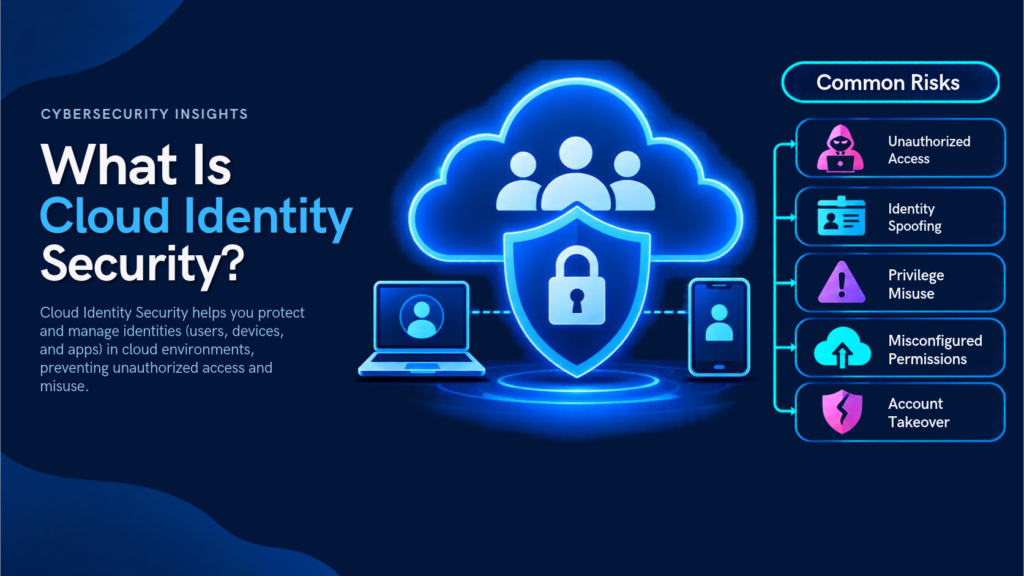
Cloud identity security is the discipline of securing every identity that can authenticate to and act within a cloud environment: human users, roles, service accounts, machine identities, and federated identities from external providers. Identity is the control plane of cloud infrastructure. It determines what every entity can read, write, modify, and delete across an environment that may span hundreds of accounts, regions, and services. Cloud identity security covers how those identities are configured, how their permissions are scoped and enforced, and how their use is monitored for behaviour that deviates from what the legitimate identity would do.
Unlike on-premises environments, where network perimeters enforce boundaries independently of the identity layer, cloud environments have no equivalent boundary. The IAM policy is the control. An over-permissioned role with valid credentials provides access to the resources it covers as reliably as a misconfigured firewall provides network access, except that cloud IAM decisions happen at API speed, leave no network-layer trace, and may cross accounts, regions, and services in a single call chain. Cloud identity security exists because identity misconfiguration is the leading cause of cloud data exposure, and because an attacker who obtains or abuses cloud credentials can move through an environment with the full authority those credentials carry.
Key Takeaways
- Cloud identity is the control plane of cloud infrastructure: IAM policies, roles, and service accounts determine what every entity can access, and there is no network-layer boundary that enforces those limits independently
- IAM misconfiguration, over-permissioned roles, unused accounts with high privileges, service account keys stored outside the platform, and trust relationships with excessive scope are the leading causes of cloud data exposure
- Cloud identity security covers human users, service accounts, machine identities, and federated identities from external providers; each requires different security controls and different testing approaches
- Federated identity attacks, including federation trust abuse and cross-account lateral movement via assumed roles, enable attackers to move from a compromised external identity into cloud environments without acquiring cloud-native credentials
- Effective cloud identity security requires continuous misconfiguration detection, behavioural monitoring for credential misuse, and periodic adversarial testing that validates whether enumerated identity paths reach actual cloud resources
Why Cloud Identity Is the Primary Attack Surface in Cloud Environments
The security model for cloud environments is built on identity in a way that on-premises infrastructure is not. On-premises, an attacker who compromises credentials still faces network controls, host-based defences, and physical boundaries that limit where those credentials can be used. In a cloud environment, valid credentials provide access to resources directly through API calls that traverse no comparable boundary. The IAM policy attached to those credentials is the entire access control model for the resources it covers.
Cloud security spans multiple layers: network controls, data protection, service configuration, and identity. Of those, identity is the layer where the highest-impact incidents originate. The shared responsibility model that governs all major cloud providers assigns the provider responsibility for the security of the infrastructure layer and assigns the customer responsibility for the configurations made within it, which includes every IAM policy, role binding, service account, and federated trust relationship the organization creates.
Identity and access management in cloud environments extends beyond the user directory management that describes IAM in on-premises contexts. Cloud IAM covers human user accounts, role-based access across services and accounts, service accounts that act on behalf of workloads and applications, machine identities for compute resources, and federated trust relationships that allow external identities from other cloud accounts, identity providers, or SaaS platforms to assume permissions within the environment. Each identity type carries its own misconfiguration risks and its own testing requirements.
The practical consequence is that cloud identity security must be a continuous discipline, not a point-in-time review. Cloud environments change rapidly: roles are created for a project and not revoked, service account keys are generated and distributed outside platform-managed credential stores, cross-account trust relationships accumulate over time, and federated identity configurations are set once and rarely revisited. Each change is a potential expansion of the attack surface that persists until it is explicitly identified and corrected.
What Does Cloud Identity Security Cover?
Cloud identity security encompasses five interconnected risk categories, each with distinct technical controls and distinct failure modes. Addressing cloud identity security requires treating all five as a unified attack surface rather than independent configuration items.
IAM misconfiguration is the broadest and most common risk category in cloud identity security. It includes roles with permissions far broader than any workload or user requires, administrator-equivalent bindings applied to accounts that perform routine tasks, unused accounts and service accounts that retain their permissions indefinitely after the project or person they were created for has gone, and wildcard resource access in policies that should be scoped to specific resources. Cloud Security Posture Management (CSPM) tools detect these misconfigurations continuously by evaluating IAM policies against established benchmarks, but they surface findings by configuration state rather than exploitability; an over-permissioned role that holds sensitive resource access is not ranked differently from one that holds access to low-impact resources unless the CSPM is configured to weight by resource sensitivity.
Privileged account abuse covers exploitation of accounts and roles with administrator-level permissions: cloud provider root accounts, accounts with IAM write permissions that allow an attacker to modify policies, and accounts with service control policy scope that affects the entire organization. The defining characteristic of privileged account abuse in cloud environments is that the attacker does not need to perform any lateral movement after achieving access; administrator-equivalent credentials reach every resource in scope directly through API calls.
Service account compromise covers credential theft from workloads and applications. Cloud provider service accounts and their equivalent in AWS (IAM roles for compute) and Azure (managed identities) are the preferred attack target in cloud environments because they are typically long-lived, hold permissions scoped to the application’s requirements rather than a user’s, and are frequently configured with more access than any single workload requires. Service account key files, when generated and distributed outside platform-managed credential mechanisms, are particularly high-value targets: they persist indefinitely unless rotated, and their use through external networks may not trigger anomaly detection tuned for console or CLI access patterns.
Federated identity attacks exploit trust relationships between cloud accounts, identity providers, and external platforms. When a cloud environment trusts assertions from an external identity provider without validating the full scope of what that provider can assert, an attacker who compromises the identity provider or who obtains a signing key can forge assertions that grant access to the cloud environment without acquiring any cloud-native credentials. Broken access control in SaaS applications that serve as identity sources for cloud federation extends this attack surface: a tenant isolation failure in a SaaS identity provider can enable cross-tenant identity assertions that reach cloud environments the target organization trusts.
Credential theft and reuse covers scenarios where cloud access keys, session tokens, or console credentials are obtained through exposure (committed to code repositories, included in container images, logged by services that handle them) and used to access cloud resources directly. Credential theft bypasses all preventive identity controls: the compromised credentials appear legitimate to every authorization check they encounter.
Which Cloud Identity Vulnerabilities Are Most Commonly Exploited?
Cloud identity security engagements at Bugstrix consistently surface the same vulnerability categories across different cloud providers, account structures, and industry verticals.
Overly permissive roles with broad resource scope are the most common finding across AWS, Azure, and GCP environments. These arise from initial configurations made for convenience and not revisited, from incremental permission additions as workload requirements change, and from permission escalation paths that allow a role that appears limited to acquire additional permissions through IAM write operations or policy attachment. The finding is frequently overlooked in internal reviews because the role appears to match its intended purpose when evaluated in isolation, without modelling the escalation paths the permissions it holds enable.
Service account key files outside platform-managed stores appear in the majority of cloud environments with workloads that authenticate to other cloud services. Developer machines, CI/CD pipelines, container images, and application configuration files are all common locations where key material is found that should instead be handled through platform-managed service account impersonation or workload identity federation. Each key file found outside a managed store is a credential that has been exposed to an unknown number of storage and transit contexts, and that may have been accessed without generating any cloud audit log entry.
Cross-account lateral movement via assumed roles is the most common technique for privilege escalation within complex multi-account cloud environments. Trust relationships between accounts allow principals in one account to assume roles in another, and those trust relationships accumulate over time as projects, integrations, and environments are added. An attacker who compromises a principal in a lower-security account can enumerate cross-account trust relationships and use them to traverse toward accounts that hold more sensitive resources. Identity threat detection and response (ITDR) capabilities that monitor role assumption chains can detect this traversal pattern, but only when the monitoring is tuned for cross-account behaviour rather than single-account access patterns.
Identity-based attack paths to critical resources combine multiple lower-severity identity findings into exploitation chains that reach high-value targets. Attack path analysis applied to cloud identity findings maps how an over-permissioned service account in a development environment connects through cross-account role trust to a production account, and how a secondary IAM write permission in that account allows the assumed role to modify policies and reach resources that no single finding would indicate as exposed. Remediating the highest-scoring individual finding without addressing the chain leaves the path open through its remaining links.
MFA gaps on privileged and console-access accounts remain common even in organizations that enforce MFA for user accounts in their corporate identity provider. Cloud console access through federated SSO inherits the MFA controls of the identity provider, but direct cloud provider accounts, root accounts, break-glass accounts, and accounts created before SSO enforcement was implemented, may retain access without MFA enforcement at the cloud provider level. These accounts are often the highest-privilege identities in the environment.
How Is Cloud Identity Security Tested and Assessed?
Cloud identity security testing combines configuration review, permission analysis, and adversarial validation to surface both misconfiguration findings and the exploitation paths those misconfigurations enable.
IAM policy and permission review enumerates every role, policy, and permission binding in scope and evaluates it against the least-privilege principle applied to the actual workload or user it serves. This phase identifies over-permissioned roles, administrator-equivalent bindings, stale accounts, service account key files outside managed stores, and cross-account trust relationships with excessive scope. The review is performed against the full IAM configuration rather than sampled, because the most significant findings are frequently in accounts or roles that appear peripheral in architecture diagrams.
Privilege escalation path analysis models what permissions a given principal can acquire through available IAM operations, not just what permissions it holds directly. A principal with IAM write access can attach policies, modify role trust relationships, or create new principals, allowing it to reach permissions that do not appear in its current policy bindings. Privilege escalation path analysis identifies which principals in the environment can reach administrator-equivalent access through sequences of permitted operations, regardless of their apparent permission level.
Service account and credential hygiene audit identifies where service account key material exists outside platform-managed credential mechanisms, assesses the rotation status and usage of all service account keys that have been generated, and identifies service accounts that hold permissions broader than any workload using them requires. This phase also covers container images, code repositories, and CI/CD pipeline configurations where credential material is commonly embedded.
Federated identity and trust relationship testing validates the scope and conditions of every cross-account and external identity trust relationship. Testing covers whether trust relationships are constrained to the specific principals and conditions they were created for, whether the external identity provider’s validation is sufficient to prevent assertion forgery, and whether federation configurations have been updated to reflect changes in the external identity provider’s security posture since the trust relationship was established.
Adversarial cloud identity testing validates whether the identified permission paths reach actual cloud resources in the target environment, rather than stopping at the policy analysis layer. Cloud security assessment and adversarial cloud penetration testing against the identity layer confirm which findings represent realised access, which privilege escalation paths execute in the target environment’s current configuration, and which cross-account traversal paths successfully reach the accounts and resources the analysis identifies. Bugstrix cloud penetration testing services for identity-focused engagements cover IAM enumeration, privilege escalation path execution, service account exploitation, and cross-account lateral movement simulation against the production cloud environment. Bugstrix security assessment services cover the full configuration and policy review layer, with findings mapped to exploitability and prioritized by the resources each identified path can reach.
Get a free quote for a cloud identity security assessment or penetration testing engagement
Frequently Asked Questions
What is the difference between cloud identity security and IAM?
IAM (Identity and Access Management) is the system that defines and enforces what every identity can access in a cloud environment. Cloud identity security is the broader discipline of protecting that system: ensuring IAM policies are correctly configured, testing whether the permissions they grant can be escalated or abused, monitoring identity behaviour for signs of compromise or misuse, and validating federated trust relationships and service account configurations. IAM is the control mechanism; cloud identity security is the practice of assessing and hardening it.
Why are service accounts a higher-priority target than user accounts in cloud environments?
Service accounts in cloud environments typically hold permissions scoped to the application or workload they serve, which can be broad, and their credentials are machine-generated and long-lived rather than tied to a user’s authentication session. When a service account key is compromised, the attacker obtains persistent access that does not expire with a session timeout, may not trigger console-access anomaly detection because the key is designed for programmatic use, and covers all the resources the application was permitted to access. User account compromise typically requires targeting a specific individual; service account key compromise can occur through code repositories, container images, or configuration files that are accessible to a much wider set of people.
How does federated identity abuse differ from standard credential theft?
Standard credential theft involves obtaining and using existing cloud credentials, an access key, a session token, or a console password. Federated identity abuse exploits the trust relationship between a cloud environment and an external identity provider, allowing an attacker to generate assertions that grant cloud access without possessing any cloud-native credential. The attack requires compromising the identity provider or obtaining its signing key, but the resulting access appears as a legitimately authenticated session from an authorized external identity, making it significantly harder to detect through credential monitoring that looks for known-bad credentials rather than anomalous use of apparently valid ones.
What cloud providers does cloud identity security testing cover?
Cloud identity security testing applies to all major cloud providers: AWS (IAM roles, policies, SCPs, identity centre), Azure (Entra ID, managed identities, role assignments, Conditional Access), and GCP (IAM bindings, service accounts, workload identity federation, organization policies). Multi-cloud environments require testing across all providers in scope, because cross-cloud trust relationships, where a workload in one cloud assumes a role in another through workload identity federation, create lateral movement paths that single-cloud reviews do not surface. The specific findings and misconfiguration patterns differ by provider, but the testing methodology applies consistently across all three.
How often should cloud identity security be assessed?
Cloud identity configurations change continuously as workloads are added, accounts are created, and integrations are built. A comprehensive IAM review and privilege escalation analysis should be performed at least annually and after significant infrastructure changes: new account structures, new federated identity providers, significant workload migrations, or changes to organization-level policies. Continuous misconfiguration detection through CSPM tooling covers the ongoing configuration drift between assessments but does not replace adversarial testing that validates whether enumerated permission paths execute against the actual environment.
Misconfigured Identity Is the Open Door; Compromised Identity Is the Attacker Walking Through It
The fundamental risk in cloud identity security is not that cloud IAM is a weak control mechanism. It is that cloud IAM is a highly capable control mechanism that is configured by people who are optimizing for access and delivery speed rather than minimal permission scope, and that the gap between what an identity is configured to access and what it needs to access to perform its function is where attackers operate.
Bugstrix cloud identity security engagements address both sides of that gap. Configuration review and privilege escalation analysis map the permission terrain as it actually exists, not as it was designed to be. Adversarial testing validates which paths through that terrain reach resources of consequence, so that remediation effort is directed at the findings that reduce real attacker capability rather than those that score highest in automated policy analysis. Cloud identity security done well is a continuous process, not a periodic audit: the attack surface grows with every new role, every new service account, and every new trust relationship added to the environment.
Contact us to discuss a cloud identity security assessment or adversarial testing engagement