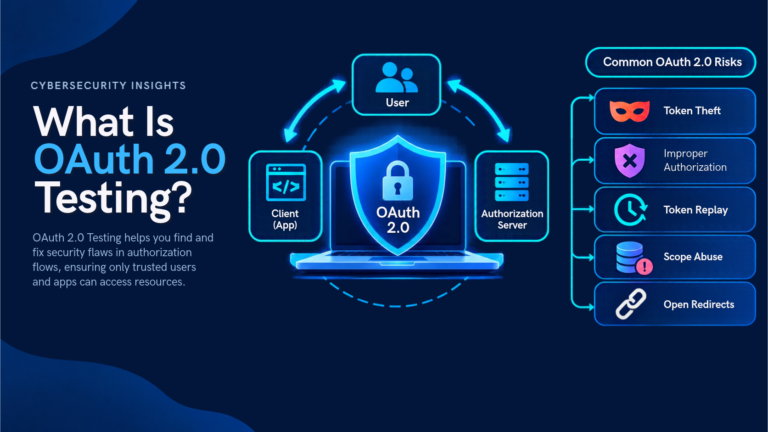
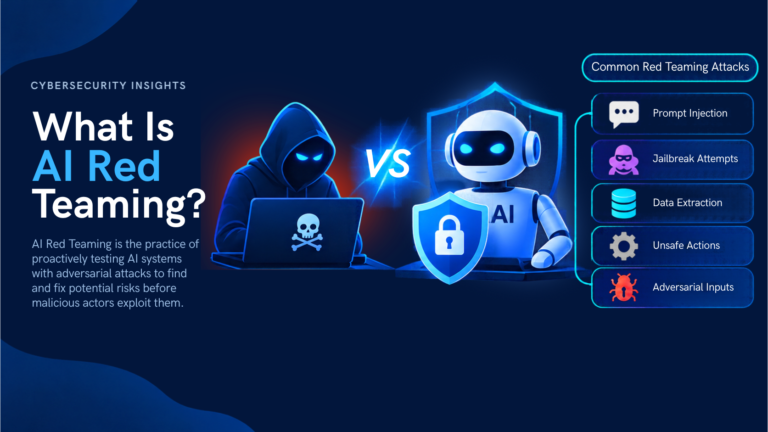
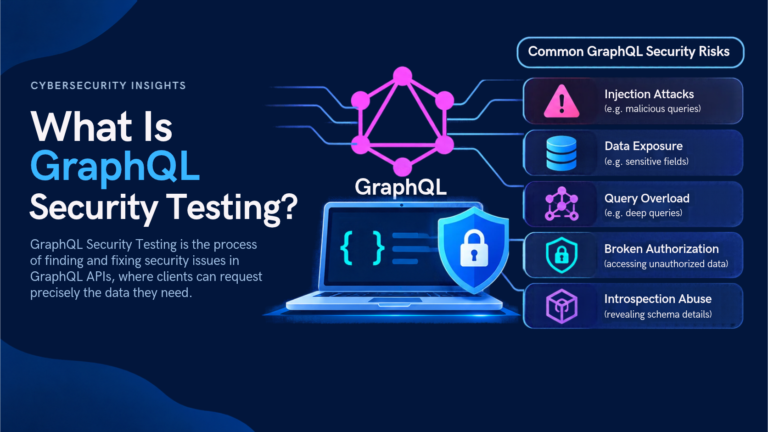
What Is AI Agent Security Testing?

Written By
Sarwat Iftikhar
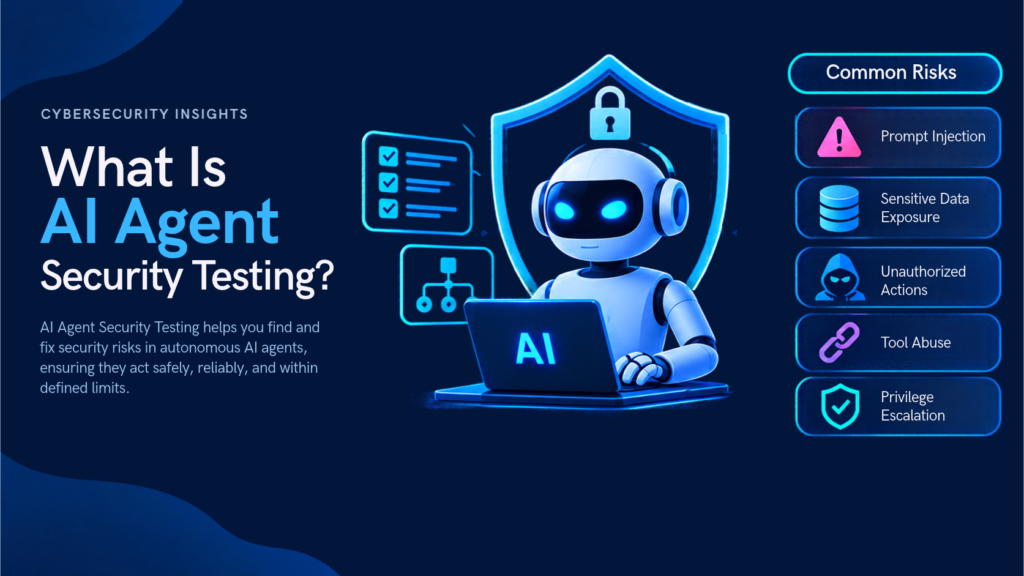
AI agent security testing is the process of assessing how an autonomous AI system can be exploited through the specific attack surfaces that agentic architectures create: prompt injection, tool and function abuse, over-privileged agent identities, supply chain compromise, and persistent memory manipulation. AI agents do more than generate responses. They reason over instructions, call external tools, execute multi-step tasks, and in some deployments maintain memory across sessions and act on behalf of users with real system permissions. Each of those capabilities is an attack surface that standard application security testing is not designed to reach.
The security model for AI agents is fundamentally different from the security model for a web application or an API endpoint. A web application does what its code instructs it to do. An AI agent does what it reasons it should do, based on input that arrives through channels an attacker can influence. That distinction means an AI agent can be manipulated into performing actions its developers never intended, using its own authorized capabilities against the systems it is meant to serve, without exploiting a code vulnerability in the traditional sense. AI agent security testing is built around finding those manipulation paths before they are found by someone who will use them.
Key Takeaways
- AI agent security testing covers the attack surfaces that autonomous AI systems create beyond what standard application testing reaches: prompt injection, tool abuse, identity escalation, supply chain compromise, and memory manipulation
- Prompt injection, both direct through user input and indirect through data the agent retrieves, is the most reliably exploitable class of vulnerability in deployed agentic systems
- AI agents operate with real permissions: they call APIs, write to databases, send communications, and trigger workflows. The impact of a successful attack scales with the agent’s granted capabilities
- Testing must cover the agent’s full operational context, including its tools, its identity and permission model, its memory and context sources, and the third-party components it integrates
- An AI agent can be manipulated into acting against its operational intent without exploiting a code vulnerability, which means testing requires adversarial reasoning over the agent’s behavior, not just static code analysis
What Makes AI Agents a Distinct Security Testing Target?
Standard application security testing assesses whether an application does what its code says it will do, and whether that code can be manipulated to do something else through injection, authentication bypass, or logic errors. AI agents introduce a category of risk that code review and standard penetration testing cannot fully surface: an agent can be made to act against its intended purpose through its inputs, its tools, and the data it retrieves from external sources, without any exploit touching the underlying code.
LLM security testing addresses the core language model and the prompt handling that surrounds it. AI agent security testing extends that scope to cover the full operational envelope of an agent: the tools it can invoke, the APIs it can call, the permissions it holds, the external data sources it reads from, and the memory it maintains across sessions. Each layer adds attack surface that is not visible from the model layer alone.
Model Context Protocol (MCP) is the infrastructure standard that connects AI agents to external tools and data sources. When an agent operates through MCP, it communicates with tool servers that expose capabilities the agent can invoke, and those tool servers become part of the attack surface. A compromised or maliciously configured MCP server can deliver instructions to the agent through its tool responses, manipulate the context the agent reasons over, and cause the agent to perform actions in other systems that the agent’s developers never intended it to authorize.
The practical consequence is that the security of an agentic system depends not just on the model and the application code, but on every component the agent interacts with at runtime. Testing must follow the same boundary.
What Does AI Agent Security Testing Examine?
Bugstrix AI agent security testing engagements cover the full attack surface of an agentic system, from the initial prompt handling through tool invocation, identity and privilege management, supply chain dependencies, and persistent memory. Each category requires testing techniques designed for the specific way that attack class is exploited in an agentic context.
Prompt injection is the foundational attack class in AI agent security. Direct prompt injection delivers attacker-controlled instructions through user input channels the agent is designed to process. Indirect prompt injection, the more impactful variant in deployed agentic systems, delivers instructions through data the agent retrieves during task execution: a web page it reads, a document it processes, an email it accesses, an API response it receives. Because the agent treats retrieved data as part of its working context, an attacker who controls any data source the agent reads can inject instructions into the agent’s reasoning process without any interaction with the user-facing input channel. Bugstrix testing covers both injection vectors across every data retrieval path in the agent’s operational scope.
Tool and function abuse testing examines whether the agent can be manipulated into invoking its authorized tools in ways that produce unauthorized outcomes. AI agents are granted tools because they need them to complete their tasks: file system access, API calls, code execution, communication sending. Each tool represents a capability that can be redirected toward an attacker’s objective if the agent’s reasoning about when and how to invoke it can be influenced. API security testing of the APIs an agent can call identifies which endpoints are callable through the agent’s tool permissions and which of those calls the application’s authorization layer enforces independently of the agent’s intent. Testing covers tool invocation sequences, parameter manipulation in tool calls, and chaining of multiple tool invocations to achieve outcomes no single tool call enables.
Identity and privilege escalation testing examines the agent’s credential model and permission scope. AI agents typically operate with a service identity that holds real credentials to real systems. Identity and access management for agentic systems raises distinct challenges: agents need broad enough permissions to complete their tasks, but the least-privilege principle applied to agents means those permissions should be scoped to exactly what the task requires, not to what is convenient to configure once and leave. Testing examines whether the agent’s credentials are over-permissioned relative to its task scope, whether permission boundaries are enforced at the resource level as well as at the agent configuration level, and whether the agent can be manipulated into using its credentials in contexts outside its declared operational scope.
Supply chain compromise testing examines the third-party components the agent depends on: the base model, fine-tuning datasets, plugins, tool server implementations, and MCP servers that extend the agent’s capabilities. Software supply chain security for agentic systems includes the integrity of every component the agent loads at runtime, because a compromised plugin or tool server can deliver arbitrary instructions to the agent through its standard communication channels. Testing covers the trust model applied to external tool servers, the validation applied to tool responses, and the agent’s behavior when it receives conflicting instructions from tool responses versus its system prompt.
Memory and context manipulation testing examines how agents that maintain persistent memory across sessions can be attacked through that persistence layer. An agent that stores information between sessions to personalize behavior or maintain task state can be made to store attacker-controlled content that modifies its future behavior without any continued attacker access. This attack class requires testing across session boundaries and against the specific mechanisms the agent uses for memory storage and retrieval.
Which AI Agent Vulnerabilities Are Most Commonly Exploited?
Bugstrix AI agent security testing engagements surface the same vulnerability categories consistently across different agentic architectures and application domains.
Indirect prompt injection through retrieved content is the highest-impact finding category in deployed agentic systems. Agents that browse the web, process documents, read emails, or retrieve data from external APIs are susceptible to instructions embedded in that content. The attack is particularly impactful because it requires no access to the user-facing input channel and can be executed by anyone who controls content the agent is likely to retrieve. A document with injected instructions that cause the agent to exfiltrate context, invoke tools in unintended ways, or modify its stated behavior toward the user can deliver significant impact at negligible attacker cost.
Over-permissioned agent identities are the most common configuration finding. Agents are frequently configured with the permissions needed to handle their broadest expected use case, without subsequent review to determine whether narrower permissions would cover all required task scenarios. The result is an agent that holds credentials authorizing actions far beyond what any single task execution requires, so that a successful prompt injection or tool abuse attack has access to a much larger blast radius than a correctly scoped agent would allow.
Authorization bypass through agent-mediated API calls occurs when the authorization model enforced at the API layer does not independently verify that the specific call being made is consistent with the authenticated user’s permissions, relying instead on the assumption that the agent will only make calls consistent with the user’s intent. Broken object-level authorization at the API layer means an agent that has been manipulated through prompt injection can make API calls accessing data or performing operations belonging to users other than the one who initiated the task, using the agent’s authorized credentials.
Insufficient tool invocation validation appears in systems where the agent’s tool calls are not independently validated against an allow-list of permissible operations, or where the parameters of tool calls are not constrained to the operational scope of the current task. An agent that can call a file write tool with arbitrary path parameters, or an email send tool with arbitrary recipient fields, provides an attacker who achieves prompt injection with a fully authorized execution channel for data exfiltration or account compromise.
How Does AI Agent Security Testing Work in Practice?
AI agent security testing combines adversarial prompt testing, tool call analysis, identity and permission review, supply chain assessment, and agent implementation code review into a structured engagement tailored to the specific agentic architecture under assessment.
Architecture mapping establishes the agent’s full operational scope before testing begins: what tools it can invoke, which APIs and systems it has credentials for, what external data sources it retrieves from, whether it maintains persistent memory, and which components in its stack are third-party. The attack surface for a prompt injection engagement is defined by what data the agent reads; the attack surface for tool abuse is defined by what tools it can invoke and with what parameters; the attack surface for supply chain testing is defined by what external components the agent loads at runtime.
Adversarial prompt testing covers direct and indirect injection vectors across every input and data retrieval channel the agent processes. Bugstrix engineers test prompt injection from user input, from each document and web content type the agent reads, from API responses in each tool the agent uses, and from any external data source the agent queries during task execution. Each injection attempt is designed around a realistic attacker objective (data exfiltration, unauthorized tool invocation, behavior modification, privilege escalation) rather than simply demonstrating that the agent can be made to output unexpected text.
Tool call and API analysis tests whether the agent’s tool invocations are independently authorized at the tool and API layer, and whether the parameters of tool calls can be manipulated to exceed the scope of the initiating user’s permissions. This phase requires testing the APIs the agent can call directly, not just testing the agent layer itself, because the authorization failure may be in the API’s trust model for agent-originated requests rather than in the agent’s own behavior.
Agent implementation code review examines the orchestration logic, prompt construction, tool call handling, and memory management code for vulnerabilities that adversarial testing surfaces as behavioral findings. Secure code review of agent implementation code focuses on where user-controlled or externally retrieved content enters the prompt construction pipeline, how tool call parameters are assembled, and how memory content is retrieved and inserted into agent context. Bugstrix cybersecurity code review for agentic systems covers the full orchestration codebase, including the integration code that connects the agent to its tools, APIs, and memory backends.
Adversarial red team exercises test whether the full combination of agent capabilities, permissions, and integration points can be exploited to achieve a meaningful attacker objective against the production system. AI red teaming at the agent level simulates realistic attack scenarios across the agent’s operational context, including multi-step sequences that chain prompt injection with tool abuse to reach objectives that neither technique alone would enable. Bugstrix penetration testing services for AI agents cover the full engagement lifecycle from architecture review through adversarial testing and remediation validation.
Get a free quote for an AI agent security testing engagement
Frequently Asked Questions
How is AI agent security testing different from LLM security testing?
LLM security testing focuses on the language model itself: prompt injection at the model layer, jailbreaking, model extraction, and the security of the prompt handling that wraps the model. AI agent security testing extends that scope to cover the full operational context of an agent: the tools it can invoke, the APIs it has credentials for, the external data sources it retrieves from, and the supply chain components it depends on. An agent can be tested at the LLM layer and pass that testing while remaining exploitable through its tool permissions, its identity scope, or its memory layer. Both assessments are required for a complete picture of an agentic system’s security posture.
What is indirect prompt injection and why is it harder to defend against than direct injection?
Direct prompt injection delivers attacker instructions through the user input channel, which can be partially mitigated by input validation, rate limiting, and prompt structure controls. Indirect prompt injection delivers instructions through data the agent retrieves during task execution: web pages, documents, API responses, emails. Because the agent is designed to process this data as part of its task, there is no clean boundary between legitimate retrieved content and attacker-controlled instructions at the data retrieval layer. Defending against indirect injection requires the agent to maintain a consistent security posture regardless of what content its data retrieval returns, which is architecturally more difficult to enforce than input channel validation.
Do AI agents require different authorization controls than traditional applications?
Yes. Traditional applications enforce authorization based on the authenticated user’s identity and the specific request the user is making. AI agents make requests to external systems on behalf of users, but the specific request is determined by the agent’s reasoning rather than directly by the user. An authorization model that trusts agent-originated requests as inherently consistent with the user’s intent, rather than independently verifying each request against the user’s permissions, is vulnerable to attacks that manipulate the agent’s reasoning to generate requests the user would not have authorized.
What is the minimum scope for an AI agent security engagement?
A minimum-scope engagement should cover the agent’s prompt injection vectors (direct and indirect), its tool invocation model and parameter handling, the permission scope of its service identity, and a review of the third-party components it depends on. Organizations deploying agents with broad tool permissions or access to sensitive data should include full adversarial red team testing and agent implementation code review in the initial engagement, because the blast radius of a successful attack scales directly with the agent’s granted capabilities.
How often should AI agent security testing be conducted?
After initial deployment before production launch, after any addition of new tools or external data sources, after model updates or fine-tuning, and after any significant change to the agent’s permission scope or integration architecture. AI agents have a faster-moving attack surface than traditional applications because new attack techniques against agentic systems are published frequently and the integration surface changes with each tool or API addition. Annual testing is a minimum; quarterly testing is appropriate for agents with broad permissions or access to sensitive data.
An AI Agent’s Authorized Capabilities Are the Attack’s Delivery Mechanism
The defining characteristic of AI agent security risk is that successful exploitation uses the agent’s own authorized capabilities to deliver impact. A prompt injection attack does not need to exploit a code vulnerability. It needs to redirect the agent’s reasoning toward an attacker’s objective, then let the agent’s own tools, credentials, and permissions do the rest. The impact is bounded only by what the agent is authorized to do.
Bugstrix AI agent security testing is built around that model. Testing covers every channel through which an attacker can influence the agent’s reasoning, every tool and API endpoint the agent can invoke, and every permission the agent’s identity holds. The goal is to map the full exploitation path from the input or data source that delivers the injection, through the tool or API call it triggers, to the resource or system that call reaches so that remediation can be targeted at the specific architectural decisions that determine how far an attack can go. An agent that is well-configured for its task does not need to hold permissions for everything it might conceivably need. It needs permissions for what it actually does, validated at the resource layer, not just at the agent configuration layer.
Contact us to discuss an AI agent security testing engagement for your system