What Is AI Red Teaming?

Written By
Sarwat Iftikhar
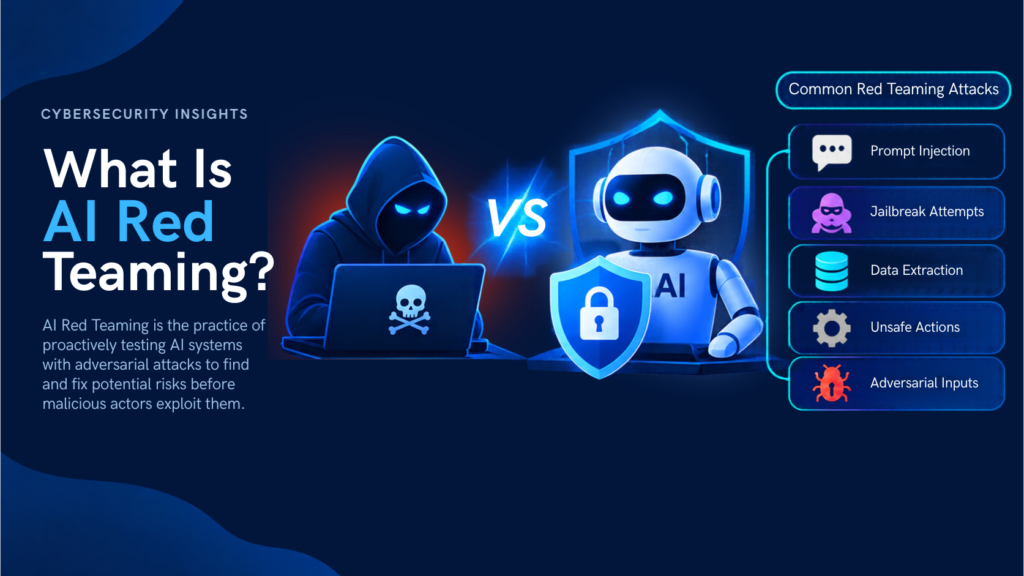
AI red teaming is the practice of adversarially testing AI-powered systems to identify how they can be manipulated, exploited, or abused. It applies an attacker’s perspective to the model, the application built around it, and the infrastructure that supports it, with the goal of discovering failures that conventional security testing and functional quality assurance are not designed to find.
As organizations integrate large language models into customer-facing products, internal tools, and automated decision workflows, the attack surface of those systems extends far beyond the code that wraps them. The model itself can be influenced through its inputs. The data it was trained or fine-tuned on can be compromised. The tools it has access to can be misused. AI red teaming is the discipline that tests all of those surfaces systematically, under realistic adversarial conditions, before they are exploited in production.
Key Takeaways
- AI red teaming applies adversarial testing methodology to AI-powered systems, covering the model, application layer, integrations, and supply chain
- Prompt injection, model extraction, agentic privilege abuse, and supply chain tampering are the highest-impact AI red team attack categories
- AI red teaming is not a substitute for LLM security testing or standard application security testing; it extends and stresses those findings under goal-oriented adversarial conditions
- Agentic AI systems that can call tools, access files, or send messages require red team testing that covers what those capabilities can be made to do, not just what they were designed to do
- Testing should be conducted before major releases, after model or integration updates, and whenever the AI system gains new capabilities or data access
How Is AI Red Teaming Different from Traditional Red Teaming?
Traditional red teaming is a full-scope adversarial simulation designed to test whether an organization’s defenses can detect and respond to a targeted attack. The red team pursues a specific objective: accessing a critical system, exfiltrating a defined dataset, or achieving domain-level compromise, using the same techniques, tools, and tradecraft an advanced attacker would use. The defending team is typically not notified. The exercise measures whether security controls work, not just whether they exist.
AI red teaming inherits that adversarial mindset but applies it to a different class of target. Where traditional red teaming attacks the boundary of an organization’s infrastructure, AI red teaming attacks the behavior of an AI system. The objective is not necessarily to achieve domain compromise. It is to make the model behave in ways the application did not intend, to extract information it was not meant to reveal, to cause downstream systems to process adversarial content, or to trigger actions the AI agent was not authorized to take.
The other structural difference is the attack surface. Traditional red teaming targets systems with defined, stable behavior. A firewall either passes traffic or it does not. An authentication system either validates credentials or it does not. AI systems are probabilistic. Their behavior in response to any given input depends on the full context in which that input is received, including the system prompt, conversation history, retrieved documents, and the structure of the user’s message. That context-dependence is what makes AI systems useful and what makes them exploitable in ways that have no direct equivalent in traditional security testing.
A traditional red team engagement also has a defined beginning and end, tied to the network or application environment being tested. AI red teaming must account for the fact that the AI system’s behavior can change with model updates, fine-tuning changes, retrieval corpus modifications, and plugin additions, each of which can introduce new exploitable behaviors that did not exist in the previous version.
What Does AI Red Teaming Examine?
Bugstrix AI red teaming engagements cover five primary attack surfaces, each requiring distinct techniques and a different understanding of how the target system works.
Adversarial prompting covers direct and indirect attempts to override the model’s governing instructions and cause it to behave outside its intended parameters. This includes jailbreak techniques that use roleplay framing, fictional scenarios, or instruction chaining to bypass safety controls, as well as indirect prompt injection attacks that embed adversarial instructions in external content the model retrieves and processes. LLM security testing maps the full range of prompt-layer attack classes. AI red teaming extends this by chaining successful prompt manipulation into downstream objectives, extracting sensitive data, triggering tool calls, or producing content that bypasses the application’s intended restrictions.
Model extraction involves probing the AI system through its exposed API to infer information about its training data, fine-tuning, system prompt, and internal architecture. Attackers who cannot access the model directly can reconstruct significant portions of its behavior and configuration through carefully crafted query sequences. Testing examines what the model reveals about its instructions under repeated probing, what training data it can be induced to reproduce, and whether the API’s response behavior enables capability inference that would give an attacker a meaningful advantage.
Supply chain attacks target the components that determine the model’s behavior below the prompt layer: training datasets, fine-tuning data, retrieval corpora, embeddings, and third-party plugins. Software supply chain security for AI-integrated systems must account for these components as attack surfaces with the same seriousness applied to code dependencies. Poisoning a retrieval corpus that the model queries on every request can produce persistent, predictable manipulation of the model’s responses to specific queries without requiring any access to the prompt interface.
Agentic privilege abuse applies to AI systems that have been granted tool access, file operations, API calls, database queries, messaging, or any capability beyond text generation. These systems can be directed through adversarial prompting to perform actions outside the user’s authorized scope, and the identity and access management controls that govern traditional application authorization do not automatically apply to actions taken by a model acting on behalf of a user. Testing examines whether tool permissions are proportionate to the system’s actual function, whether tool calls can be triggered through injection, and whether the agent enforces authorization at the action level before executing any capability it has been granted.
Output exploitation covers scenarios where the model’s response is passed to a downstream system without sanitization. When model output is rendered in a web interface, it can carry a cross-site scripting payload. When it is passed to a database query or a code execution environment, it can carry an injection payload. When it is used as the input to a downstream automated decision, it can carry fabricated content designed to influence that decision. The model is not the target. The model is the delivery mechanism, and the red team tests whether the application correctly treats model output as untrusted regardless of what the model was asked to produce.
What Techniques Does AI Red Teaming Use?
AI red teaming draws on a combination of adversarial prompting, API security testing, code review, and threat modeling techniques that are adapted from traditional offensive security but applied to AI-specific attack surfaces.
Prompt manipulation techniques include direct jailbreak attempts, multi-turn instruction chaining, role-reversal framing, nested context injection, and indirect injection through controlled external content. The red team tests each technique systematically against the model’s governing instructions and safety controls, documenting which approaches produce unauthorized behavior and under what context conditions they succeed.
API-layer testing examines the endpoint through which the AI system is accessed for authentication weaknesses, rate limiting gaps, parameter injection, and information disclosure through error responses. API security testing methodology applies directly to AI API endpoints, with additional coverage for response behavior that reveals model configuration or enables extraction attacks through repeated querying.
Threat modeling builds a goal-oriented attack map specific to the AI system being tested. The red team identifies what an attacker with access to the model’s prompt interface could accomplish: what data they could extract, what actions they could trigger, what downstream systems they could affect, and what the business impact of each would be. This framing ensures testing is directed at realistic attacker objectives rather than cataloguing every theoretical prompt variation.
Integration and infrastructure review covers the application code that constructs prompts, processes model outputs, calls external tools, and manages the model’s context. The red team examines whether prompt construction is resistant to injection through user-controlled input, whether output processing sanitizes model responses before passing them to downstream systems, and whether tool permissions are scoped to the minimum necessary function. This layer is where most of the fixable risk lives: a model that can be induced to produce a cross-site scripting payload is harmless if the application correctly encodes its output before rendering it.
How Does AI Red Teaming Fit Into an AI Security Program?
AI red teaming is most effective when it builds on a foundation of earlier security activities rather than substituting for them. The goal of red teaming is to test whether the security controls in place hold up under realistic adversarial conditions. That test is more productive when the controls have already been reviewed and hardened.
Before red teaming, the security of the AI system’s integration code should be established through a secure code review that examines prompt construction, output handling, tool permission scoping, and retrieval pipeline design. Bugstrix cybersecurity code review engagements cover AI integration patterns including system prompt design, context injection paths, and the authorization logic governing agentic tool access.
During red teaming, Bugstrix engineers operate under a defined objective, extracting a specific category of information, triggering a specific tool action, or producing a specific class of unauthorized output, and pursue that objective using the full range of adversarial techniques available to a realistic attacker. The engagement does not stop at identifying that a vulnerability class exists. It demonstrates the full exploitation chain, from the initial adversarial input to the downstream impact, with documentation that maps each finding to the application code or configuration decision that produced it.
After red teaming, findings are prioritized by exploitability and business impact, with remediation guidance that addresses the prompt construction, output handling, permission model, or retrieval pipeline decision that enabled each finding. Retesting validates that the remediation closed the finding without introducing new exposure through the change.
Bugstrix penetration testing services cover AI red teaming as a standalone engagement or as part of a broader application security assessment that includes the web layer, API surface, and infrastructure supporting the AI system.
Frequently Asked Questions
Is AI red teaming the same as LLM security testing?
They overlap significantly but are not the same exercise. LLM security testing maps the attack surface of an AI-integrated application systematically, identifying every class of risk across the prompt interface, API layer, integration code, and infrastructure. AI red teaming is goal-oriented: a team pursues a specific attacker objective using whatever combination of techniques produces results, without necessarily covering every surface. LLM security testing produces a comprehensive vulnerability inventory. AI red teaming produces a demonstrated exploitation chain against a realistic attacker scenario.
Which AI systems need red teaming?
Any AI system that handles sensitive data, is exposed to untrusted user input, operates with tool access or agentic capabilities, or produces output that feeds into automated decisions or downstream systems benefits from red teaming. The need is proportionate to what the system can do and what an attacker who successfully manipulates it could accomplish. A customer-facing chatbot with no tool access and no access to sensitive data requires a different scope than an agentic AI with file system access and the ability to send communications on behalf of users.
Can red teaming find vulnerabilities that standard security testing misses?
Yes, specifically in the classes of risk that only emerge under goal-oriented adversarial conditions. Standard security testing validates that individual controls are in place. Red teaming tests whether those controls hold when an attacker chains techniques, exploits context, and pursues an objective across multiple interactions. Multi-turn prompt manipulation that defeats a system’s instructions over a sequence of messages, indirect injection through a retrieved document, and agentic privilege escalation through a crafted tool-triggering prompt are all classes of findings that are more reliably surfaced through red teaming than through individual control testing.
How is AI red teaming scoped?
Engagements are scoped around a defined attacker objective and a defined set of capabilities the simulated attacker has, typically unauthenticated access to the prompt interface, authenticated user-level access, or in some cases insider-threat scenarios with access to the retrieval pipeline or fine-tuning data. The scope should reflect realistic attacker access to the specific system being tested rather than a generic capability list. Bugstrix works with each client to define objectives and access assumptions before the engagement begins.
How often should AI red teaming be performed?
After initial deployment, after any significant model update or fine-tuning change, after the system gains new tool access or integrations, and after the retrieval corpus or plugin set changes meaningfully. For AI systems that handle sensitive data or have agentic capabilities, annual red teaming is a reasonable minimum. Systems that update model components frequently or operate in high-risk contexts should be tested more often.
AI Systems Need a Red Team That Understands Both the Model and the Application
The risk of AI red teaming being done poorly is that it tests only the most surface-level prompt manipulation and misses the classes of vulnerability that have the most serious business impact: supply chain compromise at the retrieval layer, agentic privilege escalation through indirect injection, and output exploitation that uses the model as a delivery mechanism for attacks against downstream systems. These findings require an understanding of how AI systems work that goes beyond prompt crafting.
Bugstrix AI red teaming engagements are led by engineers who combine offensive security expertise with specific knowledge of how large language model integrations are built and where they fail. The engagement covers the prompt interface, the API layer, the integration code, the retrieval pipeline, and the agentic capabilities the system has been granted, and it pursues each objective with the same techniques a motivated attacker would use, documented in a way that maps every finding to the specific architectural or implementation decision that produced it.
Contact us to discuss an AI red teaming engagement for your system