What Is GraphQL Security Testing?

Written By
Sarwat Iftikhar
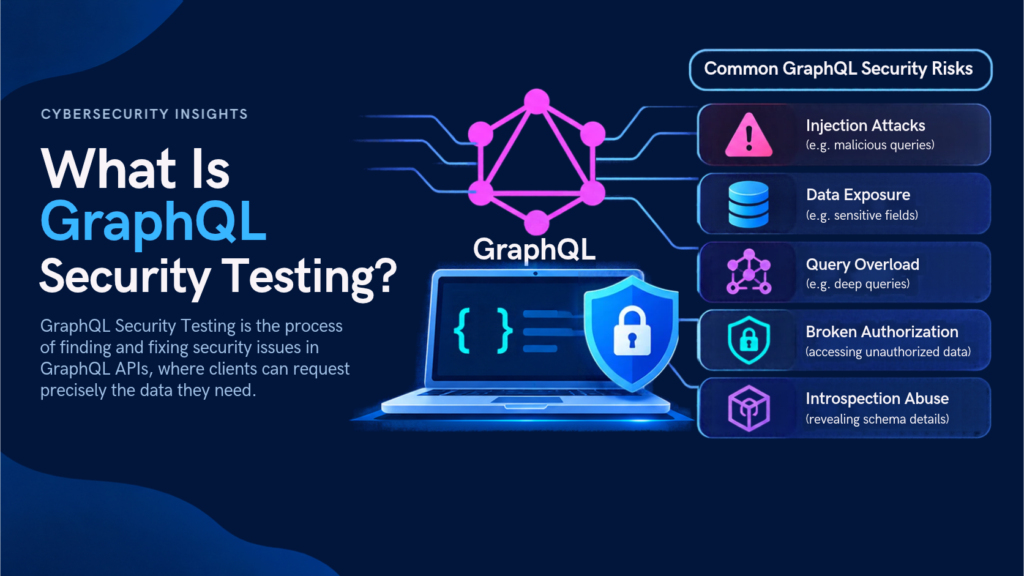
GraphQL security testing is the process of assessing the security of applications that expose a GraphQL API layer, with the goal of identifying how the query interface, schema, and resolver logic can be exploited. GraphQL offers developers a flexible, efficient way to retrieve exactly the data their application needs. That flexibility is also what makes it dangerous when the security controls around it are incomplete or misconfigured.
Unlike REST APIs, where each endpoint returns a fixed data structure, GraphQL lets clients construct their own queries, request nested object relationships, and in many implementations, ask the API to describe its own schema in full. Each of those properties creates a distinct class of risk. GraphQL security testing is designed to find and demonstrate those risks before attackers do.
Key Takeaways
- GraphQL’s single endpoint and flexible query model create attack surfaces that standard REST API security testing tools and methods do not cover
- Open introspection allows attackers to enumerate the full API schema without authentication, revealing every type, field, and mutation available
- Authorization vulnerabilities in GraphQL are field-level and object-level, not just endpoint-level, and require dedicated testing to surface
- Batch query and nested query abuse can exhaust server resources without triggering rate limits designed for REST traffic
- Full GraphQL security testing combines schema analysis, adversarial querying, code review, and infrastructure testing into a single engagement
Why Does GraphQL Create a Security Attack Surface That REST APIs Don’t?
A REST API divides its functionality across separate endpoints. Each endpoint accepts a specific method and returns a defined response. Security controls, authentication checks, and rate limits are applied per endpoint. The attack surface is predictable because the API surface is predictable.
GraphQL collapses that structure. A single endpoint receives all queries and mutations. Clients specify what fields they want, in what shape, and with what relationships. The resolver logic that handles those requests sits behind a uniform interface that looks identical from the outside regardless of what it does behind it.
That design creates three security problems that REST architectures do not share in the same form.
The first is introspection. Most GraphQL implementations enable introspection by default, which allows any client to query the schema itself and receive a complete description of every type, field, argument, mutation, and subscription the API exposes. For an attacker who gets even unauthenticated access to the endpoint, introspection is a free reconnaissance tool. API security testing for REST APIs involves discovering undocumented endpoints through fuzzing and enumeration. GraphQL hands the entire surface to anyone who asks.
The second is authorization. REST APIs enforce access control at the endpoint level. If you cannot call the endpoint, you cannot get the data. GraphQL resolvers handle authorization at the field level, inside the application logic. If a developer misses an authorization check on a single field or forgets to restrict a nested object in a relationship query, that exposure is not visible from the endpoint itself. It requires testing that explores the schema’s authorization model directly.
The third is resource consumption. GraphQL clients can submit deeply nested queries that force the server to execute hundreds of database lookups in a single request. Standard rate-limiting based on request count does not catch this, because the cost of a single GraphQL query can vary by orders of magnitude depending on what it requests.
What Does GraphQL Security Testing Examine?
GraphQL security testing covers the query interface, the schema, the resolver logic, and the infrastructure layer that hosts the API. Bugstrix assessments follow a structured methodology that works through each attack surface from the outermost query layer inward to the resolver code and backend integrations.
Introspection abuse is the first area Bugstrix assesses. When introspection is enabled on a production endpoint, any party who can reach the API can retrieve a complete map of the application’s data model: every type, field, mutation, and subscription, including fields that are never surfaced in the client interface and mutations that perform sensitive operations. Testing examines whether introspection is enabled, whether it is restricted to authenticated sessions, and whether the schema reveals implementation details that should not be publicly accessible.
Injection via arguments applies to GraphQL the same way injection applies to any user-controlled input. Query arguments passed to resolvers that build database queries, file system operations, or shell commands are potential injection vectors. GraphQL’s structured argument model does not eliminate injection risk. It moves that risk from URL parameters into query arguments. Testing covers SQL injection, NoSQL injection, and command injection through every argument the schema exposes.
Authorization bypass in a GraphQL API is distinct from endpoint-level access control. Each field in a GraphQL response can be backed by a different data source and resolver, and each resolver must independently verify that the requesting user is entitled to that field’s value. Broken object-level authorization is the most common class of GraphQL authorization failure: the resolver returns an object the user requested without verifying that they own it. Testing examines whether resolvers enforce object ownership, whether relationship queries expose data the requesting user should not reach through traversal, and whether mutations validate authorization before modifying records. The identity and access management controls that govern the application tier do not automatically extend to GraphQL’s resolver layer, and each resolver must be tested individually.
Batching and denial-of-service abuse exploit GraphQL’s ability to send multiple operations in a single request or to request deeply nested object relationships that force exponential resolver execution. Query batching allows a client to submit dozens of mutations in one HTTP request, which bypasses rate limits on operations like login attempts or one-time code requests. Nested query amplification allows a client to construct a query whose resolver cost scales multiplicatively with query depth. Testing validates whether the application enforces query depth limits, complexity limits, and batching restrictions independently of HTTP request-level rate limiting.
Schema and field exposure covers the data returned by the API beyond what the client interface is designed to show. GraphQL resolvers that return complete database objects may include fields the client never renders but that contain sensitive information: internal identifiers, hashed credentials, audit timestamps, configuration values, or cross-user data. Code review of the resolver layer examines whether resolvers apply field-level filtering before returning objects, or whether they rely on the client to discard fields it does not use.
How Does GraphQL Security Testing Fit Into the Development Lifecycle?
GraphQL security risks are introduced at multiple stages of development, and addressing them requires testing at each stage rather than a single assessment before launch.
During development, the most valuable security activity is review of the resolver logic and schema definition. The decisions made in the schema- which fields are exposed, which are nullable, and which are queryable without authentication- determine the attack surface of the finished API. A secure code review at the design and implementation stage identifies authorization gaps, injection-prone argument handling, and query complexity logic that is absent or incorrectly implemented. Bugstrix code review engagements cover GraphQL schema and resolver design as part of a full application security review.
Before deployment, static analysis of the resolver code identifies injection-vulnerable input handling, missing authorization checks, and query depth or complexity controls that are absent or misconfigured. Static application security testing tools applied to resolver code surface the same categories of vulnerability they find in any application backend before the code reaches a live environment.
After deployment, dynamic testing against the live endpoint is required to surface the interaction effects that code review and static analysis cannot observe in isolation. Dynamic application security testing of a GraphQL endpoint covers introspection state, authentication bypass attempts, injection payloads through query arguments, and batching behavior against rate limit controls. Manual testing by a security engineer extends this coverage to the authorization model, which requires understanding the schema’s access control intent before it can be tested systematically against each resolver.
Ongoing, the web application security posture of an application that exposes a GraphQL API needs to account for schema changes. Every new field, type, or mutation added to the schema potentially expands the attack surface. Periodic reassessment and integration of security review into the schema change process keeps coverage aligned with the API’s current state rather than a snapshot from a one-time engagement.
What Does a GraphQL Security Testing Engagement Actually Cover?
A Bugstrix GraphQL security testing engagement combines schema analysis, adversarial query testing, code review, and infrastructure assessment into a structured engagement designed to cover the full attack surface.
The engagement begins with schema enumeration. Bugstrix tests whether introspection is enabled and, if so, what the schema reveals about the application’s data model and operations. Where introspection is disabled, schema reconstruction through query probing identifies the same surface through iterative testing against the endpoint’s responses.
Query and mutation testing follows the schema map. Engineers submit crafted inputs through every exposed argument to test for injection vulnerabilities, probe authorization controls against each field and object type, and test for data exposure through relationship traversal. The difference between API security testing and API penetration testing applies directly here: Bugstrix engagements go beyond automated scanning to manual exploitation of identified weaknesses, demonstrating the actual business impact of each finding rather than producing a list of potential issues.
Resource limit testing validates whether the application enforces query complexity limits, depth limits, and batching restrictions independently, and whether those limits can be bypassed through alternative query structures. Infrastructure testing covers the hosting environment and network layer supporting the GraphQL endpoint, including authentication mechanisms, TLS configuration, and error handling that may reveal implementation details through verbose error messages or stack traces.
All findings are documented with proof-of-concept reproduction steps and prioritized by exploitability and business impact. Bugstrix penetration testing services and web app penetration testing services can be scoped to GraphQL APIs specifically or as part of a broader application security assessment that covers the full web layer.
Frequently Asked Questions
Is GraphQL security testing different from standard API security testing?
Yes. Standard API security testing tools and methodologies are designed for REST APIs with fixed endpoints and defined response structures. GraphQL’s single-endpoint, schema-driven model requires different tools, different attack techniques, and a different approach to authorization testing. Many automated scanners cannot reconstruct a GraphQL schema, probe nested query relationships, or test field-level authorization controls across each resolver individually.
Does disabling introspection make a GraphQL API secure?
No. Disabling introspection removes one reconnaissance capability but does not address the underlying security controls. Attackers can reconstruct a schema by probing field names through trial and error against error responses. Injection, authorization bypass, and batching attacks do not require introspection to execute successfully. Disabling introspection is a reasonable hardening step, but it is not a substitute for security testing of the resolver layer.
What is the most commonly exploited GraphQL vulnerability?
Authorization bypass at the field and object level is the most frequently identified class of issue in Bugstrix GraphQL assessments. Developers commonly implement authentication, requiring a valid token to reach the endpoint, without implementing authorization checks inside each resolver. The result is an authenticated user who can query fields or objects belonging to other users by supplying a different identifier in the query arguments.
How often should GraphQL security testing be performed?
Any schema change that adds new fields, mutations, or types should trigger a targeted review of the affected resolvers. A full GraphQL security testing engagement should be conducted at least annually, before major releases, and after architectural changes to the application or its data layer. Applications that expose the API to external clients or handle sensitive data should be assessed more frequently.
Can automated tools cover GraphQL security testing adequately?
Automated tools can enumerate a schema through introspection, submit basic injection payloads through query arguments, and test for a subset of known vulnerability patterns. They cannot evaluate the authorization logic of individual resolvers, assess whether the schema design exposes data beyond its intended scope, or test the interaction effects of nested relationship queries against the authorization model. Manual testing by a security engineer is required to cover the classes of risk that have the most direct impact in production GraphQL deployments.
GraphQL’s Query Flexibility Is Its Most Exploitable Property
The same design decision that makes GraphQL useful, giving clients control over what they query, how they traverse relationships, and how they shape the response, is what creates its most significant security risks. Authorization assumptions that hold at the endpoint level break down at the field level. Rate limits calibrated for REST traffic do not account for the per-request cost of a deeply nested GraphQL query. Schema designs that expose internal data models through unrestricted introspection make reconnaissance trivially easy for anyone who reaches the endpoint.
Bugstrix GraphQL security testing is built around the structure of these risks rather than adapted from REST API testing methodology. The assessment covers introspection state, injection exposure, authorization controls at the field and object level, resource limit enforcement, and schema design practices that create information disclosure risk. The result is a finding set that maps directly to the specific ways a GraphQL deployment can be exploited, with remediation guidance that addresses the resolver-level and schema-level decisions that produced each finding.
Contact us to discuss a GraphQL security testing engagement for your application