Manual vs Automated Penetration Testing: Key Differences

Written By
Sarwat Iftikhar
Automated scanners increased vulnerability detection by nearly 39% over the past year. Manual penetration testing uncovered far more business-critical flaws. Both statements are true at the same time, and understanding why reveals something important about how most organizations are thinking about security testing wrong.
The comparison between manual and automated penetration testing is not really about which approach is better. It is about understanding that they find fundamentally different things, serve different purposes, and address different threat models. An organization that uses only automated tools is running a wide net and finding the fish that every other scanner already catalogued. An organization that uses only annual manual testing is getting a point-in-time picture of an environment that changes every week.
The organizations that get this right use both, in combination and in the right sequence. This guide breaks down exactly what each approach covers, what each misses, how they compare on cost, and what a correctly structured program looks like.
Key Takeaways
- Automated scanning and manual penetration testing find fundamentally different vulnerability categories. Conflating them is the most common and most expensive testing mistake.
- 68% of enterprise attack surfaces go untested on average, even though 95% of organizations rank penetration testing as a top priority.
- Organizations applying continuous exposure management are projected to reduce breaches by two-thirds compared to those relying on point-in-time testing alone.
- False positive rates for automated scanning tools run between 20% and 30%, requiring human validation before any finding can be confidently acted on.
- Every major compliance framework, including PCI DSS, SOC 2, ISO 27001, and DORA, requires manual penetration testing as the standard evidence of security control effectiveness. Automated scans do not satisfy these requirements.
- The time from vulnerability discovery to active exploitation has compressed to approximately five days in 2026. Annual manual testing alone cannot keep pace with that window.
What Is the Core Difference Between Manual and Automated Penetration Testing?
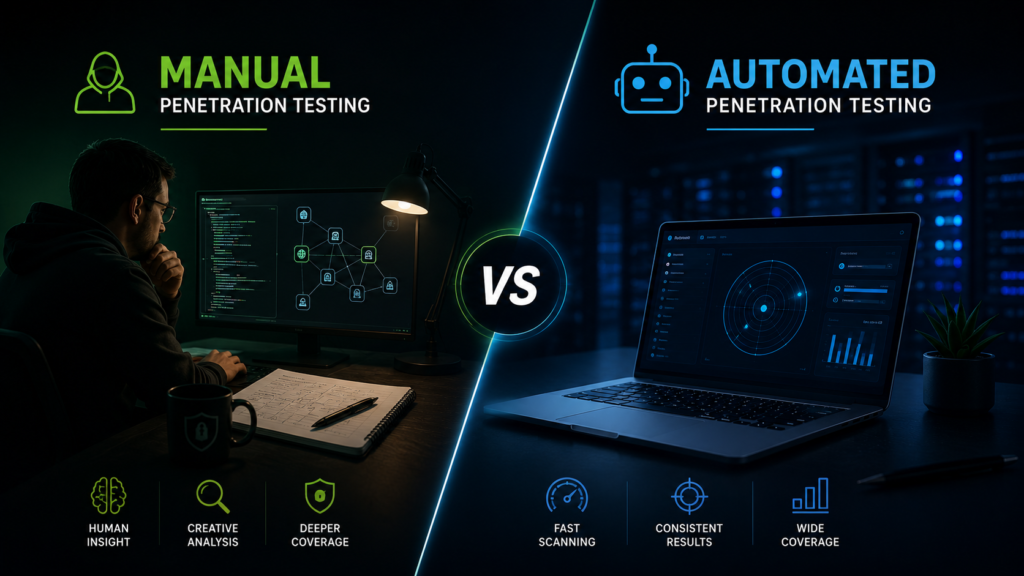
Manual penetration testing is a human-led, objective-driven security assessment where a skilled tester simulates real-world attacks against your systems using their judgment, creativity, and contextual understanding to identify exploitable vulnerabilities. Automated penetration testing uses software tools to scan environments for known vulnerabilities, misconfigurations, and patterns against a predefined set of signatures and checks.
The distinction matters because the finding categories are almost entirely different. Automated tools are pattern matchers. They compare what they observe against a database of known vulnerabilities and report matches. They do not reason about what the application is supposed to do, whether authorization logic is implemented correctly for this specific business context, or how a combination of lower-severity issues creates a high-severity attack path. These are judgment calls, and judgment is what manual testers apply.
Manual testers bring something automated tools fundamentally cannot: the ability to ask “what should this system not allow, and can I make it do it anyway?” That question drives the discovery of authorization failures, business logic flaws, multi-step attack chains, and IDOR vulnerabilities that represent the findings most likely to cause significant real-world damage. These categories are almost absent from automated scan output regardless of how sophisticated the tool.
The operational difference is equally significant. Automated scanning runs continuously or on a schedule, covers broad environments quickly, and costs a fraction of manual testing per finding identified. Manual testing requires significant skilled tester time, is typically scoped to a defined window, and costs more per engagement but produces qualitatively different evidence of exploitability.
What Can Automated Penetration Testing Actually Find?
Automated penetration testing reliably identifies known, signature-based vulnerabilities across large environments at a speed and scale no human tester can match. The finding categories it covers well are consistent: software versions with published CVEs, common misconfigurations, missing security headers, default credentials on identified services, SSL and TLS configuration weaknesses, and some injection indicators detectable through pattern analysis.
The speed advantage of automated scanning is substantial. A tool can scan an entire external attack surface in hours. It can run continuously, triggering on infrastructure changes or new CVE publications. It scales across hundreds of hosts simultaneously. These characteristics make it genuinely valuable for maintaining baseline coverage and catching known issues quickly after they are published.
The limitation is equally substantial. Automated tools produce false positives at a rate of 20 to 30%, meaning a significant portion of findings require human validation before they can be acted on. They cannot confirm whether a theoretical vulnerability is actually exploitable in your specific environment or whether a CVE in a component you run is reachable through your application logic. And they structurally cannot test the finding categories that matter most in real breaches.
Critical vulnerability findings rose 83% year over year in 2025, with attackers increasingly chaining low-severity issues into high-impact exploit paths. Automated scanners identify individual low-severity findings but cannot reason about whether those findings chain into a critical attack path. That analysis requires a human tester.
What Does Manual Penetration Testing Find That Automation Cannot?
Manual penetration testing finds the vulnerability categories that require human reasoning to identify: business logic flaws, authorization failures, IDOR vulnerabilities, multi-step attack chains, and context-specific weaknesses that depend on understanding what the application is supposed to do before testing whether it enforces those constraints correctly.
These categories are not edge cases. Broken access control has held the number one position in the OWASP Top 10 for consecutive editions. IDOR and Broken Object Level Authorization hold the top spot in the OWASP API Security Top 10. The vulnerabilities most consistently identified in breach investigations are authorization failures and business logic weaknesses, precisely the categories automated tools cannot find.
The reason is structural. An automated tool that hits an API endpoint and receives a 200 response cannot determine whether the data returned belongs to the requesting user or to a different user whose identifier was manipulated in the request. It sees a successful response. A manual tester with accounts for two different users can confirm exactly whether that endpoint enforces ownership. That test requires understanding the permission model and designing a specific cross-user access attempt. No scanner can do this.
Business logic vulnerabilities require the same contextual reasoning at a different level. A payment flow that allows a negative quantity to reduce a total, a promotional code that can be applied multiple times through the API even though the UI enforces single use, an account verification step that can be bypassed by calling the subsequent endpoint directly. These findings require a tester who was briefed on how the application is supposed to work and is testing whether it actually enforces those constraints. That briefing does not exist for an automated tool.
For web applications specifically, our web app penetration testing focuses on exactly these manual testing categories because they represent the highest-impact finding classes and the ones automated tools consistently fail to surface.
How Do the Costs Compare Between Manual and Automated Testing?
Automated testing costs significantly less per execution than manual penetration testing. A commercial automated scanning tool runs between $2,000 and $30,000 annually for enterprise coverage, with some open-source tools available at minimal cost. A manual web application penetration test costs $8,000 to $30,000 per engagement. A full-scope assessment covering applications, APIs, network, and cloud infrastructure runs $20,000 to $100,000 or more for complex environments.
The cost comparison is more nuanced than the headline numbers suggest. Automated tools require significant human time to configure, tune, and interpret output. Raw scanner results without human validation are not actionable, because the 20 to 30% false positive rate means a meaningful portion of findings require expert review before they can be prioritized for remediation. Factoring in the analyst time required to process scanner output narrows the cost gap between automated and manual testing considerably.
One in three organizations cites budget as their primary reason for not conducting penetration tests more frequently. For these organizations, automated scanning provides a cost-effective mechanism for maintaining baseline coverage between annual manual engagements rather than replacing the manual test entirely.
The other important cost dimension is the cost of missing what each approach cannot find. A manual test that misses a known CVE in a public-facing service because it was not in scope for manual testing is addressable through automated coverage. An automated scan that misses an authorization failure that lets any authenticated user access any other user’s data is not addressable through more scanning. It requires a human tester to find.
For a detailed breakdown of what manual penetration testing costs across different engagement types and what drives pricing variation, our penetration test pricing guide covers the full range.
Do Compliance Frameworks Require Manual or Automated Testing?
Every major compliance framework applicable to businesses in 2026 requires manual penetration testing as the standard of evidence for security control effectiveness. Automated vulnerability scans are required separately as a parallel activity in most frameworks but cannot substitute for penetration testing requirements.
PCI DSS v4.0 is the clearest example. Requirement 11.3 mandates quarterly automated scanning by a certified Approved Scanning Vendor. Requirement 11.4 mandates annual manual penetration testing using a documented methodology. The two requirements address different things and are explicitly non-substitutable. A Qualified Security Assessor reviewing audit evidence will identify the absence of either as a separate compliance gap.
SOC 2 Type II auditors expect penetration testing as evidence that controls are effective under real-world adversarial conditions, specifically under CC4.1. An automated scan report submitted in response to this expectation is typically rejected because auditors understand the distinction between scanning and testing and evaluate evidence accordingly.
ISO 27001 Annex A.8.8 requires technical vulnerability management, and the most widely accepted evidence of this control is a penetration test using a documented methodology. Automated scanning provides supporting evidence but does not independently satisfy the control requirement.
DORA, in force since January 2025 for EU financial entities, requires an annual security testing program that explicitly includes penetration testing, social engineering assessments, and web application tests, all activities that require human execution.
The compliance implication is practical: if your testing program needs to produce evidence for a regulatory audit, automated scanning does not satisfy the penetration testing requirement. It satisfies the scanning requirement, which is a separate obligation that runs in parallel.
When Should You Use Automated Testing, Manual Testing, or Both?
The right approach depends on what question you are trying to answer. Automated testing is the right tool for continuous baseline coverage, catching known CVEs quickly after publication, and maintaining visibility into a broad and changing attack surface. Manual testing is the right tool for validating that security controls actually work, satisfying compliance requirements, and finding the vulnerabilities that cause the most significant real-world breaches.
Most organizations with meaningful security programs use both, structured in a way where automated coverage runs continuously, and manual testing occurs on a cadence that reflects the organization’s risk profile and compliance obligations.
The practical framework:
Use automated scanning for: continuous coverage of the external attack surface, triggered testing on new CVE publications relevant to your technology stack, regression checks after patching cycles, and broad asset discovery to ensure the manual testing scope reflects the actual environment.
Use manual penetration testing for: compliance evidence under PCI DSS, SOC 2, ISO 27001, DORA, or HIPAA; pre-launch security validation for customer-facing applications; validation of authentication, authorization, and business logic controls; and any engagement where the goal is understanding real attacker capability against your specific environment.
Use both in combination for: a complete security testing program that provides continuous baseline coverage through automation and periodic adversarial depth through manual testing. This combination addresses the 68% of enterprise attack surface that currently goes untested while ensuring the highest-risk components receive the manual attention that automated tools cannot provide.
Organizations applying continuous threat exposure management are projected to reduce breaches by two-thirds compared to those relying on point-in-time testing alone. That reduction reflects what continuous automated coverage plus periodic manual validation produces when both are operating correctly.
For mobile applications specifically, our mobile app penetration testing covers the iOS and Android attack surface that automated tools address only superficially, including SSL pinning bypass, runtime analysis, and local storage inspection that require human execution on instrumented devices.
For a complete framework on how often manual penetration testing should occur based on your environment, compliance requirements, and risk profile, our pentesting frequency guide covers the decision in full.
What Does a Correctly Structured Testing Program Look Like?
A correctly structured testing program combines automated scanning and manual penetration testing in a way that matches each approach to the questions it can actually answer. The most common structural failure is treating these as alternatives on a budget spectrum rather than as complementary tools serving different functions.
The program structure that works consistently combines four elements:
Continuous automated scanning of the external attack surface, triggered on infrastructure changes and CVE publications relevant to the technology stack. This provides ongoing visibility into known exposure across the full environment without the scheduling and cost constraints of manual testing.
Annual full-scope manual penetration test covering the complete application stack, authentication systems, authorization logic, and API surface. This satisfies compliance requirements, provides validated evidence of security control effectiveness, and surfaces the finding categories automated tools cannot reach.
Quarterly or release-triggered manual testing for high-change components: web applications in active development, APIs that handle sensitive data, and any significant new feature that modifies authentication or authorization behavior. The time from vulnerability discovery to active exploitation is approximately five days in 2026. An annual manual test that does not cover changes made between cycles leaves those changes untested for up to 12 months.
Post-remediation retesting to confirm that critical and high findings were effectively resolved. This closes the loop between finding and confirmed fix, which both compliance auditors and security teams need as evidence of a functioning remediation process.
Our penetration testing services are structured around this program model rather than isolated engagement delivery, because the security value of testing is highest when it operates as a continuous practice rather than an annual event.
Choosing the right provider to deliver the manual testing component of this program is a separate decision with its own criteria. Our guide on choosing a penetration testing company covers the specific qualifications, methodology signals, and red flags that distinguish quality providers from scan-and-report operations.
Frequently Asked Questions
Can automated testing replace manual penetration testing for compliance?
No. Every major compliance framework that requires penetration testing, including PCI DSS Requirement 11.4, SOC 2 CC4.1, ISO 27001 Annex A.8.8, and DORA’s testing obligations, requires manual, human-led testing as evidence of security control effectiveness. Automated scans are a separate, parallel requirement in most frameworks. Submitting scan output in place of penetration test evidence is a documented compliance gap that auditors identify, and that can affect audit outcomes.
What is the false positive rate for automated scanning tools?
False positive rates for automated scanning tools typically run between 20% and 30%, meaning a significant portion of flagged issues require human expert validation before they can be confidently prioritized for remediation. This false positive rate is one of the key reasons automated scanning cannot fully substitute for manual testing, and it represents the hidden cost of scan-only programs: significant analyst time required to filter and validate output before findings are actionable.
Does manual penetration testing use automated tools?
Yes. Manual penetration testing incorporates automated tools as part of a broader methodology rather than relying on them exclusively. A manual tester uses scanners for reconnaissance, automated fuzzers for initial input testing, and various platform-specific tools to accelerate specific testing phases. What distinguishes manual testing is that a human tester makes the judgment calls: which findings to investigate further, how to chain issues into attack paths, what business logic to test, and how to interpret ambiguous responses in context. Automation accelerates the process; human judgment drives the findings that matter.
How often should automated scanning run versus manual penetration testing?
Automated scanning should run continuously or on a frequent schedule, weekly at minimum for external attack surface monitoring. Manual penetration testing should occur annually at minimum for compliance purposes, with additional testing triggered by significant infrastructure changes. These new application releases modify security-sensitive functionality, and after security incidents. The exact cadence depends on your environment’s rate of change and your compliance obligations.
What is the most important thing automated testing cannot do?
Automated testing cannot confirm whether a vulnerability is genuinely exploitable in your specific production environment, and it cannot test authorization logic that depends on understanding the application’s intended permission model. A scanner can identify that two API endpoints return similar data structures. It cannot determine whether accessing one endpoint while authenticated as a different user represents an authorization failure, because that determination requires understanding which user should have access to which data. That understanding comes from a tester who was briefed on the application, not from a pattern-matching tool.
The Honest Summary
Manual and automated penetration testing are not competitors for your security budget. They are tools for answering different questions, and a program that uses only one of them has a structural gap in what it can tell you about your security posture.
Automated scanning tells you what known vulnerabilities exist across your environment right now. Manual penetration testing tells you whether a skilled attacker could compromise your most valuable systems, move through your network, access data that should be restricted, and cause real damage. The first question is important. The second is the one that determines your actual risk.
Most organizations need both. The combination of continuous automated coverage and periodic manual adversarial testing is what “security testing” should mean in 2026, and organizations that structure their program this way are measurably better positioned than those treating it as a binary choice.