How Much Does a Penetration Test Cost in 2026?

Written By
Sarwat Iftikhar
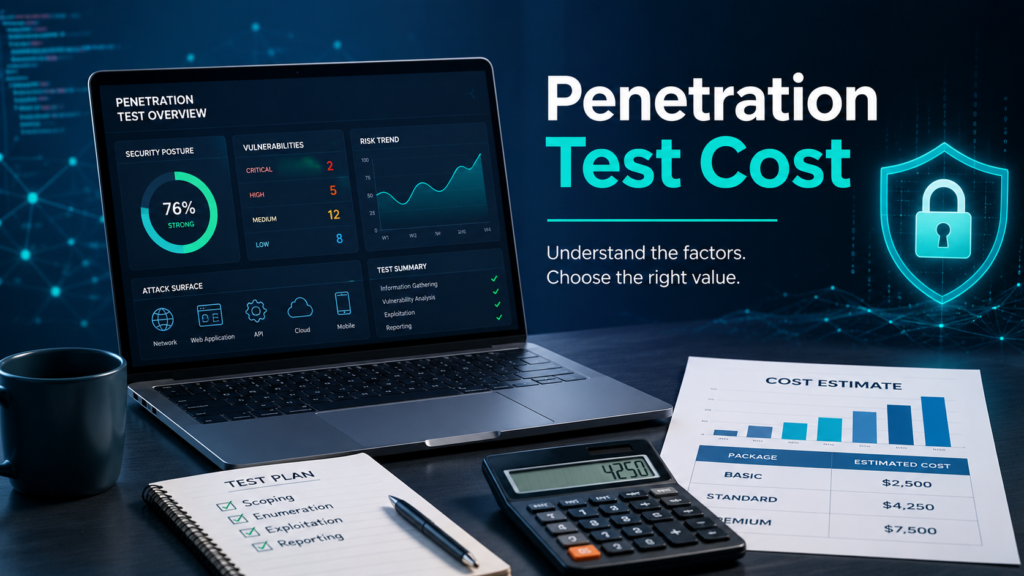
A professional penetration test costs between $5,000 and $50,000 for most organizations and well over $100,000 for large enterprises with complex environments. But that range alone won’t help you budget. The real question is what drives the price and what you actually get for the money.
Here’s the uncomfortable truth: tests under $4,000 are almost always automated scans, not real penetration tests. Genuine manual exploitation, attack chain simulation, and logic-flaw discovery cost more because skilled pentesters are expensive and their time reflects the actual depth of what gets found. Before comparing quotes, it helps to understand what penetration testing services actually include and how methodologies differ between providers.
Key Takeaways
- Penetration testing costs range from $5K to $100K+ depending on scope, test type, and compliance requirements.
- The global pentest market was valued at $2.74 billion in 2025 and is projected to reach $7.41 billion by 2034.
- The average U.S. data breach costs $10.22 million, making even a $30,000 pentest an ROI-positive investment.
- AI-enabled phishing attacks surged over 1,200% in 2025, pushing enterprise security budgets higher.
What Does a Penetration Test Cost by Type?
The type of test you need is the single biggest cost driver. A focused external network test and a full red team engagement are completely different products in methodology, time, and price.
Here’s the market breakdown for 2026:
| Test Type | Typical Cost Range |
| External Network Penetration Test | $5,000 – $20,000 |
| Internal Network Penetration Test | $7,000 – $35,000 |
| Web Application Penetration Test | $5,000 – $50,000 |
| Mobile Application Penetration Test | $5,000 – $40,000 |
| API Penetration Test | $5,000 – $30,000 |
| Cloud Penetration Test | $5,000 – $50,000 |
| Black Box Penetration Test | $10,000 – $50,000 |
| Red Team Engagement | $25,000 – $100,000+ |
External network tests are typically the entry point for organizations doing their first pentest. They’re scoped to internet-facing assets, web servers, email gateways, and VPN endpoints and take 1 to 2 weeks to complete.
Web application tests vary the most. A simple 5-page brochure site costs far less than a SaaS platform with 50+ dynamic endpoints, custom APIs, and role-based access logic. Bugstrix scopes every web app penetration test based on the counts of authenticated and unauthenticated pages, not on a flat fee.
Red team engagements are in a different category entirely. They simulate a full adversarial campaign phishing, physical access attempts, and internal lateral movement, and typically run for 4 to 8 weeks. They’re not appropriate for every organization, but for those handling sensitive financial, healthcare, or government data, they represent the most accurate measure of real-world breach risk. To understand how red team work differs from a standard assessment, a breakdown of attack surface management vs. penetration testing highlights the key distinctions.
What Factors Make a Penetration Test More Expensive?
Most buyers get surprised by quotes that come in higher than expected. That’s usually because certain scope elements are priced differently, and the variables below are the main ones that drive up cost.
Scope size and complexity are the primary drivers. More IP addresses, more URLs, more API endpoints, and more user roles all extend testing time. A test covering 500 internal hosts costs more than one covering 50.
Testing methodology also matters. Black-box tests, in which testers begin with no internal knowledge, take longer because reconnaissance and enumeration are part of the engagement. White-box tests, where testers have access to full architecture diagrams and source code, can be faster but require different analyst skills.
Compliance requirements add cost in two ways: they specify a minimum testing depth and often require formal deliverables (executive summaries, evidence packages, remediation tracking). A SOC 2 Type II pentest doesn’t just need findings; it needs documentation that satisfies auditors. PCI DSS ASV scans, HIPAA risk assessments, and ISO 27001 annex controls all have specific reporting requirements that extend project scope.
Tester credentials and firm reputation significantly affect price. An OSCP-certified tester at a boutique firm charges more per hour than an automated tool run by a junior analyst at a high-volume shop. The difference shows up not in the report length but in the quality of the findings, specifically whether manual logic flaws, business-logic vulnerabilities, and chained exploits are documented.
Geographic location still influences pricing, though less so with remote-first delivery. U.S.-based firms generally command higher rates than offshore providers. That said, many organizations in regulated industries require testers based in specific jurisdictions for compliance reasons.
Industry pricing data shows the average U.S. organization spends between $5,000 and $40,000 per pentest engagement, with enterprise buyers regularly exceeding $100,000 for comprehensive annual programs.
Most vendors won’t surface the full picture upfront. For a frank look at what’s often left out of sales conversations, the hard truths about penetration testing services are worth reading before you request quotes.
How Much Does Compliance-Driven Pentesting Cost?
If you’re pursuing a security certification, your pentest isn’t optional, and the compliance standard you’re targeting will shape what you need to buy.
SOC 2 Type II requires evidence of annual penetration testing as part of the Common Criteria. Most SOC 2 auditors accept a scoped web application and external network test. Budget $8,000 to $25,000 depending on your environment size.
PCI DSS v4.0 (effective March 2025) requires annual internal and external penetration tests plus quarterly network scans. Organizations in scope typically spend $12,000 to $40,000 annually on PCI-compliant testing.
ISO 27001 doesn’t mandate penetration testing explicitly but does require organizations to evaluate technical vulnerabilities. Most certification auditors expect evidence of regular testing. Budget $7,000 to $30,000 depending on the scope of your ISMS.
HIPAA doesn’t specify penetration testing, but the Security Rule requires a technical safeguards evaluation. OCR has cited a lack of penetration testing in enforcement actions. Healthcare organizations typically budget $10,000 to $35,000 for HIPAA-aligned security assessments.
CMMC Level 2/3 (for U.S. defense contractors) requires penetration testing as part of continuous monitoring requirements. Costs vary widely: $15,000 to $60,000+ depending on the assessed environment.
Bugstrix delivers compliance-ready pentest reports with the documentation formats auditors actually accept, not generic PDFs that require manual reformatting before your next assessment. See how vulnerability assessment services complement penetration testing for organizations managing multiple compliance requirements simultaneously.
Is a Cheap Penetration Test Worth It?
Here’s where most buyers make a costly mistake. Sub-$4,000 “penetration tests” are almost universally automated scan reports, Nessus output, Burp Suite spider results, or similar tooling repackaged as pentest deliverables.
That’s not penetration testing. It’s vulnerability scanning with a premium label.
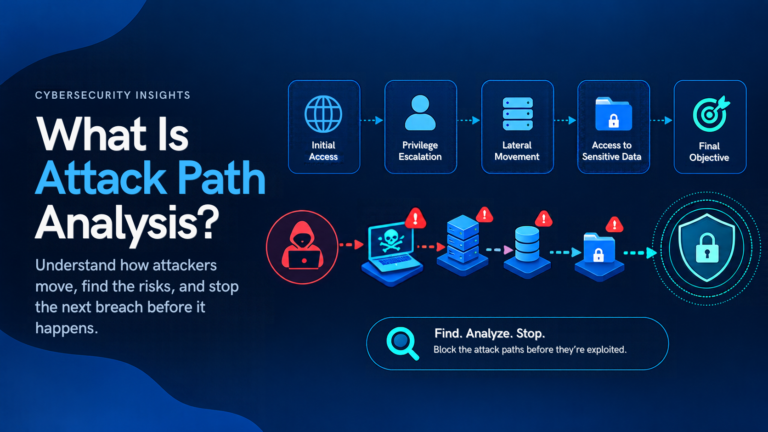
Real penetration testing involves manual exploitation, a tester actually confirming that a vulnerability is exploitable, chaining multiple weaknesses together into a meaningful attack path, and testing business logic that no scanner can understand. The scanner finds “SQL injection possible.” The pentester finds “SQL injection allows full database dump, including user PII and session tokens.”
The cost difference between a $3,000 scan and a $12,000 manual test isn’t just a price gap; it’s a fundamental difference in what gets discovered. If you’re unclear on where that line sits, the breakdown of vulnerability assessment vs penetration testing explains exactly what separates the two before you request quotes.
Consider the ROI math: the average U.S. data breach costs $10.22 million. Even at the high end, a $50,000 annual pentest is less than 0.5% of that exposure. Organizations that invest in rigorous testing consistently identify critical vulnerabilities before attackers do, and that’s exactly the outcome a real penetration test is designed to produce.
Recent analysis found that AI-assisted breach costs now average $5.72 million, a 13% year-over-year increase, as attackers deploy autonomous tools that continuously probe infrastructure. That context makes the cost of a thorough manual pentest look very different.
How Do Penetration Testing Pricing Models Work?
Firms price penetration tests in several ways. Understanding the model helps you compare quotes accurately.
Project-based (flat fee) is the most common model. You agree on scope, the firm quotes a fixed price, and you pay that amount regardless of how many hours the test takes. Good for buyers who want cost certainty.
Time-and-materials (hourly/daily rates) charges you for actual tester time. Senior pentesters typically bill $150 to $300/hour in the U.S. market. This model works well for engagements with variable scope but can be difficult to budget.
Retainer/continuous testing (PTaaS) is an emerging model where you pay a monthly fee for ongoing access to a testing team. Bugstrix offers this for organizations that need regular assessments rather than the single annual test, which is especially common in fast-moving SaaS environments where the attack surface changes monthly. Contact us to discuss pricing.
Per-asset pricing is common for network tests. External IP addresses might be quoted at $50 to $200 per host; internal hosts at similar rates. This model scales transparently with your environment.
Most reputable firms will provide a detailed scope breakdown with their quote showing exactly what’s being tested, at what depth, and with what methodology. If a quote arrives as a single number without a scope document, that’s a red flag.
What’s the ROI of a Penetration Test?
The question most security teams get asked in budget meetings: why are we spending $20,000 on a test that might not find anything?
The honest answer is that finding nothing is the best possible outcome, and it costs the same as finding something critical. But the more accurate framing is that professional penetration tests virtually always find findings worth addressing.
The global penetration testing market was valued at $2.74 billion in 2025, reflecting the widespread adoption of regular testing as a baseline security control. That market is projected to reach $7.41 billion by 2034, driven by regulatory expansion, cyber insurance requirements, and rising breach costs.
From a direct ROI perspective: if a $15,000 pentest identifies a critical vulnerability that would have cost $10 million to remediate after a breach, the return is over 650x. Even identifying a single exploitable finding that prevents a regulatory fine, GDPR fines average 2% of global annual revenue, which justifies the cost of most engagements.
Bugstrix clients regularly discover critical issues in their first engagement, including broken access controls, exposed credentials, and unpatched systems with public exploits that automated scanning programs missed. The value isn’t in the report. It’s in what gets fixed.
Frequently Asked Questions
How much does a basic penetration test cost for a small business?
A small business with a modest web application and limited external attack surface should budget $5,000 to $12,000 for a professional penetration test. Anything significantly below that range is likely an automated scan rather than a manual test. Most firms will scope a test based on your actual environment rather than a flat fee.
Why do penetration test quotes vary so much between providers?
The range reflects differences in testers’ skill levels, methodological depth, scope interpretation, and deliverable quality. A $4,000 quote and a $25,000 quote for “the same test” usually describe completely different products: one is automated tooling with a report, the other is a senior tester manually exploiting your environment and documenting attack chains.
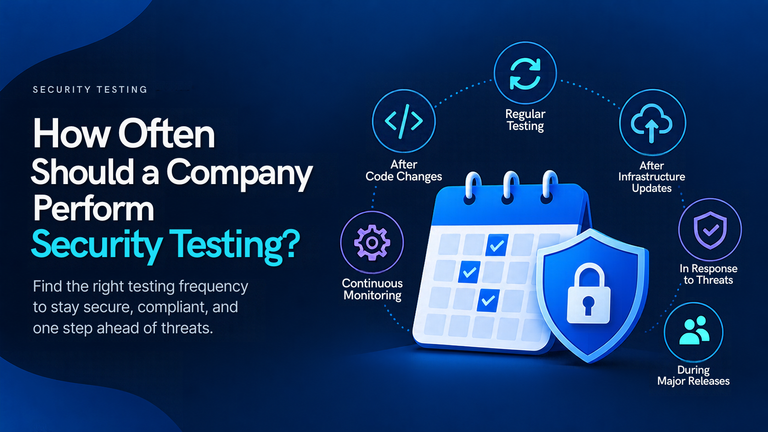
How often should an organization run a penetration test?
Most compliance frameworks (SOC 2, PCI DSS, ISO 27001) require annual testing at minimum. Fast-moving organizations, especially SaaS platforms releasing code continuously, benefit from quarterly or continuous testing models. Bugstrix’s continuous penetration testing service is designed for teams that need coverage beyond the annual engagement cycle.
Does the penetration test cost include remediation?
No. A penetration test identifies and documents vulnerabilities with remediation guidance. Actual fixing is done by your development or IT team. Some firms offer retesting at a reduced rate after you’ve made fixes. Bugstrix includes one retest cycle in its standard engagement packages.
How do I get an accurate penetration test quote?
You’ll need to define: the number of IP addresses or URLs in scope, the type of test (web app, network, API, mobile), whether it’s black-box or grey-box, and any compliance requirements. Bugstrix provides detailed scoping consultations before issuing any quote. Get a free quote.
What Should a Penetration Test Report Include?
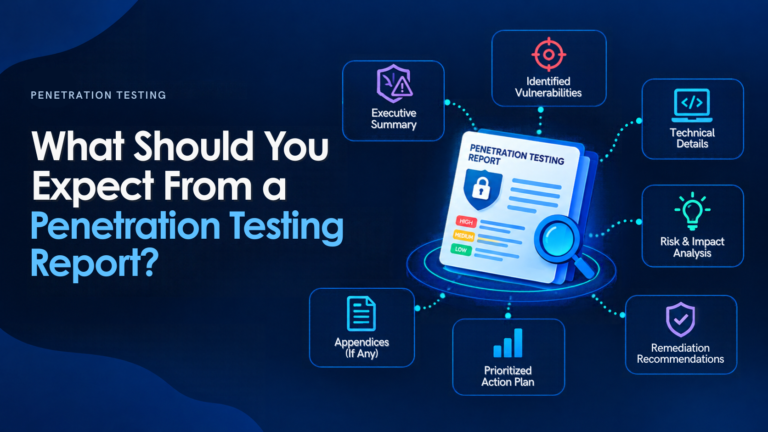
This is the deliverable you’re paying for. A professional pentest report should contain:
- Executive summary: a non-technical overview of risk posture and key findings, written for board-level review
- Technical findings: each vulnerability with a severity rating (typically CVSS-based), a proof-of-concept demonstrating exploitability, affected assets, and step-by-step remediation guidance
- Risk scoring: overall risk rating with context about how findings relate to your specific threat model
- Attack chain narrative: how individual findings could be chained together in a realistic attack scenario
- Remediation priority matrix: findings ranked by risk and effort to fix
- Compliance mapping: findings mapped to relevant controls (e.g., PCI DSS requirements, OWASP Top 10)
Reports that are just a Nessus or Burp Suite export reformatted as a PDF don’t meet this standard. Bugstrix reports are written by the tester who conducted the assessment, not auto-generated from tooling, and include manual findings that automated scanners miss entirely. You can see what a complete engagement looks like across web app, cloud, and mobile environments on the services pages.
How to Choose a Penetration Testing Provider
Not all penetration testing firms deliver the same product. Here’s what to evaluate when comparing providers:
Certifications matter. Look for testers who hold OSCP, OSEP, GPEN, GWAPT, CEH, or equivalent credentials. Certifications don’t guarantee quality, but they establish a baseline of technical competency.
Methodology transparency. A reputable firm will tell you exactly what methodologies they use, OWASP Testing Guide, PTES, NIST SP 800-115, OSSTMM, before you sign a contract. If they won’t discuss methodology, that’s a concern.
Samples of past work. Ask for a redacted sample report. The quality of the report reflects the quality of the testing. A thin 10-page PDF with no proof-of-concept screenshots or attack chain narrative suggests limited depth.
References from similar environments. A firm that specializes in SaaS application testing may not be the right fit for an OT/ICS environment. Ask about their experience with your specific technology stack.
Remediation support. Some firms offer retesting after fixes, and some offer calls with your engineering team to walk through findings. This is worth asking about; it significantly increases the value you get from an engagement.
Bugstrix operates as a dedicated offensive security firm; every engagement is conducted by senior testers, not junior analysts using automated tooling. Our methodology is documented, our reports are written for engineers and executives, and we include remediation guidance that your team can act on immediately. For a full overview of services and engagement structure, visit the Bugstrix services page.
Conclusion
Penetration test costs in 2026 range from $5,000 for a scoped external network test to $100,000+ for a full red team engagement. The right number for your organization depends on your environment size, compliance requirements, and risk tolerance, not on finding the cheapest quote.
The key takeaways:
- Sub-$4,000 tests are automated scans, not genuine penetration tests
- Compliance-driven testing (SOC 2, PCI DSS, HIPAA, ISO 27001) adds scope and documentation requirements that affect cost
- A professional pentest is among the highest-ROI security investments available; the average U.S. breach costs $10.22 million
- The global pentest market will reach $7.41 billion by 2034, reflecting how standard regular testing has become
If you’re ready to scope a penetration test or want to understand what your environment would cost to test properly, contact Bugstrix, and we’ll give you a detailed breakdown, not a ballpark.