What Is Managed Detection and Response (MDR)?

Written By
Sarwat Iftikhar
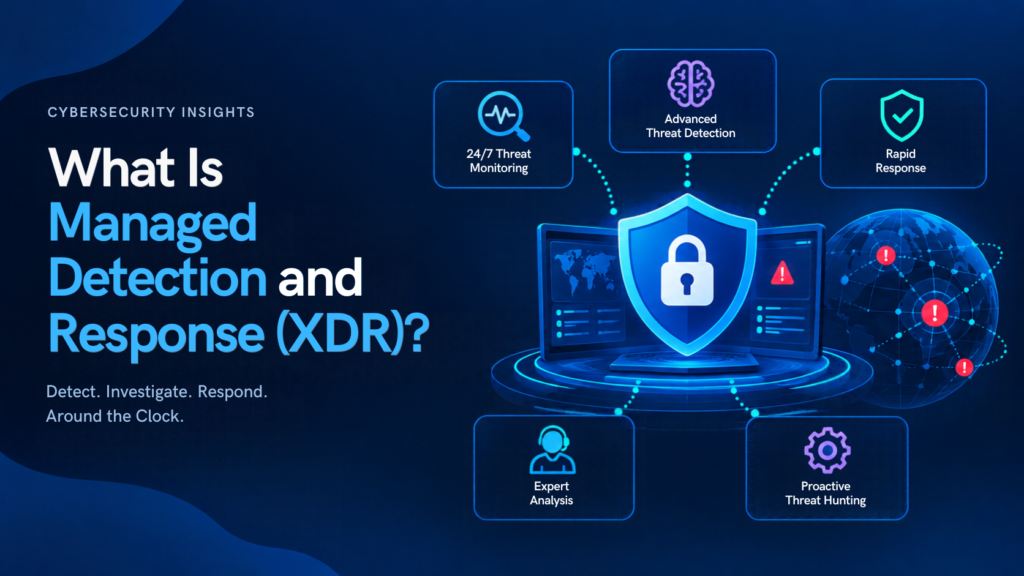
Most organizations have more security tools than they have the capacity to operate effectively. Alerts accumulate faster than analysts can investigate them. Detection logic goes untuned for months. Incidents are missed not because the tooling failed to generate a signal but because no one had the time to look at it. Managed Detection and Response exists as a service category specifically for this gap.
MDR is a security service in which a provider takes responsibility for monitoring an organization’s environment for threats, investigating alerts, and responding to confirmed incidents on the client’s behalf. The provider supplies the analysts, detection technology, and response capability. The client supplies access to the environment and agreement on the scope of permissioned response actions.
This post covers what MDR includes, how it compares to adjacent services and technologies, where its structural limitations are, and what to evaluate when determining whether an MDR engagement matches what a specific environment requires.
Key Takeaways
- MDR is a service delivery model, not a technology category. The provider operates the detection and response function; the buyer gets continuous monitoring and analyst-backed incident response without staffing an internal security operations center.
- MDR differs from MSSP in a meaningful way: MSSP manages security tools and forwards alerts; MDR actively investigates those alerts and responds to confirmed threats.
- The service covers only what the provider’s sensors can see. Assets and layers not feeding telemetry into the MDR platform are invisible to it, regardless of how capable the analyst team is.
- Detection coverage is bounded by the provider’s detection logic library. Attack techniques that fall outside that library do not produce alerts. Bugstrix engagement data consistently shows that MDR providers miss modified and novel techniques adapted to avoid known signatures, and that detection coverage is rarely validated against the specific threats targeting a client’s industry.
- MDR addresses detection and response. It does not address proactive vulnerability identification, external attack surface outside the sensor perimeter, or the offensive validation needed to confirm that provider detections actually fire on real techniques.
What Is Managed Detection and Response (MDR)?
Managed Detection and Response is a security service in which an external provider continuously monitors an organization’s environment for threats, investigates detections to confirm or dismiss them, and takes response actions against confirmed incidents within a defined scope. The service combines detection technology with human analyst coverage to provide ongoing threat monitoring and response that an organization does not have to staff or operate internally.
The defining characteristic of MDR is the response function. Alert monitoring alone does not constitute MDR the service must include analyst investigation of detections and the ability to act on confirmed threats. The depth and speed of that response, the layers of the environment that the provider monitors, and the scope of permissioned actions are the variables that distinguish one MDR provider from another.
MDR emerged as a practical answer to a real operational problem: continuous monitoring requires continuous staffing, and security operations analysts are expensive, specialized, and in short supply. An MDR provider spreads that operational cost across many clients while concentrating expertise in a dedicated team. In Bugstrix’s work with organizations assessing their detection and response programs, the gap MDR most reliably fills is coverage outside of business hours and the triage capacity to process alert volumes that an internal team cannot handle alone.
How Does MDR Differ From MSSP and SOC-as-a-Service?
MDR, MSSP, and SOC-as-a-service are terms that describe related but distinct service models for outsourced security operations. The distinctions are meaningful for evaluating what a service actually provides and whether it matches the security program requirement.
MSSP (Managed Security Service Provider) manages security tools and typically provides alert monitoring, log aggregation, and alert forwarding, but does not actively investigate or respond to threats. An MSSP delivering firewall management and SIEM log forwarding is not performing the triage and incident response that defines MDR. The key question when evaluating a service is not what it is called but whether the provider confirms threats before escalating them and whether they take response actions within the environment.
SOC-as-a-Service describes a range of offerings from basic alert monitoring to full-stack detection and response. Some SOC-as-a-service products are functionally MDR; others are MSSP under a different name. The label is less reliable than the specific deliverables: does the analyst team confirm threats before escalation, and can the provider take containment action without requiring client approval for every step?
MDR vs XDR: Extended Detection and Response is a technology platform for cross-layer detection and response; MDR is a service model. An MDR provider typically uses XDR or an equivalent platform as the underlying detection infrastructure and then layers human analyst coverage on top. Our post on extended detection and response (XDR) covers the platform category and its detection logic in detail; understanding the platform informs what the MDR service built on top of it can realistically deliver.
What Does an MDR Service Typically Include?
A full-scope MDR engagement covers the detection and response cycle from monitoring through containment. What is included in a specific engagement varies by provider and contract, but the following components represent the standard scope of a complete MDR service.
Continuous monitoring. The provider ingests telemetry from connected security controls and monitors it continuously, including outside business hours and on weekends. Coverage scope depends on what layers the provider’s platform supports: endpoint, network, identity, cloud, and email coverage each require specific tooling and integration. Not all providers monitor all layers to equivalent depth.
Alert triage and investigation. When a detection fires, a provider analyst reviews the alert in the context of the environment to determine whether the activity represents a genuine threat or a false positive. This investigation step is the differentiator between MDR and an alert-forwarding service: it applies human judgment to context that automated tooling cannot evaluate, including understanding of the client’s environment, business processes, and known-good activity patterns.
Incident containment. For confirmed threats, the MDR provider takes agreed-upon response actions within a permissioned scope: isolating an endpoint, blocking a network connection, disabling a compromised account, or executing a response playbook. The scope of permissioned actions is defined at engagement setup and limits what the provider can do without requesting client approval. Response scope that requires approval for each action introduces delays that matter in an active incident.
Threat hunting. Beyond reactive alert response, MDR providers conduct proactive searches for attacker activity that has not yet triggered automated detections. Effective threat hunting identifies indicators of slow-moving attacks, living-off-the-land techniques, and low-confidence signals that fall below alert thresholds individually but pattern-match to known attack sequences when reviewed by an experienced analyst.
Reporting and advisory. Periodic reporting on detection activity, confirmed incidents, and security posture observations. The quality of this reporting varies significantly: providers with strong advisory capability surface specific observations about the environment’s security state that go beyond a log of what was detected, while lower-tier services deliver summary activity reports with limited actionable content.
What Are the Limitations of MDR?
MDR’s value is real, but understanding its structural limitations is necessary for evaluating whether the service covers the gaps that actually concern a specific organization.
Detection logic is the ceiling. MDR analysts can only investigate alerts that the detection platform generates. An attack technique that has not been incorporated into the provider’s detection library produces no alert and receives no investigation, regardless of how capable the analyst team is. In Bugstrix red team engagements, attack techniques modified to avoid known signatures consistently bypass MDR provider detections without triggering a single alert. The gap between a provider’s claimed detection coverage and what they actually detect on real techniques is the most significant and most underdiscussed limitation of MDR as a security control.
Breach and attack simulation is the most direct method for measuring this gap: it executes real attack techniques against the live environment and records which ones produce detections, which ones generate analyst investigation, and which ones pass through completely undetected. Most organizations that deploy MDR do not run this validation and operate on the assumption that provider coverage matches the threat landscape targeting their environment.
Scope is limited to connected and instrumented assets. MDR visibility is bounded by what feeds telemetry into the provider’s platform. An endpoint without an agent, a cloud workload with logging disabled, an identity system not integrated with the platform, and external attack surface that exists outside the monitored perimeter are all invisible to the MDR service regardless of how serious the risk they represent. Attack surface management addresses the external dimension of this gap specifically: discovering internet-exposed assets, shadow IT, and external exposures that the MDR provider’s sensor perimeter never reaches.
MDR is reactive by design. The service activates on detection. Vulnerabilities in production systems, overpermissive access controls, attack paths through the environment, and misconfigurations that enable privilege escalation exist before any attacker uses them, and MDR does not surface them proactively. A vulnerability assessment identifies these conditions before exploitation; MDR responds after an exploitation attempt generates a detection. The two controls address different points in the attack lifecycle and are not substitutes for each other.
Identity coverage is often partial. Most MDR services integrate with identity systems and monitor for anomalous authentication behavior, but comprehensive coverage of credential-based attack techniques requires detection logic specific to identity attack paths that standard MDR platforms do not fully implement. Identity-targeted attacks that use legitimate credentials and normal authentication protocols are among the hardest detections to build and the most commonly missed. Our post on identity threat detection and response (ITDR) covers the identity-specific detection layer and where MDR coverage typically ends.
How Does MDR Fit Into a Broader Security Program?
MDR covers the detection and response function within a broader security program. The services and frameworks that address the gaps outside MDR’s scope are what determine whether the overall program is coherent or has structural blind spots.
CTEM integration. Continuous Threat Exposure Management provides the program framework that the detection and response function fits into. MDR generates incident data and detection findings that inform exposure prioritization; CTEM’s attack surface mapping and exposure analysis identifies the conditions MDR is positioned to detect, and proactively reduces the exposure that would otherwise drive MDR alert volume. Our post on continuous threat exposure management (CTEM) covers how the framework connects exposure identification, prioritization, validation, and remediation into a continuous cycle that MDR alone does not provide.
Offensive validation of MDR coverage. Deploying an MDR service and validating that the service detects real attacks are two different states. Continuous penetration testing closes the gap between them: executing real attack techniques against the environment and measuring whether they produce MDR detections, analyst investigation, and containment actions within the expected response time. This validation is the only reliable way to establish whether the MDR engagement is functioning as expected against the techniques that would actually be used against the environment.
What Should You Look for in an MDR Provider?
The variables that determine MDR service quality are not always visible in the evaluation process. A provider’s marketing materials describe claimed capabilities; a structured evaluation surfaces whether those capabilities hold against real requirements.
Response scope and permissioned actions. The contract should define explicitly what actions the provider is authorized to take without requesting client approval. Containment actions that require a manual approval step before execution introduce delay that matters in an active incident. Evaluate whether the permissioned scope enables meaningful response at the speed required, not just whether a response capability exists.
Detection technology and layer coverage. Understand specifically what the provider’s platform monitors: endpoint, network, identity, cloud, and email coverage each require different tooling. Confirm that the layers in scope match the environment being protected. A provider with strong endpoint coverage but limited cloud detection is a poor match for an environment where cloud workloads represent the primary attack surface.
Mean time to detect and respond. Ask for historical performance data on these metrics for clients with environments similar to yours. Claimed response times without supporting data should be treated with skepticism. In Bugstrix’s evaluation of MDR providers, response time variance between clients in similar environments is frequently wider than providers acknowledge in their standard materials.
Threat hunting methodology. Ask specifically how often proactive hunting occurs, what methodology the analyst team uses, and whether hunting output is included in client-facing reporting. Providers who rely primarily on automated detections and perform minimal analyst-led hunting are delivering a more limited service than the MDR category promises.
Detection validation process. Does the provider validate their detection coverage against the specific threat landscape targeting your industry and environment? Can they document which detection techniques are covered and which are not? A provider who cannot answer these questions has not performed this validation themselves. The most important question in an MDR evaluation is not what the provider claims to detect but how they know.
Frequently Asked Questions
Is MDR the same as SOC outsourcing?
MDR and SOC outsourcing overlap significantly. A full SOC-as-a-service engagement may include broader security operations functions beyond detection and response: vulnerability management, compliance monitoring, and security program advisory. MDR is scoped specifically to threat detection, investigation, and response. Many providers use both terms interchangeably; the service deliverables rather than the label determine the fit.
Can MDR replace an internal security team?
MDR replaces some security operations functions but not the full security program. The provider handles detection, investigation, and response. Security architecture decisions, vulnerability management, compliance requirements, and proactive security testing typically remain the responsibility of an internal team or external specialists engaged for those functions specifically. Organizations with small security teams most commonly use MDR to extend capacity rather than eliminate internal headcount.
How is MDR priced?
MDR pricing is typically structured on a per-endpoint or per-user basis for a defined coverage scope, with adjustments for the number of layers monitored, the response scope, and the service tier. Annual contracts are standard. Pricing varies considerably based on provider scale, analyst team depth, and the specific coverage layers included.
Does MDR cover cloud environments?
Most MDR providers offer cloud coverage, but depth varies significantly. Coverage for cloud-native workloads, serverless functions, container environments, and cloud IAM typically requires platform-specific support that not all providers have built equally. Organizations with significant cloud footprint should evaluate cloud coverage depth explicitly rather than assuming it is equivalent to endpoint coverage in the provider’s standard offering.
What is the difference between MDR and an incident response retainer?
An incident response retainer provides access to a specialized response team when a significant incident occurs but does not include continuous monitoring between incidents. MDR provides continuous monitoring and response as an ongoing service. The two are complementary: MDR handles the detection and initial response layer; an IR retainer provides surge capacity and specialized forensic investigation for major incidents that exceed normal MDR response scope.
MDR and the Security Program Around It
MDR solves a real operational problem: continuous threat monitoring requires continuous staffing, and most organizations cannot sustain that function internally. The service fills that gap reliably when the detection technology covers the right layers, the analyst team has the depth to investigate what the platform surfaces, and the response scope is defined specifically enough to enable meaningful action before damage is contained.
What MDR does not do is reduce the attack surface before exploitation, extend visibility to assets outside the sensor perimeter, or confirm that the provider’s detection logic holds against the techniques being used against the specific environment. Bugstrix works with organizations using MDR to identify and close these gaps: proactive testing of the environment to find what MDR will eventually respond to, external attack surface mapping to cover what MDR cannot see, and offensive validation to confirm that the MDR engagement is working as expected under real attack conditions.