What Is Endpoint Detection and Response (EDR)?

Written By
Sarwat Iftikhar
Most successful attacks execute their objectives on endpoints. Phishing delivers a payload to a workstation. A vulnerable service gets exploited on a server. Credentials pulled from memory enable lateral movement to every system reachable from the initial foothold. Perimeter controls intercept some of this, but once an attacker is operating inside a network using legitimate tools and stolen credentials, traditional defenses generate little signal. Endpoint Detection and Response was built to provide the visibility and response capability that matters after the perimeter has been breached.
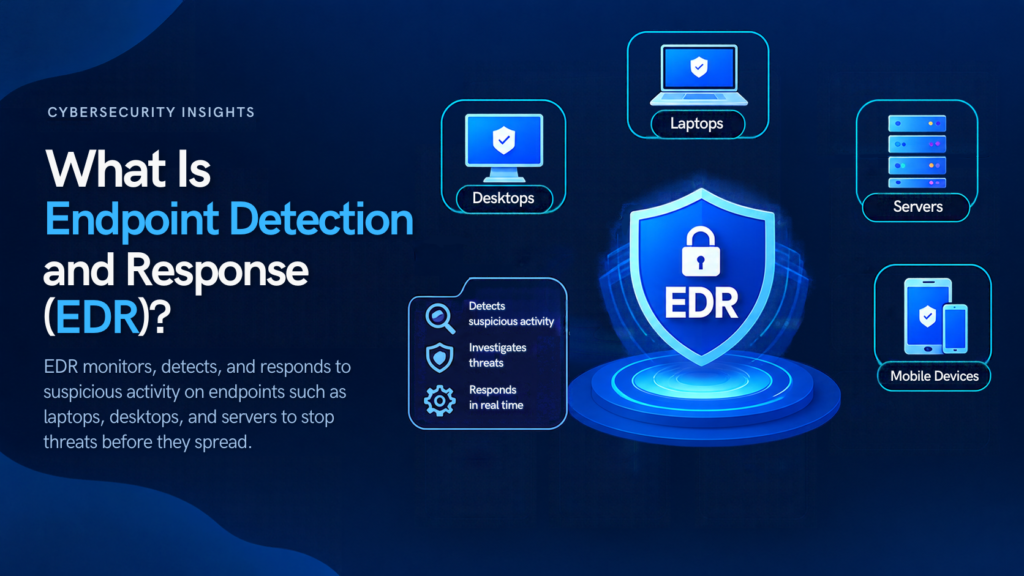
EDR is a security control that installs an agent on endpoint devices, continuously records process-level activity, and analyzes that data for behavioral patterns that indicate active compromise. The platform assumes some attacks will get through and focuses on making their activity visible, investigable, and containable before damage escalates.
This post covers how EDR works, what it detects, where its structural gaps are, and what to evaluate when assessing whether an EDR deployment is functioning as expected against the threats targeting a specific environment.
Key Takeaways
- EDR is a security control, not a service. It collects continuous process-level telemetry from endpoint devices and uses behavioral analytics to detect active threats that signature-based tools miss.
- EDR differs from antivirus in a fundamental way: antivirus matches signatures of known malicious files; EDR records what processes do and detects behavioral patterns that indicate compromise, including threats with no known signature.
- Visibility is bounded by the endpoint agent. Unmanaged devices, network traffic between systems, identity layer activity, and cloud workloads are invisible to EDR regardless of what happens on or between them.
- Detection coverage is bounded by the platform’s behavioral analytics library. Techniques that fall outside that library pass through without generating an alert. Bugstrix red team engagements consistently demonstrate that modified and living-off-the-land techniques bypass default EDR configurations without triggering a single detection.
- EDR addresses endpoint-layer detection and response. It does not cover the external attack surface, identity-based attack paths, or the offensive validation needed to confirm that its detections fire on real techniques in a specific environment.
What Is Endpoint Detection and Response (EDR)?
Endpoint Detection and Response is a security control that installs a lightweight agent on endpoint devices, records process execution, file activity, network connections, registry modifications, and authentication events continuously, and analyzes that behavioral telemetry to identify indicators of active compromise. It pairs automated detection with the forensic data needed for analyst investigation and response at the endpoint level.
The defining characteristic of EDR is the continuous recording model. Unlike tools that evaluate files at execution time, EDR captures a running record of what processes do after they start: what they spawn, what they read and write, what network connections they initiate, and how their behavior evolves over time. This telemetry makes it possible to detect attacks that operate without recognizable malicious files, connect low-confidence individual events into patterns that indicate a live intrusion, and reconstruct the full timeline of a compromise for investigation and remediation.
In Bugstrix’s penetration testing engagements, the endpoint is where post-exploitation activity is most visible to defenders and where EDR detection failures have the most direct consequences for how far an attacker can advance before being stopped.
How Does EDR Work?
EDR operates through four interconnected stages that each extend the platform’s capability: telemetry collection, behavioral analysis, alert generation, and response execution. The overall effectiveness depends on how well each stage is configured and tuned to the environment it monitors; limitations at any stage constrain what the platform can accomplish regardless of how capable the others are.
Telemetry collection. An agent installed on each endpoint records operating system-level events continuously: process creation and termination, parent-child process relationships, file reads and writes, network connection initiation and termination, authentication activity, and registry modifications. This event stream is the raw material for everything the platform does. Coverage is strictly bounded by where agents are deployed; any device without an installed and active agent produces no telemetry and is invisible to the EDR platform.
Behavioral analysis. The collected telemetry is evaluated against a library of detection rules and behavioral models that describe patterns associated with known attack techniques. The analysis engine correlates individual events across time and process context: a single event that looks benign in isolation becomes significant when it appears in a sequence matching a known attack pattern. The depth and accuracy of this library is the primary determinant of what the platform detects.
Alert generation. When the analysis engine identifies activity that matches a behavioral pattern, it generates an alert for review. Alert quality depends heavily on environment-specific tuning: detection logic calibrated to a general baseline generates more false positives in environments where legitimate administrative activity looks unusual against a broad-population baseline. In Bugstrix assessments of EDR-protected environments, alert fatigue and false positive management are consistently cited by internal teams as the primary operational constraint on investigation capacity.
Response execution. For confirmed threats, the platform provides response actions including endpoint isolation (severing the device from the network while preserving it for forensic review), process termination, file quarantine, registry rollback, and execution of predefined response playbooks. The scope of automated versus analyst-triggered response is a configuration decision that balances containment speed against the risk of disrupting legitimate business processes.
How Does EDR Differ From Antivirus and Traditional Endpoint Protection?
Antivirus, endpoint protection platforms, and EDR are related but distinct controls built on different detection models, and the distinction matters for understanding what class of threats each one addresses, where each one falls short, and why the shift from signature-based prevention to behavioral detection represents a qualitative change in what endpoint security can catch.
Antivirus operates on signature matching: it compares files against a database of known malicious content at execution time and blocks or quarantines matches. This model is reliable against known malware with stable signatures and provides no detection capability against threats that operate without files, modify their signatures on delivery, or use the operating system’s own administrative tools to execute attack phases.
Endpoint protection platforms (EPP) extend antivirus with additional preventive controls including application allowlisting, memory exploit prevention, and limited behavioral detection. EPP reduces the attack surface and blocks a broader range of initial access techniques, but remains primarily preventive: it is designed to stop known and anticipated threat categories at execution, not to detect and investigate post-exploitation activity that gets through.
EDR shifts the fundamental model from prevention to detection and investigation. Rather than attempting to block every malicious execution before it starts, EDR records everything and analyzes it for behavioral patterns associated with compromise. This creates the audit trail needed to detect attacks that bypass preventive controls, understand their full scope, and contain them with forensic confidence. Our post on extended detection and response (XDR) covers how EDR’s behavioral detection model extends beyond endpoints to network, identity, and cloud telemetry when cross-layer visibility is required.
What Does EDR Detect?
EDR’s detection capability is defined by its behavioral analytics library. The platform detects activity that matches the behavioral patterns in that library and produces no alert for techniques the library does not cover. Understanding which attack categories are well-represented in EDR detection logic, and which are not, is the accurate basis for evaluating what the platform reliably delivers.
Process injection. Attackers inject malicious code into legitimate processes to execute in the context of trusted software and evade tools that evaluate process identity. EDR monitors for the behavioral signatures of common injection techniques, including process hollowing, dynamic-link library injection, and reflective loading, by analyzing anomalous cross-process memory access and execution sequencing.
Credential harvesting. Attempts to read credentials from protected memory locations, including the system process responsible for managing authentication credentials, generate behavioral patterns that EDR platforms consistently detect. Credential harvesting is among the most reliably detected attack categories because the underlying techniques have stable behavioral signatures that are well-represented in detection libraries across modern EDR platforms.
Persistence mechanisms. Registry modifications that create startup entries, scheduled task creation, and service installation each produce behavioral traces that EDR analyzes against known persistence patterns. Coverage of persistence techniques is generally strong because these behaviors have stable signatures and are difficult for attackers to avoid entirely when trying to maintain access across reboots.
Living-off-the-land techniques. Attackers frequently avoid delivering external malware and instead use tools already present on endpoint systems to execute attack phases: scripting engines for payload staging, built-in administration utilities for reconnaissance, and system management tools for credential access and lateral movement preparation. EDR monitors for anomalous use of these tools, but distinguishing malicious use of a legitimate administration tool from legitimate use of that same tool requires accurate environment baselining that many deployments have not established. Bugstrix assessment data consistently identifies living-off-the-land techniques as the category where EDR detection gaps are most significant and most consequential.
Lateral movement. Remote execution attempts, authentication with harvested credentials to adjacent systems, and connection patterns associated with moving between endpoints are detectable when the agent is installed on both the initiating and receiving systems. Movement to systems without agents, or movement conducted entirely through identity-layer channels, is invisible to endpoint detection regardless of how it is conducted.
What Are the Limitations of EDR?
EDR addresses a real gap in endpoint visibility, but its structural limitations define the boundaries of what it can reliably detect and respond to. Understanding these limitations is the accurate basis for evaluating whether EDR coverage matches the actual risk profile of a specific environment.
Detection logic is the ceiling. EDR cannot detect what its behavioral analytics library has not been built to identify. Attack techniques that fall outside the library, novel approaches that modify known techniques to avoid their signatures, and custom tooling built to evade common detections pass through without generating alerts. Bugstrix red team engagements against EDR-protected environments demonstrate this consistently: modified attack techniques and living-off-the-land sequences adapted to avoid known behavioral signatures pass through without triggering a single detection. The gap between a vendor’s claimed coverage and what the platform actually detects against real techniques is the most significant and most commonly unexamined limitation in EDR evaluations.
Breach and attack simulation. provides direct measurement of this gap: it executes real attack techniques against the live EDR deployment and records which produce alerts, which generate analyst investigation, and which pass through entirely undetected. Most organizations that deploy EDR do not validate coverage this way and operate under the assumption that vendor-claimed detection rates reflect what the platform detects in their specific environment configuration.
Scope is limited to instrumented endpoints. EDR visibility ends at the boundary of where agents are deployed. Unmanaged devices, contractor endpoints not enrolled in the program, legacy systems that cannot support the agent, and newly provisioned devices not yet onboarded all represent blind spots regardless of what happens on them. An organization with seventy percent agent deployment has thirty percent of its endpoint estate invisible to its EDR platform. The external dimension of this scope problem extends further: internet-exposed assets, shadow IT, and external attack surface exist entirely outside the managed endpoint perimeter. Attack surface management addresses this external layer, identifying the assets and exposures that EDR never reaches.
Identity-based attacks largely bypass EDR. Attackers who compromise credentials and use legitimate authentication protocols to move through an environment generate minimal suspicious endpoint behavior. Authentication events, access patterns enabled by stolen credentials, and lateral movement conducted through legitimate remote access channels are identity-layer events that EDR is not designed to detect. Our post on identity threat detection and response (ITDR) covers the detection model built specifically for credential-based attack techniques that consistently fall outside EDR coverage.
EDR is reactive by design. The platform activates on detected behavioral signals. Unpatched vulnerabilities on endpoints, privilege escalation paths enabled by misconfiguration, and local access control weaknesses exist before any attacker exploits them, and EDR does not surface these conditions proactively. Proactive assessment identifies them before they are used; EDR responds after an exploitation attempt generates a behavioral signal.
How Does EDR Fit Into a Broader Security Program?
EDR covers the endpoint detection and response function within a broader security program. The controls that address the gaps outside EDR’s scope determine whether the overall program has coherent cross-layer coverage or structural blind spots that leave significant attack surface unmonitored. MDR, XDR, and identity-specific detection each extend the program in directions that EDR alone cannot address.
XDR extends EDR’s detection model across layers. An attacker who compromises credentials through a phishing email, authenticates through the identity layer, accesses cloud-hosted data through legitimate channels, and exfiltrates through normal network paths generates minimal suspicious behavior at any single endpoint. The attack sequence crosses multiple layers, and endpoint-only monitoring cannot detect the cross-layer pattern. Extended detection and response (XDR) applies the same behavioral correlation model across endpoint, network, identity, and cloud telemetry simultaneously, detecting attack patterns that EDR’s single-layer view misses entirely.
MDR adds human coverage to EDR data. EDR generates telemetry and detections; investigating those detections in context and responding to confirmed incidents requires analyst capacity. Organizations that lack the internal staffing to monitor EDR alerts continuously, tune detection logic against evolving attack techniques, or scale response capacity to incident volume use managed detection and response (MDR) to supply that human layer. MDR providers use EDR or XDR as the underlying detection platform and add dedicated analyst investigation and incident response capacity on top of the platform data.
Offensive validation confirms EDR coverage. Deploying an EDR platform and confirming that it detects real attack techniques in a specific environment are two different states. Continuous penetration testing closes the gap between them by executing real attack techniques against the live environment and measuring which ones generate alerts, analyst investigation, and containment actions within expected time frames. Bugstrix works with organizations using EDR to validate that detection coverage assumptions hold against the specific techniques relevant to their industry and environment configuration, rather than operating on vendor coverage claims alone.
What Should You Look for in an EDR Solution?
The variables that determine EDR effectiveness are not always visible in standard vendor evaluations. A provider’s marketed capability describes what the platform is built to do in general; assessing whether those capabilities hold in a specific environment requires evaluation against the actual endpoint configuration, threat landscape, and operational requirements in place.
Detection coverage against your actual threat landscape. Ask vendors specifically which attack techniques their detection library covers and request evidence that those detections fire against live techniques in environments similar to yours. Vendors who cannot document their detection coverage or demonstrate it in a live environment have not validated it themselves. The most important question in any EDR evaluation is not what the platform claims to detect but how you can verify that it detects real techniques in your specific environment configuration.
Agent compatibility and deployment scope. Review which operating systems, versions, and hardware configurations the agent supports. Gaps in the compatibility matrix become permanent blind spots in the detection program. Legacy systems, specialized devices, and non-standard configurations that cannot run the agent represent coverage gaps that a deployment plan must account for explicitly rather than treating as temporary.
Automated response scope and configuration. Evaluate what actions the platform executes automatically without analyst approval and what actions require a manual trigger. Fully automated response reduces time-to-containment but risks disrupting legitimate business processes when detection logic fires on benign activity. Analyst-triggered response limits that risk but introduces delay. The right balance depends on the organization’s tolerance for both disruption and containment latency in an active incident.
Telemetry retention and forensic depth. The endpoint activity records that make EDR valuable for incident investigation are only accessible for the period they are retained. Retention windows that are too short prevent investigation of slow-moving attacks and limit the ability to establish the full scope of a compromise that went undetected for days or weeks. Evaluate retention duration against the realistic dwell time of threat actors targeting your environment.
Integration with detection validation and tuning. Determine whether the platform supports external testing of its detection coverage and whether the vendor facilitates ongoing tuning against new techniques. Platforms designed to be tested and measured externally are more transparent and produce more reliable coverage data than those that resist external coverage assessment. Periodic validation through offensive testing is the only reliable way to establish whether the platform detects the techniques that matter.
Frequently Asked Questions
Does EDR replace antivirus?
EDR replaces antivirus as the primary endpoint detection control in most modern security programs because behavioral detection covers both known malware and unknown threats, while signature matching covers only the former. Some EDR platforms include integrated signature-based prevention to maintain immediate blocking of known commodity malware alongside the behavioral detection layer. Organizations transitioning from antivirus to EDR should verify that prevention-layer coverage is maintained rather than assuming behavioral detection alone provides equivalent commodity malware coverage.
Can EDR detect fileless attacks?
EDR is specifically designed to detect fileless attack techniques that antivirus cannot identify, because it analyzes process behavior rather than file content. Fileless attacks that execute entirely in memory, use scripting engines as staging mechanisms, or leverage legitimate system utilities to conduct attack phases leave behavioral traces in process telemetry that EDR’s analysis engine is built to detect. Coverage for specific fileless techniques varies by platform and depends on how accurately the detection library distinguishes malicious from legitimate use of the same system tools, which requires environment-specific tuning to get right.
How does EDR handle encrypted network traffic?
EDR does not decrypt network traffic to inspect its contents; it monitors the endpoint-side behavior associated with that traffic. An endpoint establishing a connection to an unusual external destination, transmitting data volumes outside normal patterns, or initiating connections through processes that do not normally generate network activity are all detectable behavioral signals regardless of whether the traffic itself is encrypted. Network-layer inspection of encrypted content is a separate capability that requires different tooling outside the endpoint layer.
What is the difference between EDR and XDR?
EDR monitors and responds to threats at the endpoint layer only. XDR extends the same behavioral detection model across multiple telemetry sources simultaneously: endpoint, network, identity systems, cloud workloads, and email. The practical difference is the ability to detect attacks that cross layers. An attacker who compromises a credential, authenticates through the identity layer, and accesses cloud data through legitimate channels generates minimal suspicious behavior at any single endpoint; XDR detects the cross-layer pattern that endpoint-only monitoring never sees as a connected sequence.
Does EDR require a dedicated security team to operate?
EDR platforms can be configured with automated response rules that operate without continuous analyst oversight, but effective EDR operation requires regular attention: detection logic tuning as the threat landscape and the environment evolve, investigation of alerts that automated logic escalates, and periodic validation that detections fire on real techniques. The analyst capacity required depends on alert volume, the depth of investigation the organization performs, and how much of the incident response lifecycle automated response covers. Organizations that cannot sustain this capacity internally typically use MDR to supply it.
EDR and the Security Program Around It
EDR addresses the endpoint visibility gap that perimeter controls and signature-based tools leave open. The behavioral telemetry it generates is the foundation for detecting post-exploitation activity that traditional defenses cannot see, and the response capability it provides is what enables containment before an incident expands further into the environment.
What EDR does not do is provide visibility into identity-based attacks, extend coverage to unmanaged devices and external attack surface, or confirm that its detection logic holds against the techniques being used against the specific environment. Bugstrix works with organizations using EDR to address these gaps: validating detection coverage through offensive testing, mapping the endpoint estate to identify agent deployment gaps, and identifying the identity and external attack surface conditions that fall entirely outside EDR’s visibility.