What Is Infrastructure as Code (IaC)?

Written By
Sarwat Iftikhar
Before infrastructure as code, provisioning a cloud environment meant someone logging into a console, clicking through configuration menus, selecting storage types, setting network rules, assigning permissions, and hoping the person who did it next time made all the same choices. The resulting environment was defined by whatever a person happened to configure on a particular day. There was no record of why a security group rule existed. There was no way to reproduce the exact environment in another region. There was no version history to track when a configuration changed or who changed it.
Infrastructure as code changed this by treating cloud infrastructure configuration the same way software development treats application code: you write it in a file, commit it to version control, review it before it is applied, test it in lower environments before production, and apply it through an automated pipeline rather than manual action. The infrastructure is defined in machine-readable templates. Every configuration decision is explicit, reviewable, and reproducible.
This shift solved significant operational problems around consistency, reproducibility, and deployment speed. It also created a new class of security challenge. When infrastructure is provisioned through code, a security misconfiguration in a template does not affect one environment configured by one person on one day. It replicates across every environment where that template is applied, automatically, at deployment speed. The efficiency of IaC works in both directions: it propagates correct configurations reliably, and it propagates misconfigurations just as reliably.
Key Takeaways
- Infrastructure as code defines cloud infrastructure through machine-readable templates that are version-controlled, reviewed, and applied automatically, replacing manual console configuration.
- A misconfiguration in an IaC template replicates across every environment the template is deployed to. The reach of a single misconfigured template is proportional to how widely it is used.
- In Bugstrix cloud security assessments, IaC templates with permissive IAM roles, overly open security group rules, and disabled logging configurations are consistently among the highest-impact findings, because each one represents a misconfiguration that exists in every environment the template has been applied to.
- IaC security is most effective when scanning happens in the CI/CD pipeline before templates are applied, not through posture management after misconfigured infrastructure is already running in production.
- The combination of IaC template scanning, cloud security posture management, and manual cloud penetration testing covers the full range of IaC-introduced risk: policy violations at build time, configuration drift at runtime, and exploitable attack paths that automated scanning cannot discover.
What Is Infrastructure as Code?
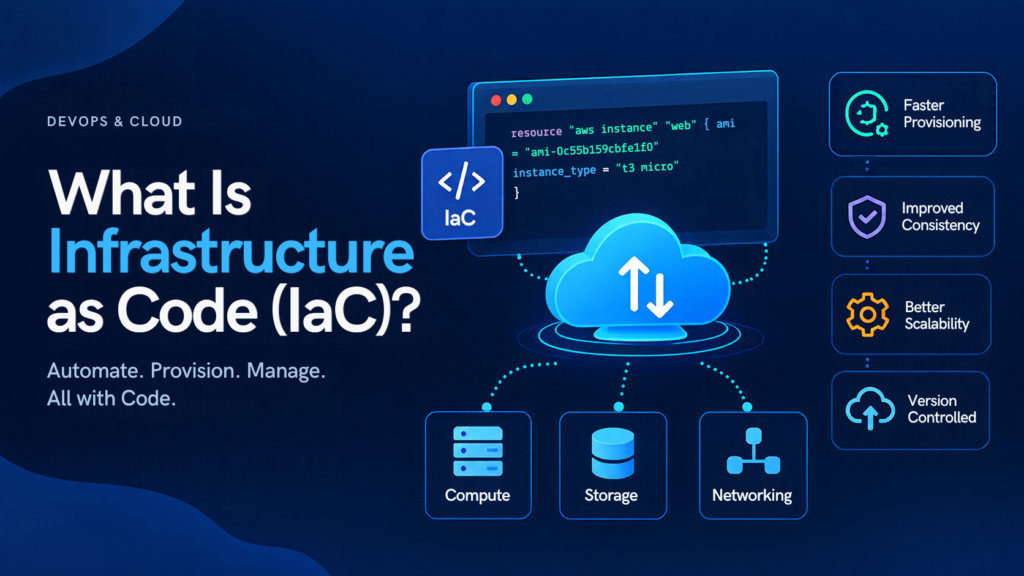
Infrastructure as code is the practice of defining, provisioning, and managing cloud infrastructure through machine-readable configuration files rather than manual processes, enabling infrastructure to be version-controlled, reviewed, tested, and deployed with the same engineering practices applied to application software.
The practical effect of IaC is that a cloud environment becomes describable in text. A file defines which virtual machines exist and their specifications, which network rules govern traffic between them, which storage buckets exist and their access configurations, which IAM roles are created and what permissions they carry, and which logging and monitoring configurations are enabled. Applying that file to a cloud account produces the described environment. Applying it again produces an identical environment. Applying it to a different cloud account produces the same environment in a different region or for a different purpose.
This reproducibility is the core operational value of IaC. Development, staging, and production environments can be defined from the same templates, ensuring that what is tested in development is what runs in production. New environments can be provisioned in minutes by running an existing template rather than hours of manual configuration. Environments can be destroyed and recreated cleanly. Changes can be tracked through version history.
The security implications of this model follow directly from its operational properties. Understanding those implications requires understanding how IaC templates create the cloud security risk landscape that security teams then have to manage. Our post on cloud security covers the broader cloud security model that IaC operates within, including the shared responsibility framework that defines which configuration decisions belong to the cloud customer rather than the provider.
What Are the Most Common IaC Security Risks?
IaC security risks fall into two categories: misconfigurations deliberately written into templates by engineers who did not recognize the security implications, and misconfigurations that accumulate as templates are modified over time without security review. Both categories produce the same outcome: infrastructure running in production with a configuration that creates an exploitable attack surface.
Overpermissive IAM configurations are the most frequently exploited IaC misconfiguration category in Bugstrix cloud penetration testing engagements. A template that attaches a broadly permissive IAM role to a compute resource because an engineer needed wide access during development and never tightened it before the template was committed creates an exploitable privilege escalation path in every environment that template runs in. The IAM role definition is in the template. The template is applied to production. The overpermission is in production. Because IaC is typically where cloud IAM roles and policies are first defined, getting Identity and Access Management right at the template stage is far more efficient than remediating overpermissions across deployed environments after the fact.
Open network rules provisioned through IaC represent a specific risk pattern that is hard to catch without template scanning. A security group rule permitting inbound traffic from any address to an administrative port, written into a template for convenience during initial development, may persist through every deployment cycle if no IaC scanner checks for it before the template is applied.
Public storage resources provisioned without access controls are a recurring source of cloud data exposure. A storage resource provisioned through a template without explicit access restrictions may default to public accessibility depending on the cloud provider’s default configuration. The template defines no ACL. The deployed resource has no ACL. The data it receives is publicly accessible.
Disabled logging configurations are frequently present in IaC templates because engineers who are not thinking about incident response do not think to enable audit logging when provisioning a resource for application use. The resulting environment has no visibility into access and modification events, which creates a detection gap attackers can use to operate without leaving traces.
Hardcoded secrets are an IaC-specific risk that does not exist in the same form in traditional provisioning. When credentials, API keys, or database passwords are written directly into template variable values and committed to version control, they are exposed to anyone with repository access and to any system that reads the commit history.
How Does IaC Affect the Attack Surface?
IaC defines the attack surface. Every resource provisioned by a template, every network rule that template creates, every IAM role it attaches, and every service it enables becomes part of the environment’s attack surface. The security of the attack surface that results is a direct function of the security of the templates that defined it.
The relationship between IaC and attack surface has a specific implication for attack surface management: the attack surface is now partially enumerable from the template repository without needing to scan the deployed environment. A security team with access to the IaC templates that define production knows in advance what resources exist, what permissions are in place, and what network rules govern traffic before any scanning tool touches the live environment.
This also means that attack surface changes can be detected before they are deployed. A pull request that adds a new publicly accessible resource, opens a new network port, or expands an IAM policy represents an attack surface change that can be reviewed, questioned, and blocked at the code review stage rather than discovered as a live misconfiguration after deployment. Our attack surface management service includes assessment of IaC-defined attack surface alongside the runtime discovery that identifies what is actually exposed in the deployed environment.
The connection to attack path analysis is direct: IaC misconfigurations are the nodes that attack paths run through. An overpermissive IAM role defined in an IaC template and an open network rule from the same or another template may each appear as separate low-severity findings in isolation. In an attack path model, they may form a chain that creates a traversable route to a critical target. Our post on attack path analysis covers how these findings combine into paths and why path-level prioritization changes which IaC misconfigurations matter most.
What Is IaC Scanning and How Does It Work?
IaC scanning is the practice of analyzing infrastructure as code templates before they are applied, checking them against security policies, compliance benchmarks, and known misconfiguration patterns to identify security issues at the point where they are cheapest and easiest to fix: before the misconfigured infrastructure exists.
The core mechanic of IaC scanning is policy evaluation. A scanning tool parses the template file, extracts the resource definitions and their configured attributes, and evaluates each resource against a library of security rules. A rule checks whether a storage resource has public access disabled. Another checks whether security group rules permit inbound traffic from unrestricted address ranges. Another checks whether encryption is enabled on database resources. A finding is generated for each resource that fails a rule.
IaC scanning is most effective when integrated directly into the CI/CD pipeline as a required stage that must pass before a template can be merged or deployed. A scan that runs in a separate dashboard reviewed occasionally finds the same misconfigurations but after the fact. A scan integrated as a pipeline gate prevents templates that fail security policies from reaching the deployment stage. This shift-left positioning changes IaC security from a detection activity to a prevention activity.
The relationship between IaC scanning and cloud security posture management is complementary and sequential. IaC scanning operates on templates before deployment: it catches misconfigurations in the defined state before they become live infrastructure. Our post on cloud security posture management covers how CSPM operates on the deployed environment: monitoring live cloud configurations against security benchmarks and detecting drift from the intended configuration defined by the IaC templates. Together, IaC scanning catches misconfigurations at definition time and CSPM catches misconfigurations that enter the environment through manual changes, configuration drift, or cloud provider default behavior changes after the templates are applied.
How Should Security Teams Approach IaC Security?
IaC security requires activity at three distinct points in the infrastructure lifecycle: before templates are applied, during runtime, and through periodic deep validation.
Before deployment: template scanning in the pipeline. The most efficient IaC security investment is scanning that happens before templates are applied. A security issue found at the template stage costs a developer a few minutes to fix. The same issue found in production through a penetration test or a breach costs significantly more to remediate and may have already been exploited. Integrating IaC scanning as a required pipeline stage, with security policies that fail the pipeline on critical findings, prevents the largest category of IaC-introduced risk from reaching production.
At runtime: cloud security posture management. Templates define the intended state, but the deployed state drifts. Engineers make manual console changes that the IaC does not capture. Cloud provider defaults change. New resources are provisioned outside the IaC workflow. CSPM monitors the live environment continuously, detecting the gap between what the templates define and what is actually running.
Periodic validation: manual cloud penetration testing. Automated IaC scanning and CSPM cover policy compliance and known misconfiguration patterns. They do not discover attack paths that require combining multiple findings into an exploitation chain, authorization misconfigurations that require understanding the application’s permission model, or vulnerabilities in the application code that runs on the IaC-provisioned infrastructure. Our cloud penetration testing services provide the manual validation layer that confirms which IaC-introduced misconfigurations are genuinely exploitable and discovers the attack paths that automated tools cannot model.
Code review: IaC as code. IaC templates benefit from the same security review practices applied to application code. Our cybersecurity code review service applies expert security review to IaC templates alongside application code, identifying the logic and design issues that automated policy scanners cannot catch: IAM configurations that are technically policy-compliant but structurally insecure, network architectures that create implicit trust relationships between segments that should be isolated, and resource dependency chains that create unexpected privilege escalation paths.
Frequently Asked Questions
Is IaC more or less secure than manual cloud configuration?
IaC creates both security advantages and new security risks relative to manual configuration. The advantages are significant: consistent configuration across environments, version history that tracks every change, code review processes that can catch security issues before they are applied, and the ability to scan templates programmatically before deployment. The new risks are also significant: a misconfiguration in a widely used template propagates automatically to every environment that template defines, and IaC repositories become high-value targets because they contain the full definition of production infrastructure. Overall, IaC enables better security outcomes when security practices are integrated into the IaC workflow, and introduces significant risk when they are not.
What is the difference between IaC scanning and CSPM?
IaC scanning analyzes template files before they are applied to a cloud environment, identifying misconfigurations in the defined state at definition time. CSPM monitors the live deployed cloud environment, detecting misconfigurations in the actual state at runtime. The two are complementary: IaC scanning prevents misconfigurations from being deployed, and CSPM detects the misconfigurations that enter the live environment through other means, including manual changes, configuration drift, and cloud provider default behavior. Running both provides coverage at the definition and runtime layers.
Can IaC templates contain hardcoded secrets?
Yes, and this is a recurring finding in Bugstrix cloud security assessments. Credentials, API keys, database passwords, and other sensitive values are sometimes written directly into IaC template variable values during initial development and then committed to version control without being moved to a secrets management system. The secrets are then accessible to anyone with repository access, exposed in CI/CD system logs, and present in the git history even after removal from the current template version. IaC security scanning includes checks for patterns consistent with hardcoded credentials in template files.
Should IaC security scanning run in the developer’s local environment or in CI/CD?
Both, ideally. Local scanning gives developers fast feedback before they commit, reducing the number of findings that reach the pipeline. Pipeline scanning provides the enforcement layer that catches issues regardless of whether developers ran local scanning, and creates an auditable record of template security status at each deployment. The pipeline gate is the control that actually prevents misconfigured templates from reaching deployed environments. Local scanning is a developer productivity improvement that reduces the frequency of pipeline failures.
How does IaC security fit into a Zero Trust architecture?
Zero Trust architecture depends on every identity, network connection, and resource access being explicitly authorized rather than implicitly trusted based on network position. IaC is the primary mechanism through which those explicit authorizations are defined and provisioned in cloud environments. IaC security ensures that the configurations actually provisioned by the templates enforce Zero Trust principles: no implicit trust relationships between resources, no overpermissive IAM roles that grant access beyond what a specific function requires, and explicit deny rules for network traffic that should not be permitted. An IaC template that provisions open network rules or wildcard IAM policies undermines Zero Trust at the definition layer.
The Configuration Is the Security
Cloud security in 2026 is substantially a configuration problem. The infrastructure does not have a vulnerability in the traditional sense of a software flaw waiting to be exploited. It has a configuration that either correctly implements security controls or does not. That configuration is increasingly defined in IaC templates, committed to repositories, and applied by automated pipelines.
This means that the point where security can most efficiently intervene has moved. Finding a misconfiguration in production through a penetration test is useful. Preventing it from reaching production through a pipeline scan is better. The logic is the same as the rest of software security: fixing a finding is cheaper the earlier in the development lifecycle it is caught, and IaC scanning catches findings at the earliest possible point: before the misconfigured infrastructure exists.
Organizations that treat IaC templates as code, with the code review practices, security scanning, and access controls that code deserves, are in the best position to benefit from IaC’s operational efficiency without inheriting its security risks. Those that treat IaC as configuration files too operational for security involvement accumulate misconfigurations as efficiently as they provision infrastructure.
Contact us to discuss IaC security assessment for your cloud environment