What Is Cloud-Native Application Protection Platform (CNAPP)?

Written By
Sarwat Iftikhar
A typical cloud security stack grows the way most security stacks grow: one problem at a time. A tool to catch misconfigured storage buckets. Another to scan container images. Another to review IAM permissions. Another to check infrastructure-as-code templates before they deploy. Each tool does its job, each produces its own dashboard and its own list of findings, and none of them knows what the others have found.
The result is a security team that has plenty of data and very little context. A container with a known vulnerability appears in one tool. The overly permissive role attached to it appears in another. The storage bucket that role can reach appears in a third. Each finding looks moderate in isolation. Together they are a route to a data breach, and no single console shows that.
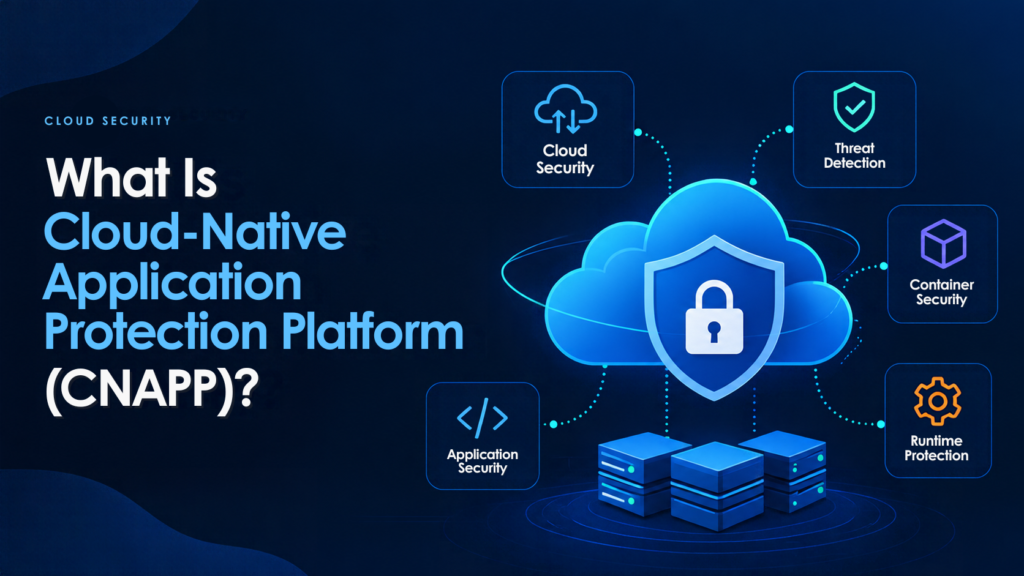
Cloud-Native Application Protection Platform, or CNAPP, is the category built to close that gap. It consolidates the capabilities that used to live in separate cloud security tools into a single platform with a shared data model, so that findings across code, configuration, workloads, and identities can be correlated rather than reviewed one dashboard at a time.
Key Takeaways
- CNAPP is a platform category that combines cloud security posture management, cloud workload protection, entitlement management, and code-level scanning into one integrated product with a shared view of risk.
- The defining value of a CNAPP is correlation, not coverage alone: connecting a vulnerability, a permission, and an exposed resource into a single prioritized risk instead of three unrelated findings.
- A CNAPP identifies and prioritizes risk based on configuration, known vulnerabilities, and permissions. It does not confirm that a given path is actually exploitable, and it cannot evaluate business logic, which is where manual testing still matters.
- In Bugstrix cloud assessments, organizations running a CNAPP typically have far better visibility into misconfigurations and known vulnerabilities than those without one, but still show identity and trust-relationship attack paths that the platform flagged as low priority and a tester then chained into real access.
- CNAPP is a product category sold by platform vendors, not a service. The decision that matters most is not which logo to buy but whether the organization has the process to act on what the platform surfaces.
What Is a Cloud-Native Application Protection Platform?
A Cloud-Native Application Protection Platform is an integrated security platform that protects cloud-native applications across their full lifecycle, from the code and infrastructure definitions developers write through the cloud configuration, workloads, and identities that run in production, by combining multiple security capabilities that were previously separate tools into a single product with one shared data model.
The term was introduced by Gartner to describe the convergence of tooling that had developed separately: tools that scan configuration, tools that protect running workloads, tools that analyze permissions, and tools that scan code before it deploys. Each of those capabilities is valuable on its own. A CNAPP’s argument is that they are far more valuable combined, because cloud risk rarely lives in one layer. It usually emerges from the interaction between layers.
It helps to be precise about what CNAPP is and is not. It is a product category, delivered by vendors as a platform. It is not a methodology, and it is not a replacement for security testing. It is the instrumentation layer that continuously observes a cloud environment and reports what it sees. Our post on cloud security covers the broader discipline of securing cloud environments, including the shared responsibility model that determines which of these controls an organization is responsible for in the first place.
Why Did CNAPP Emerge as a Category?
CNAPP emerged because tool sprawl in cloud security created a correlation problem that no individual tool could solve. Every point solution generated accurate findings within its own domain, but cloud risk is a property of how domains interact, and a team working from five separate consoles had no practical way to see those interactions.
The scale of cloud-native environments made this worse. Containers, serverless functions, managed services, and infrastructure defined as code change continuously, and an organization may have thousands of resources whose configuration and permissions shift with every deployment. Triaging findings from several disconnected tools against that rate of change meant either an enormous manual correlation effort or, more commonly, working through each tool’s severity-sorted queue independently and accepting that the connections between them would go unnoticed.
The second driver was the shift toward developer-owned infrastructure. When engineering teams deploy their own cloud resources through code, security can no longer rely on reviewing a stable, centrally managed environment. Findings need to surface early, in the pipeline and in the repository, as well as in production, which pushed the category to extend left into the development workflow rather than monitoring only what was already running.
What Does a CNAPP Include?
A CNAPP combines five functional capabilities that were previously separate product categories, joined by a correlation layer that connects their findings. The exact feature set varies by vendor, but these are the building blocks the category is defined around.
Code and infrastructure-as-code scanning examines Terraform, CloudFormation, Kubernetes manifests, container images, and application dependencies before they are deployed, flagging misconfigurations and known-vulnerable components while they are still cheap to fix.
Cloud security posture management continuously monitors deployed cloud configuration against security benchmarks and compliance frameworks, catching issues such as publicly exposed storage, unencrypted data stores, and overly open network rules. Our post on cloud security posture management covers this capability in depth, and it is the component of a CNAPP that most organizations already have in some form before they consider the full platform.
Cloud entitlement management analyzes the permissions granted to human and machine identities, identifying accounts and roles with far more access than they use, and surfacing the permission combinations that create privilege escalation routes. The next section covers this capability in more detail because it is where CNAPP and identity security intersect most directly.
Workload protection secures the compute layer: virtual machines, containers, Kubernetes clusters, and serverless functions. It scans for vulnerabilities in what is running and, in platforms that include runtime protection, monitors behavior for signs of compromise.
API and data security extends coverage to the interfaces and data stores that cloud-native applications expose. Platforms in this space discover the APIs running in an environment and assess their exposure, and increasingly map where sensitive data lives so that a finding can be weighted by what it could actually reach. Our post on API security posture management covers the inventory and governance problem that this capability addresses within a CNAPP.
How Does a CNAPP Handle Identity and Entitlements?
Identity is the layer where cloud risk most often becomes real compromise, because a misconfigured permission is not a vulnerability in any software sense. It is a legitimate access grant that happens to be too broad, and traditional vulnerability scanning has nothing to say about it. This is why entitlement management became a core CNAPP component rather than a separate concern.
A CNAPP’s entitlement capability builds a map of which identities, human users, service accounts, and machine roles, can access which resources, including indirect access through role assumption, group membership, and cross-account trust. It then compares granted permissions against actually used permissions to find the gap, since unused permissions are pure risk with no operational benefit. Surfacing a role that has administrative access it has never exercised is exactly the kind of finding that is invisible to scanners and obvious to an entitlement analysis.
It is worth being clear about where this capability stops. Entitlement management is a governance and posture function: it identifies excessive access and risky configurations. It does not replace the access policy layer that defines who should have access in the first place, which is the domain of Identity and Access Management. And it does not, on its own, provide the behavioral detection that spots a legitimate credential being abused in real time, which is the job of identity threat detection and response. A mature program treats these as three distinct layers, governance, posture, and detection, rather than assuming a CNAPP’s identity features cover all of them.
What Does “Code to Cloud” Mean in a CNAPP?
“Code to cloud” is the CNAPP promise that a risk found in production can be traced back to the line of code or infrastructure template that created it, and that a risk caught in the repository can be understood in terms of what it would expose once deployed. It is the capability that distinguishes a platform from a collection of tools that happen to share a login.
In practice this means linking a runtime finding, say a container running with a vulnerable library, back to the image, the Dockerfile, the pipeline that built it, and the repository and team that own it. That linkage turns a security finding into an assignable ticket with a clear owner, which is the difference between a finding that gets fixed and one that sits in a backlog because nobody knows whose it is.
The upstream half of this chain is software supply chain risk: the dependencies, base images, and build tooling that determine what actually ships. A CNAPP typically covers the scanning side of that, flagging known-vulnerable components, but the broader discipline, including build pipeline integrity and artifact verification, goes beyond what a platform’s scanner can see. Our post on software supply chain security covers that wider scope.
Automated scanning at the code layer also has the limits that all automated analysis has: it matches known patterns and misses the logic-level flaws that require a human to understand what the code is supposed to do. Our cybersecurity code review service provides that manual layer for applications where a scanner’s output is not enough assurance.
How Does a CNAPP Prioritize Findings?
The most important thing a CNAPP does, and the thing most vendors lead with, is move from a flat list of findings to a ranked set of risks by correlating signals across layers. This is where the platform model earns its cost, because a severity score on an isolated finding says little about whether anyone could actually use it.
The mechanism is context. A vulnerable library on a workload with no internet exposure and no sensitive data nearby is low priority. The same library on a workload that is internet-facing, runs with an overly permissive role, and can reach a storage bucket containing customer records is a serious risk, even though the library’s CVSS score is identical in both cases. A CNAPP evaluates these combinations, often called toxic combinations, by joining exposure, vulnerability, permission, and data sensitivity into a single risk assessment.
The more advanced platforms push this further into attack path modeling, representing the environment as a graph and identifying the specific routes from an internet entry point to a critical asset. That is a distinct analytical discipline in its own right, and our post on attack path analysis covers how it works and why chains of individually moderate findings often matter more than a single critical one. When evaluating a CNAPP, the quality of its risk correlation is the criterion that most separates platforms that reduce noise from platforms that merely relocate it.
What Can’t a CNAPP Do?
A CNAPP is an observation and prioritization platform. It tells you what is misconfigured, what is vulnerable, and what is over-permissioned, and it ranks those findings by apparent risk. Understanding the limits of that function is what prevents a security program from treating a clean CNAPP dashboard as proof of a secure environment.
It does not confirm exploitability. A CNAPP infers risk from configuration and known vulnerability data. It does not attempt to exploit anything. A path it ranks as critical may be blocked by a control it did not model, and a path it ranks as low may be fully traversable through a trust relationship it underweighted. Only active testing resolves that uncertainty.
It cannot evaluate business logic. Whether an application correctly enforces its own rules, such as who may approve a transaction, whether one tenant can reach another tenant’s data, or whether a workflow can be completed out of sequence, is invisible to a platform that reasons about infrastructure and known vulnerability signatures.
It reports what it can see. Coverage depends on the platform having access to every account, cluster, and region. Shadow accounts, forgotten environments, and resources in clouds the platform is not connected to are blind spots that produce a clean-looking dashboard over an incomplete picture.
It can create false confidence. A prioritized list feels like a finished answer. Organizations that treat the top of the CNAPP’s ranked list as the complete set of things that matter risk ignoring the cross-account trust chains and identity-layer paths that scoring models tend to rate as moderate.
This is the role manual testing plays alongside a CNAPP rather than instead of it. Our cloud penetration testing services actively test the paths a platform flags and the ones it misses, confirming which exposures are genuinely exploitable and which are blocked, and testing the cross-account IAM and trust relationships where cloud compromises most often originate.
Who Needs a CNAPP?
A CNAPP delivers the most value to organizations where tool sprawl has made cross-layer correlation impractical and where the cloud footprint is large or changing quickly enough that manual correlation cannot keep up.
Organizations running containers and Kubernetes at scale produce the volume and rate of change that makes siloed tooling unmanageable, and benefit most from workload protection joined to posture and identity context.
Multi-cloud environments multiply the number of separate native tools an organization would otherwise juggle, and a platform that normalizes findings across providers removes a significant amount of reconciliation work.
Teams already owning several overlapping point tools often find that consolidation reduces both cost and the manual effort of reconciling dashboards, which is frequently the practical trigger for evaluating a CNAPP.
Smaller organizations with a single cloud account and a modest footprint may not need a full platform. A well-configured native posture tool and disciplined IaC review can cover the essentials, and adopting a CNAPP prematurely can add a console that the team lacks the capacity to act on.
What Should You Look for When Evaluating a CNAPP?
The evaluation criteria that matter most are the ones that determine whether the platform changes what the security team actually does, rather than the length of the feature list.
Quality of risk correlation. Ask to see how the platform ranks a realistic scenario, not just a demo environment. A platform whose prioritization collapses back into severity-sorted lists is not delivering the core value of the category.
Coverage model. Agentless scanning deploys quickly and covers broad configuration and vulnerability data, while agent-based approaches provide deeper runtime visibility on workloads. Many organizations need both, and the right balance depends on how much runtime detection matters for their risk profile.
Developer workflow integration. A finding that cannot be routed to the owning team inside the tools they already use, their repository, pipeline, and ticketing system, is a finding that will age in a dashboard.
Multi-cloud and account coverage. Confirm that the platform can see every account, cluster, and region in scope, since the dashboard is only as complete as its connections.
False positive handling. Every platform generates noise. What matters is how easily the team can suppress verified false positives and whether the platform learns from that tuning.
Frequently Asked Questions
Is CNAPP the same as CSPM?
No. CSPM is one component of a CNAPP, focused specifically on cloud configuration and compliance. A CNAPP includes CSPM alongside workload protection, entitlement management, code scanning, and a correlation layer that joins their findings. Many organizations adopt CSPM first and move to a full CNAPP when they need cross-layer context.
Do I need a CNAPP if I only use one cloud provider?
Not necessarily. A single-cloud organization with a modest footprint can often cover the essentials with the provider’s native security tooling plus disciplined infrastructure-as-code review. A CNAPP becomes more compelling as the number of accounts, clusters, and teams grows, or when the organization needs consistent coverage across multiple providers.
What is the difference between agent-based and agentless CNAPP?
Agentless approaches read configuration and snapshot workload data through the cloud provider’s APIs without installing software on each workload, which makes deployment fast and coverage broad. Agent-based approaches run software on workloads and provide deeper visibility into runtime behavior. Many platforms combine both, using agentless for breadth and agents where runtime detection is a priority.
Does a CNAPP replace penetration testing?
No. A CNAPP identifies and prioritizes risk from configuration and known vulnerability data. Penetration testing confirms which of those risks are genuinely exploitable, evaluates business logic, and finds paths the platform’s model did not capture. Compliance frameworks that require penetration testing do not accept platform output as a substitute.
Is CNAPP only for large enterprises?
It is most common in larger organizations because the problems it solves, tool sprawl and cross-layer correlation at scale, are most acute there. Smaller teams can benefit from the same ideas, particularly shift-left scanning and posture monitoring, without necessarily buying a full platform.
Consolidation Is Not the Same as Coverage
A CNAPP solves a real problem. Cloud risk lives in the interactions between layers, and a security team working from five unconnected consoles cannot see those interactions. A platform that joins them and ranks what matters is a genuine improvement over the alternative.
What it does not do is tell you whether the picture is right. It reports configuration, known vulnerabilities, and permissions as they appear, scored by a model, and the model has limits that only a human attacker’s perspective can test. The organizations that get the most from a CNAPP are the ones that treat it as the continuous observation layer and pair it with periodic, adversarial validation of what it surfaces and what it might be underrating.
The platform shows you where to look. Testing confirms what is actually there.