What Is Vulnerability Management?

Written By
Sarwat Iftikhar
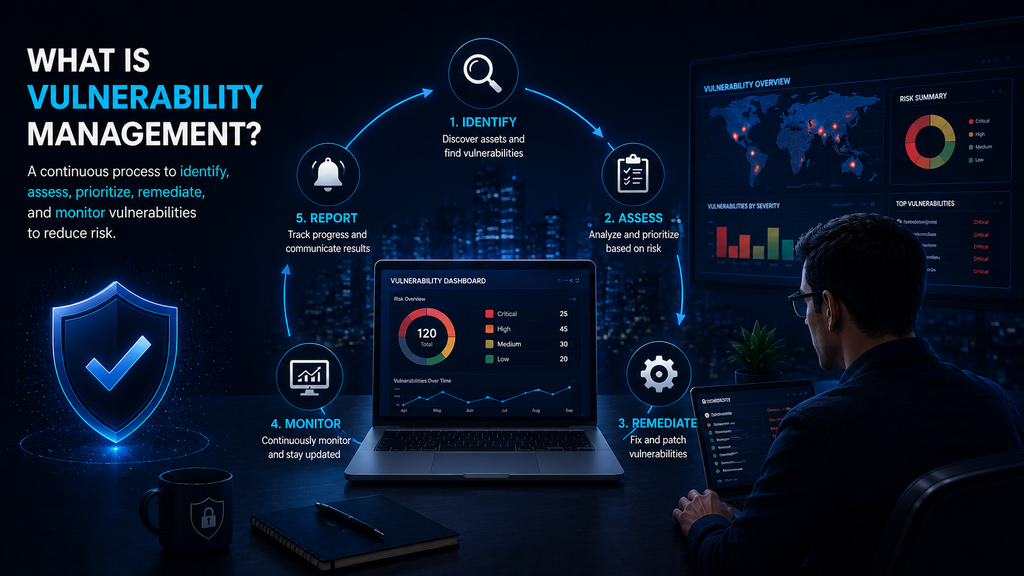
Vulnerability management is the continuous process of identifying, classifying, prioritizing, remediating, and verifying security weaknesses across an organization’s systems, applications, and infrastructure. It is not a one-time scan or an annual audit. It is an ongoing security discipline that runs in parallel with every development release, infrastructure change, and vendor update your organization deploys.
The scale of the problem makes this continuous discipline non-negotiable. In 2025, a record 48,185 CVEs were published, a 20.6% increase over the previous year’s record, averaging 131 new vulnerabilities every single day. FIRST forecasts that number reaching 59,000 in 2026, one new CVE every nine minutes. Meanwhile, the mean time to exploit a published vulnerability has collapsed to negative seven days, meaning attackers are routinely exploiting vulnerabilities before a patch is even released. Organizations that treat vulnerability management as a periodic activity are perpetually behind the curve that attackers are already ahead of.
Key Takeaways
- Vulnerability management is a continuous process covering discovery, classification, prioritization, remediation, and verification, not a single scan or annual report.
- 48,185 CVEs were published in 2025, averaging 131 per day, with FIRST forecasting 59,000 in 2026, one every nine minutes.
- The mean time to exploit a vulnerability dropped to negative seven days in 2025, meaning exploitation routinely precedes public patch availability.
- 60% of breaches involved exploiting known vulnerabilities where a patch was already available, making remediation speed the most critical operational metric in a vulnerability management program.
- Risk-based prioritization, using exploitability, asset criticality, and exposure context rather than CVSS scores alone, is the difference between a program that reduces real risk and one that processes tickets.
Why Is Vulnerability Management More Critical Than Ever in 2026?
Vulnerability management is more critical than ever in 2026 because the volume of new vulnerabilities, the speed of weaponization, and the sophistication of exploitation have all accelerated simultaneously while the average remediation timeline has not kept pace. The result is a growing structural gap between what attackers know and what most security programs are closing.
The numbers define the gap clearly. Attacks targeting website vulnerabilities reached 6.29 billion in 2025, a 56% year-over-year increase. Vulnerability exploitation now drives 20% of all breaches, up 34% year-over-year. For critical edge device vulnerabilities, including firewalls and VPN gateways, the median time between public disclosure and mass exploitation was zero days in 2025, meaning those vulnerabilities were being exploited before most organizations had finished reading the advisory.
At the same time, 32% of identified vulnerabilities remain unpatched for more than 180 days, and 60% of breaches exploited known vulnerabilities where a patch was already available. That combination tells a clear story: the vulnerability management problem in 2026 is not primarily a detection problem. It is a prioritization and remediation speed problem. Organizations are finding more vulnerabilities than ever and closing fewer of the ones that matter fast enough to outpace attackers.
A vulnerability management program that works in 2026 needs to operate at the speed and specificity that the current threat environment demands, not at the cadence a compliance calendar requires.
What Are the Core Components of a Vulnerability Management Program?
A vulnerability management program has five core components that must operate as a continuous cycle rather than sequential phases: asset discovery, vulnerability scanning and identification, risk-based prioritization, remediation and patching, and verification. Skipping or underinvesting in any one component leaves the others unable to produce the risk reduction the program exists to deliver.
Asset discovery is the foundation that everything else depends on. You cannot identify vulnerabilities in assets you do not know exist. Asset discovery maintains a current inventory of every device, application, API, cloud resource, and third-party integration in the environment. The challenge in 2026 is that asset inventories are not static. Cloud environments spin up and tear down resources continuously. Shadow IT introduces systems that IT and security teams were never told about. APIs get deployed and deprecated in development cycles that outpace inventory update processes.
Vulnerability scanning and identification systematically test the discovered asset inventory against known vulnerability patterns, including published CVEs, misconfiguration patterns, missing patches, and outdated software versions. Scanning tools compare the state of each asset against vulnerability databases and produce a list of potential issues. This step is often treated as the whole of vulnerability management, when it is actually just one component of a five-part cycle.
Risk-based prioritization determines which vulnerabilities to address first, and in what order. This is where most vulnerability management programs fail. A 2026 environment produces more vulnerabilities than any team can remediate simultaneously. CVSS severity scores alone are an insufficient prioritization signal because they measure theoretical severity without accounting for whether a vulnerability is actually exploited in the wild, whether the affected asset is internet-facing or air-gapped, or whether a patch is even available. Risk-based prioritization incorporates all of these factors to produce an actionable remediation order rather than a ranked list of theoretical scores.
Remediation and patching close the identified vulnerabilities through patches, configuration changes, compensating controls, or, in cases where remediation is not immediately possible, formal risk acceptance with documented mitigation. The average time to fix a security flaw has increased 47% since 2020, reaching 252 days for the industry average. High and critical application vulnerabilities take an average of 54.81 days to close. Both figures represent significant exposure windows given the current mean time to exploit.
Verification and reporting confirm that remediation actions actually closed the identified vulnerability and did not introduce new issues. Verification testing and reporting provide the evidence of control effectiveness that compliance frameworks require and that security leadership needs to assess program performance over time.
What Is the Difference Between Vulnerability Management and Vulnerability Assessment?
Vulnerability management is an ongoing program. A vulnerability assessment is a point-in-time exercise. The two are related but serve different purposes, and treating a periodic vulnerability assessment as equivalent to an ongoing vulnerability management program is one of the most consistent gaps Bugstrix identifies in organizations at the start of a security engagement.
A vulnerability assessment scans a defined scope at a specific point in time, identifies the vulnerabilities present, and produces a report. It answers the question: what vulnerabilities exist in this environment right now? That is a useful question, but the answer expires quickly in an environment that changes continuously. The assets discovered in an assessment are a snapshot. The vulnerabilities identified are a snapshot. Three months later, new assets have been deployed, new vulnerabilities have been published, and the assessment’s coverage no longer reflects the actual state of the environment.
A vulnerability management program answers a different question: how do we maintain continuous, current, risk-appropriate visibility into the vulnerability state of our environment and close the most important issues fast enough to stay ahead of exploitation? It uses vulnerability assessments as one input into the continuous cycle, alongside automated scanning, threat intelligence, penetration testing findings, and asset inventory updates.
Our vulnerability assessment services are structured to provide the point-in-time assessment component that feeds into a broader vulnerability management program, with findings prioritized and formatted to drive remediation rather than produce a compliance artifact.
How Does Risk-Based Prioritization Work in Vulnerability Management?
Risk-based prioritization in vulnerability management ranks vulnerabilities for remediation based on a combination of exploitability, asset criticality, exposure, and business context rather than CVSS severity scores alone. It produces a remediation order that reflects which vulnerabilities represent the greatest real risk to the specific organization, not which vulnerabilities are theoretically most severe in the abstract.
The case against CVSS-only prioritization is straightforward. A critical-rated CVE in a software package running on an air-gapped development server with no network exposure and no sensitive data is a lower real-world priority than a medium-rated CVE in a public-facing payment API with confirmed active exploitation in the wild. CVSS scores do not encode that difference. A risk-based prioritization model does.
The factors a mature risk-based prioritization model incorporates:
Exploitability in the wild. Is this vulnerability actively being exploited by threat actors today, or is it a theoretical risk without confirmed real-world exploitation? The CISA Known Exploited Vulnerabilities catalog, which grew 20% to 1,484 entries in 2025, provides a direct signal for this factor. A vulnerability on the KEV list deserves immediate attention regardless of its CVSS score.
Asset criticality and exposure. An internet-facing API handling financial transactions and a database server with no external exposure require different remediation urgency for the same vulnerability. Asset criticality scoring, which assigns priority based on the business value of the asset and its exposure to potential attackers, produces better triage decisions than treating all instances of a vulnerability identically.
Patch availability and remediation complexity. A vulnerability with a vendor patch available should be treated differently from one where no patch exists, and a compensating control must be designed. Prioritization models that account for remediation feasibility produce action-oriented queues rather than academic risk rankings.
Threat intelligence context. Is this vulnerability being actively targeted in campaigns against organizations in your industry? Threat intelligence that surfaces industry-specific exploitation activity should elevate the priority of relevant vulnerabilities above what their base scores would suggest.
What Is the Difference Between Vulnerability Management and Penetration Testing?
Vulnerability management and penetration testing serve complementary but distinct purposes in a security program. Vulnerability management continuously monitors and tracks known weaknesses across the full environment. Penetration testing actively attempts to exploit vulnerabilities to demonstrate real-world impact and find the issues that automated scanning consistently misses.
The distinction matters in practice because they answer different questions and produce different kinds of evidence. Vulnerability management answers: what known issues exist across our environment, are they getting closed at the right pace, and where are we accumulating risk? Penetration testing answers: can an attacker actually exploit these issues, what can they access if they do, and what vulnerabilities exist that our scanning program is not finding?
Automated vulnerability scanning finds known CVEs, misconfiguration patterns, and issues that match documented vulnerability signatures. It does not find authorization failures, business logic flaws, chained attack paths, or the class of vulnerabilities that require human judgment and adversarial creativity to identify. Those findings come from penetration testing. In practice, penetration test findings frequently surface in components that the vulnerability management program had assessed as clean, because they are vulnerabilities that the scanning tools are not designed to detect.
The two are not substitutes for each other. A vulnerability management program without periodic penetration testing produces false confidence about the issues scanners cannot find. Periodic penetration testing without a continuous vulnerability management program means the findings from each test accumulate between cycles without a systematic process to track and close them.
Our penetration testing services feed directly into vulnerability management programs by surfacing the manual-finding categories that scanning misses, providing exploitability evidence that improves prioritization decisions, and validating that the highest-risk components of the environment are as secure as the scanning data suggests. For a detailed breakdown of how vulnerability assessments differ from penetration testing and where each fits in a mature security program, our post on vulnerability assessment vs penetration testing covers the distinction in full.
Is Vulnerability Management Only for Large Organizations?
No. Vulnerability management is relevant and achievable for organizations of every size, and the belief that it is only for large enterprises is one of the most expensive security misconceptions small and mid-sized businesses carry. The vulnerabilities that attackers exploit do not discriminate by company size. The patch cadence that leaves a 50-person SaaS company exposed to a known critical CVE is the same exposure that a Fortune 500 company faces, with the same exploitation timeline.
What differs by size is not whether vulnerability management is needed but what a program proportionate to the organization’s risk profile and resources looks like. An enterprise security team running a full vulnerability management platform with automated asset discovery, continuous scanning, and integrated ticketing is not the right model for a 20-person startup. But a startup that runs quarterly vulnerability assessments, maintains an asset inventory, monitors the CISA KEV catalog for vulnerabilities affecting their stack, and has a defined process for patching critical issues within a defined window is running a vulnerability management program appropriate to its context.
The common thread is continuity and process. A vulnerability management program does not require enterprise tooling. It requires a repeatable process that ensures vulnerabilities are found, assessed, prioritized, remediated, and verified on a cadence that matches the real-world exploitation timeline.
Our post on whether vulnerability management is only for large companies addresses this directly with a practical framework for right-sizing a vulnerability management approach to different organizational contexts.
How Does Vulnerability Management Apply to Web Applications Specifically?
Vulnerability management for web applications requires a combination of automated scanning, manual testing, and developer-integrated processes because web application vulnerabilities include both known, scannable issues and the logic-level weaknesses that only human testing can surface. Treating web application security exclusively through the lens of infrastructure vulnerability management misses the vulnerability categories that cause the majority of web application breaches.
Web application-specific vulnerability management covers:
Dependency and software composition analysis. Modern web applications depend on dozens of open-source libraries and frameworks, each with its own CVE exposure. Tracking which dependencies are in use across applications and alerting when a dependency has a published vulnerability is a foundational component of web application vulnerability management that many organizations still handle manually, if at all.
Dynamic application scanning. Automated web application scanners probe running applications for known vulnerability patterns: SQL injection signatures, cross-site scripting, insecure authentication configurations, and missing security headers. These tools find a meaningful subset of web application vulnerabilities without requiring manual testing effort and should run continuously against development and staging environments.
API security monitoring. Web application vulnerability management needs to explicitly cover the API layer, which represents the highest-density attack surface in most modern applications. Automated API discovery, endpoint inventory maintenance, and regular authorization testing are distinct requirements from general web scanning and require dedicated coverage.
Integration with the development lifecycle. Vulnerabilities introduced during development are cheaper and faster to fix than those found in production. Web application vulnerability management programs that integrate scanning into the CI/CD pipeline catch newly introduced issues at the point of creation rather than after deployment.
Our web app penetration testing services address the manual testing component that automated scanning cannot cover, identifying the authorization failures, business logic issues, and chained attack paths that produce the most significant real-world web application breaches.
Frequently Asked Questions
What is the difference between vulnerability scanning and vulnerability management?
Vulnerability scanning is a technical activity that uses automated tools to identify potential weaknesses in systems, applications, or infrastructure. Vulnerability management is the broader program that uses scanning as one input and surrounds it with asset discovery, risk-based prioritization, remediation tracking, verification, and reporting. Scanning without the surrounding program produces vulnerability lists. Vulnerability management produces measurable risk reduction.
How often should vulnerability scanning be performed?
The appropriate scanning frequency depends on the pace of change in the environment and the risk profile of the assets being scanned. Internet-facing systems and applications should be scanned at minimum monthly, with continuous scanning as the standard for high-risk environments. Internal systems with lower exposure can be scanned quarterly in lower-risk environments. Any significant change to the environment should trigger an immediate targeted scan of the affected assets regardless of the scheduled cadence.
What is a CVE and why does it matter for vulnerability management?
CVE stands for Common Vulnerabilities and Exposures. It is the standard identification system for publicly known security vulnerabilities. Each CVE has a unique identifier, a description of the vulnerability, and an associated CVSS severity score. Vulnerability management programs use CVE databases as the primary reference for known vulnerabilities to scan for and patch. In 2025, 48,185 new CVEs were published. Understanding which CVEs affect the software and systems your organization runs, and how quickly they are being exploited in the wild, is central to effective vulnerability prioritization.
What is the CISA Known Exploited Vulnerabilities catalog?
The CISA Known Exploited Vulnerabilities catalog is a maintained list of vulnerabilities that have confirmed evidence of active exploitation in the wild. It grew to 1,484 entries by the end of 2025. For vulnerability management programs, the KEV catalog provides a direct prioritization signal: any vulnerability on this list that affects systems in your environment deserves immediate remediation attention, regardless of its CVSS severity score. Most compliance frameworks now reference KEV catalog status as a prioritization requirement.
How does vulnerability management relate to compliance?
Most major compliance frameworks require some form of vulnerability management as a control. PCI DSS requires quarterly vulnerability scanning by an Approved Scanning Vendor and annual penetration testing. SOC 2 CC7.1 requires that vulnerabilities be detected, assessed, and remediated. ISO 27001 Annex A.8.8 requires technical vulnerability management as part of the ISMS. HIPAA requires regular technical security reviews. Vulnerability management is not a compliance exercise — it is a security practice that compliance frameworks require evidence of because it produces real risk reduction. Treating it purely as a compliance checkbox produces documentation without risk reduction.
The Foundation Every Security Program Needs
Vulnerability management is not the most sophisticated component of a security program. It is the most fundamental one. Before red team exercises, before advanced threat detection, before zero-trust architecture, an organization needs to know what vulnerabilities exist in its environment, which ones matter most, and whether they are being closed fast enough.
With 48,185 CVEs published in 2025, 131 arriving daily, and the mean time to exploit now preceding patch availability by an average of seven days, the operational tempo that vulnerability management needs to operate at has never been more demanding. The programs that keep pace are the ones that invest in continuous discovery, risk-based prioritization, and remediation velocity, not in comprehensive quarterly reports that describe risk that already materialized by the time the report was finished.
Contact us to discuss building or improving your vulnerability management program