Is Vulnerability Management Only for Large Companies?

Written By
Sarwat Iftikhar

Most founders and IT managers at small companies hear “vulnerability management” and picture a team of 20 security engineers, a six-figure tooling budget, and a dedicated SOC. That image is wrong, and it is costing small businesses dearly.
Here’s the reality: 43% of all cyberattacks target small businesses. Not large enterprises. Not Fortune 500 companies. Small businesses. And yet only 22% of those companies perform regular vulnerability scanning. That gap is not a coincidence. It is the result of a persistent myth that vulnerability management is an enterprise-only discipline.
This article breaks that myth apart. You’ll learn what vulnerability management actually is, why smaller companies are increasingly the preferred target, what a realistic program looks like for a lean team, and when you should start.
Key Takeaways
- 43% of all cyberattacks target small businesses, yet only 22% perform regular vulnerability scanning.
- 88% of SMB breaches involve ransomware, more than double the rate at large organizations.
- The median time to exploit a known vulnerability is now under 5 days, making patching delays extremely costly.
- Vulnerability management does not require a large team. A structured four-step process works for startups and SMBs.
- Companies with risk-based vulnerability programs reduce their annual security expenses by up to 25.5%.
What Is Vulnerability Management, and Why Does the Definition Matter?
Vulnerability management is the ongoing process of finding, prioritizing, fixing, and verifying weaknesses across your systems before attackers find them first. That definition matters because most people confuse it with a much narrower activity: running a scanner once a quarter and hoping for the best.
A scanner is a tool. Vulnerability management is a program. The difference is significant.
A proper program has four stages. First, asset discovery, knowing exactly what you have: every server, every endpoint, every API, every third-party integration. Second, vulnerability identification through scanning, code review, and manual testing. Third, risk-based prioritization, fixing what matters most given your specific threat model, not just whatever scores highest on a generic severity chart. Fourth, remediation verification, confirming that fixes actually work rather than just closing tickets.
The reason this definition matters for small businesses is that the “just run a scanner” approach creates a false sense of security. You can run automated scans across your infrastructure every week and still miss a critical authentication bypass in your API. You can patch every CVE on the list and still leave a misconfigured S3 bucket open to the internet.
What Bugstrix sees repeatedly across SMB engagements is that the vulnerabilities causing real damage are rarely the ones scanners catch. They are logic flaws, access control gaps, and chained low-severity issues that automated tools score as informational but lead directly to full compromise. A formal program catches those. A scanner alone does not.
The median time to exploit a newly disclosed vulnerability is now under 5 days. By the time a patch advisory goes public, attackers are already scanning for unpatched systems. That speed means a vulnerability management program is not something you set up eventually. It is something your security posture depends on right now.
For a deeper explanation, businesses should understand the difference between vulnerability assessment and penetration testing before deciding how to structure their security program.
Do Attackers Actually Target Small Businesses?
Yes. Without question. And the data from the past year makes this clearer than ever.
88% of SMB breaches involved ransomware, compared to just 39% at large organizations. That is not a rounding error. Small businesses are not collateral damage in attacks targeting larger targets. They are the primary target. Attackers specifically seek out organizations that lack the layered defenses, network segmentation, and recovery readiness that larger companies have built over the years.
The numbers compound quickly. 43% of all cyberattacks target small businesses. Zero-day exploits targeting small businesses grew by 267% in a single year, while the average window between a vulnerability being discovered and it being weaponized shrank from 68 days to just 14. Your patching schedule, whether monthly or quarterly, is already behind.
Why do attackers prefer smaller targets? A few reasons.
Easier to Breach
Many SMBs run unpatched software, rely on default configurations, and lack monitoring tools that would flag suspicious activity. An attacker can move from initial access to data exfiltration in hours.
Still Valuable
Small businesses hold customer PII, payment data, health records, and intellectual property. The value per breach may be smaller than at an enterprise, but the effort required is also far smaller. The math works in the attacker’s favour.
Supply Chain Access
A mid-size SaaS company serving enterprise clients is a backdoor into those enterprises. Attackers increasingly use small vendors as entry points into larger organizations. If you are in that supply chain, you are a target whether you think about it or not.
The shift toward indiscriminate scanning has fundamentally changed who is at risk. Attackers no longer manually select targets based on size. They scan entire IP ranges for specific vulnerabilities and hit whoever responds. Your company does not need to be interesting. It just needs to be reachable and unpatched.
For more on the specific weaknesses attackers exploit most often, a web application vulnerabilities guide can help teams understand common security flaws and how to fix them.
Why Do SMBs and Startups Skip Vulnerability Management?
Only 38% of small businesses have a formal vulnerability management program. The other 62% are not ignorant of cyber risk. Most cite three specific barriers, and all three are worth challenging directly.
“It Costs Too Much”
66% of SMBs name cost as their single biggest obstacle to stronger cybersecurity. That is understandable. A full enterprise vulnerability management platform can run tens of thousands of dollars per year. But a formal program does not require enterprise tooling. A structured process that combines open-source scanners, periodic professional assessments, and clear remediation workflows can be built for a fraction of that cost.
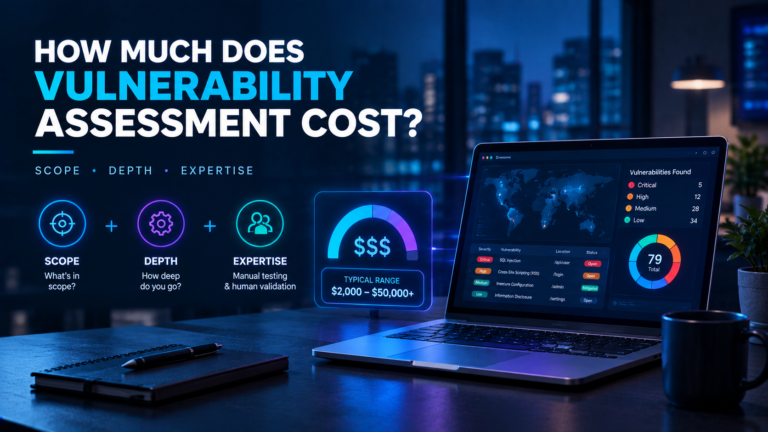
The more useful cost comparison is this: the global average cost of a data breach is $4.44 million. For businesses with fewer than 500 employees, the average reaches $3.31 million. A basic vulnerability assessment, by comparison, starts at $1,000 to $5,000 for an automated scan and $5,000 to $15,000 for a manual assessment on a focused scope. The math favours prevention by a wide margin.
“It’s Too Complicated for Our Team”
This is where the enterprise image does the most damage. Vulnerability management does not require a security team. It requires a process. One person owns the program, a scanning tool, a prioritization framework, and a patch cadence. That is a starter program. It is not perfect, but it is infinitely better than nothing.
“We’re Too Small to Matter”
As the previous section showed, this is simply false. Attackers use automated tools that do not filter targets by company size.
The real cost of skipping vulnerability management is not just breach costs. It is the compounding effect of security debt. Every unpatched system, every misconfigured service, every ignored finding adds to a backlog that grows faster than teams can address reactively. Companies with risk-based vulnerability programs reduce their annual security expenses by up to 25.5%, precisely because proactive fixes are cheaper than emergency incident response.
What Does a Vulnerability Management Program Actually Look Like for a Small Team?
A working vulnerability management program for a startup or SMB does not need a SOC. It needs four things done consistently.
Step 1: Know What You Have
You cannot protect assets you do not know exist. Start with a complete inventory of your attack surface: every server, every cloud resource, every third-party integration, every API endpoint. This may sound obvious, but shadow IT, forgotten dev environments, and untracked SaaS integrations make it harder for fast-moving teams.
Step 2: Scan Regularly
Automated scanning should run continuously or, at a minimum, weekly on externally facing assets. Monthly scans on internal systems are a reasonable floor for smaller teams. The key is consistency. A scan run once after a new deployment and then forgotten is not a program.
Step 3: Prioritize by Risk, Not Just Severity
Not every critical CVE is equally dangerous to your specific environment. A critical vulnerability in software you do not run is irrelevant. A medium-severity misconfiguration in your authentication flow is urgent. Risk-based prioritization asks: Is this exploitable in our environment, and what is the business impact if it is? That question should drive your fix queue, not CVSS scores alone.
Step 4: Verify That Fixes Worked
This step is where most small programs fall apart. Teams patch, close the ticket, and move on. But patches fail, rollbacks happen, and misconfigurations return after infrastructure changes. Retesting after every significant remediation effort confirms that the fix actually closed the gap.
This four-step process is exactly what Bugstrix’s vulnerability assessment services are designed to support. Whether you need a one-time assessment to establish a baseline or ongoing support to run the program, the engagement scales to your team size and budget.
How Does Vulnerability Management Fit with Penetration Testing?
Vulnerability management and penetration testing are not competing approaches. They are complementary layers of a security program, and understanding how they fit together changes how you invest in both.
Vulnerability management is continuous. It runs in the background, scanning your environment for known weaknesses, tracking patch status, and flagging new exposures as they appear. It tells you what is potentially vulnerable.
Penetration testing is periodic. A skilled security researcher takes your environment and tries to actually exploit those vulnerabilities, chaining findings together the way a real attacker would. It tells you what is actually exploitable and what the real-world impact looks like.
You need both. Here’s why.
60% of breaches involve exploiting known vulnerabilities where a patch was already available. That means the vulnerability was detectable. It appeared in scans. Someone saw it and did not prioritize it, or patched the wrong instance, or fixed it in staging but not production. A penetration test would have caught that gap before it became a breach, because it validates whether your remediation actually works in practice.
Without ongoing vulnerability management, your penetration test is a snapshot of a moving target. You fix what the test finds, and three months later, a new deployment introduces the same class of issues. Without periodic penetration testing, your vulnerability management program has no way to validate that the process is actually closing the gaps that matter.
The combination is how security teams close the loop.
Bugstrix’s penetration testing services are designed to plug directly into your existing vulnerability management process, validating findings, uncovering what scanners miss, and delivering remediation guidance your engineers can act on immediately. If you want testing that runs continuously rather than annually, continuous penetration testing services keep pace with your deployment cadence.
For a detailed breakdown of how web application vulnerabilities get exploited in real attacks, a web application penetration testing guide can explain the full process in more practical detail.
Ready to Find Your Vulnerabilities Before Attackers Do?
Most small businesses discover their security gaps in one of two ways: through a professional assessment or through a breach. One of those options costs considerably less.
Bugstrix’s security assessment services give you a clear, prioritized view of your actual risk, across web apps, APIs, cloud infrastructure, and internal systems. Findings come with verified exploits, CVSS scores, and stack-specific remediation guidance your team can act on immediately.
Get a free quote for your vulnerability assessment and find out exactly what is exposed before someone else does.
When Should a Startup or SaaS Company Start a Vulnerability Management Program?
Before your first user’s data hits production. That is the honest answer.
The practical triggers are: first deployment to a production environment, any point before a compliance audit, post-funding when investor and customer scrutiny increases, and pre-launch when fixing issues is still cheap.
Security posture is increasingly a sales requirement for SaaS companies, not just an IT concern. A vulnerability management program provides teams with the structure they need to keep controls up to date, document remediation efforts, and reduce last-minute pressure before customer reviews or audits.
The earlier you start, the cheaper each fix is. Vulnerabilities found during development cost a fraction of those found post-breach. Security debt, like technical debt, compounds. A team that builds vulnerability management into its SDLC from the first deployment spends far less per finding over time than a team that inherits years of unaddressed issues.
If your team is preparing for a compliance review or approaching your first formal security assessment, reach out to Bugstrix to understand exactly what your assessment scope should cover and how to prioritize findings within your existing engineering workflow.
Frequently Asked Questions
How much does vulnerability management cost for a small business?
A basic automated scan for a small business typically runs $1,000 to $5,000. A manual professional assessment on a focused scope starts around $5,000 to $15,000. The more relevant number is this: the average breach costs a business with fewer than 500 employees $3.31 million. Prevention costs a fraction of recovery.
Can vulnerability management replace penetration testing?
No, and they should not be treated as substitutes. Vulnerability management identifies what is potentially exposed through continuous scanning and monitoring. Penetration testing validates what is actually exploitable by simulating real attacker behaviour. Both are necessary. Vulnerability management without pen testing leaves your program unvalidated. Pen testing without vulnerability management means your environment changes faster than you can test it.
What’s the difference between vulnerability scanning and vulnerability management?
Scanning is a single activity: running a tool to detect known weaknesses at a point in time. Vulnerability management is a full program: asset inventory, continuous scanning, risk-based prioritization, remediation, and verification. 60% of breaches exploit known vulnerabilities where patches were available. The difference between scanning and managing is whether those patches actually get applied and verified.
How often should a startup run vulnerability scans?
Weekly automated scanning on externally facing assets is a practical minimum. Monthly scans on internal systems work for smaller teams. After any significant deployment, infrastructure change, or third-party integration, a targeted scan is worth running regardless of schedule. The goal is to keep the window between when a vulnerability is introduced and when it is detected as short as possible: ideally, hours, not months.
Does vulnerability management help with SOC 2 or ISO 27001 compliance?
Yes. Formal vulnerability management helps organizations identify, prioritize, remediate, and document security risks on an ongoing basis. It also creates useful evidence for audits, customer security reviews, and internal risk reporting. It is much easier to prove that security controls are working when vulnerability discovery, remediation, and verification are already part of your normal workflow.
Conclusion
Vulnerability management is not an enterprise discipline that scales down to smaller companies. It is a fundamental security practice that applies to any organization holding data, running software, or connected to the internet. The question is not whether your company is large enough to need it. The question is whether you can afford to find out the hard way.
The barriers are real but solvable. Cost scales with scope. Complexity reduces with process. And the “we’re too small” assumption is directly contradicted by every major breach dataset published in the past three years.
Start with a clear picture of what you have and what is exposed. Build a process around it. Validate it periodically with professional testing. Iterate.
If you are not sure where to begin, a professional assessment provides a baseline. Bugstrix’s team delivers prioritized, engineer-ready findings across web apps, APIs, cloud infrastructure, and internal systems, with retesting included.