What Is Penetration Testing? A Complete Guide (2026)

Written By
Sarwat Iftikhar
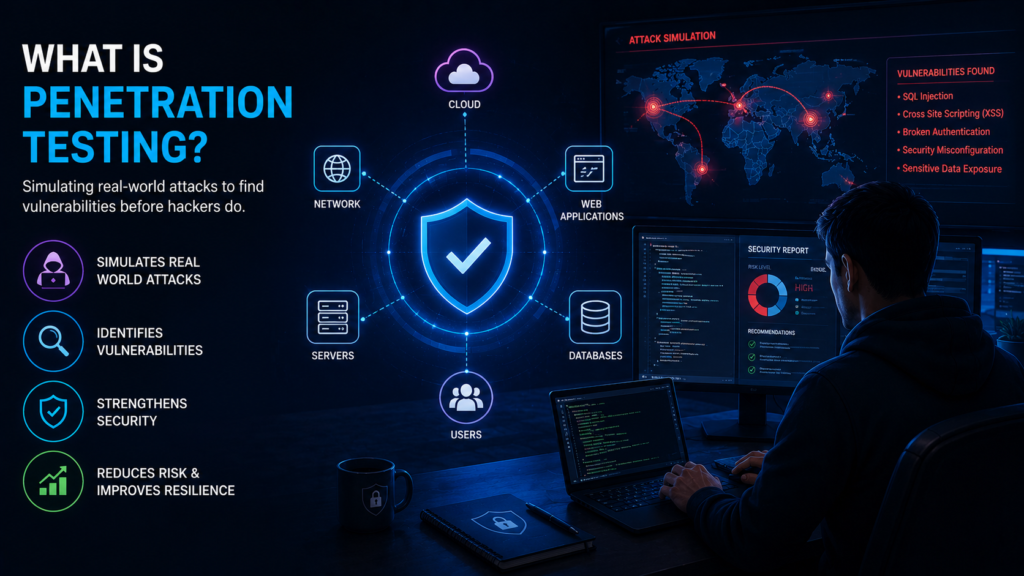
Penetration testing is an authorized, manual security assessment where skilled testers simulate real-world attacks against your systems to find and safely exploit vulnerabilities before a malicious actor does. Unlike an automated scan that flags theoretical weaknesses, a genuine penetration test involves a human tester actively proving that a vulnerability is real, chaining smaller weaknesses into a meaningful attack path, and documenting exactly how far that path could take an attacker.
The distinction matters more than most buyers realize. A tool can tell you that a login form might be vulnerable to SQL injection. A penetration tester confirms whether that injection actually exposes your customer database, and if it does, walks the chain further to see what else it touches. That difference, between a theoretical finding and a proven one, is the entire value proposition of penetration testing, and it’s also where most of the confusion in the market comes from.
For a business owner evaluating whether to invest in one, the practical case is straightforward. The average U.S. data breach now costs $10.22 million. A well-scoped penetration test, even at the higher end of the market, represents a fraction of that exposure, and it consistently finds the exact class of vulnerabilities that scanners and internal reviews miss.
Key Takeaways
- Penetration testing is a manual, authorized attack simulation that proves whether vulnerabilities are actually exploitable, not just theoretically present.
- Tests are typically run as black box, white box, or gray box, depending on how much information the tester starts with.
- Common test types include web application, mobile application, cloud, network, and API penetration testing, each covering a different part of your environment.
- Penetration testing costs range from $5,000 to $100,000 or more depending on scope, test type, and compliance requirements.
- Most compliance frameworks, including SOC 2, PCI DSS, and HIPAA, treat annual penetration testing as a minimum, not a ceiling.
What Is Penetration Testing?
Penetration testing is a controlled, authorized simulation of a real cyberattack, conducted by skilled security professionals to identify and validate exploitable vulnerabilities across applications, networks, and cloud environments. The goal is not simply to produce a list of weaknesses. It is to demonstrate what an actual attacker could do with them, using the same techniques, tools, and creativity a real adversary would bring.
This is why penetration testing is fundamentally a manual discipline, even when automated tools support parts of the process. A scanner can flag a missing security header or an outdated software version. It cannot chain an authorization flaw with an exposed API endpoint to demonstrate a full account takeover, and it cannot understand whether a business logic quirk in your checkout flow lets a user apply the same discount code infinite times. That kind of finding requires a human tester who understands how your application is supposed to work well enough to find where it breaks.
Bugstrix’s penetration testing services are built around exactly this principle: senior testers manually exploiting your environment and documenting real attack chains, not automated tooling repackaged with a premium label.
Why Is Penetration Testing Important?
Penetration testing is important because it shows whether your security controls actually hold up against a real attack, rather than whether they look correct on paper. Businesses that skip this step typically find out where their defenses fail during an actual breach, which is a far more expensive way to learn the same lesson.
It prevents breaches before they happen. A penetration test finds the specific, exploitable path an attacker would use, authentication bypasses, exposed APIs, and misconfigured cloud storage. It gives your team the chance to close it before it’s used against you rather than after.
It protects customer data directly. Most high-impact breaches trace back to a single overlooked vulnerability: an unpatched endpoint, a broken access control, a forgotten admin panel. Penetration testing is built specifically to surface those before customer records, payment data, or health information are exposed.
It supports compliance obligations. Frameworks including SOC 2, PCI DSS, HIPAA, and ISO 27001 all lean on penetration testing as evidence that your security controls work in practice, not just in policy documentation. Auditors consistently treat a recent, well-documented test as the strongest form of evidence available.
It’s fundamentally different from running a security scan. A vulnerability scan checks your environment against a list of known signatures and reports what might be wrong. Penetration testing manually proves what is actually exploitable, chains findings together the way a real attacker would, and shows the business impact rather than a raw list of alerts. This distinction is also why regulators and cyber insurers increasingly reject scan-only reports as testing evidence.
Identify security weaknesses before attackers do. Get a manual penetration testing assessment from Bugstrix.
Who Needs Penetration Testing?
Penetration testing is relevant to any business with a digital presence that handles customer data, processes payments, or supports operations that would be disrupted by a breach, though what gets tested and how often varies significantly by industry.
Startups benefit most from a scoped, budget-conscious first engagement, typically a web application and API test, before pursuing a funding round or an enterprise sales cycle where prospects will ask for security evidence. Getting this done early avoids a rushed, expensive test under deal pressure later.
SaaS companies need testing that keeps pace with continuous deployment. Multi-tenant architecture, frequent releases, and API-driven integrations create a rate of change that a single annual test consistently underserves, which is why many SaaS businesses move toward continuous penetration testing aligned to their release cycle.
Fintech companies carry some of the highest stakes, given payment data, regulatory scrutiny, and the direct financial incentive attackers have to target them. Testing here typically needs to cover web applications, APIs, and infrastructure together, with reporting formats mapped to PCI DSS and SOC 2 requirements.
Healthcare organizations face both patient safety and HIPAA compliance obligations. Testing needs to be scoped carefully around clinical systems and patient portals to avoid operational disruption while still validating that patient data is genuinely protected.
E-commerce companies combine payment processing risk with high-volume customer data handling, making checkout flows, payment integrations, and customer account systems the highest-priority testing targets.
Enterprises typically need the broadest scope: web, mobile, cloud, network, and API testing across a large, often federated environment, frequently combined with red team engagements that simulate a full adversarial campaign rather than a single test type.
How Does a Penetration Test Work?
A penetration test works through five structured phases: reconnaissance, threat modeling, vulnerability discovery, exploitation, and reporting with remediation guidance. Each phase builds on the last, moving from broad information gathering to specific, proven findings.
| Phase | What Happens |
| Reconnaissance | Testers gather intelligence on the target environment, technology stack, and potential entry points |
| Threat modeling | Attack vectors are identified and prioritized based on architecture and likely business impact |
| Vulnerability discovery | Manual and automated techniques identify exploitable flaws, misconfigurations, and weaknesses |
| Exploitation | Testers safely validate selected vulnerabilities to confirm real-world impact, with proof-of-concept evidence |
| Reporting and remediation | Findings are documented with severity, evidence, and remediation guidance, followed by retesting |
Source: Bugstrix penetration testing methodology, 2026
Reconnaissance sets the foundation. Testers map the agreed scope, whether that’s a web application, a network, or a cloud environment, and identify the technology stack, endpoints, and potential entry points an attacker would look for first.
Threat modeling takes that information and prioritizes it. Not every discovered component carries equal risk, so testers focus their effort on the vectors most likely to produce meaningful findings given the architecture and business context.
Vulnerability discovery combines automated tooling with manual analysis to identify exploitable flaws, misconfigurations, and weaknesses across the tested scope. This is where breadth of coverage gets established before testers narrow in on what’s actually worth exploiting.
Exploitation is what separates a real penetration test from a vulnerability scan. Where authorized, testers safely validate selected vulnerabilities to demonstrate real-world impact, producing proof-of-concept evidence rather than a theoretical severity score.
Reporting and remediation close the loop with a detailed report and, in a well-structured engagement, a free retest to confirm that fixes actually hold.
What Does a Penetration Test Include?
A professional penetration testing engagement includes ten distinct components, from initial scope definition through final retesting, and a client should expect to see all of them documented in the engagement plan before testing begins.
Across that process, a client should expect these ten components as standard parts of the engagement:
- Scope definition: the specific assets, environments, and testing boundaries agreed before work begins
- Reconnaissance: intelligence gathering on the target environment and technology stack
- Manual security testing: hands-on testing by a human tester, not just automated tooling
- Vulnerability validation: confirming that a flagged issue is real rather than a false positive
- Exploitation testing: safely proving that a vulnerability is actually exploitable, with evidence
- Risk analysis: assessing what a successful exploit would actually mean for the business
- Technical report: detailed findings with reproduction steps, evidence, and CVSS severity scoring
- Executive summary: a non-technical overview for leadership and board-level review
- Remediation guidance: specific, actionable fix recommendations at the code or configuration level
- Retesting: a follow-up test confirming that remediated vulnerabilities are actually closed
What Does a Penetration Testing Report Contain?
A penetration testing report contains seven core sections, each serving a different audience and purpose, from the executive summary that leadership reads to the proof-of-concept evidence that engineers use to reproduce and fix each finding.
| Section | Purpose |
| Executive summary | Non-technical overview of risk posture and key findings for leadership review |
| Vulnerability details | Full technical description of each finding, including where and how it was found |
| Severity ratings | CVSS-based scoring so findings can be prioritized by actual risk |
| Proof of concept | Evidence, screenshots, request/response data, or exploit chains, confirming exploitability |
| Business impact | What a successful exploit would mean in practical terms, not just a technical description |
| Remediation recommendations | Specific, actionable guidance at the code or configuration level |
| Retest results | Confirmation of whether previously identified vulnerabilities have been resolved |
Source: Bugstrix penetration testing report structure, 2026
A report missing any of these sections is a signal worth noticing. A thin PDF with a findings list and no proof-of-concept evidence or business impact context is typically a reformatted scanner export, not the output of a genuine manual penetration testing process.
Penetration Testing Standards and Methodologies
Professional penetration testing follows established industry frameworks rather than an ad hoc approach, and understanding the major ones helps non-security readers evaluate whether a provider’s methodology is credible.
OWASP Testing Guide is the most widely referenced framework for web application testing, maintained by the Open Web Application Security Project. It defines a structured approach to testing authentication, session management, input validation, and business logic, and underpins the OWASP Top 10 vulnerability categories most testers reference.
PTES (Penetration Testing Execution Standard) defines a complete engagement lifecycle, from pre-engagement scoping through post-exploitation and reporting. It’s less web-specific than OWASP and more focused on the overall structure of a professional testing engagement.
NIST SP 800-115 is a U.S. government publication providing technical guidance on planning and conducting security testing, widely referenced in regulated industries and used as a baseline for many compliance-driven penetration testing programs.
OSSTMM (Open Source Security Testing Methodology Manual) takes a more operational, metrics-driven approach, focused on measuring the actual effectiveness of security controls rather than only cataloging vulnerabilities.
A credible provider should be able to name which of these frameworks their penetration testing methodology draws from and explain how it applies to your specific environment, not just cite the acronyms in a sales deck.
What Are the Different Types of Penetration Testing Methodology?
The three main penetration testing methodologies are black box, white box, and gray box, and they differ based on how much information the tester has before testing begins. The right choice depends on what you’re trying to learn: how a real external attacker would fare with zero information, or how deep a tester can go with legitimate insider knowledge.
Black box testing gives the tester no prior knowledge of the environment, mirroring how an actual external attacker would approach your systems. It produces the most realistic simulation of an outside threat but requires more time for reconnaissance, which can narrow the depth of testing within a fixed engagement window.
White box testing gives the tester full access to source code, architecture diagrams, and credentials upfront. This produces the deepest possible coverage, particularly for business logic and code-level flaws, since testers spend their time exploiting rather than discovering.
Gray box testing sits between the two, giving testers limited access or credentials, simulating what an authenticated user or a low-privilege insider could do. It’s the most common approach in practice because it balances realistic attacker constraints with efficient use of the testing window.
Bugstrix’s full comparison of black box, white box, and gray box penetration testing goes deeper into which approach fits which business scenario.
What Are the Main Types of Penetration Testing?
The main types of penetration testing are defined by what’s being tested rather than how it’s tested, and most businesses need more than one type to get complete coverage of their environment. Each type requires different tools, different tester expertise, and surfaces a different category of risk.
| Test Type | What It Covers | Bugstrix Services |
| Web application | Authentication, authorization, input handling, business logic, APIs | Web App Penetration Testing |
| Mobile application | iOS and Android binaries, local storage, APIs, runtime behavior | Mobile App Penetration Testing |
| API | Authorization logic, data exposure, and business logic in API endpoints | Penetration Testing Services |
| Cloud | AWS, Azure, GCP misconfigurations, IAM, exposed services | Cloud Penetration Testing |
| Network | External and internal infrastructure, perimeter, lateral movement | Penetration Testing Services |
| Continuous | Ongoing testing aligned to release cycles rather than an annual snapshot | Continuous Penetration Testing |
Source: Bugstrix service scope, 2026
These types of penetration testing are not mutually exclusive. Most businesses need a combination, and the right mix depends on which systems actually hold sensitive data or process transactions.
Web application penetration testing targets the layer most businesses expose to the public internet: authentication flows, session handling, input validation, and business logic. Bugstrix’s breakdown of web application penetration testing covers exactly what this involves and why it consistently produces the highest volume of critical findings across client engagements.
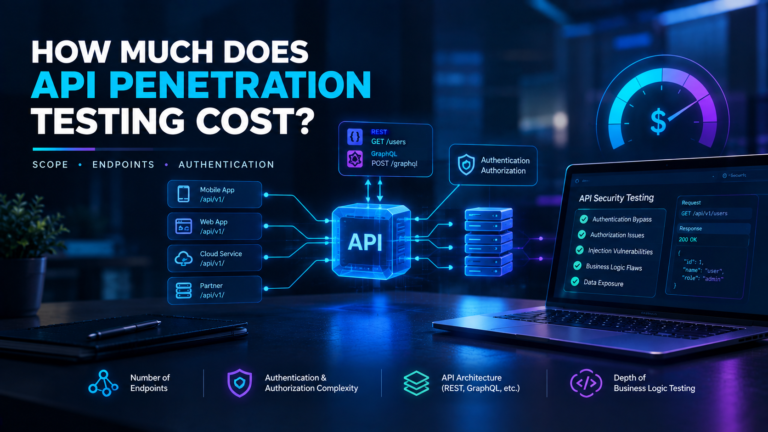
API penetration testing is consistently one of the highest-risk categories, since API endpoints are often deployed quickly and left with authorization logic that’s never been tested under adversarial conditions. Bugstrix’s breakdown of API security testing covers the authorization gaps and data exposure issues that show up once those endpoints are actually tested, and why this layer is the one most teams skip.
Mobile application penetration testing covers a fundamentally different attack surface, since a mobile app runs on a device an attacker can physically hold, decompile, and instrument. Bugstrix’s guide on what mobile application penetration testing actually covers breaks down the five coverage layers, from binary analysis to backend authorization.
Cloud penetration testing focuses on the misconfigurations, excessive permissions, and exposed services that consistently rank among the most common causes of cloud breaches, across AWS, Azure, and GCP environments.
Network penetration testing assesses external perimeter defenses and internal lateral movement paths, the traditional starting point for most organizations’ first engagement.
Continuous penetration testing addresses a real gap in the traditional model: your environment changes constantly, but an annual test only reflects a single point in time. Continuous engagement models test on a rolling basis aligned to your deployment cadence instead.
Manual vs Automated Penetration Testing: What’s the Real Difference?
Automated scanning and manual penetration testing find almost entirely different categories of vulnerabilities, and treating them as interchangeable is one of the most common and costly mistakes businesses make when budgeting for security testing. A scanner checks your environment against a known list of signatures. A human tester thinks about your environment the way an attacker would.
The two are not competitors. They’re complementary, and the businesses that get the most value run both: continuous automated scanning to maintain a baseline, paired with periodic manual penetration testing to validate whether controls actually hold under adversarial pressure. Bugstrix’s full breakdown of manual vs automated penetration testing covers the data behind these false positive rates and why regulators increasingly reject scan-only reports as audit evidence.
Not sure whether your current testing is manual or automated? Ask Bugstrix for a scope review, and we’ll tell you plainly what your last report actually covered.
How Is Penetration Testing Different From Vulnerability Assessment?
A vulnerability assessment identifies and catalogs potential weaknesses across your environment, while a penetration test actively exploits selected vulnerabilities to prove real-world impact. A vulnerability assessment answers “what could be wrong.” A penetration test answers “what is actually exploitable, and how bad is it?”
Neither replaces the other, and the confusion between them causes real budgeting mistakes. A vulnerability assessment is broader and faster, useful for maintaining ongoing visibility across a large environment. A penetration test is narrower and deeper, useful for proving whether your highest-risk assets can withstand a determined attacker. Bugstrix’s detailed comparison of vulnerability assessment vs penetration testing explains exactly where the line sits and which one most businesses should budget for first.
How Much Does a Penetration Test Cost?
A professional penetration test costs between $5,000 and $50,000 for most organizations, and well over $100,000 for large enterprises with complex, multi-environment scopes. The type of test is the single biggest cost driver: a focused external network test and a full red team engagement are fundamentally different products in time, methodology, and price.
| Test Type | Typical Cost Range |
| External network penetration test | $5,000 – $20,000 |
| Web application penetration test | $5,000 – $50,000 |
| Mobile application penetration test | $5,000 – $40,000 |
| Cloud penetration test | $5,000 – $50,000 |
| Red team engagement | $25,000 – $100,000+ |
Source: Bugstrix, How Much Does a Penetration Test Cost in 2026?
Sub-$4,000 “penetration tests” are almost always automated scan output repackaged as a pentest deliverable, not genuine manual testing. Bugstrix’s complete pentest cost breakdown for 2026 covers exactly what drives price by test type, compliance requirement, and provider pricing model, along with the ROI math against the $10.22 million average U.S. breach cost.
How Often Should You Run a Penetration Test?
Most compliance frameworks treat annual penetration testing as the minimum requirement, not the recommended cadence. For businesses with fast-changing environments, annual testing alone typically leaves significant risk unexamined between cycles. The median attacker dwell time, the gap between initial compromise and detection, sits around 14 days, which means a vulnerability introduced shortly after your last test could be actively exploited long before your next one is scheduled.
The right frequency depends on how fast your environment changes, how sensitive your data is, and which compliance frameworks apply to your business. Bugstrix’s guide on how often a business should perform a penetration test breaks down a practical tiered framework for building a testing calendar that reflects actual risk rather than a flat annual schedule.
Does Cyber Insurance Require a Penetration Test?
Increasingly, yes. Most cyber insurance carriers now require annual penetration testing for policies above $1 million in coverage, and policies at $5 million and above typically require documented internal and external tests with remediation evidence before coverage is issued or renewed. Even where testing isn’t a hard underwriting requirement, it directly affects premium pricing and whether a claim actually pays out after an incident.
Bugstrix’s breakdown of whether cyber insurance requires a penetration test covers how testing affects premiums, underwriting thresholds by coverage tier, and why misrepresented security controls are a leading reason claims get denied.
Is Penetration Testing Required for SOC 2 Compliance?
Penetration testing is not always explicitly named as a hard SOC 2 requirement. Still, most auditors expect it as evidence supporting the Common Criteria, and organizations without a recent test typically face auditor pushback that delays certification. A scoped web application and external network test is usually sufficient for most SOC 2 Type II audits.
Bugstrix’s guide on why SOC 2 penetration testing matters in 2026 covers exactly what auditors expect to see, how to time testing against your audit observation window, and what documentation format satisfies reviewers without requiring rework.
How Do You Choose a Penetration Testing Provider?
Choosing a penetration testing provider comes down to five factors: tester certifications, methodology transparency, sample report quality, relevant industry experience, and remediation support. Not all firms deliver the same product, and the gap between a $4,000 quote and a $25,000 quote for “the same test” is usually the difference between automated tooling with a report and a senior tester manually exploiting your environment.
Look for testers holding OSCP, OSEP, GPEN, or equivalent credentials, ask for a redacted sample report before signing anything, and confirm the firm will discuss its methodology, OWASP Testing Guide, PTES, and NIST SP 800-115 before you commit. Bugstrix’s full guide on how to choose a penetration testing company in 2026 walks through each of these factors in detail, including the red flags that separate a real testing partner from a repackaged scan vendor.
Is Penetration Testing Worth the Investment?
Penetration testing is worth the investment for any business with a meaningful digital presence, because the cost of a professional test is a small fraction of what a single breach costs, and it consistently surfaces the exact class of vulnerabilities, business logic flaws, authorization failures, chained exploits, that automated tools and internal reviews miss. A $15,000 test that identifies one critical vulnerability which would have cost millions to remediate after exploitation represents a return that’s hard to match with any other single security investment.
The businesses that get the least value from penetration testing are the ones treating it as a compliance checkbox: a cheap, scan-based test purchased once a year to satisfy an auditor, then filed away until the next renewal. The businesses that get the most value treat it as an operational input, feeding findings directly into their development and remediation process, and pairing it with continuous penetration testing so coverage doesn’t lapse between annual engagements.
What Are the Limitations of Penetration Testing?
Penetration testing is one of the most reliable ways to validate security. Still, it is not a guarantee of complete security, and treating it as one is a common and costly misunderstanding.
It does not guarantee complete security. A test proves that the specific vulnerabilities found and validated during the engagement are real. It cannot prove the absence of every possible vulnerability, including ones that a different tester, a different technique, or a different day might have found.
It only covers the agreed scope. Anything outside the defined scope, an unlisted subdomain, a third-party integration not included in the engagement, a system added after scoping, simply isn’t tested. This is exactly why scope definition at the start of the engagement matters as much as the testing itself.
New vulnerabilities can appear after testing ends. A penetration test is a snapshot. New code, new dependencies, and newly disclosed vulnerabilities in third-party software can all introduce risk the day after a test concludes, which is why the report reflects a point in time rather than an ongoing guarantee.
It should be combined with continuous security practices, not treated as a standalone annual event. Vulnerability scanning, patch management, and continuous penetration testing between full engagements all help close the gap that a single annual snapshot leaves open.
Understanding these limitations doesn’t diminish the value of penetration testing. It clarifies what the engagement is actually for: proving exploitability within a defined scope at a specific point in time, as one part of an ongoing security program rather than a replacement for one.
Frequently Asked Questions
What is the difference between penetration testing and ethical hacking?
The terms are often used interchangeably. Ethical hacking is the broader practice of using hacking techniques for defensive, authorized purposes. Penetration testing is a specific, structured engagement within that broader practice, with a defined scope, methodology, and deliverable report.
How long does a penetration test take?
Most penetration tests take one to four weeks depending on scope. A focused external network test can be completed in one to two weeks. A full red team engagement covering multiple environments and social engineering can run four to eight weeks.
Will a penetration test disrupt my live systems?
A properly planned test is designed to minimize risk and disruption. Before testing begins, the scope, testing window, rate limits, and prohibited actions are agreed in advance, and high-risk tests are performed only with explicit approval or moved to a staging environment.
Can a small business benefit from penetration testing?
Yes. A small business with a modest web application and limited external attack surface can budget $5,000 to $12,000 for a professional test. Attackers do not select targets based on company size, and a small business handling payment or customer data carries real exposure regardless of its scale.
What happens after a penetration test finds vulnerabilities?
You receive a detailed report with severity ratings, proof-of-concept evidence, and step-by-step remediation guidance. Your development or IT team implements the fixes, and a reputable provider includes a retest cycle to confirm the vulnerabilities are actually resolved before the engagement closes.
Why is penetration testing important?
It’s the only reliable way to confirm whether your security controls hold up against a real attack rather than just looking correct on paper. It surfaces exploitable vulnerabilities before attackers find them, protects customer data, and provides the evidence most compliance frameworks expect.
Who needs penetration testing?
Any business handling customer data, payments, or health information benefits from penetration testing, including startups preparing for enterprise sales, SaaS companies shipping continuously, fintech and healthcare organizations under regulatory pressure, e-commerce platforms processing payments, and enterprises managing large, complex environments.
What does a penetration testing report include?
A complete report includes an executive summary, detailed vulnerability findings, CVSS-based severity ratings, proof-of-concept evidence for each finding, business impact analysis, specific remediation guidance, and retest results confirming which issues have been resolved.
How often should penetration testing be performed?
Most compliance frameworks treat annual testing as the minimum. Businesses with fast-changing environments, customer-facing applications, or frequent releases typically benefit from quarterly or continuous testing rather than a single annual engagement.
Proof Beats Theory
Penetration testing exists because knowing a vulnerability might exist is not the same as knowing what an attacker could actually do with it. That gap, between a scanner’s theoretical finding and a tester’s proven exploit, is where real risk hides, and it’s exactly what a genuine manual engagement is built to close.
Getting this right means treating penetration testing as an ongoing discipline rather than an annual compliance artifact: choosing the right test type and methodology for what you’re trying to learn, running it at a cadence that matches how fast your environment actually changes, and working with a provider whose testers manually prove their findings rather than relaying scanner output.
If you’re ready to see what a real, manually-tested attack path looks like in your own environment, contact the Bugstrix security team, and we’ll walk you through scope, timeline, and what a genuine penetration test would uncover for your business.