What Is Security Orchestration, Automation and Response (SOAR)?

Written By
Sarwat Iftikhar
Security operations centers deal with an alert volume problem that grows faster than headcount can. Endpoints generate behavioral telemetry. Identity platforms flag anomalous access. Network sensors log lateral movement. Threat intelligence feeds produce new indicators continuously. The result is a triage queue that outpaces manual analyst workflows by design, not because teams are understaffed, but because the volume was never something manual processes could scale to handle.
SOAR was built to address this structural problem. Rather than asking analysts to work faster, the platform automates the steps that do not require human judgment: enrichment, initial triage, containment, and ticketing. It surfaces only the decisions that actually need a person.
This post covers how SOAR works, what it automates across a SOC workflow, how it compares to SIEM and XDR, where its structural limitations are, and what to evaluate when deciding whether a SOAR deployment makes sense for a specific environment.
Key Takeaways
- SOAR stands for Security Orchestration, Automation and Response: a platform layer that connects security tools, automates repetitive SOC workflows, and coordinates response from detection through containment.
- SOAR operates through playbooks, predefined logic-driven workflows that execute automated steps when specific alert types or conditions are triggered.
- SOAR is not a replacement for SIEM or XDR. It sits above the detection layer as a response execution and workflow coordination platform.
- Without high-quality detections feeding it, SOAR amplifies noise rather than reducing analyst workload.
- SOAR works best as part of a layered program that includes endpoint visibility, identity threat detection, vulnerability management, and proactive penetration testing.
What Do Orchestration, Automation, and Response Actually Mean?
SOAR is a category of security platform that connects security tools across a stack, automates the repetitive analyst work that consumes the most SOC time, and coordinates response actions across the connected environment from the moment a threat is detected to the point of containment. The platform assumes that manual triage and response cannot scale to match modern alert volumes and focuses on automating everything that does not require specialized analyst judgment.
The name breaks down into three distinct functions that together define what the platform does.
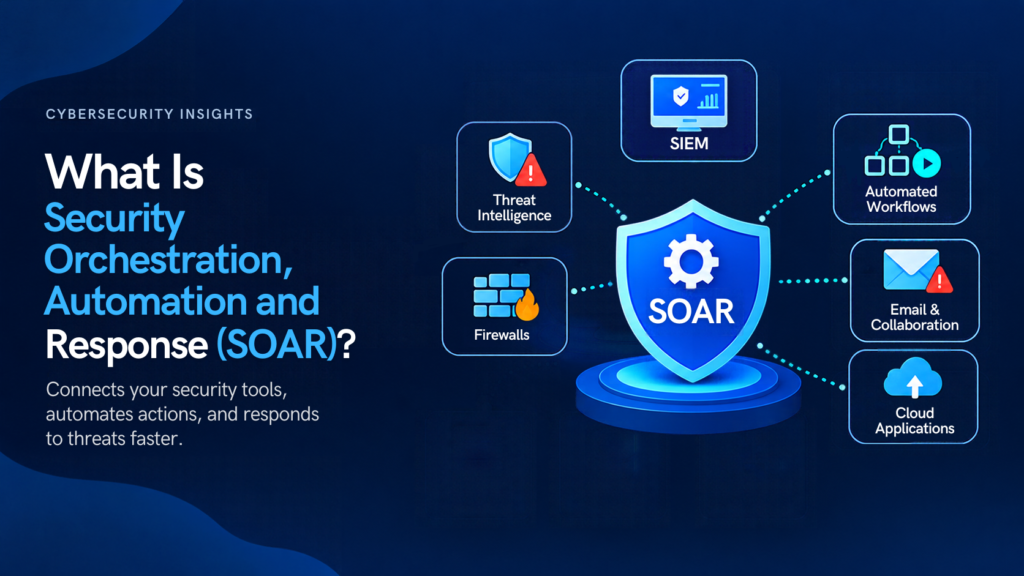
Orchestration is the integration layer. A SOAR platform connects to tools across the security stack, including endpoint detection, identity platforms, firewalls, ticketing systems, and threat intelligence feeds, allowing them to operate as a coordinated unit rather than in silos. When an alert fires in one system, orchestration ensures the relevant context from every other connected system is available before a decision is made.
Automation handles execution. SOAR replaces the manually performed, repetitive steps that follow every alert: looking up an IP in a threat intelligence feed, pulling context from the endpoint, querying the identity directory, logging a ticket. These steps are defined once and then executed automatically every time the triggering condition is met, without a human touching any of them.
Response is the outcome. After enrichment and triage, the platform either takes automated containment action (isolating a device, disabling an account, blocking traffic) or routes the case to a human analyst with full context already assembled. Response steps can be fully automated for high-confidence detections or require human approval before executing higher-impact actions.
In Bugstrix’s engagement work, organizations that see the most measurable improvement in detection-to-containment time after a SOAR deployment are those where detection quality was already strong before the platform was introduced. The automation multiplies existing signal quality rather than compensating for its absence.
How Does a SOAR Platform Work?
A SOAR platform operates through playbooks: predefined, logic-driven workflows that specify exactly what automated steps run when a particular type of alert is received, detailing which integrations to query, which enrichment actions to execute, and whether a containment step should run automatically or wait for human approval.
When an alert arrives from a connected tool, the SOAR platform matches it against the playbook library, executes the defined steps in sequence, and updates the case record with everything it found and did. Analysts receive a fully enriched incident rather than a raw data point.
The core components of a SOAR platform:
| Component | Function |
| Connectors | API integrations to tools across the stack: SIEM, EDR, firewalls, identity platforms, ticketing systems |
| Playbooks | Logic-driven workflows that define what automated steps run for each alert type or trigger condition |
| Alert Queue | Centralized inbox that receives alerts from connected tools and routes them to the appropriate playbook |
| Enrichment Engine | Automated lookups against threat intelligence feeds, WHOIS, DNS, and internal asset data |
| Response Actions | Automated or approval-gated steps: device isolation, account lockdown, traffic block, case escalation |
| Case Management | Structured incident records that capture alert context, enrichment results, actions taken, and analyst notes |
Most SOAR platforms support both fully automated playbooks and semi-automated playbooks that pause for analyst approval before executing high-impact actions such as blocking a network range or disabling a user account.
What Does SOAR Automate in a Security Operations Center?
The highest-value automation targets in a SOC are the tasks that consume significant analyst time without requiring specialized judgment: alert triage, threat enrichment, initial containment steps, and the documentation and ticketing work that follows every incident regardless of severity or outcome.
Alert triage. SOAR ingests raw alerts from across the stack, scores them against defined criteria, and determines which warrant immediate human attention. Alerts that fall below confidence thresholds are logged and closed automatically, eliminating a large portion of alert fatigue in high-volume environments.
Threat enrichment. Before an analyst sees a case, SOAR has already gathered relevant context, including IP reputation, domain age, file hash status, geolocation data, and associated CVE records. Analysts receive a complete picture rather than a raw alert.
Endpoint containment. For high-confidence detections, SOAR can trigger isolation of the affected endpoint directly through the connected EDR platform, removing a compromised host from the network in seconds rather than waiting for an analyst to act manually.
Attack path interruption. When detection tools identify active traversal of a known attack path, SOAR can trigger automated containment at key choke points, blocking lateral movement before it reaches high-value assets.
Identity-based response. For alerts involving account compromise or anomalous access behavior, SOAR executes identity-level containment: disabling accounts, revoking active sessions, and forcing re-authentication. This works closely with how identity threat detection and response (ITDR) surfaces and categorizes identity-layer events.
Vulnerability prioritization. When new vulnerabilities are flagged, SOAR correlates them against active asset inventory to determine exposure scope and prioritize remediation based on exploitability and asset criticality. This integrates with how vulnerability management programs track and action risk over time.
Ticketing and documentation. SOAR automatically creates, updates, and closes tickets in connected ITSM platforms, building an auditable record for every alert processed without requiring analysts to manually log each step.
How Is SOAR Different From SIEM and XDR?
SOAR, SIEM, and XDR are frequently grouped together because all three process security data and each plays a role in detection or response, but the distinction between them matters for understanding where SOAR actually adds value in a layered security program.
A SIEM collects and correlates log and event data from across the environment to generate alerts and support compliance reporting. It is a detection and visibility layer, not a response execution platform.
XDR (Extended Detection and Response) goes beyond logs to provide native telemetry collection and automated detection across endpoints, networks, and cloud workloads. XDR can execute some automated response actions, but only within its own ecosystem of connected tools.
SOAR sits above both. It does not collect telemetry or generate detections independently. It receives alerts from SIEM, XDR, EDR, and other tools and orchestrates what happens next. SOAR’s value is in execution: automating the response workflow once a detection has already been made and routing enriched cases to analysts with full context pre-assembled.
In practice, many security programs run all three together: SIEM for centralized log management and compliance, XDR for detection correlation, and SOAR for automated response execution across the full connected stack.
How Does SOAR Integrate With EDR, MDR, and ITDR?
SOAR platforms deliver the most consistent value when connected to detection tools that are already generating high-fidelity, actionable signals, and the integration points that matter most in mature security programs are endpoint detection, managed detection and response, and identity threat detection.
SOAR and EDR. An EDR platform generates high-fidelity endpoint alerts that are frequently the first confirmed signal in an attack chain. SOAR consumes those alerts, enriches them with context from other connected tools, and can trigger automated endpoint isolation directly, compressing the window between detection and containment from hours to seconds.
SOAR and MDR. A managed detection and response (MDR) service pairs tooling with human analysts who actively investigate and respond to threats. MDR providers typically use SOAR platforms as the backbone of their response operations, automating enrichment and initial triage so analysts can concentrate on investigation and judgment-heavy escalations. For organizations without an in-house SOC, MDR often delivers SOAR-driven automation as part of the managed service rather than requiring a separate platform deployment.
SOAR and ITDR. Identity-layer attacks move fast. Credential stuffing, session hijacking, and privilege escalation can progress to full environment compromise in under an hour. SOAR platforms integrated with ITDR tools execute identity-specific playbooks in near real time: disabling compromised accounts, invalidating active tokens, and alerting on anomalous access patterns before lateral movement gains traction.
What Are the Limitations of SOAR?
SOAR platforms are powerful as a response execution layer, but the real-world limitations of a deployment are just as important to understand as the capabilities when evaluating whether the investment makes sense for your organization’s current security maturity and operational scale.
Detection quality is a hard dependency. SOAR automates responses to alerts. It does not generate detections. If the detection layer is producing noisy, low-fidelity alerts, SOAR will execute automated playbooks against false positives at scale. Garbage in, garbage out. Deploying SOAR before investing in detection quality upstream typically creates more operational burden than it eliminates.
Playbooks require continuous maintenance. Playbooks are written for known threat patterns and defined environment states. As environments change, as attack techniques evolve, and as tools are updated, playbooks drift out of alignment with reality. Stale playbooks execute the wrong actions or fail silently. SOAR requires sustained security engineering effort to stay calibrated over time.
Integration complexity is significant. Each connected tool requires a working API integration. Older systems, custom-built tools, and platforms with restricted API access create gaps in the automation chain, meaning certain alert types still require fully manual handling despite the platform investment.
SOAR does not find what your detection layer has not already caught. SOAR responds to detected threats. It has no visibility into undetected vulnerabilities, exposed attack paths, or misconfigurations that have not triggered an alert. Bugstrix penetration testing services address exactly this gap, surfacing exploitable conditions that instrumented monitoring never sees until an attacker finds them first.
Deployment timelines are long. Getting meaningful value from a SOAR platform typically requires months of integration work, playbook development, and tuning. Organizations with lean security teams should weigh the deployment and maintenance cost against the operational benefit before committing to the investment.
Does Your Organization Need a SOAR Platform?
SOAR delivers the most consistent value in environments that are already generating a significant volume of security alerts daily, have established tooling across the stack, and have the security engineering capacity to build and maintain playbooks on an ongoing basis.
Organizations that typically benefit from SOAR:
- SOC teams processing high volumes of alerts where manual triage is creating coverage gaps and analyst burnout
- Security programs that already have EDR, SIEM, and identity tooling deployed and want to automate the connective tissue between them
- MDR providers and MSSPs where operational efficiency directly determines service delivery quality
- Enterprise environments with compliance mandates that require documented, auditable incident response workflows
Organizations where SOAR may not yet be the right investment:
- Small teams without dedicated security engineering resources to build and maintain playbooks over time
- Programs where detection coverage is still thin, because adding automation to a weak detection layer amplifies noise rather than reducing it
- Organizations that have not completed a thorough Bugstrix vulnerability assessment to understand their actual risk exposure and where detection gaps exist
For most mid-market organizations, the more practical path is building detection coverage first: EDR, identity visibility, vulnerability tracking, and regular Bugstrix assessments to validate what instrumented monitoring is missing. SOAR layers on top once the detection layer is producing reliable, actionable signals.
Frequently Asked Questions
What does SOAR stand for?
SOAR stands for Security Orchestration, Automation and Response. It describes a category of security platform that integrates disparate security tools, automates repetitive analyst workflows, and coordinates response actions across a connected environment from alert receipt through containment.
Is SOAR the same as SIEM?
No. A SIEM collects and correlates log and event data to generate alerts. SOAR consumes those alerts and automates the response workflow: enrichment, triage, containment, and escalation. SOAR is a response execution layer built on top of the detection layer, not a detection platform in its own right. Most mature environments run both.
Can a small security team benefit from SOAR?
SOAR was built to extend the operational capacity of lean teams, but it requires upfront engineering effort to configure integrations and develop playbooks. Smaller teams typically access SOAR capabilities through a managed detection and response provider rather than deploying and maintaining the platform in-house.
What is a SOAR playbook?
A SOAR playbook is a predefined, logic-driven workflow that specifies the automated steps that execute when a specific alert type or trigger condition is met. Playbooks cover scenarios such as phishing triage, malware alert response, account compromise containment, and vulnerability escalation workflows.
How does SOAR handle false positives?
SOAR applies confidence thresholds and enrichment logic before executing containment actions. Alerts that fall below defined thresholds are automatically logged and closed or routed to a low-priority queue rather than triggering automated response. The accuracy of that filtering depends entirely on the quality of the detection rules feeding the platform.
Does SOAR replace penetration testing?
No. SOAR responds to threats that detection tools have already identified. It has no capability to find undetected vulnerabilities, unmonitored attack paths, or misconfigurations that have not yet triggered an alert. Bugstrix penetration testing services surface the exposure that SOAR will never see until an attacker moves through it.
SOAR and the Security Program Around It
SOAR addresses the manual workflow problem that high-volume alert environments create. By automating enrichment, triage, and initial containment, it extends what a lean security team can manage without expanding headcount proportionally, and it compresses the detection-to-containment window in programs where that gap creates the most direct risk exposure.
What SOAR does not do is replace the detection quality and coverage that feeds it. Undetected vulnerabilities, blind spots in endpoint or identity coverage, and attack paths that instrumented monitoring has never mapped remain invisible to a SOAR platform regardless of how well it is configured. Bugstrix works with organizations building automated response capabilities to identify and close these coverage gaps: through penetration testing that surfaces what detection tools miss, vulnerability assessments that establish the actual risk exposure driving prioritization, and ongoing validation that the detection layer feeding SOAR is catching the techniques relevant to the specific environment.