What Is Business Logic Vulnerability Testing?

Written By
Sarwat Iftikhar
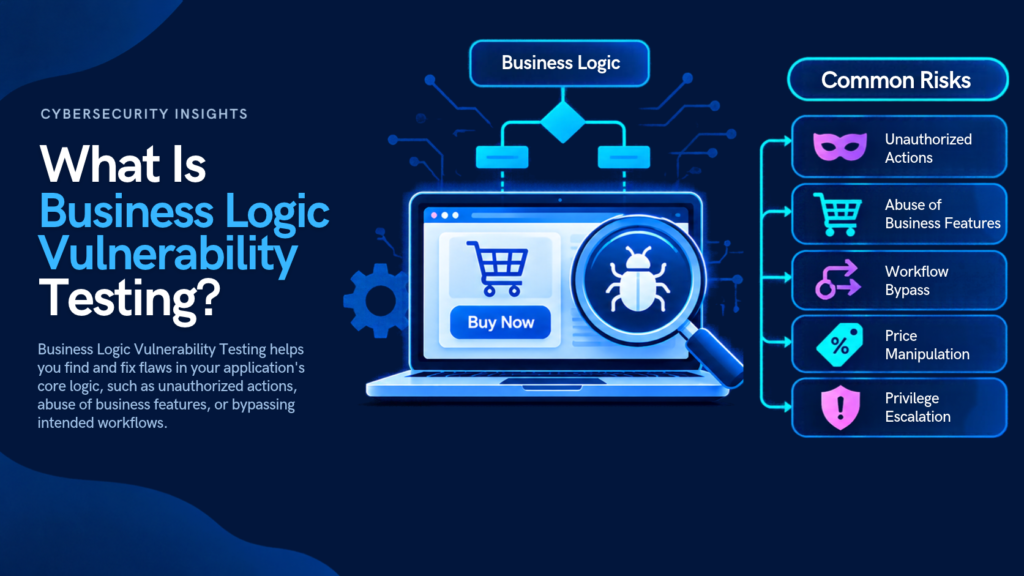
Business logic vulnerability testing is the process of assessing whether an application’s intended workflows and business rules can be abused to produce outcomes the application was not designed to allow. A business logic vulnerability is not a technical flaw in the code; it is a flaw in the rules the code implements. The price calculation works correctly. The discount application works correctly. The order submission works correctly. The flaw is that combining them in a sequence the developers did not anticipate produces an order that ships goods for zero or negative cost, without triggering any validation error. Business logic vulnerability testing is built around finding those sequences before they are found by someone who will exploit them.
The category is defined by what automated scanners cannot reach. A vulnerability scanner detects signatures of known technical flaws: SQL injection, cross-site scripting, insecure deserialization. It has no model of what the application is supposed to do. It cannot determine that a user who is midway through a password reset flow should not also be able to change their email address, or that an order that has been partially refunded should not be eligible for the full refund again. Identifying those flaws requires a tester who understands the application’s business rules and applies them adversarially, testing not whether the application does what the code says, but whether what the code says is what the business actually requires.
Key Takeaways
- Business logic vulnerabilities arise from flaws in how an application’s intended rules are implemented and enforced, not from technical coding errors; automated scanners cannot detect them because they have no model of what the application is meant to do
- The highest-impact business logic flaws cluster around financial operations (price, discount, and payment logic), multi-step workflows (checkout, registration, password reset), authorization enforcement (access to objects and functions beyond the user’s intended scope), and concurrent operations (race conditions that break intended sequencing rules)
- Business logic vulnerability testing is manual by nature; it requires a tester who understands the application’s intended behavior and can probe each workflow state for transitions the application does not validate
- API endpoints are a primary surface for business logic testing because they often enforce validation at the client rather than at the server, exposing server-side logic to direct manipulation
- The most effective business logic testing combines adversarial workflow analysis with source code review, because code review surfaces the validation gaps that live in functions automated testing does not reach
Why Business Logic Vulnerabilities Are Different From Technical Flaws
Technical vulnerabilities have a standard signature. SQL injection occurs when user input reaches a database query without sanitization. Cross-site scripting occurs when user input reaches the DOM without encoding. The fix is a known technical control, and the vulnerability is identifiable by pattern matching against known signatures. Business logic vulnerabilities have no standard signature, because they are defined by what the application is supposed to do, which is different for every application.
Web application security encompasses both technical vulnerability classes and business logic flaws, but the two require fundamentally different testing approaches. Technical vulnerability testing can be partially automated: a scanner can fuzz parameters, detect injection points, and identify known misconfiguration patterns across an application’s attack surface. Business logic testing cannot be automated in the same way because automation requires a specification to test against, and the specification for business logic lives in product requirements documents, user stories, and developers’ assumptions about how their code will be used rather than in a format that a scanner can consume.
API security testing surfaces a particularly high density of business logic flaws because APIs are the layer where server-side business logic is most directly exposed. A web application may enforce a business rule through client-side validation, a minimum order quantity, a maximum discount percentage, or a required approval step, but the API accepts requests that bypass it entirely. API endpoints that were designed for internal service-to-service communication frequently lack the input validation and state enforcement that client-facing endpoints implement, because the developers who built them assumed the caller would already have validated the input. Business logic testing against the API layer probes those assumptions directly.
The practical consequence is that business logic vulnerability testing requires investment in understanding the application before testing begins. A tester who does not know that a voucher code should be single-use cannot determine that the application allows it to be applied multiple times. A tester who does not know that a trial account should not be able to access premium features cannot identify that upgrading and immediately downgrading leaves premium access active. The testing methodology is built around mapping the application’s intended state machine and then probing each state transition for cases the implementation does not validate.
What Does Business Logic Vulnerability Testing Examine?
Business logic vulnerability testing covers five interconnected vulnerability categories that together represent the primary ways applications fail to enforce their own intended rules. Each category requires testing against the specific workflow logic the application implements, not against a generic checklist.
Workflow bypass testing examines whether required steps in multi-step processes can be skipped, reordered, or replayed without detection. Applications that implement checkout flows, approval chains, identity verification sequences, or account upgrade processes typically enforce those sequences through client-side state management or through server-side checks that assume requests arrive in the intended order. Testing probes whether step validation is enforced at the server for each individual request, or whether the server assumes the client has completed all prior steps before submitting a final action. Common findings include submitting an order confirmation request without completing payment, skipping email verification by directly requesting the authenticated endpoint, and replaying completed steps from a previous session to access expired states.
Price and value manipulation testing examines whether financial and quantity parameters are validated at the server for every transaction, or whether the server accepts values submitted by the client without validating them against a server-side pricing model. This category includes negative quantity submissions that reverse the sign of a transaction total, applying promotional codes that are single-use or user-scoped in ways that bypass the intended restriction, manipulating instalment payment parameters to reduce total payment amounts, and exploiting partial refund logic to claim full refunds on partially fulfilled orders. The unifying characteristic is that the application processes a transaction whose financial outcome the application’s developers did not intend.
Privilege and role abuse testing examines whether authorization is enforced at the object and function level for every request, or whether the application assumes that authenticated users will only access objects and functions appropriate to their role. Broken Object Level Authorization (BOLA) is the most common form of this vulnerability class: a user who is authenticated and authorized to view their own records can access or modify another user’s records by substituting the target object’s identifier in an otherwise valid request. Broken access control in SaaS applications extends this to multi-tenant environments where the authorization failure crosses tenant boundaries, a user in one organization’s tenant accessing data belonging to another tenant through object identifiers that are not scoped to the requesting user’s context.
Race condition exploits test whether operations that should be atomic or sequentially enforced can be executed concurrently to produce states the application’s logic prohibits. Sending multiple simultaneous requests to redeem a single-use voucher code can succeed if the check-then-use operation is not atomic, allowing multiple redemptions before the code is marked as used. The same pattern applies to loyalty point redemptions, concurrent account balance deductions, referral bonus claims, and any operation where the application reads a value, makes a decision based on it, and writes an update, with a window between the read and the write in which a concurrent request can pass the same check.
Authentication flow abuse testing examines whether the multi-step flows for password reset, account registration, email verification, and two-factor authentication can be manipulated to bypass their intended security guarantees. Common findings include completing a password reset for one account using a token generated for a different account, skipping email verification by guessing or enumerating verification tokens with insufficient entropy, and using a partially completed authentication state from one session to bypass requirements in another.
Which Business Logic Flaws Are Most Commonly Exploited?
Business logic vulnerability testing at Bugstrix surfaces consistent patterns across different application types and industry verticals, though the specific implementation differs by application.
Client-side price and quantity parameter trust is the most reliably found financial logic flaw across e-commerce, subscription, and marketplace applications. Applications that calculate prices on the client and submit the calculated value to the server for processing, rather than calculating server-side from submitted quantities, provide any user who intercepts the request with direct control over the transaction value. This finding is frequently categorized by development teams as low-severity because it requires intercepting HTTP requests, but the financial impact of a single exploited transaction in a high-value application can be significant, and the technical barrier is low for anyone with a proxy tool.
Single-use resource reuse appears consistently in applications that implement vouchers, referral bonuses, free trial extensions, and promotional entitlements. The application enforces the single-use restriction by checking a flag at the point of redemption, but the check and the update are not atomic, or the flag is stored client-side, or the restriction is checked in one code path but not in an alternative path that reaches the same resource. Race condition exploitation of the check-then-update pattern is a frequent finding in concurrent API testing, where simultaneous requests can pass the initial check before any of them triggers the update.
Object-level authorization gaps in API endpoints are the most common authorization finding in applications that expose data through REST or GraphQL APIs. The gap typically exists because authorization is implemented at the route or controller level (the user is authenticated and has access to this resource type) rather than at the object level (the user is authenticated and has access to this specific object instance). The result is that any authenticated user can access or modify any object of the accessible type by substituting its identifier. Secure code review of the authorization layer identifies these gaps at the source: code that fetches an object by ID without filtering by the requesting user’s ownership or organization membership is a business logic flaw that adversarial testing validates against the production data model.
Workflow step sequencing failures are found in applications where multi-step processes are enforced by client-side state rather than by server-side validation of the preceding steps’ completion. The application tracks which step the user is on in a session variable or in the request itself, and the server processes whichever step the client claims to be on. Testing this pattern requires submitting step N+1 requests without completing step N and observing whether the server validates that the prerequisite step was completed in the current session context.
Account state inconsistencies post-transition occur in applications where account state changes, upgrades, downgrades, cancellations, suspensions, do not fully propagate to all access control enforcement points. A user who upgrades to a premium plan and immediately downgrades may retain premium feature access if the access control check reads from a cached role that is not invalidated on downgrade. A suspended account may retain API key access if the suspension logic updates the UI-facing authentication path but not the API key validation path. These findings require testing each access control enforcement point independently rather than assuming that a state change propagates uniformly.
How Does Business Logic Vulnerability Testing Work in Practice?
Business logic vulnerability testing is structured around mapping an application’s intended state machine and then probing each state and transition for enforcement gaps. It is a manual discipline that requires application understanding before testing begins.
Application and workflow mapping is the foundation of business logic testing. Before probing for vulnerabilities, Bugstrix engineers map the application’s core workflows: the steps in each multi-step process, the state transitions each user role can trigger, the financial operations the application performs, and the resource relationships that determine which objects each role should be able to access. This mapping phase requires access to the application and typically includes reviewing API documentation, intercepting legitimate traffic to understand the request structure for each workflow step, and identifying the parameters that carry business-significant values.
Adversarial workflow testing probes each mapped workflow for bypass conditions: requests that skip steps, requests that modify parameters the server should derive rather than accept from the client, and requests that replay states from completed or expired sessions. This phase tests each identified state transition for server-side enforcement of its prerequisites, covering the happy-path flow, out-of-order step submission, and direct access to later-stage endpoints without completing earlier stages.
Authorization and object access testing validates whether the application enforces access control at the object level for every endpoint that accepts an object identifier. This phase submits valid requests with substituted object identifiers across every endpoint that exposes user-scoped data, testing whether the server validates that the requesting user has access to the specific object referenced rather than only validating that the user has access to the resource type.
Race condition testing sends concurrent requests to operations that should be atomic or single-execution: voucher redemptions, referral claims, balance operations, and state-change endpoints where concurrent execution would produce a prohibited state. Testing uses parallel request delivery to minimize the window between the concurrent requests, targeting the check-then-update pattern specifically.
Source code review of the business logic layer identifies enforcement gaps that adversarial testing does not reach, validation logic in dead code paths, authorization checks that exist in the primary flow but are absent in alternative flows, and financial calculations that accept client-supplied parameters without server-side validation. Web application penetration testing combined with source code review provides coverage of both the behavioral and implementation layers of business logic security. Bugstrix web app penetration testing services for business logic engagements cover adversarial workflow testing, authorization validation, race condition testing, and financial logic analysis. Bugstrix penetration testing services cover the broader application security scope alongside the business logic layer.
Get a free quote for a business logic vulnerability testing engagement
Frequently Asked Questions
Why can’t automated scanners detect business logic vulnerabilities?
Automated scanners detect known vulnerability signatures by pattern matching against requests and responses. They have no model of what the application is intended to do, so they cannot determine that a parameter should be derived server-side rather than accepted from the client, that a workflow step should require a preceding step to have been completed, or that a voucher code should only be redeemable once per user. Identifying those conditions requires a tester who understands the application’s business rules and applies them adversarially. Business logic testing can be supported by automation for tasks like concurrent request delivery in race condition testing, but the test cases themselves must be designed by a human who understands the application’s intended behavior.
What types of applications have the highest density of business logic vulnerabilities?
E-commerce and marketplace applications, where financial transactions, discount logic, and inventory operations create a dense set of business rules, consistently have the highest density. Subscription and SaaS applications with trial periods, plan upgrades, and feature entitlement enforcement are the next most common category. Applications with multi-step onboarding, identity verification, or approval workflows have high workflow bypass exposure. The density of business logic vulnerabilities scales with the complexity of the application’s business rules, not with the application’s technical architecture.
How is business logic vulnerability testing scoped?
Business logic testing is scoped to the workflows, user roles, and API surfaces that implement the application’s core business rules. A typical engagement scope includes all authenticated user flows for the application’s primary use cases, the API endpoints that back those flows, and the authorization model that separates user roles and tenant contexts. Financial operations, promotional systems, and multi-step processes are prioritized for depth of testing because they carry the highest business impact when flawed. The engagement scope is defined during the pre-testing mapping phase, based on the application’s architecture and the development team’s own assessment of which workflows carry the highest business risk.
Can business logic vulnerabilities be found during development rather than in production?
Yes, and earlier detection is significantly cheaper. Threat modeling during design identifies workflows where the intended rules require server-side enforcement and flags them for security review before implementation. Secure code review during development identifies authorization checks that exist in one code path but not in alternatives, client-side parameter trust, and non-atomic check-then-update patterns before they are deployed. Penetration testing before launch validates that the implemented controls hold up against adversarial use. The cost of finding a business logic flaw in production, including the financial impact of exploitation between deployment and discovery, consistently exceeds the cost of finding it earlier in the development lifecycle.
How often should business logic vulnerability testing be performed?
After significant changes to core workflows, pricing logic, promotional systems, authorization models, or API surfaces. Business logic vulnerabilities are introduced when features change, not on a fixed calendar. Applications that release frequently should include business logic review in their release validation process for any change to a financially or authorization-sensitive workflow. A baseline full-scope engagement at launch followed by targeted testing for significant feature releases is the most effective cadence for applications with complex business rules.
The Flaw Is in the Rules, Not the Code
The defining characteristic of business logic vulnerabilities is that the application is working as implemented. The validation code runs. The database query executes. The response is returned. The flaw is that the implemented rules do not match the intended rules: the price field should not accept a client-submitted value; the voucher code should not be redeemable after a concurrent request has claimed it; the step should not be completable without a confirmed prior step. Finding those mismatches before attackers do requires a tester who approaches the application the way its most motivated users will: not looking for broken code, but for rules that the implemented code does not fully enforce.
Bugstrix business logic vulnerability testing is built around that model. Each engagement begins with understanding the application’s intended rules well enough to probe each one adversarially. Findings are documented with the specific request sequence that demonstrates the enforcement gap, the business impact of exploitation, and the implementation change that closes it, not just a flag that a parameter was accepted from the client, but a demonstration of the transaction outcome that acceptance enables.
Contact us to discuss a business logic vulnerability testing engagement for your application