What Is OAuth 2.0 Testing and How Does It Work?

Written By
Sarwat Iftikhar
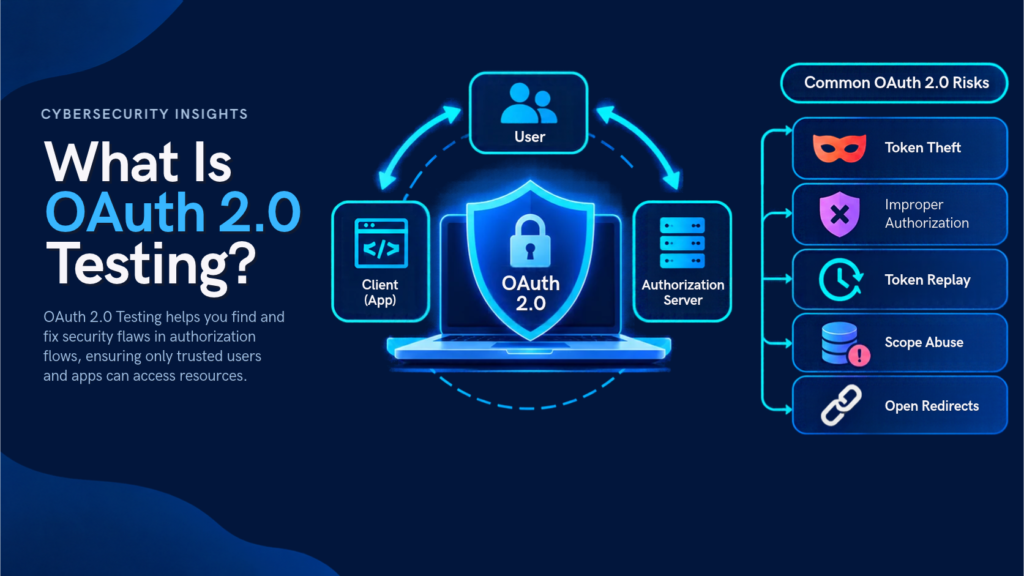
OAuth 2.0 testing is the process of assessing how securely an application implements the OAuth 2.0 authorization framework, with the goal of identifying how the authorization flow, token handling, and permission model can be exploited. OAuth 2.0 is the protocol that lets users grant third-party applications access to their data without sharing their credentials. It underpins login flows, API authorization, and third-party integrations across nearly every web and mobile application in production today.
The gap between how OAuth 2.0 is designed and how it is implemented in practice is where most of the risk lives. The protocol offers multiple grant types, requires careful validation of redirect URIs, state parameters, and token scopes, and places significant security responsibility on each party in the flow. Applications that implement OAuth 2.0 without fully understanding those requirements create vulnerabilities that give attackers access to user accounts, sensitive data, and third-party integrations without needing to compromise credentials directly.
Key Takeaways
- OAuth 2.0 testing assesses the authorization flow, token lifecycle, scope model, and configuration decisions that determine whether an OAuth implementation can be exploited
- Redirect URI manipulation, missing state parameters, and PKCE bypass are the most reliably exploited OAuth vulnerabilities in production applications
- Token exposure through referrer headers, browser history, and log files is a persistent risk in implementations that have not been tested
- Scope and permission misconfiguration allows attackers to obtain tokens with broader access than the application intended to grant
- Testing must cover each grant type in use, because each introduces a distinct set of risks that do not appear in the others
Why Does OAuth 2.0 Implementation Create Security Vulnerabilities?
OAuth 2.0 is a delegation protocol. Its job is to allow one application to act on behalf of a user within another system, with the user’s consent and within the limits the user approves. It is not an authentication protocol, and it does not define how tokens should be stored, how scopes should be enforced, or how redirect URIs should be validated. Those decisions are left to the implementing application, and each one creates an opportunity for a security failure if made incorrectly.
The authorization flows that make OAuth 2.0 flexible also make it complex. The authorization code flow, the most secure grant type, involves multiple redirects between the application, the authorization server, and the user’s browser. Each redirect carries parameters that must be validated. If the redirect URI is not strictly matched against a registered allowlist, an attacker who intercepts or influences the flow can redirect the authorization code to an endpoint they control. If the state parameter is absent or predictable, the flow is vulnerable to cross-site request forgery that forces a user to authorize access under an attacker’s session.
The identity and access management architecture of an application determines what an attacker can reach once they have a valid token. OAuth 2.0 testing sits at the intersection of authorization flow security and access control: a successfully exploited OAuth vulnerability does not just expose the protocol. It exposes everything the compromised token was authorized to access.
What Does OAuth 2.0 Testing Examine?
Bugstrix OAuth 2.0 testing engagements cover the full authorization flow, the token lifecycle, the scope model, and the application configuration decisions that determine whether the implementation can be exploited. The assessment works through each attack surface from the initial authorization request to token storage, use, and revocation.
Authorization code flaws are the most significant attack class in applications using the authorization code grant type. Testing examines whether the redirect URI is validated against a strict allowlist, whether partial URI matching or wildcard patterns can be exploited to redirect the authorization code to an attacker-controlled domain, and whether the state parameter is present, cryptographically random, and validated on return. An application that accepts a redirect URI with a path prefix match instead of an exact match, or that generates a predictable state value, can have its authorization code intercepted by an attacker who can influence any part of the redirect chain.
Token security covers how access tokens and refresh tokens are issued, stored, transmitted, and invalidated. Bugstrix assessments examine whether access tokens appear in URLs, referrer headers, or server logs that could expose them to parties outside the authorization flow, whether token lifetimes are proportionate to the sensitivity of the resources they protect, whether refresh tokens are rotated on use, and whether the application provides a working token revocation mechanism. Tokens used to authorize API security testing engagements represent the most direct route to data access in most web and mobile applications, and a stolen token bypasses every authentication control in the application.
Scope and permission bypass testing examines whether the application enforces token scopes at the resource server level, not just at the point of issuance. A token issued with a narrow scope is only secure if every API endpoint and data access path in the application validates that the token’s scope covers the requested operation. Broken object-level authorization is the most common failure mode: a token that was issued for read access to one user’s data is accepted for write access, or for access to another user’s resources, because the resource server validates the token’s signature without checking its scope against the specific operation requested.
PKCE and state weaknesses cover the security parameters that protect the authorization code flow from interception and injection. Proof Key for Code Exchange prevents authorization code interception attacks in public clients where the client secret cannot be kept confidential. Testing examines whether PKCE is implemented, whether the code verifier entropy meets minimum requirements, and whether the authorization server enforces PKCE validation even when the code challenge is not supplied. State parameter testing examines entropy, binding to the user session, and server-side validation on code redemption.
OAuth misconfiguration covers the authorization server and client registration settings that determine what the protocol will and will not accept. Testing includes open redirect tests against the redirect URI validation logic, implicit flow exposure in applications that have not migrated away from the deprecated grant type, overly broad scopes registered for client applications, and missing HTTPS enforcement on token endpoints. These are configuration-level issues rather than code-level issues, but they carry the same exploitation risk as a code vulnerability because the authorization server will process whatever the configuration permits.
Which OAuth 2.0 Vulnerabilities Are Most Commonly Exploited?
Bugstrix engineers encounter the same categories of OAuth vulnerability repeatedly across web and mobile application assessments, regardless of the technology stack or the authorization library in use.
Redirect URI validation bypass is present in a significant proportion of assessments. Applications frequently implement partial matching rules accepting any redirect URI that begins with the registered domain or fail to validate the redirect URI at all when the client has only one registered URI, on the assumption that there is nothing to validate. Both create exploitable conditions. An open redirector anywhere on the application’s registered domain becomes a viable code theft vector if partial URI matching is in use.
Missing or weak state parameters remain common in applications that have implemented OAuth 2.0 from scratch rather than using a well-tested library. The state parameter is easy to omit during initial development, and the absence of CSRF protection in the OAuth flow is not surfaced by functional testing. Applications that generate state values using timestamps, sequential counters, or short random strings are vulnerable to state prediction attacks.
Token leakage through implicit flow still appears in applications that were built when the implicit grant type was the recommended approach for single-page applications. The implicit flow delivers access tokens in the URL fragment, where they are visible in browser history and can be captured through referrer headers. Applications that have not migrated to the authorization code flow with PKCE continue to expose tokens to these channels.
Scope misconfiguration at the resource server is the most impactful finding category when it is present. An application can implement the authorization flow correctly, issue tokens with appropriate scopes, and still be fully vulnerable to unauthorized data access if the resource server APIs do not validate scope against each operation. This failure is not visible from the authorization server side and requires testing at the API layer to detect.
How Does OAuth 2.0 Testing Work in Practice?
OAuth 2.0 testing combines flow analysis, token lifecycle testing, scope validation, and application code review into a structured engagement that covers both the authorization server configuration and the resource server enforcement.
Flow analysis maps the full authorization flow as the application implements it, documenting every parameter, every redirect, every token exchange, and every validation step. Bugstrix engineers intercept and modify requests at each stage of the flow to test redirect URI validation, state parameter handling, PKCE enforcement, and the application’s response to malformed or missing parameters. Each test is designed to match a realistic attack scenario rather than testing protocol compliance in isolation.
Token lifecycle testing examines how the application issues, transmits, stores, and invalidates tokens across the full range of conditions an attacker might create: expired tokens, revoked tokens, tokens issued to a different client, tokens with scopes that do not match the requested operation, and tokens delivered through channels that expose them to logging or history.
Scope and authorization testing validates that the resource server enforces scope against every API endpoint and every data operation, not just the operations tested during development. A secure code review of the authorization and resource server code examines the specific validation logic applied to each token and each scope claim, identifying gaps between what the authorization server issues and what the resource server enforces.
Configuration review covers the authorization server settings, client registration parameters, CORS policy on token endpoints, error response verbosity, and HTTPS enforcement. This layer of review identifies the misconfiguration categories that standard dynamic testing may not reach, particularly in applications that restrict testing access to their authorization server administrative interface.
Web application security testing for any application that uses OAuth 2.0 for authorization should include dedicated OAuth flow testing as a named scope item, not as a subset of general authentication testing. The failure modes are distinct and require specific techniques to surface. Bugstrix web app penetration testing services cover OAuth 2.0 implementation testing as a standard component of web application assessments, with scope extensions available for applications with complex authorization server configurations or multiple grant types in use. Standalone OAuth 2.0 testing engagements are available through Bugstrix penetration testing services for teams that want to assess their OAuth implementation independently of a broader application security engagement.
Get a free quote for an OAuth 2.0 security testing engagement
Frequently Asked Questions
What is the difference between OAuth 2.0 testing and authentication testing?
OAuth 2.0 is an authorization protocol, not an authentication protocol. OAuth 2.0 testing examines how the application delegates access and manages tokens, not how it verifies user identity. Authentication testing examines login flows, credential handling, session management, and multi-factor authentication. The two overlap when OAuth is used as the foundation for a sign-in flow, but each requires distinct testing techniques and covers different failure modes.
Which OAuth 2.0 grant types require the most security attention?
The authorization code grant type requires the most thorough testing because it is the most widely deployed and has the most attack surface: redirect URIs, state parameters, PKCE, code exchange, and token issuance each represent a potential failure point. The implicit grant type is deprecated and should be tested specifically for migration completeness; its continued presence in a production application is itself a finding. The client credentials grant type has a narrower attack surface but requires validation of client secret handling and token scope enforcement at the resource server.
Can OAuth 2.0 vulnerabilities lead to full account takeover?
Yes. A redirect URI validation bypass that allows an attacker to intercept the authorization code, combined with a client that does not enforce PKCE, allows the attacker to exchange the intercepted code for a valid access token. Depending on the token’s scope, this can provide full access to the user’s account within the connected application. A stolen refresh token with no revocation mechanism can provide long-term persistent access.
Does using an established OAuth library eliminate the need for testing?
No. OAuth libraries handle the protocol mechanics correctly but do not make scope enforcement, redirect URI validation policy, or token storage decisions for the application. The most common OAuth vulnerabilities arise from configuration decisions made by the application developer, not from protocol implementation errors in the library. Testing is required to validate that the library has been configured correctly and that the resource server enforces what the authorization server issues.
How often should OAuth 2.0 implementations be tested?
After initial implementation before launch, after any change to the authorization server configuration or client registration, after adding new scopes or grant types, and after updating the OAuth library or upgrading the authorization server. Applications that handle sensitive data or expose OAuth-protected APIs to external parties should include OAuth flow testing in each major release cycle.
Correctly Implementing OAuth 2.0 Is Not the Same as Securing It
The OAuth 2.0 specification is well-documented, and the protocol mechanics are widely understood. The security failures that make OAuth implementations exploitable are almost always in the decisions surrounding the protocol: how redirect URIs are validated, how state and PKCE parameters are handled, how scopes are enforced at the resource server, and how tokens are stored and transmitted. None of those decisions are enforced by the protocol itself, and none of them are visible from functional testing that only verifies that the authorization flow completes successfully.
Bugstrix OAuth 2.0 testing is designed to find the gap between a working implementation and a secure one. The engagement maps the authorization flow as implemented, tests each parameter and each validation step under adversarial conditions, examines scope enforcement at the resource server against every protected endpoint, and reviews the configuration decisions that determine what the authorization server will and will not accept. The result is a finding set that maps directly to the specific implementation and configuration decisions that produced each vulnerability, with remediation guidance that addresses the root cause rather than the symptom.
Contact us to discuss an OAuth 2.0 security testing engagement for your application