What Is Vulnerability Remediation?

Written By
Sarwat Iftikhar
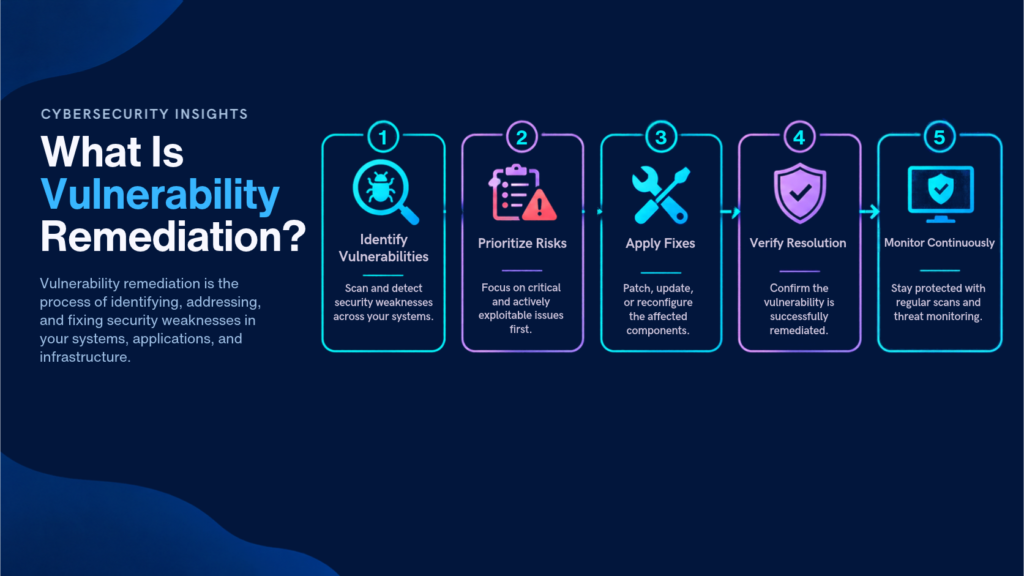
Vulnerability remediation is the process of identifying, prioritizing, and resolving security vulnerabilities in systems, applications, and infrastructure before they can be exploited. It is the operational core of any security program: the work that converts findings from assessments and tests into actual risk reduction.
The term is sometimes used interchangeably with vulnerability management, but the two are distinct. Vulnerability management is the broader program that governs how an organization discovers, tracks, and responds to vulnerabilities over time. Vulnerability remediation is the specific activity within that program where a vulnerability is actually fixed, whether through patching, configuration change, code correction, architectural adjustment, or compensating control.
Remediation that is thorough and consistent produces measurable improvement in security posture over time. Remediation that is incomplete, poorly prioritized, or unvalidated produces a false sense of security: findings get closed on paper while the underlying risk persists.
Key Takeaways
- Vulnerability remediation is the process of fixing security vulnerabilities, not just cataloging them
- Effective remediation requires prioritization based on severity, exploitability, and business context before fix work begins
- Patching a vulnerability without validating the fix leaves open the possibility that the fix was incomplete or introduced new issues
- Root cause analysis separates remediation that prevents recurrence from remediation that only closes the current instance
- Continuous validation through testing confirms that remediation is working and new vulnerabilities are not being introduced
What Is Vulnerability Remediation in Cybersecurity?
In cybersecurity, vulnerability remediation refers to the deliberate process of resolving a known security weakness to the point where it no longer represents exploitable risk. That resolution can take several forms depending on the nature of the vulnerability and the constraints of the environment.
Patching is the most common remediation action for software vulnerabilities. A vendor releases a security patch that corrects the flaw in the affected software version, and the organization deploys that patch to affected systems. Patching is effective when the vulnerability is in a component the vendor maintains and updates are available and deployable.
Configuration changes address vulnerabilities that arise from insecure defaults or misconfigured settings rather than from code flaws. Disabling unnecessary services, enforcing authentication on exposed interfaces, restricting network access to administrative ports, and removing default credentials are all configuration-based remediation actions.
Code fixes apply to vulnerabilities in code the organization owns and maintains. An injection vulnerability corrected through proper input validation, an authentication bypass resolved through logic correction, or a broken access control finding remediated through permission enforcement all require code changes rather than external patches.
Compensating controls are used when a direct fix is not immediately available or technically feasible. Network segmentation that limits blast radius, a web application firewall rule that blocks known exploit patterns, or enhanced monitoring on a system pending a patch cycle are compensating controls that reduce risk while a permanent fix is developed.
Accepting risk is a formal remediation decision applied to vulnerabilities where the cost of remediation exceeds the business risk they represent and compensating controls are in place. Risk acceptance should be documented, reviewed on a schedule, and not used as a default path for findings that are simply inconvenient to fix.
Integrating remediation into a structured vulnerability management program ensures that findings from every source feed into a consistent prioritization and tracking process rather than being handled ad hoc by individual teams.
How Are Vulnerabilities Prioritized for Remediation?
Prioritization is where most remediation programs succeed or fail. An organization that treats every vulnerability as equally urgent will exhaust remediation capacity on low-risk findings while critical exposures remain open. An organization with no prioritization model will remediate in the order findings arrive, which correlates poorly with actual risk.
Effective prioritization uses multiple inputs to rank vulnerabilities by the risk they represent to the specific environment.
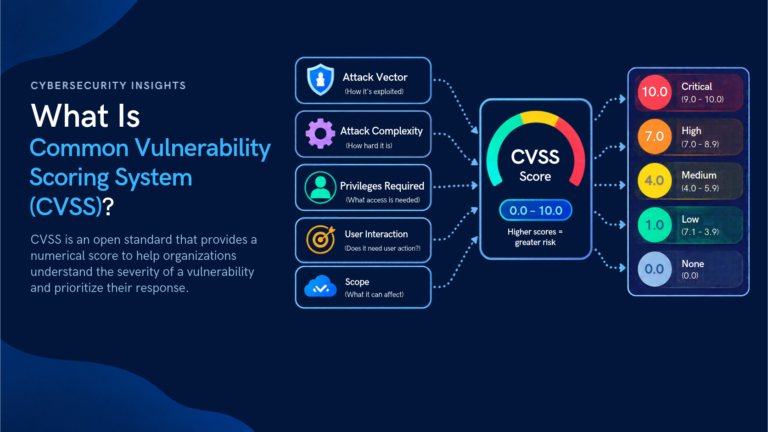
Severity scoring with CVSS provides a standardized starting point. CVSS scores rate vulnerabilities from 0.0 to 10.0 based on attack vector, attack complexity, privileges required, user interaction, scope, and impact. A Critical CVSS score indicates a vulnerability that is network-accessible, requires no authentication, and can result in full system compromise. CVSS gives teams a consistent language for severity that applies across all vulnerability types and sources.
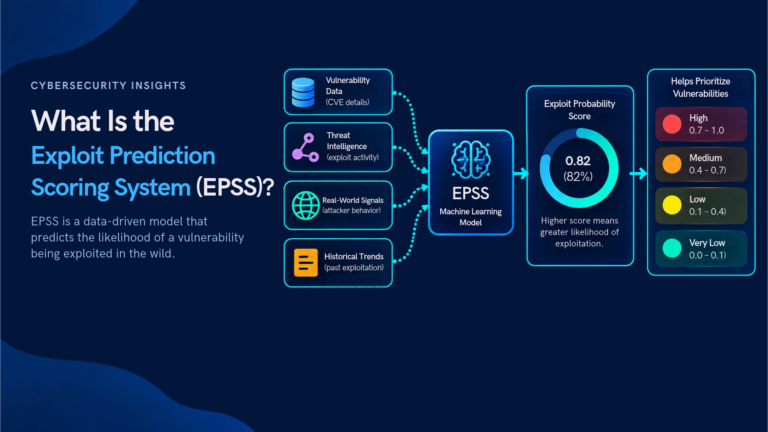
Exploit prediction with EPSS adds a probability dimension that CVSS alone does not provide. EPSS scores express the probability that a given CVE will be exploited in the wild within the next 30 days. A vulnerability with a Critical CVSS score and a low EPSS score represents theoretical high severity with low current exploitation activity. A Medium CVSS score with a high EPSS score may represent lower theoretical severity but active exploitation in the wild. Combining both signals produces a more accurate picture of which vulnerabilities require immediate action.
Business context adjusts the priority produced by scoring. A vulnerability on a system that processes payment card data or stores regulated personal information carries higher business risk than the same vulnerability on an isolated development server. Asset criticality, data classification, and regulatory context all adjust the remediation priority assigned to a technically identical finding.
What Are the Core Steps in a Vulnerability Remediation Process?
Vulnerability remediation is not a single action but a sequence of steps that move a finding from discovery to verified closure. Skipping steps in that sequence is how organizations end up with findings that are closed on paper but unresolved in practice.
Discovery produces the findings that enter the remediation process. Vulnerability scanners, vulnerability assessments, penetration tests, code reviews, and bug bounty reports all generate findings that require remediation. The quality and completeness of discovery determines what the remediation program is working against. A program with limited discovery coverage will remediate the vulnerabilities it can see while remaining exposed to those it cannot.
Assessment and classification convert a raw finding into a prioritized work item. The finding is verified to confirm it is a genuine vulnerability and not a false positive, scored using severity and exploitability metrics, classified by vulnerability type, and assigned to the team responsible for remediation. Classification by vulnerability type is important because findings of the same type often share a root cause and can be addressed together more efficiently than individually.
Prioritization applies the framework described above: severity, exploitability, asset criticality, and regulatory context combine to produce a remediation tier and target SLA for each finding. Prioritization decisions should be documented so that the rationale for any delayed remediation is traceable.
Remediation is the fix work itself: deploying patches, making configuration changes, correcting code, or implementing compensating controls. For code-level vulnerabilities, secure code review during the fix process confirms that the correction is complete and does not introduce new weaknesses. Bugstrix supports remediation guidance as part of engagement deliverables, providing development teams with specific fix recommendations rather than leaving remediation to interpretation.
Validation confirms that the fix was effective. A remediated vulnerability that has not been retested may have been incompletely addressed, incorrectly implemented, or bypassed through a different attack path. Validation by the team that identified the original finding, or by an independent security tester, is the only reliable confirmation that a vulnerability is closed.
Tracking and closure records the remediation action, validation result, and closure date. Closed findings should be tracked alongside open findings so that recurrence can be detected in subsequent assessments. A finding that reappears after closure indicates either that the fix was insufficient or that the root cause was not addressed.
How Does Root Cause Analysis Fit Into Vulnerability Remediation?
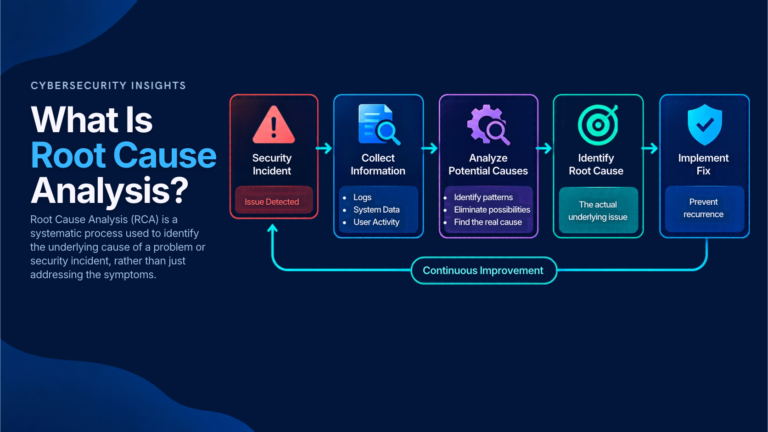
Remediation that addresses only the immediate finding is necessary but not sufficient. A SQL injection vulnerability patched in one endpoint will reappear in other endpoints if the underlying reason for its presence has not been resolved. Root cause analysis is the step that bridges the gap between closing a finding and preventing its recurrence.
RCA applied to vulnerability remediation asks why the vulnerability existed rather than just how to fix it. The answer reveals the systemic gap: a missing secure coding requirement, an absent code review step, a provisioning process that does not enforce security baselines, or an asset that was not covered by the patch management program. Addressing that gap changes the conditions that produced the vulnerability, reducing the probability that the same class of finding will appear in future assessments.
The practical integration of RCA into remediation is straightforward. For Critical and High severity findings, RCA is performed as part of the remediation process, not as an optional follow-up. The RCA outcome is documented alongside the technical fix, and the systemic gap identified by RCA generates a separate work item with its own owner and timeline. For Medium severity findings with recurrence across multiple systems, the recurrence pattern is treated as a trigger for RCA even if individual instances do not meet the threshold.
Organizations that integrate RCA into remediation consistently see declining finding volumes in successive assessments. Those that patch without investigating causes see consistent or increasing finding volumes as new code and new systems repeat the patterns that generated previous findings. Bugstrix engagement retests quantify this difference: clients with RCA-integrated remediation programs show measurably lower recurrence rates across assessment cycles.
How Is Vulnerability Remediation Validated?
Validation is the step that separates remediation that works from remediation that appears to work. The most common validation failure mode is closing a finding based on the developer confirming the fix was deployed, without an independent technical verification that the vulnerability is no longer exploitable.
Retest by the original tester is the most direct validation approach. The security tester who identified the vulnerability confirms that the specific exploit path they used during discovery no longer works, and that obvious bypass paths have also been addressed. Retest validation is included in most Bugstrix penetration testing engagements as a standard deliverable.
Penetration testing as a validation layer is appropriate for remediation programs that need broad coverage rather than targeted retest of specific findings. Understanding how penetration testing works clarifies why testing after remediation is structurally different from testing before: the tester is attempting to confirm that specific known weaknesses have been closed and that the remediation has not introduced new issues, rather than discovering weaknesses for the first time.
Continuous testing validates remediation at the cadence vulnerabilities are introduced rather than at a fixed assessment interval. Continuous penetration testing provides ongoing coverage that catches regressions, newly introduced vulnerabilities, and cases where a remediation was effective against the original finding but left an adjacent attack surface unaddressed. For organizations with active development pipelines, continuous testing ensures that the attack surface being validated matches the attack surface that is actually deployed.
Bugstrix continuous penetration testing engagements provide remediation validation as part of the ongoing testing cycle, giving development and security teams real-time confirmation of fix effectiveness rather than waiting for the next scheduled assessment. The result is a shorter window between vulnerability introduction and confirmed remediation, which directly reduces the organization’s exposure.
How Does Vulnerability Remediation Fit Into a Continuous Security Program?
Vulnerability remediation is most effective when it operates within a security program that continuously surfaces new findings rather than batch-discovering them at fixed intervals. A remediation program that only receives input from an annual penetration test is remediating against a snapshot of the attack surface that may be months out of date by the time fixes are deployed.
Attack surface management provides the continuous visibility that feeds a mature remediation program. Attack surface management continuously monitors the organization’s external exposure, surfacing newly added assets, newly exposed services, and newly emerged vulnerabilities as they appear rather than when the next scheduled scan runs. When attack surface findings are fed into the remediation process alongside assessment findings, the remediation program operates against a current view of the environment.
Continuous Threat Exposure Management (CTEM) is the programmatic framework that connects discovery, prioritization, and remediation into a cycle that operates continuously rather than periodically. CTEM scopes the assessment, identifies exposures, prioritizes them by actual risk, validates that prioritization through testing, and drives remediation. Each cycle’s output feeds the next cycle’s input, producing an iterative improvement process rather than a periodic compliance checkpoint. Vulnerability remediation is the operational heart of the CTEM cycle: without effective remediation, the discovery and prioritization work produces findings that accumulate rather than close.
SLA tracking and metrics make the remediation program accountable. Mean time to remediate by severity tier, remediation completion rate within SLA, recurrence rate by vulnerability class, and retest failure rate are the metrics that reveal whether the remediation program is functioning as designed or accumulating a growing backlog. Bugstrix security program reporting includes remediation metrics alongside finding data so that clients can track the effectiveness of their remediation processes over time, not just the findings being generated.
Get a quote for a vulnerability assessment or continuous penetration testing engagement
Frequently Asked Questions
What is the difference between vulnerability remediation and vulnerability management?
Vulnerability management is the broader program that governs how an organization discovers, tracks, prioritizes, and responds to vulnerabilities over time. It includes policies, processes, tooling, and governance. Vulnerability remediation is the specific operational activity within that program where a vulnerability is actually fixed. Remediation is a component of vulnerability management, not a synonym for it.
What happens when a vulnerability cannot be patched immediately?
When an immediate patch is not available or deployable, a compensating control is implemented to reduce exploitability while a permanent fix is developed. Common compensating controls include web application firewall rules, network segmentation, enhanced monitoring, and access restrictions that reduce the attack surface around the vulnerable component. Compensating controls should be documented as temporary measures with a defined timeline for replacement by a permanent fix.
How should organizations handle third-party and open-source vulnerabilities?
Third-party and open-source vulnerabilities require a software composition analysis process that tracks dependency versions across the codebase and flags newly disclosed CVEs in dependencies currently in use. Remediation typically involves updating the affected dependency to a patched version, which may require testing to confirm compatibility. Organizations that lack dependency tracking cannot reliably know which vulnerabilities in third-party components affect their environment.
What is the difference between remediation and mitigation?
Remediation eliminates a vulnerability by correcting its root cause: applying a patch, fixing the code, or changing the configuration that created the exposure. Mitigation reduces the risk a vulnerability presents without eliminating it: a firewall rule, network segmentation, or monitoring enhancement that makes exploitation harder or detection faster. Mitigation is appropriate as a short-term measure while remediation is developed, or for vulnerabilities that cannot be remediated due to technical or operational constraints.
How do you measure the effectiveness of a vulnerability remediation program?
Key metrics include mean time to remediate by severity tier, remediation completion rate within assigned SLA, retest failure rate (the percentage of findings retested and found not fully remediated), and recurrence rate (the percentage of vulnerability classes that reappear in subsequent assessments). A healthy remediation program shows declining recurrence rates and a mean time to remediate that meets or beats the target SLA for each severity tier.
How often should vulnerability remediation SLAs be reviewed?
SLAs should be reviewed at least annually and after any significant change in the organization’s risk profile: a new regulatory requirement, a major architecture change, a material change in attack surface size, or a security incident that reveals gaps in the current SLA structure. SLAs that were set based on historical capacity may no longer reflect actual risk if the organization’s exposure profile has changed.
A Remediation Program That Actually Reduces Risk
Vulnerability remediation is the point where security investment converts into security outcome. Assessments, tests, and scanners surface the findings. Remediation is where those findings become closed gaps rather than open risks.
The organizations that consistently improve their security posture over time share a common operational pattern: they prioritize findings accurately, fix them before SLAs expire, validate fixes independently, investigate root causes for recurring vulnerability classes, and measure their progress through metrics that reveal both what is being found and how effectively it is being closed.
Bugstrix works with organizations to build remediation programs that are operationally realistic and security-effective: finding classification that produces actionable priorities, remediation guidance that gives development teams what they need to fix the first time correctly, and validation testing that confirms the program is delivering the risk reduction it measures.
Contact us to build a vulnerability remediation program that produces measurable results