What Is Cloud Security Assessment and How Does It Work?

Written By
Sarwat Iftikhar

Moving infrastructure to the cloud does not automatically make it more secure. It changes the attack surface, shifts the security responsibility model, and introduces an entirely new category of misconfiguration risks that on-premises security programs were never designed to catch. Misconfigured cloud storage buckets, overly permissive IAM roles, publicly exposed management interfaces, and missing network controls in cloud-native environments represent some of the most consistently exploitable vulnerabilities in modern infrastructure, and most are invisible to the security tools organizations brought from their on-premises environment.
A cloud security assessment is a structured evaluation of an organization’s cloud infrastructure, configuration, and access controls against security best practices, compliance requirements, and realistic threat scenarios. It identifies what is exposed, what is misconfigured, and what an attacker could realistically accomplish within the cloud environment before they get the opportunity to find out themselves.
In 2026, with most enterprise workloads running in public cloud environments, a cloud security assessment is not an advanced security practice reserved for large organizations. It is a baseline requirement for any business that has moved critical data, applications, or infrastructure to the cloud and wants to understand whether that environment is actually secure.
Key Takeaways
- Cloud security assessments find misconfiguration-based vulnerabilities that traditional security tools and on-premises testing methodologies were not designed to detect.
- The shared responsibility model means your cloud provider secures the infrastructure. You are responsible for everything built on top of it, including IAM configuration, storage permissions, network controls, and application security.
- In Bugstrix cloud assessments, overly permissive IAM policies and publicly exposed storage buckets are the two most consistently present critical findings across AWS, Azure, and GCP environments.
- A cloud security assessment is not the same as a cloud penetration test. The two cover different ground and answer different questions. Most mature cloud security programs use both.
- Compliance frameworks including SOC 2, ISO 27001, PCI DSS, and HIPAA all expect cloud environments to be included in security testing scope, but most businesses underestimate how much of their cloud configuration falls within that obligation.
What Is a Cloud Security Assessment?
A cloud security assessment is a comprehensive evaluation of an organization’s cloud environment that identifies security misconfigurations, access control weaknesses, compliance gaps, and design vulnerabilities across cloud infrastructure, services, and integrations. It combines automated configuration scanning with manual expert review to produce a complete picture of the cloud environment’s security posture that neither approach can deliver alone.
The scope of a cloud security assessment typically covers identity and access management configuration, storage permissions and data exposure, network security controls and segmentation, logging and monitoring capabilities, encryption configuration, cloud service-specific security settings, and compliance posture against the relevant frameworks and benchmarks that apply to the organization.
Cloud security assessments are distinct from traditional infrastructure security testing in a specific way: the attack surface in a cloud environment is defined by configuration rather than by physical topology. In an on-premises environment, an exposed service is typically a software vulnerability or a misconfigured firewall rule. In a cloud environment, the most dangerous exposures are usually configuration decisions made during provisioning that were never reviewed, permissions granted for convenience that were never scoped down, and default settings from cloud providers that are not secure by default.
Understanding the foundational concepts behind cloud security is useful context before diving into what an assessment covers. Our post on what cloud security is explains the broader discipline, the shared responsibility model, and the specific risk landscape that cloud environments introduce.
Why Does an Organization Need a Cloud Security Assessment?
An organization needs a cloud security assessment because the shared responsibility model of cloud computing places the security of configuration, access controls, and data handling squarely on the customer, and because cloud misconfigurations are currently the leading cause of cloud-based data breaches. Understanding the boundary between what your cloud provider secures and what you must secure is the prerequisite for knowing where your real exposure lies.
The shared responsibility model varies by cloud service type. For infrastructure as a service, the provider secures the physical hardware, hypervisor, and network fabric. The customer is responsible for the operating system, network configuration, access controls, data protection, and everything else running on top of the provider’s infrastructure. For platform as a service, the responsibility boundary moves further toward the provider, but the customer retains responsibility for data, access management, and application configuration. For software as a service, the provider handles most security, but data governance and access management remain customer responsibilities.
Most cloud security incidents trace back to the customer’s side of that responsibility boundary. A storage bucket configured for public access because a developer needed to share a file quickly and never changed the permissions back. An IAM role with administrator-level permissions attached to a service that only needed read access to a specific resource. A cloud management console exposed to the internet without multi-factor authentication because the team assumed network segmentation they had not actually configured would protect it. These are not sophisticated attacks. They are misconfigurations that a cloud security assessment would identify, and that standard on-premises security testing would never examine.
What Does a Cloud Security Assessment Actually Cover?
A cloud security assessment covers seven core domains: identity and access management, data security and storage configuration, network security controls, logging and monitoring, encryption configuration, cloud service security settings, and compliance posture. Each domain addresses a distinct category of risk that the shared responsibility model places on the customer.
Identity and Access Management is the highest-priority domain in every cloud security assessment. IAM defines who and what can access every resource in the cloud environment, and misconfigured IAM is the starting point for the majority of cloud-related breaches. The assessment examines whether IAM roles follow least-privilege principles, whether service accounts have broader permissions than their function requires, whether administrator-level access is appropriately restricted and protected with multi-factor authentication, whether long-lived access keys exist for accounts that should use temporary credentials, and whether there are inactive accounts or roles that have accumulated permissions over time without ever being revoked.
Data and storage configuration examines whether cloud storage services, databases, and data pipelines are configured to prevent unintended public access and unauthorized internal access. Publicly accessible storage buckets remain one of the most commonly discovered critical findings in cloud security assessments, even in 2026, because they are frequently created for a specific purpose and then forgotten without permissions being reviewed afterward.
Network security controls evaluate VPC configuration, security group rules, network ACLs, and the effectiveness of network segmentation between environments. The cloud equivalent of a misconfigured firewall rule is a security group rule that allows inbound access from any IP address on sensitive ports, which appears in a significant proportion of cloud environments that have not been formally assessed.
Logging and monitoring examines whether audit logging is enabled across cloud services, whether logs are retained appropriately, whether alerts are configured for security-relevant events, and whether the logging configuration would actually detect the attack patterns most commonly used against cloud environments.
Encryption configuration evaluates whether data at rest and in transit is encrypted appropriately, whether encryption keys are managed through the cloud provider’s key management service or a customer-managed solution, and whether any data is stored or transmitted without encryption where encryption should be present.
How Does a Cloud Security Assessment Work?
A cloud security assessment works through four structured phases: scoping and access setup, automated configuration analysis, manual expert review of high-priority findings and complex configurations, and findings documentation with remediation guidance mapped to the specific cloud environment and technology stack being assessed.
Phase 1: Scoping and access setup. The assessment begins by defining which cloud accounts, regions, and services are in scope. Read-only access to the cloud environment is configured using the minimum permissions needed to conduct the assessment, typically through a dedicated assessment role or service account. The scope is mapped against the organization’s compliance obligations to ensure the assessment covers what relevant frameworks require.
Phase 2: Automated configuration analysis. Automated tools scan the cloud environment against security benchmarks and best practices, producing a broad initial set of findings across IAM, storage, networking, logging, and service-specific configuration. This phase covers the entire in-scope environment efficiently, identifying the misconfigurations and compliance gaps that pattern-based tools can reliably detect. At Bugstrix, this phase produces a preliminary findings set that guides where manual review effort is concentrated.
Phase 3: Manual expert review. Security engineers review the most significant findings from the automated phase, validate their exploitability in the specific environment context, and examine the complex configuration areas that automated tools assess poorly: IAM policy combinations that are individually acceptable but problematic in combination, data flow paths that expose sensitive information through a chain of services, and trust relationships between cloud accounts or federated identity providers that create unintended access pathways.
Phase 4: Findings documentation and remediation guidance. Every confirmed finding is documented with its location in the cloud environment, a clear description of the misconfiguration and its exploitability, a severity rating, the specific compliance framework control it violates where applicable, and remediation guidance written for the specific cloud provider and service involved. Generic guidance such as “restrict IAM permissions” is not useful to a team managing an AWS environment. Specific guidance referencing the IAM policy, the specific permission to remove, and the AWS documentation for the relevant service is.
Our security assessment services follow this four-phase process, with the manual review depth and compliance mapping tailored to the specific cloud environment and frameworks in scope for each engagement.
How Is a Cloud Security Assessment Different from Cloud Penetration Testing?
A cloud security assessment and cloud penetration testing address different questions about cloud security and cannot be substituted for each other. A cloud security assessment evaluates configuration and compliance, asking whether the cloud environment is built and configured correctly. Cloud penetration testing evaluates real-world exploitability, asking whether an attacker could actually exploit the identified weaknesses to achieve a meaningful outcome.
The distinction matters practically because the two approaches find different things. A cloud security assessment will identify a storage bucket with public read permissions. A cloud penetration test will confirm whether that bucket contains data an attacker could actually access, attempt to escalate from that initial access to other resources in the environment, and demonstrate what the end-to-end attack path from the publicly exposed storage to sensitive internal systems would look like.
Both have a role in a complete cloud security program. Configuration assessments run more frequently, providing ongoing visibility into the configuration posture of an environment that changes constantly as new services are deployed and existing services are modified. Penetration testing runs less frequently but produces the validated exploitation evidence that compliance frameworks, enterprise customers, and cyber insurers specifically look for.
Understanding where each approach fits in the broader landscape is worth reading about before deciding which one your program needs right now. Our post on vulnerability assessment vs penetration testing explains the structural differences, which apply equally to cloud-specific variants of both approaches.
Our cloud penetration testing services cover active exploitation and attack-path development that goes beyond configuration assessment, for organizations that need both layers of cloud security evidence.
Which Cloud Platforms Does a Cloud Security Assessment Cover?
A cloud security assessment covers AWS, Microsoft Azure, and Google Cloud Platform as the three dominant public cloud providers, with the specific assessment methodology adapted to each provider’s service architecture, IAM model, and native security tooling. Multi-cloud environments, where an organization runs workloads across more than one provider, require assessment of each platform separately rather than treating the multi-cloud environment as a single unified entity.
AWS assessments focus on IAM roles and policies, S3 bucket permissions, Security Group and Network ACL configurations, CloudTrail logging, KMS key management, EC2 instance metadata service configuration, and the security posture of widely used managed services such as RDS, Lambda, EKS, and API Gateway. AWS’s breadth of services means AWS assessments typically cover the widest range of service-specific configuration areas.
Azure assessments concentrate on Azure Active Directory configuration, role-based access control assignments, Azure Blob Storage permissions, Network Security Group rules, Azure Defender and Sentinel coverage, Key Vault access policies, and the security configuration of Azure-native services including Azure Kubernetes Service, Azure SQL, and Azure Functions.
GCP assessments examine IAM bindings and service account configurations, Cloud Storage bucket permissions, Firewall Rules and VPC Service Controls, Cloud Audit Logs configuration, Cloud KMS key management, and the security posture of GCP-native services including GKE, Cloud Run, BigQuery, and Cloud SQL.
Multi-cloud environments introduce additional assessment surface around identity federation, cross-cloud access paths, and whether security controls that work correctly in one cloud provider’s environment have equivalent coverage in another. For organizations running on AWS, Azure, or GCP, our deep-dive post on cloud penetration testing across AWS, Azure, and GCP covers the specific attack surface and testing approach for each platform.
What Are the Most Common Cloud Security Findings?
The most common cloud security findings are not exotic vulnerabilities in cloud provider software. They are well-understood misconfigurations that appear in a majority of cloud environments because cloud infrastructure is provisioned quickly under operational pressure and reviewed for security far less often than it should be.
The findings that appear most consistently in Bugstrix cloud assessments:
Overly permissive IAM roles and policies. IAM roles created with broad permissions because the narrower scope required more time to define, service accounts with administrator-level access attached to workloads that only needed a fraction of those permissions, and users with direct IAM permissions where role-based access through a properly scoped role would have been safer. IAM misconfiguration is the starting point for lateral movement in cloud environments in the same way that Active Directory misconfiguration is in on-premises environments.
Publicly accessible storage. S3 buckets, Azure Blob containers, and GCP Cloud Storage buckets configured for public access or with bucket policies that allow broader access than intended. These findings range from low-sensitivity public content that was intentionally public but undocumented, to highly sensitive data stores that were made public by misconfiguration and contain customer records, financial data, or internal credentials.
Missing or incomplete logging. CloudTrail disabled in specific regions, Azure Monitor gaps that leave administrative actions unlogged, GCP Audit Logs with admin activity logging disabled. Incomplete logging does not create a breach risk directly but means that when a breach occurs, the forensic evidence needed to understand what happened and what was accessed may not exist.
Unrestricted security group and firewall rules. Inbound rules allowing access from any IP address on management ports such as 22 (SSH) and 3389 (RDP). These rules are commonly created during development for convenience and persist into production because nobody reviewed them before the workload was promoted.
Unencrypted data at rest. Databases, storage services, and compute volumes running without encryption enabled. Cloud providers make encryption easy to enable, but it is not always the default setting, and it is frequently missed in environments that were provisioned without a formal security baseline.
Exposed instance metadata services. EC2 instances with the IMDSv1 endpoint accessible without token authentication, allowing server-side request forgery vulnerabilities in applications running on those instances to retrieve IAM credentials for the instance role.
Does a Cloud Security Assessment Satisfy Compliance Requirements?
A cloud security assessment contributes to compliance evidence for SOC 2, ISO 27001, PCI DSS, and HIPAA, but satisfies their requirements differently depending on the framework and what specific evidence each auditor expects. For most frameworks, an assessment provides configuration posture evidence that complements but does not replace the penetration testing evidence auditors expect separately.
For SOC 2, a cloud security assessment provides evidence of control evaluation under CC4.1, demonstrating that cloud security controls were assessed and misconfiguration issues were identified and addressed. Most SOC 2 auditors also expect an active penetration test in addition to the configuration assessment.
For PCI DSS, cloud infrastructure within the Cardholder Data Environment must be included in the annual penetration testing scope under Requirement 11.4. A configuration assessment contributes to the quarterly vulnerability scanning requirement under Requirement 11.3 but does not substitute for the annual penetration test.
For ISO 27001, a cloud security assessment satisfies Annex A.8.8 (Technical Vulnerability Management) requirements and contributes to the continuous improvement evidence the standard requires. Combined with periodic penetration testing, it provides strong technical security evidence for the ISMS.
For HIPAA, cloud environments handling PHI must be included in the risk analysis. A cloud security assessment identifies the configuration vulnerabilities that feed into that risk analysis and documents the misconfigurations that represent exploitable risks to PHI.
Our vulnerability assessment services complement cloud security assessments for organizations that need both layers of compliance evidence, and our penetration testing services cover the active exploitation layer that configuration assessments do not address.
How Much Does a Cloud Security Assessment Cost?
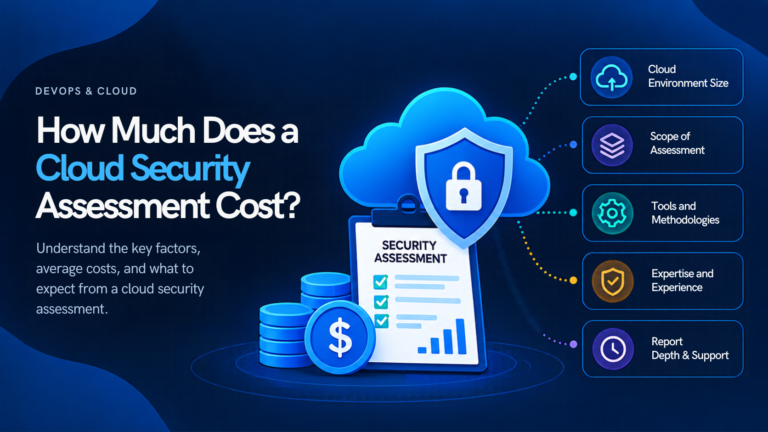
A cloud security assessment for a typical mid-market organization running a single cloud provider typically costs $8,000 to $25,000, driven primarily by the number of cloud accounts in scope, the number of regions and services being assessed, and whether compliance-specific reporting and framework mapping is required. Multi-cloud assessments covering two or three providers run proportionally higher.
The cost factors that move a cloud security assessment toward the higher end of the range: large numbers of cloud accounts requiring individual assessment, environments with complex IAM structures and multi-account architectures, compliance-specific evidence requirements that add report structure and documentation overhead, and multi-cloud deployments that require provider-specific expertise across platforms.
The cost factors that move toward the lower end: a single cloud account with a limited service footprint, a relatively recent cloud deployment where configuration has not had years to accumulate technical debt, and scope limited to specific high-risk services rather than the full environment.
For a detailed breakdown of cloud security testing costs, including the factors that drive pricing for different scope types and cloud configurations, our post on how much cloud penetration testing costs in 2026 covers the full pricing landscape.
How Do You Choose the Right Cloud Security Assessment Provider?
Choosing the right cloud security assessment provider requires confirming that the provider has genuine expertise in the specific cloud platforms being assessed, uses a methodology that combines automated tooling with manual expert review, and produces findings documented with remediation guidance specific to the cloud provider and service rather than generic advice.
Cloud security is a specialized discipline. A provider who does application security testing well may not have the specific knowledge of AWS IAM policy evaluation logic, Azure RBAC inheritance behavior, or GCP service account impersonation pathways needed to identify the subtler misconfiguration findings that matter most. Platform-specific expertise is what separates a cloud security assessment that finds the important issues from one that produces a generic configuration report.
The questions that distinguish genuine cloud security expertise from generalist security providers offering cloud assessments:
Does their methodology cover IAM policy analysis at the resource-specific level? IAM misconfigurations are often not visible at the policy level in isolation. They require understanding how multiple policies combine, how resource-based policies interact with identity-based policies, and how service-specific IAM behaviors affect the effective permissions of a given principal. A provider who cannot describe this analysis in detail is not conducting the IAM review that cloud environments require.
Does their remediation guidance reference the specific cloud provider’s tools and documentation? Generic security remediation advice is not actionable in a cloud environment. Guidance that says “restrict permissions” is far less useful than guidance that specifies the exact IAM policy element to remove or modify, the specific AWS CLI or Terraform syntax for the fix, and the provider documentation that explains the correct configuration.
Have they assessed environments on your specific cloud provider? AWS, Azure, and GCP have meaningfully different security models, service architectures, and assessment methodologies. Experience on one provider does not automatically transfer to another. Ask specifically about the provider’s experience on the platforms your organization uses.
Frequently Asked Questions
What is the difference between a cloud security assessment and a cloud penetration test?
A cloud security assessment evaluates configuration, access controls, and compliance posture, identifying misconfigurations and control gaps. A cloud penetration test actively attempts to exploit identified weaknesses to demonstrate real-world attack paths and impact. Both address cloud security but answer different questions. Most organizations using cloud infrastructure for critical workloads need both, with assessments running more frequently and penetration testing providing the exploitation validation auditors and enterprise buyers specifically require.
How long does a cloud security assessment take?
A cloud security assessment for a single cloud provider with a typical mid-market environment takes one to two weeks for the assessment itself, plus additional time for findings documentation and remediation guidance. Multi-cloud assessments covering multiple providers or large multi-account environments take two to four weeks. The timeline depends primarily on the number of accounts and services in scope, not the size of the individual resources being assessed.
Does a cloud security assessment require read access to my cloud environment?
Yes. A cloud security assessment requires read-only access to the cloud environment to examine IAM configurations, service settings, network controls, and logging configuration. This is typically configured through a dedicated assessment role with the minimum permissions needed to conduct the review, which can be scoped precisely using the cloud provider’s IAM system. No write access is required, and changes to the environment are never made during an assessment engagement.
How often should a cloud security assessment be conducted?
At minimum, annually, and after any significant cloud infrastructure change: a major new service deployment, an account reorganization, a significant IAM restructuring, or a cloud migration. Cloud environments change constantly as services are added, modified, and retired, and a point-in-time assessment becomes stale faster than assessments of more static environments. Many organizations run quarterly configuration assessments of their highest-risk cloud accounts alongside an annual comprehensive engagement.
Can a cloud security assessment be conducted on a multi-cloud environment?
Yes, but each cloud provider’s environment needs to be assessed using that provider’s specific methodology and tooling. A multi-cloud assessment is typically structured as separate assessment tracks for each provider that run in parallel and produce a consolidated findings report mapping issues across the full environment. The multi-cloud structure also introduces additional assessment areas around cross-cloud identity federation and access pathways that do not exist in single-provider environments.
The Cloud Environment You Think Is Secure May Not Be
The consistent finding across cloud security assessments is not that organizations have ignored security. It is that cloud environments accumulate configuration debt at a pace that manual oversight cannot track, and the misconfigurations that result are genuinely difficult to spot without a structured assessment methodology designed for the specific cloud provider.
A developer adds a temporary security group rule to debug a production issue and forgets to remove it. An IAM role gets administrator permissions because a narrower scope was too time-consuming to define under deadline pressure. A new cloud account gets provisioned without CloudTrail enabled because the default was not checked during setup. None of these feel like significant security failures at the time. They accumulate into a cloud environment with meaningful exposure that nobody realized was there until a structured assessment finds it.
The goal of a cloud security assessment is not to find catastrophic architectural failures. It is to surface the realistic, practical exposure that exists in every cloud environment that has not been formally reviewed, and to produce the specific remediation guidance that closes those gaps before an attacker finds them instead.
Contact us to discuss a cloud security assessment for your environment.