What Is Attack Surface Management and Why Does Your Business Need It?

Written By
Sarwat Iftikhar
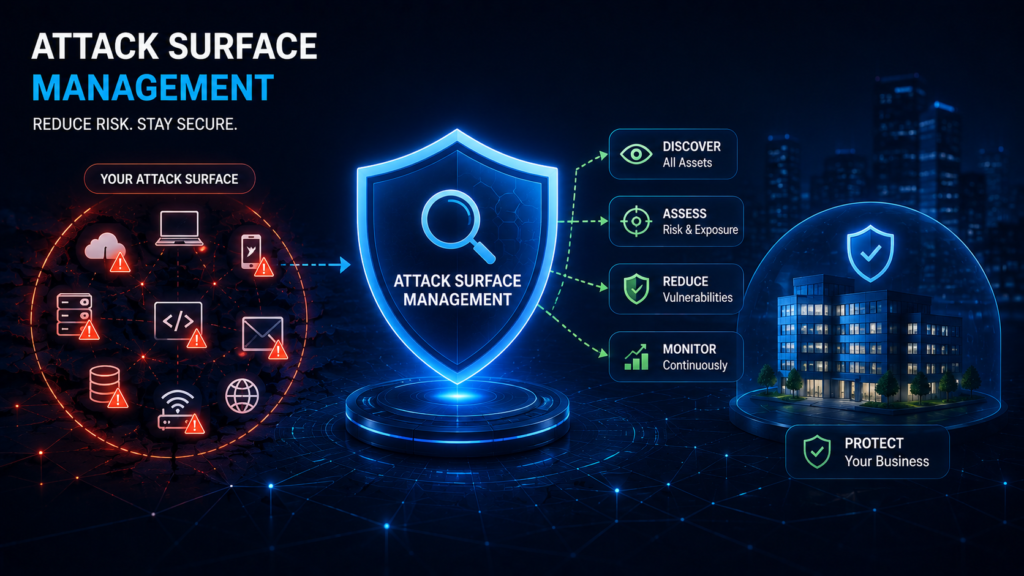
Attack Surface Management is the continuous process of discovering, monitoring, and analyzing every internet-facing asset your business owns, so exposures and misconfigurations get flagged before an attacker finds them first. Every domain, subdomain, IP address, API, cloud service, and third-party integration your business uses is part of that surface, whether your team is tracking it or not.
Most businesses do not have a visibility problem because they are careless. They have one because their environment changes faster than any manual inventory can keep up with. A developer spins up a staging environment and forgets to take it down. A marketing team connects a new SaaS tool without looping in IT. A contractor gets temporary access that never gets revoked. None of this is negligence in the traditional sense, but it is exactly how attack surfaces quietly expand past what any security team believes they are responsible for.
This is also why Attack Surface Management has become a starting point rather than an add-on for businesses building out a security program. You cannot properly scope a penetration test, prioritize a vulnerability assessment, or defend a compliance audit if you do not have an accurate picture of what you actually have exposed to the internet.
Key Takeaways
- Attack Surface Management continuously discovers, monitors, and analyzes internet-facing assets to identify exposures before attackers do.
- It covers known assets as well as unknown ones, including shadow IT, forgotten subdomains, and unmanaged third-party integrations.
- Small businesses often have more exposed assets than they realize, since fast-moving teams outpace manual asset tracking.
- Attack Surface Management is different from penetration testing: it gives visibility, while a pentest gives verified proof of exploitability.
- Most businesses benefit from starting with Attack Surface Management to build an accurate picture before scoping a penetration test.
What Is Attack Surface Management?
Attack Surface Management continuously discovers, inventories, monitors, and analyzes internet-facing assets to identify exposures, misconfigurations, and vulnerabilities for prioritized remediation. Unlike a one-time asset inventory, it is designed to run on an ongoing basis, since your attack surface changes every time a developer deploys new code, a new cloud service gets spun up, or a contractor is granted access.
The goal is not simply to produce a list of assets. It is to understand which of those assets are actually visible to an attacker, which ones carry real risk, and which need to be addressed before they become an entry point into your environment. Bugstrix’s attack surface management service approaches this from an attacker’s perspective, mapping your external exposure the way a threat actor would before deciding where to strike.
How Does Attack Surface Management Work?
Attack Surface Management works through four continuous stages: asset discovery, exposure analysis, ongoing monitoring, and remediation support. Each stage feeds into the next, and because the process never stops, new assets and changes get caught as they appear rather than months later during the next scheduled review.
| Stage | What Happens |
| Asset discovery | Continuous discovery of internet-facing assets, including domains, subdomains, IPs, APIs, cloud services, and third-party exposures |
| Exposure analysis | Security experts analyze discovered assets for vulnerabilities and misconfigurations, prioritizing by exploitability and business impact |
| Continuous monitoring | The attack surface is monitored on an ongoing basis to catch new assets, configuration changes, and emerging exposures |
| Remediation support | Prioritized fix guidance and re-testing to confirm that identified exposures have actually been resolved |
Source: Bugstrix Attack Surface Management approach, 2026
Asset discovery is where the process starts, and it is also where most businesses are surprised by what turns up. Forgotten subdomains, staging environments never taken offline, and shadow IT tools connected without security review routinely surface during this phase.
Exposure analysis takes that raw asset list and applies real judgment to it. Not every discovered asset carries the same risk, so this stage prioritizes findings by how exploitable they are and what the actual business impact would be if they were.
Continuous monitoring is what separates Attack Surface Management from a one-time audit. Your environment does not stay still, so the monitoring does not either. New assets, expired certificates, and configuration drift all get flagged as they happen.
Remediation support closes the loop with practical guidance your team can act on, along with re-testing to verify that a fix actually holds.
What Does Attack Surface Management Actually Cover?
Attack Surface Management covers every internet-facing asset a business owns, whether that asset is formally tracked by IT or not. In practice, that scope breaks down into a handful of categories that consistently produce the highest-risk findings.
| Asset Category | Examples |
| Web-facing infrastructure | Domains, subdomains, IP addresses, exposed admin panels |
| APIs | Authenticated and unauthenticated endpoints, forgotten legacy routes |
| Cloud services | AWS, Azure, and GCP resources, storage buckets, serverless functions |
| Third-party integrations | Vendor tools, SaaS connections, contractor access |
| Shadow IT | Unsanctioned tools and services deployed outside IT’s visibility |
Source: Bugstrix Attack Surface Management scope, 2026
Attackers do not care whether an asset was intentionally deployed or forgotten about. A misconfigured storage bucket carries the same risk whether your security team knew it existed or not. This is precisely why Attack Surface Management is built to surface the unknown alongside the known, rather than simply re-checking assets you already had on a list.
Why Does Your Business Need Attack Surface Management?
Your business needs Attack Surface Management because your digital environment is very likely larger and more exposed than your internal team assumes, and the gap between what security teams think exists and what an attacker can actually find is where the most damaging breaches originate.
This is not unique to large enterprises. Small and mid-sized businesses often carry more exposed assets than they realize precisely because they move quickly and lack a dedicated security team to track every tool, integration, and service in active use. A few reasons this matters in practice:
- Fast-moving teams outpace manual tracking. Every new feature, environment, or SaaS connection adds to your attack surface, and spreadsheets do not scale with that pace of change.
- Attackers look for what you forgot about. Forgotten subdomains, exposed admin panels, and misconfigured cloud storage are exactly the assets that show up first in reconnaissance.
- Compliance increasingly expects it. SOC 2, PCI DSS, and similar frameworks are placing growing weight on demonstrable, continuous visibility into your environment, not a one-time snapshot.
- It makes every other security investment more effective. A penetration test scoped against an incomplete asset list misses exactly the things an attacker would find first.
How Is Attack Surface Management Different From Penetration Testing?
Attack Surface Management is continuous and broad, covering your entire environment on an ongoing basis. At the same time, penetration testing is time-boxed and deep, targeting a defined scope at a specific point in time. Attack Surface Management tells you what is exposed. Penetration testing tells you what is actually exploitable and how far an attacker could take it.
Neither replaces the other, and running one without the other leaves a real gap. A penetration test scoped against an incomplete picture of your environment will miss the forgotten subdomains and shadow IT assets that attackers find first. Attack Surface Management, on its own, surfaces potential exposures without verified proof of what an attacker could actually do with them. Bugstrix’s full breakdown of Attack Surface Management vs Penetration Testing covers how the two work together and which one most businesses should start with.
For most businesses building a security program from the ground up, Attack Surface Management comes first, since it builds the accurate inventory that makes a penetration test worth scoping properly in the first place.
What Role Do APIs Play in Your Attack Surface?
APIs are consistently one of the highest-risk asset categories in Attack Surface Management, since they are often deployed quickly, rarely documented completely, and frequently left with authorization logic that was never tested under adversarial conditions. A single forgotten or undocumented API endpoint can expose the same data a full application does, without ever showing up in a standard asset inventory.
This matters because API discovery is a core part of what Attack Surface Management is built to catch. Legacy routes, debug endpoints, and internal-only APIs that were never meant to stay reachable from the internet are exactly the kind of asset that a continuous discovery process surfaces and a one-time review misses. Bugstrix’s breakdown of why API security testing is the part most teams skip goes deeper into the authorization gaps and data exposure issues that show up once those endpoints are actually tested.
How Does Attack Surface Management Work With Web Application Security?
Web applications remain one of the largest and most consistently attacked categories within any business’s attack surface, which is why ongoing discovery and monitoring of web-facing assets has to work alongside dedicated application testing rather than instead of it. Attack Surface Management identifies which web applications, staging environments, and subdomains exist and are exposed. It does not replace the deeper, manual testing needed to find business logic flaws and chained vulnerabilities within those applications.
Bugstrix’s guide on web application penetration testing covers what that deeper layer of testing actually involves, and why the two disciplines are most effective when run together: continuous visibility from Attack Surface Management, paired with verified, hands-on testing of the applications it surfaces.
Is Attack Surface Management Worth It for Your Business?
Attack Surface Management is worth the investment for any business with a digital presence that changes regularly, which in 2026 describes nearly every company with a website, a cloud environment, or a handful of SaaS integrations. The return is straightforward: catching a misconfigured storage bucket or forgotten subdomain through continuous monitoring costs a fraction of what recovering from a breach through that same exposure would cost.
Businesses that skip Attack Surface Management typically discover their real exposure the hard way, either through a breach or through a penetration test that surfaces assets nobody remembered were live. A managed program run by a provider with direct experience avoids that outcome by design. Bugstrix’s Attack Surface Management services combine automated discovery with expert analysis to continuously monitor your environment, prioritize real risk, and hand your team practical remediation guidance rather than a raw list of alerts. For businesses that also want a broader evaluation of controls and gaps across their environment, Bugstrix’s security assessment services complement ASM with a structured review of systems, applications, and cloud configurations.
Frequently Asked Questions
What is Attack Surface Management in simple terms?
Attack Surface Management is the ongoing process of finding and monitoring every internet-facing asset a business has, including the ones nobody remembered existed, so exposures get caught and fixed before an attacker finds them.
Is Attack Surface Management the same as a vulnerability scan?
No. A vulnerability scan checks a known list of assets for known weaknesses at a point in time. Attack Surface Management continuously discovers assets you may not know exist and monitors your environment on an ongoing basis, not just the assets already on your list.
Can a small business benefit from Attack Surface Management?
Yes. Small businesses often carry more exposed assets than they realize because they move quickly without a dedicated security team tracking every tool and integration in use. Attack Surface Management gives smaller teams that visibility without requiring a large internal security function to maintain it manually.
Does Attack Surface Management replace penetration testing?
No. Attack Surface Management provides continuous visibility into what is exposed. Penetration testing verifies what is actually exploitable within a defined scope. Most businesses get the most value from running both, with Attack Surface Management typically informing the scope of the penetration test.
How often will I see new findings from Attack Surface Management?
That depends on how frequently your environment changes, but a managed program should generate alerts for critical exposures as they are discovered, along with regular reports summarizing new assets, risk status, and remediation progress over time.
Visibility Comes Before Verification
Attack Surface Management exists because most businesses have a larger, faster-changing digital footprint than their internal teams can track manually, and attackers only need to find the one exposed asset nobody remembered. Continuous discovery, honest exposure analysis, and ongoing monitoring turn that blind spot into something your team can actually manage.
Getting this right is what makes every other security investment more effective. A penetration test scoped against a complete, current asset inventory finds what actually matters. One scoped against guesswork misses exactly what an attacker would find first.