What Is a Bug Bounty Program?

Written By
Sarwat Iftikhar
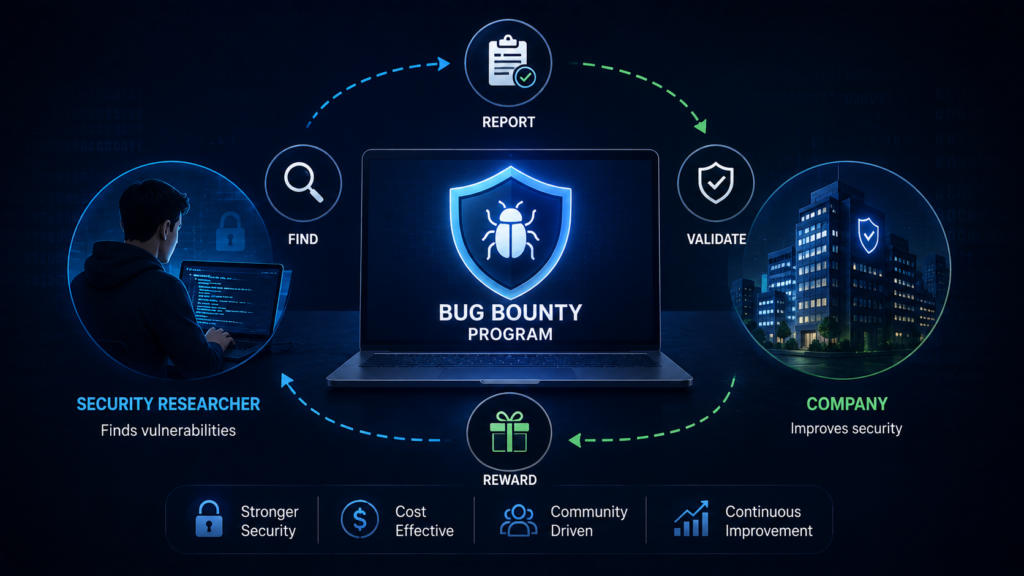
A bug bounty program is a structured arrangement where a company invites independent security researchers to find and responsibly report vulnerabilities in its systems, paying a reward for every valid finding. Instead of relying on a single scheduled test, the business gets ongoing scrutiny from a global pool of researchers who are only paid when they find something real.
For a business owner weighing where this fits in a security strategy, the appeal is straightforward: you pay for results, not hours. A conventional security engagement bills for time and expertise regardless of outcome. A bug bounty program bills for outcomes directly, which is why it has become a standard layer in security programs across fintech, SaaS, and e-commerce rather than a niche practice reserved for large tech companies.
Running one well takes more than posting a reward table and waiting, though. Scope, triage, and researcher quality decide whether a program becomes a genuine security asset or an operational headache. Programs that skip those foundations tend to underperform regardless of how competitive the rewards are. In contrast, well-structured programs, even modestly funded ones, consistently surface findings a scheduled assessment alone would miss.
Key Takeaways
- A bug bounty program rewards researchers only for valid, in-scope vulnerabilities, making it a pay-per-result security model.
- Programs can be public (open to any researcher) or private (invite-only, vetted researchers), each suited to different risk tolerances.
- A managed bug bounty program typically costs between $30,000 and $500,000 or more per year once platform fees, triage, and payouts are combined.
- Bug bounty programs work best alongside penetration testing and vulnerability management, not as a replacement for either.
- Program design and triage quality matter more than reward pool size when it comes to catching real vulnerabilities.
What Is a Bug Bounty Program and How Is It Different From a Vulnerability Disclosure Program?
A bug bounty program invites independent security researchers to responsibly identify and report valid vulnerabilities within an agreed scope, in exchange for a financial reward tied to severity. The company defines what systems are in scope, what testing methods are allowed, and how much a finding is worth. Researchers only get paid for accepted, reproducible reports.
This is easy to confuse with a vulnerability disclosure program (VDP), which follows the same responsible reporting structure but offers recognition instead of payment. A VDP gives researchers a legitimate channel to report issues without a financial commitment from the company. A bug bounty program adds a reward table to actively incentivize researcher time and attention, which typically produces higher engagement and more thorough testing than a disclosure channel alone.
The scope document is what separates a productive program from a chaotic one. It should specify which domains, applications, or environments are testable, which vulnerability classes are in scope, what evidence a report needs to include, and what testing techniques are off-limits. Bugstrix builds this scope definition into every bug bounty program management engagement before a single researcher is onboarded.
How Does a Bug Bounty Program Work?
A bug bounty program works in four stages: program design, researcher access, submission and triage, and reward payout. Each stage has to function correctly for the program to produce useful results instead of noise.
| Stage | What Happens |
| Program design | Scope, reward tiers, disclosure rules, and eligibility criteria are defined before launch |
| Researcher access | Public programs open to any registered researcher; private programs restrict access to a vetted pool |
| Submission and triage | Reports are validated for reproducibility, checked for duplicates, and assigned a severity rating |
| Reward payout | Accepted, validated findings are paid according to the program’s severity-based reward table |
Source: Bugstrix bug bounty program management framework, 2026
Program design comes first. This is where scope, reward tiers, disclosure rules, and eligibility criteria get defined. A program that skips this step, or writes vague rules, tends to attract vague, low-value submissions.
Researcher access follows, and this is where public and private programs diverge. Public programs open submissions to any registered researcher on a platform. Private programs restrict access to a vetted group invited based on reputation and technical fit.
Submission and triage are the operational core. Researchers submit reports through a portal or platform, and a triage team validates reproducibility, checks for duplicates, and assigns a severity rating before anything reaches the engineering team. Without dedicated triage capacity, this stage becomes a bottleneck fast, especially with the volume of automated and AI-assisted submissions programs receive in 2026.
Reward payout closes the loop. Accepted, validated findings are paid according to the program’s severity-based reward table, and the researcher is notified once remediation is confirmed.
What Are the Different Types of Bug Bounty Programs?
The two main types of bug bounty programs are public and private, and the right choice depends on your security maturity, asset sensitivity, and triage capacity.
| Program Type | Best For | Tradeoff |
| Private | First-time programs, sensitive assets | Smaller researcher pool, lower submission volume, higher signal |
| Public | Mature security operations, broad attack surfaces | Wider coverage, but far higher submission volume to triage |
| Vulnerability disclosure (VDP) | Organizations not ready to fund payouts | No financial reward, so weaker incentive for deep researcher effort |
Source: Bugstrix program design observations across client engagements, 2026
A private program limits participation to a vetted, invite-only pool of researchers, trading some coverage breadth for higher-quality reports and lower noise. Most companies starting a bug bounty program for the first time are better served by this model. It gives your team time to build out triage processes and reward workflows without being immediately buried in submissions of mixed quality.
A public program is open to any researcher on the platform, which means broader coverage but a much higher volume of submissions to filter. Companies with mature security operations and higher risk tolerance sometimes graduate to public programs once their processes can absorb the volume.
What Are the Benefits of Running a Bug Bounty Program?
The core benefit of a bug bounty program is continuous, real-world testing from a diverse pool of researchers, catching vulnerabilities that a scheduled assessment might miss between testing cycles. Attackers do not wait for your annual pentest, and neither do the researchers in a well-run program.
A few benefits stand out for business owners evaluating the model:
- Continuous coverage. Your attack surface changes every time you ship code. A bug bounty program keeps eyes on it between formal assessments rather than leaving gaps.
- Pay for results. Rewards go out for validated, in-scope findings, not billable hours, which makes the cost model directly tied to value delivered.
- Access to diverse expertise. A global researcher network brings varied technical backgrounds and attack techniques that a single testing team cannot fully replicate.
- Signal to customers and partners. A visible, well-managed program demonstrates a proactive security posture, which matters increasingly for SaaS and fintech buyers doing vendor due diligence.
None of these benefits materialize without disciplined scope management and triage, which is why most companies without a dedicated security team choose a managed program over running one in-house. Scope also matters more than most companies expect. APIs are consistently one of the largest sources of valid findings in a bug bounty program, since authorization gaps and data exposure issues are exactly what a scanner misses and a motivated researcher finds first. If your program scope includes APIs, it is worth understanding why API security testing is the part most teams skip before writing your scope document.
How Much Does a Bug Bounty Program Cost?
A managed bug bounty program typically costs between $30,000 and $500,000 or more per year once platform fees, triage services, and researcher payouts are combined. The wide range reflects real differences in scope size, program type, and the maturity of the triage function behind it.
Smaller, private programs with a narrow scope and modest reward tiers sit at the lower end. Public programs covering large attack surfaces, with competitive rewards designed to attract top-tier researchers, push costs toward the higher end. A full breakdown of what drives these numbers, including platform fees, triage staffing, and payout benchmarks by severity, is covered in Bugstrix’s guide on how much a managed bug bounty program costs.
Budgeting for a program means accounting for more than the reward pool. Triage capacity, whether in-house or outsourced, is often the line item companies underestimate, and it is usually the one that determines whether a program actually works.
How Is a Bug Bounty Program Different From Penetration Testing?
A penetration test is a time-boxed, scoped assessment conducted over a defined window, while a bug bounty program provides ongoing testing with no fixed end date. A pentest gives you a snapshot of your security posture at a specific point in time, backed by a structured report and remediation guidance. A bug bounty program gives you continuous coverage that catches issues introduced after that snapshot was taken.
Neither replaces the other. A bug bounty program without a baseline assessment lacks the context to properly evaluate what a finding actually means for your risk profile. A pentest conducted once a year, on its own, goes stale the moment new code ships.
Bugstrix pairs penetration testing services with managed bug bounty coverage for exactly this reason. The pentest establishes a verified baseline. The bug bounty program keeps that baseline current as your product evolves. Businesses that want coverage between formal testing cycles without the operational overhead of a full bug bounty program often start with continuous penetration testing instead, which follows deployment cadence rather than open researcher submissions.
How Is AI Changing Bug Bounty Programs in 2026?
AI is reshaping bug bounty programs on both sides of the table, helping researchers find real vulnerabilities faster while also flooding programs with low-quality, AI-generated submissions. Companies running programs in 2026 are dealing with a genuinely different landscape than they were even two years ago.
On the positive side, AI is accelerating legitimate research. Skilled researchers use it to automate recon, analyze large codebases, and map attack surfaces faster, freeing up time for the judgment-driven work that finds business logic flaws and chained vulnerabilities. On the negative side, the same tools have made it trivial to generate reports at scale, and programs without dedicated triage capacity are drowning in noise as a result.
New vulnerability classes have emerged alongside this shift, including prompt injection, model extraction, and agentic AI abuse, all of which are now recognized categories with real payouts attached. Bugstrix covers this evolving landscape in depth in its analysis of how AI is changing bug bounty programs, including what scope updates companies should make to stay ahead of it.
Is a Bug Bounty Program Worth It for Your Business?
A bug bounty program is worth the investment when you have a defined external attack surface, enough internal capacity to review and act on incoming findings, and the expectation that ongoing researcher coverage will surface issues a point-in-time assessment would miss. For businesses that meet those conditions, the return is straightforward: paying a researcher a few thousand dollars for a critical finding costs a fraction of what remediating that same issue after exploitation would cost.
Programs that do not deliver strong returns tend to share the same gaps: scope too vague to attract useful submissions, reward tiers too low to hold serious researcher attention, and no dedicated triage capacity to keep pace with what comes in. A managed program run by a provider with direct experience avoids these failure modes by design. Bugstrix’s bug bounty program management service handles scope design, researcher recruitment, triage, and reward coordination end to end, so your team only sees validated, actionable findings.
Frequently Asked Questions
What is a bug bounty program in simple terms?
A bug bounty program is a system where a company pays independent researchers to find and report security vulnerabilities. Payment only happens when a researcher finds something real and in scope, making it a results-based approach to ongoing security testing.
Is a bug bounty program worth it for a small business?
It can be, provided the business has a scope narrow enough to manage and a triage process in place. A private, well-scoped program is usually more practical for a small business than an open public program, since it limits submission volume while still delivering continuous coverage.
How long does it take to set up a bug bounty program?
Program design, scope definition, and researcher onboarding typically take two to four weeks for a private program. Public programs with broader scope and more complex reward structures can take longer to prepare properly before launch.
Do researchers get paid if they don’t find anything?
No. Bug bounty programs are pay-per-result by design. Researchers are only compensated for valid, reproducible findings that fall within the agreed scope, which is what makes the cost model different from a traditional time-based security engagement.
Can a bug bounty program replace penetration testing?
No. A bug bounty program provides ongoing, researcher-driven coverage, while a penetration test delivers a structured, time-boxed assessment with a clear report and remediation plan. Businesses get the most value from running both together rather than choosing one over the other.
Program Design Matters More Than Reward Pool Size
A bug bounty program gives businesses continuous, results-based security testing from a global pool of researchers, but only when the scope, triage, and reward structure behind it are built correctly. Companies that treat program design as an afterthought end up buried in noise. Companies that invest in scope clarity and dedicated triage turn their program into a genuine security asset.
Getting those structural decisions right at launch, specifically scope definition, reward calibration, researcher pool selection, and triage planning, determines whether a bug bounty program becomes an efficient part of your security stack or an expensive line item that underdelivers.