Black Box vs. White Box vs. Gray Box Penetration Testing: Key Differences

Written By
Sarwat Iftikhar
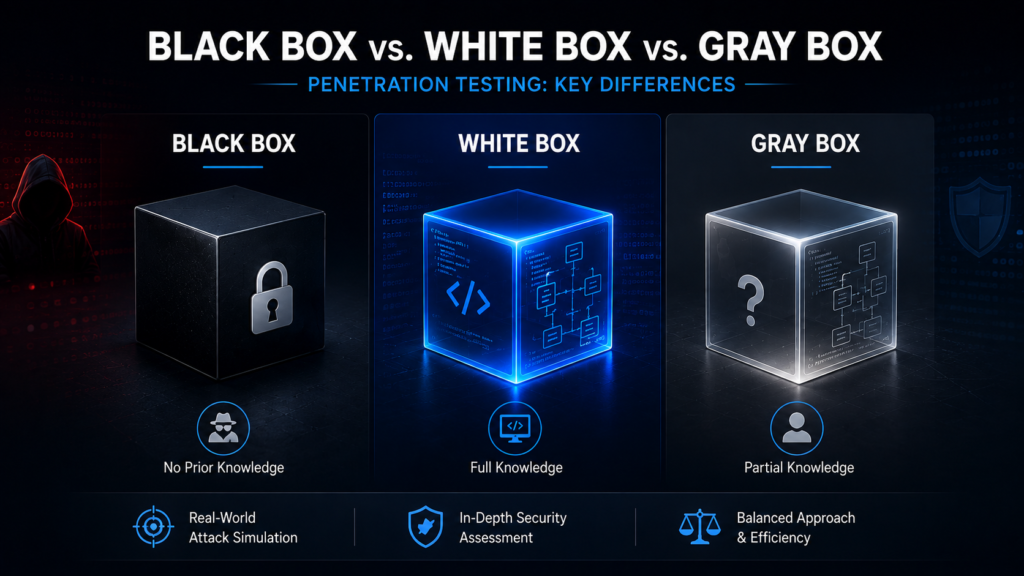
The difference between black box, white box, and gray box penetration testing comes down to one variable: how much information the tester receives before the engagement starts. Black box gives the tester nothing. White box gives the tester everything, including source code. Gray box gives the tester a defined slice, typically credentials and some context. That single variable, not access level or how deep the tester goes, is what separates the three models.
This difference determines which attack paths get tested, how much of the engagement is spent on discovery versus exploitation, what vulnerability categories can realistically be found, and what the results ultimately tell you about your security posture. Most buyers pick a model without weighing these tradeoffs, either defaulting to black box because it sounds most realistic or accepting gray box because it is the provider’s default.
Organizations that perform regular penetration testing reduce their breach impact by 38% compared to those relying solely on automated tools. Still, that reduction only shows up when the testing model actually matches the environment and threat scenario being tested.
Key Takeaways
- The core difference between the three models is prior knowledge, not access level: black box (none), gray box (partial), white box (full, including source code).
- Gray box skips blind discovery, so more of the engagement time goes toward exploitation and finding depth. This makes it the most commonly chosen model for enterprise environments in 2026.
- White box is the only model that can surface code-level vulnerabilities, insecure logic, and architectural weaknesses invisible from the outside.
- Black box is the most realistic simulation of an external attacker but risks shallow coverage if the perimeter is not breached during the engagement window.
- Compliance frameworks including PCI DSS, SOC 2, ISO 27001, and DORA do not name a specific box color but require both internal and external perspectives, which in practice means combining models.
What Is the Core Difference Between Black Box, White Box, and Gray Box?
The core difference is the amount of prior knowledge the tester is given, not the access level once testing begins. A black box tester and a gray box tester can end up with identical access to a system mid-engagement; the difference is that the gray box tester already knew how to get there. That knowledge gap is what determines whether testing time is spent discovering the environment or actually testing it.
A common misconception is that black box is inherently more rigorous because it is more realistic. Realism is one dimension of value. Finding the highest-impact vulnerabilities is another, and the two do not always align. An engagement that spends most of its time on discovery may never reach the authorization failures and business logic flaws that cause real breaches.
Here is the full comparison across the factors that matter most when choosing a model:
| Factor | Black Box | Gray Box | White Box |
| Prior Knowledge | None | Partial (credentials, context) | Full (source, architecture) |
| Perspective Simulated | External attacker | Authenticated user / insider | Developer / privileged insider |
| Time to Findings | Slower (discovery phase) | Faster (skips discovery) | Longest (full code review) |
| Coverage Depth | External surface only | Authenticated + external | Full stack including code |
| Relative Cost | Lowest to moderate | Moderate | Highest |
| Can Find Code-Level Bugs? | No | No | Yes |
| Best For | External realism, red team simulations, perimeter assessments | Web apps, APIs, compliance testing, most enterprise use cases | Source code review, pre-launch assessment, SDLC integration |
Source: Bugstrix engagement data + industry penetration testing methodology frameworks, 2026
The three models are not ranked by quality. They serve different purposes, and choosing based on what sounds most rigorous rather than what matches the testing objective is the most common selection mistake.
Black Box vs. Gray Box: What Actually Changes When You Add Credentials?
The difference between black box and gray box is entirely about the starting point, not the skill applied during testing. Black box starts the tester at zero, requiring reconnaissance and mapping before any real testing begins. Gray box hands the tester credentials and context up front, so that discovery time is eliminated and replaced with exploitation time.
What black box keeps that gray box loses: realism of the external attacker perspective. A black box engagement tells you what a genuine outsider with no inside knowledge could find and exploit in the engagement window. If the tester never breaches the perimeter, everything behind it remains unvalidated, regardless of how long the engagement runs.
What gray box gains that black box cannot reach: authenticated-layer coverage. With credentials in hand from the start, a gray box tester can immediately test privilege escalation, whether other users’ data is accessible, whether the permission model holds, and whether API endpoints enforce authorization independently of the UI. A black box tester may spend a meaningful portion of the engagement just reaching the point where those tests become possible.
For most web application and API environments, this is why gray box produces more findings per tester day. The highest-impact bug classes for these environments, authorization failures, IDOR, business logic flaws, and multi-tenant isolation gaps, all require an authenticated starting point to test properly. Our web app penetration testing engagements use gray box as the default for exactly this reason.
Gray Box vs. White Box: Where Does Code Access Actually Add Value?
The difference between gray box and white box is depth of visibility, and it shows up almost entirely at the code and architecture level. Gray box testers still operate through the application’s interfaces, using their credentials to test what the system does at runtime. White box testers additionally see the source code, so they can identify vulnerabilities that never surface through runtime behavior at all: insecure logic in the code, weak cryptographic implementations, and architectural design flaws.
What gray box cannot see that white box can: anything that lives purely in the implementation and never manifests as an observable runtime symptom during the test window. A logic error in a rarely triggered code path, an insecure default buried in a configuration file, or a cryptographic weakness that would only be exploitable under specific conditions are all more reliably caught through direct code review than through black-box or gray-box probing.
What white box costs that gray box does not: time. Reviewing source code, tracing logic through complex application flows, and validating architectural decisions takes substantially longer than testing through the application’s normal interfaces. This is why white box is consistently the most expensive and time-consuming of the three models.
White box is worth that cost specifically when the goal is a pre-launch review, when compliance requires evidence of code-level testing, or when the application’s biggest risk sits in complex authorization logic that is difficult to fully exercise through the UI alone.
Black Box vs. White Box: The Two Extremes
Black box and white box sit at opposite ends of the same spectrum, and the difference between them is the widest of any pairing in this comparison.
Show Image
Black box tells you what an attacker with zero information can achieve in a fixed window. White box tells you what a thorough review of the entire codebase and architecture can surface, independent of whether that vulnerability would ever be discoverable from the outside. Neither answers the other’s question. A black box engagement will not surface an insecure cryptographic implementation buried in code that is never exercised through a testable path. A white box engagement will not tell you how long it would realistically take an outside attacker with no information to compromise the perimeter.
This is why organizations with mature security programs rarely choose one over the other permanently. They use black box or red team exercises to validate real-world exposure, and white box review at key points in the development lifecycle, typically pre-launch, to catch what only code review can find.
How Do the Three Models Compare on Cost, Time, and Coverage?
Cost, time, and coverage differences across the three models reflect the actual testing work each one requires, not arbitrary pricing.
Black box is typically the fastest external assessment because it only covers the external attack surface. If the tester does not penetrate the perimeter, internal systems stay untested no matter how long the engagement runs. In a time-boxed engagement, black box frequently produces shallower total coverage than gray box for the same duration.
Gray box produces the most findings per tester day for most web application and API environments because discovery time is eliminated and redirected into exploitation and finding depth. It costs modestly more than black box for the same duration, reflecting its broader scope, but consistently returns more actionable findings for that investment.
White box is the most expensive and time-consuming because it adds source code review, logic tracing, and architectural validation on top of runtime testing. Where code review is genuinely needed, that cost buys findings no other model can produce. Where it is not the primary goal, white box is often more than the engagement requires.
For a full breakdown of what drives price differences across engagement types, our penetration test pricing guide covers the range across models and scopes.
Which Compliance Frameworks Require Which Model?
Compliance frameworks rarely name a testing model directly, but their scope requirements effectively decide which models satisfy them.
PCI DSS v4.0 Requirement 11.4 requires both internal and external penetration testing. External testing alone, a pure black box engagement, does not satisfy the internal requirement. The combination of external black or gray box testing with internal gray box testing from inside the network boundary satisfies both. Segmentation testing, a related PCI DSS requirement, tests whether isolation controls hold from both sides.
SOC 2 Type II expects penetration testing as evidence of control effectiveness under CC4.1. Auditors are not prescriptive about model, but expect evidence that authentication, authorization, and access control were actively tested, not assumed. Gray box, which directly exercises these controls through authenticated sessions, produces the most relevant evidence.
ISO 27001 Annex A.8.8 and A.8.29 require technical vulnerability management and security testing across the development and operational lifecycle, implying both internal and external perspectives. White box is frequently appropriate where the ISMS scope includes software development.
DORA, in force since January 2025, requires Threat-Led Penetration Testing for selected financial entities performing critical functions every three years. TLPT typically uses a black box approach for maximum realism. Annual testing for other in-scope entities under DORA is generally gray box.
Which Model Should You Choose?
The right model depends on the question you are trying to answer, not on which one sounds most thorough.
Choose black box when the goal is validating the external attack surface from zero knowledge, simulating an opportunistic external attacker, or running a red team exercise where realism depends on the team having no advance information.
Choose gray box when the goal is maximizing finding depth within a defined window, testing authentication, authorization, and business logic in web apps or APIs, or satisfying compliance requirements that expect evidence of authenticated control testing.
Choose white box when the goal is reviewing source code before launch, testing an application where the biggest risk sits in implementation logic rather than the external surface, or integrating security testing directly into the development lifecycle.
Combine models when the goal is comprehensive assurance. External black or gray box testing covers the attacker’s perspective. Authenticated gray box testing covers authorization and business logic. White box code review covers what neither can reach. Most mature security programs run all three across different cycles or components.
For environments where code and infrastructure change frequently, our continuous penetration testing service provides ongoing gray box coverage rather than a point-in-time snapshot that ages quickly. For cloud-specific environments, our cloud penetration testing engagements use gray box methodology to test IAM configurations, trust relationships, and storage access controls that require authenticated access to assess properly.
The model is a separate question from methodology. A gray box engagement still needs disciplined manual testing to produce meaningful findings. Our manual vs automated testing guide covers that distinction. When evaluating providers, confirm they have real expertise across the model your environment needs rather than defaulting to one approach for every engagement; our provider selection guide covers what to check for.
Our penetration testing services at Bugstrix cover all three models. During scoping, we assess your environment, objectives, and compliance requirements to recommend whichever model, or combination, produces the highest-value findings for your specific situation.
Frequently Asked Questions
Is gray box penetration testing always better than black box?
Not always. Gray box produces more findings per testing hour for most authenticated application environments because it skips blind discovery. But black box is the right choice when the specific goal is validating what an external attacker with no prior knowledge can achieve, or running a red team exercise where realism requires the team to have no advance information. The question is which threat scenario you are simulating, not which model sounds more thorough.
Can the same penetration test use multiple models?
Yes, and this is common in comprehensive engagements. An assessment might begin with external black box testing of the perimeter, transition to gray box testing with compromised credentials to evaluate lateral movement and privilege escalation, and include white box code review of specific high-risk components. The model used for each phase should match the threat scenario for that phase.
Does white box testing find more vulnerabilities than black box?
White box finds different vulnerabilities, not simply more. It surfaces code-level issues, logic errors, and architectural weaknesses invisible from the outside. Black box may find exploitable external vulnerabilities that white box review would not have prioritized. Which produces more findings in a given engagement depends on where the actual vulnerabilities exist in that specific environment.
How does the model affect the cost of a penetration test?
Gray box and black box testing of the same scope and duration cost roughly similarly, though gray box often produces more findings per dollar because testing time is applied more efficiently. White box costs more because reviewing source code and tracing application logic takes substantially more tester time than runtime testing alone. Scope and duration drive cost more than the model itself for most standard engagements.
What starting information does gray box testing typically include?
Most web application and API gray box engagements start with one or more sets of user credentials at different permission levels, an application entry point, and sometimes documentation on intended functionality or role structure. Cloud gray box engagements typically start with cloud account credentials scoped to the environment being tested. The exact information provided should be defined during scoping based on the threat scenarios the engagement is designed to simulate.
The Difference Sets the Starting Point, Not the Outcome
Black box, white box, and gray box describe how an engagement begins, not how thorough or valuable it turns out to be. A gray box engagement run by an experienced manual tester with a rigorous methodology consistently outperforms a white box engagement run mostly through automated tooling with light human review. The model sets the starting information state. What happens after that depends on the testers doing the work.
Choose the model, or combination of models, that matches your threat scenario and compliance requirements. Then evaluate the provider on tester expertise, methodology, and report quality. Both dimensions matter, and neither alone is sufficient.