SOC 2 Penetration Testing: Why It Matters for Compliance in 2026

Written By
Sarwat Iftikhar
Most SaaS companies pursuing SOC 2 discover the penetration testing question at the worst possible moment: mid-audit, when a prospect is waiting on the report, and the auditor asks for evidence of security testing that does not exist.
SOC 2 does not explicitly mandate penetration testing in its written criteria. In 2026, however, showing up to a Type II audit without a credible, scoped, third-party penetration test with documented remediation evidence is a risk most organizations cannot afford to take. Auditors treat it as essential proof that your security controls work in practice, not just on paper. A well-scoped penetration test can help identify security weaknesses before a SOC 2 audit and provide useful evidence for evaluating relevant controls.
This guide covers what SOC 2 actually requires, what auditors expect in practice, which Trust Services Criteria penetration testing addresses, and what a test needs to include to satisfy those expectations without delays or surprises.
Key Takeaways
- SOC 2 does not explicitly mandate penetration testing, but auditors overwhelmingly expect it under CC4.1 of the Trust Services Criteria in 2026.
- Companies that perform comprehensive penetration testing before SOC 2 audits reduce critical audit findings by 68% compared to those without testing.
- 92% of organizations now conduct two or more SOC 2 audits annually, reflecting its shift from competitive differentiator to baseline enterprise requirement.
- Automated vulnerability scans without human validation are routinely rejected by auditors in 2026 as insufficient evidence of control effectiveness.
- The three most common SOC 2 penetration testing failures are scan-only testing, a single test scheduled immediately before the audit, and missing retest evidence.
- In Bugstrix SOC 2 engagements, authorization failures in multi-tenant SaaS applications are the most common critical finding and the most frequently missing from scan-only reports.
What Is SOC 2 and Why Does It Matter for Technology Companies?
SOC 2 is a compliance framework developed by the American Institute of Certified Public Accountants that requires service organizations to demonstrate that they protect customer data against unauthorized access, security incidents, and availability failures. In 2026, it has shifted from a competitive differentiator to a baseline requirement for any SaaS company pursuing enterprise sales, investor due diligence, or regulated-industry customers.
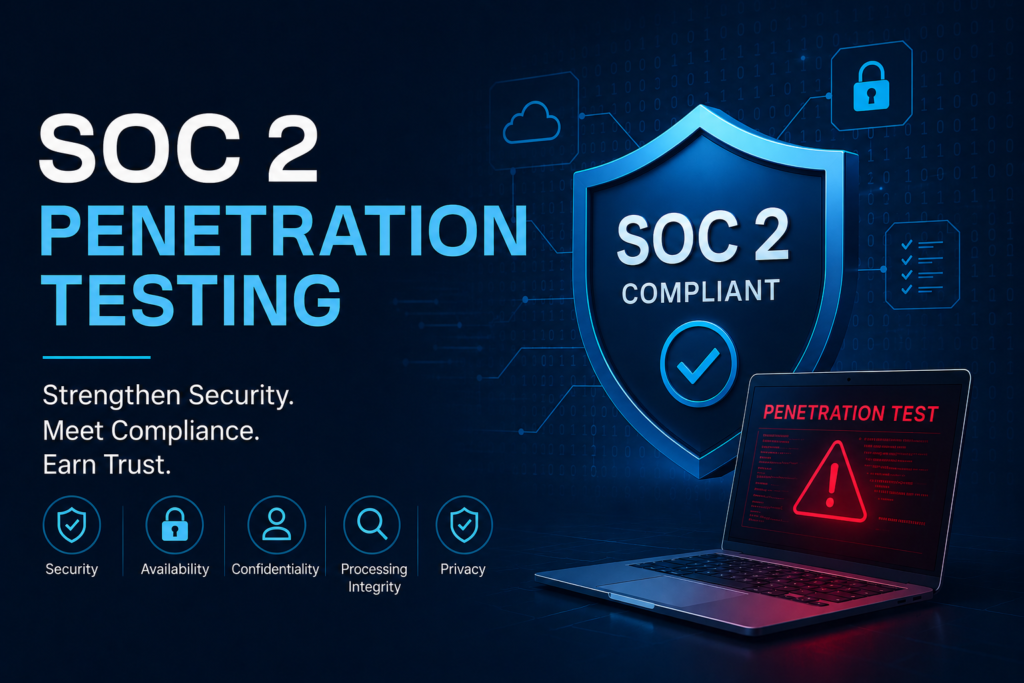
The framework evaluates organizations against five Trust Services Criteria: Security, Availability, Processing Integrity, Confidentiality, and Privacy. Security is mandatory in every audit. The others are selected based on what the organization’s services commit to. Every criterion is outcomes-based rather than prescriptive, meaning the framework defines what your controls must demonstrate rather than dictating exactly how to demonstrate it.
That flexibility is the source of most SOC 2 confusion. There is no checklist that says “run a penetration test.” Instead, there is a set of criteria that require organizations to demonstrate that their security controls function under real-world conditions, which auditors routinely interpret as requiring a penetration test to satisfy. 92% of organizations now conduct 2 or more SOC 2 audits annually, and 65% report that customers, investors, and suppliers require more compliance demonstrations than in previous years.
The practical consequence is that SOC 2 compliance is no longer a project with an end date. It is an ongoing security posture requirement, and penetration testing is the most commonly used mechanism to demonstrate that the posture holds up under realistic adversarial conditions.
Does SOC 2 Explicitly Require Penetration Testing?
SOC 2 does not explicitly require penetration testing in its written criteria. The framework is outcomes-based, meaning it requires evidence that security controls are effective without mandating specific testing methods. In practice, however, auditors in 2026 treat penetration testing as the standard evidence for several criteria, and organizations that arrive at an audit without one face significant friction and delay.
The clearest statement of this expectation appears in CC4.1 of the Trust Services Criteria, rooted in COSO Principle 16. It requires organizations to select, develop, and perform ongoing or separate evaluations to confirm that internal controls are present and functioning. The AICPA’s own guidance explicitly cites penetration testing as an example of an evaluation that satisfies this requirement. That is not a mandate, but in practice it functions as one.
The distinction between “not required” and “expected” matters in a specific way for audit preparation. An organization without a penetration test is not automatically non-compliant. It is, however, required to provide alternative evidence that its security controls function effectively under real-world conditions, and few alternatives carry the same credibility with auditors as a scoped, third-party penetration test.
Vulnerability exploitation as an initial access vector rose 34% year-over-year in 2025, accounting for 20% of all confirmed breaches. In that context, auditors have become significantly stricter about what counts as adequate evidence of control effectiveness. What satisfied an auditor in 2022 does not satisfy most auditors in 2026.
Which SOC 2 Trust Services Criteria Does Penetration Testing Address?
Penetration testing addresses multiple SOC 2 Trust Services Criteria simultaneously, which is one of the key reasons auditors consider it the most efficient mechanism for demonstrating the effectiveness of security controls. Understanding the mapping helps frame the test as a compliance asset rather than a standalone security exercise.
CC4.1 (Monitoring Activities) is the criterion most directly satisfied by penetration testing. It requires ongoing evaluation of whether controls are present and functioning. A scoped, third-party penetration test with documented findings and remediation evidence is the most accepted form of evidence for this criterion.
CC6.1 (Logical Access Controls) requires demonstration that access to systems, data, and resources is restricted to authorized users and entities. Penetration testing validates this by actively attempting to bypass access controls and documenting whether those attempts succeed.
CC7.1 (System Operations) requires that vulnerabilities be detected, assessed, and remediated. The combination of a penetration test and documented remediation cycle directly satisfies this requirement in a way that a vulnerability scan alone does not.
CC7.2 (Threat Monitoring) requires that security events be identified and evaluated for potential impact. Penetration test findings, categorized by severity and business impact, provide structured evidence that the organization evaluates threats with appropriate rigor.
CC9.2 (Risk Mitigation) requires that identified risks be mitigated to within acceptable tolerance. A penetration test followed by documented remediation and a retest demonstrating successful remediation is the clearest possible evidence of this process working as intended.
Understanding this mapping allows organizations to brief their penetration testing provider on which criteria the test needs to address, ensuring the report structure and evidence documentation are audit-ready rather than requiring rework after delivery.
What Do SOC 2 Auditors Actually Expect from a Penetration Test?
SOC 2 auditors in 2026 expect five specific elements from a penetration test: a qualified independent third-party tester; a scope that matches the organization’s defined system boundary; findings documented with business impact context and severity ratings; documented remediation and retest evidence; and a test date that falls within or near the audit period.
Getting all five right transforms a penetration test from a compliance checkbox into a compliance asset. Getting any one of them wrong creates auditor questions, evidence gaps, and, in the worst cases, audit delays that cost organizations enterprise deals.
What auditors specifically reject in 2026:
Automated scanner reports presented as penetration tests. Scanners identify potential issues. They do not validate exploitability, develop attack chains, or test for business logic vulnerabilities and authorization failures. Auditors have become significantly more sophisticated about distinguishing scan reports from genuine adversarial testing, and a scan-only report will result in a request for additional evidence.
Tests were conducted outside the audit period. For Type II audits, the penetration test needs to fall within or be proximate to the observation period. A test conducted 14 months before the audit window reflects your security posture 14 months ago, not how your current controls perform.
Missing remediation documentation. Finding vulnerabilities is only part of the process. Auditors want to see that identified issues were remediated and that the remediation was validated through a retest. A report listing critical findings without evidence that they were addressed raises more questions than it answers.
Scope that does not match the system boundary. The penetration test must cover the systems in scope for the SOC 2 audit. Testing a subset of systems while the audit covers the full environment leaves coverage gaps that auditors will identify.
Our penetration testing services are structured specifically to produce audit-ready evidence, not just vulnerability lists.
What Is the Difference Between SOC 2 Type I and Type II for Penetration Testing?
SOC 2 Type I and Type II have different implications for penetration testing because they assess different criteria. Type I assesses whether security controls are suitably designed at a specific point in time. Type II assesses whether those controls operated effectively over a six- to twelve-month observation period. Penetration testing is more critical for Type II and more time-sensitive in execution.
For Type I, a penetration test near the audit date demonstrates that controls are suitably designed. The test does not need to fall within an extended observation window because Type I is a point-in-time assessment. Remediation documentation is recommended but not always required.
For Type II, the timing and documentation requirements are stricter. The observation period typically runs six to twelve months, and the penetration test should fall within that window. More importantly, remediation and retest evidence needs to be complete before the audit window closes. A practical approach for Type II is to schedule the test early in the observation period, remediate identified findings, conduct a retest to confirm remediation, and have clean security evidence ready for the auditor’s review period.
A common timing mistake is scheduling the penetration test immediately before the audit for a Type II engagement. That leaves no time to remediate and retest critical findings before the observation period closes. If an authorization failure or an exposed credential is identified in the final weeks, the remediation timeline overlaps with the audit itself.
For organizations pursuing SOC 2 for the first time, understanding how penetration testing fits relative to a broader vulnerability management program is important context. Our breakdown of vulnerability assessment vs penetration testing explains the difference and where each fits in an audit preparation program.
What Are the Most Common SOC 2 Penetration Testing Mistakes?
The three most common SOC 2 penetration testing mistakes are substituting automated scanner output for manual testing, scheduling a single test immediately before the audit, and delivering findings without documented remediation and retest evidence. Each one creates a different type of auditor friction, and each is entirely avoidable with the right engagement structure.
Scan-only testing presented as manual penetration testing. Automated scanners are useful for identifying known CVEs and misconfiguration patterns. They do not test business logic, authorization boundaries, multi-tenant isolation, or chained vulnerabilities. In Bugstrix SOC 2 engagements, authorization failures in multi-tenant SaaS applications are the most common critical finding reported, and they are also the category of findings most completely absent from automated scanner output. An auditor who understands the difference, and most do in 2026, will ask whether the testing was manual and human-validated.
Single test scheduled immediately before the audit. SOC 2, particularly Type II, emphasizes consistency over time. A single test immediately before the audit is evidence of a point-in-time security check, not of ongoing control effectiveness. It also leaves no time to remediate and retest findings before the audit window closes, which is a separate and more immediate problem.
Missing retest evidence. Finding a critical vulnerability and remediating it is not the end of the process for SOC 2 purposes. Auditors require evidence that the remediation was validated, meaning a retest confirming the original finding no longer exists in its exploitable form. A penetration test report listing unresolved critical findings is worse than having no penetration test at all from an auditor’s perspective.
Scope that does not align with the system boundary. Testing three of the six applications in scope for the SOC 2 audit creates obvious coverage gaps. Every application, API, and network segment included in the system boundary description should be covered by the penetration test.
Using an internal team without independence documentation. SOC 2 does not require an external tester, but auditors strongly prefer independent third-party assessments. If an internal team conducts the test, the documentation needs to clearly establish the testers’ independence and qualifications, which is significantly harder to demonstrate than simply providing a third-party report.
What Should a SOC 2 Penetration Test Report Include?
A SOC 2-compliant penetration test report must include five elements to satisfy auditor expectations: an executive summary that maps findings to the Trust Services Criteria; detailed technical findings with severity ratings and business impact context; evidence of exploitation for each validated finding; a remediation plan with ownership and timeline; and retest results confirming successful remediation.
The report structure matters as much as the findings it contains. A technically thorough penetration test that produces a report organized for a security team rather than an auditor creates unnecessary friction. Auditors are reviewing evidence of control effectiveness, not a list of vulnerabilities. The report needs to speak to both audiences.
Specific elements Bugstrix includes in every SOC 2 penetration test report:
TSC mapping table. Every finding is mapped to the relevant Trust Services Criteria it violates or validates. This allows the auditor to directly connect the penetration test evidence to the criteria being assessed without interpretation.
Business impact context. Each finding includes a description of what an attacker could realistically achieve by exploiting it, not just a technical severity rating. CVSS scores alone do not satisfy auditor expectations for risk assessment.
Exploitation evidence. Screenshots, API responses, and proof-of-concept outputs demonstrating that each finding was confirmed as genuinely exploitable rather than theoretically possible.
Remediation tracking. A structured table linking each finding to a remediation action, an owner, a target date, and the retest result confirming closure. This is the element most frequently missing from penetration test reports prepared for general security purposes rather than compliance.
Auditor-facing executive summary. A concise summary of overall security posture, methodology, scope coverage, and the relationship between findings and the organization’s stated security controls, written for an auditor rather than a technical reader.
How Does Bugstrix Structure SOC 2 Penetration Testing Engagements?
Bugstrix structures SOC 2 penetration testing engagements around the audit evidence requirements first, and the technical testing methodology second. Most penetration testing providers approach it the other way, which produces technically thorough reports that require significant rework before they satisfy an auditor.
In practice, our SOC 2 engagement process works across four stages:
Stage 1: Scope and criteria alignment. Before testing begins, we map the defined system boundary to the Trust Services Criteria in scope for the audit. This determines which systems, applications, APIs, and network segments need to be covered, as well as which criteria the report needs to address.
Stage 2: Manual penetration testing. We conduct grey-box penetration testing with credentials across all in-scope systems. Our focus is on the findings that matter most for SOC 2 evidence: authorization failures, access-control bypasses, multi-tenant isolation issues, business-logic vulnerabilities, and authentication weaknesses. Automated tooling is used for reconnaissance and for identifying known patterns; every finding is human-validated before it appears in the report.
Stage 3: Audit-ready report delivery. The report is structured around the TSC mapping table, business impact context, and remediation tracking format that auditors expect. We deliver this within an agreed timeline that preserves sufficient time for remediation and retesting before the audit window closes.
Stage 4: Remediation support and retest. We include a full retest of all critical and high findings in every SOC 2 engagement. The retest report documents the remediation outcome for each finding and is formatted as a standalone addendum to the original report, which is the format most auditors prefer for evidence submission.
Since 2022, every Bugstrix client that has used our SOC 2 penetration testing engagement structure has passed their audit without significant delays related to penetration testing evidence. That outcome is not accidental. It is the result of designing the engagement around what auditors actually need rather than what makes a good security report.
Frequently Asked Questions
Is penetration testing required for SOC 2?
SOC 2 does not explicitly mandate penetration testing in its written criteria. In 2026, however, auditors overwhelmingly expect it as evidence that controls function effectively under real-world conditions, particularly under CC4.1. Organizations that arrive at an audit without a credible, scoped, third-party penetration test with remediation evidence regularly face delays, additional evidence requests, and, in some cases, qualified audit opinions. The practical answer is: technically no, but effectively yes.
How often should you do penetration testing for SOC 2?
At minimum, annually and within the audit observation period for Type II reports. Most auditors also expect a fresh assessment following any significant infrastructure change: a new application, a major feature release, a cloud migration, or an acquisition. Organizations operating under continuous Type II compliance should build penetration testing into their annual security calendar with sufficient lead time to remediate and retest before the observation window closes.
What is the difference between a vulnerability scan and a penetration test for SOC 2?
A vulnerability scan identifies potential issues using automated tools. A penetration test goes further: a human tester actively exploits confirmed vulnerabilities, develops attack chains, and tests business logic and authorization boundaries that automated scanners cannot reach. SOC 2 auditors distinguish between the two, and a scan report presented as penetration test evidence will be rejected by most auditors in 2026. The findings that matter most for SOC 2, specifically authorization failures and access control bypasses, are almost never found by automated scanners.
How long does a SOC 2 penetration test take?
A SOC 2 penetration test typically takes 1 to 3 weeks for the testing phase, depending on the scope. Add two to four weeks for remediation of critical and high findings, and one week for retesting. Organizations should build six to eight weeks of total lead time into their audit preparation timeline to allow for the complete process without timeline pressure.
Can we use an internal team for SOC 2 penetration testing?
It is possible but not recommended. SOC 2 auditors strongly prefer independent third-party testing because it demonstrates objectivity. If an internal team conducts the test, the documentation must clearly establish the testers’ independence and qualifications, a task that is difficult to demonstrate convincingly. A third-party report from a qualified security firm is the cleaner evidence path and eliminates the potential for an auditor conversation about independence.
What Comes After the Penetration Test?
A penetration test that satisfies your SOC 2 auditor is not the end of your security program. It is a point-in-time assessment of your controls under current conditions. The environment changes, new applications are deployed, infrastructure evolves, and the threat landscape in which both your auditor and your actual adversaries operate continues to shift.
The organizations that handle SOC 2 compliance well in the long run treat penetration testing as part of an ongoing security practice rather than as an annual audit-preparation exercise. That means testing after significant changes, not just on a calendar schedule. It means retesting remediated findings to confirm fixes hold. And it means using the penetration test findings to inform your security roadmap rather than filing the report and moving on.
SOC 2 compliance signals to your customers that your security posture is real and maintained. A penetration test that genuinely improves your security, rather than just producing a report for the auditor, is what backs that signal with substance.
Contact us to discuss your SOC 2 penetration testing requirements