What Is Identity and Access Management (IAM)?

Written By
Sarwat Iftikhar
Every security control in an organization ultimately depends on one thing: knowing who is asking for access, what they are authorized to do, and whether the system is enforcing that boundary correctly. A firewall that blocks unauthorized network traffic only works if the identity making the request has been correctly validated. An application that restricts sensitive operations to administrators only works if the administrator role has been granted to the right people and cannot be accessed by anyone else.
Identity and Access Management is the discipline that governs all of this. It defines who and what can access organizational systems and data, establishes the processes for granting, reviewing, and revoking that access, and implements the technical controls that enforce those decisions at every point where a user, service, or device requests access to a resource.
IAM failures are consistently among the highest-severity findings in security assessments. Not because IAM is poorly understood as a concept, but because the gap between what organizations intend their access model to enforce and what it actually enforces tends to widen silently over time, through permission accumulation, process lapses, and configuration drift that no individual change made obvious.
Key Takeaways
- IAM governs every decision about who can access what across an organization, covering human users, service accounts, applications, and devices through both authentication and authorization controls.
- The gap between intended and actual access is the most consistently critical IAM finding in Bugstrix security assessments. Permissions accumulate over time through role additions, account retention after role changes, and administrative shortcuts that were never reversed.
- Misconfigured IAM is one of the most common causes of cloud security incidents, through over-permissioned service accounts, publicly accessible resources, and poorly scoped role assignments.
- Least privilege, the principle that every identity should have exactly the access it needs and nothing more, is universally understood and almost universally under-implemented in real environments.
- IAM security requires both technical controls and operational processes. The controls define the policy. The processes keep the policy accurate as the organization changes.
What Is Identity and Access Management?
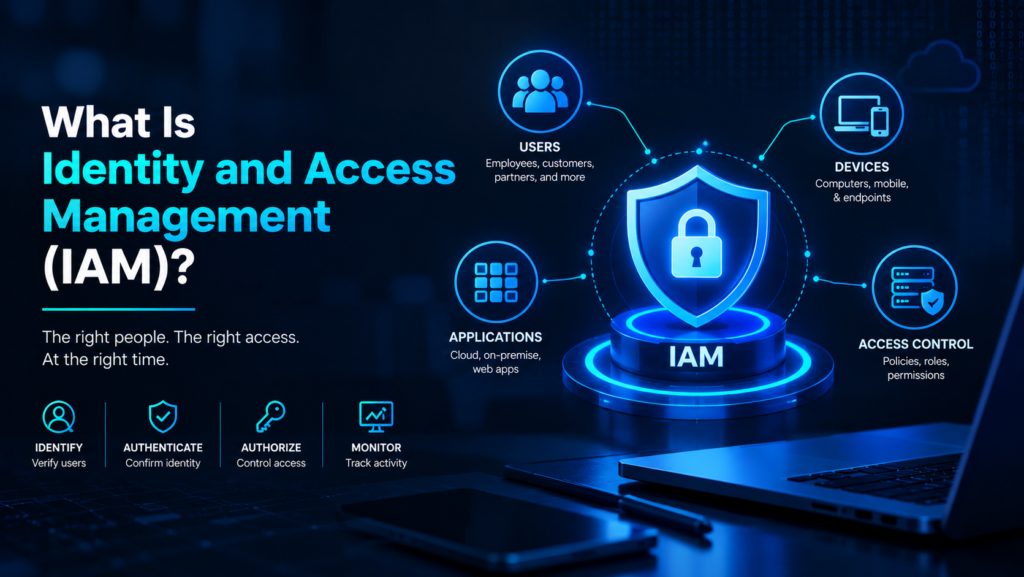
Identity and Access Management is the framework of policies, processes, and technologies that controls which users, applications, services, and devices can access which resources within an organization, and what they can do with that access once it is granted. It spans the full lifecycle of an identity from creation through modification, review, and revocation.
IAM operates at two distinct layers that work together: identity management, which handles who and what exists in the system, and access management, which handles what those identities are permitted to do. Identity management covers provisioning new user accounts, assigning them to appropriate roles and groups, updating access when roles change, and deprovisioning accounts when someone leaves the organization. Access management covers defining what each role can do, enforcing those permissions at every access point, and providing the authentication mechanisms that confirm an identity before access is granted.
The scope of what IAM governs has expanded significantly as organizations have moved to cloud infrastructure and adopted modern software architectures. Traditional IAM was primarily about managing employee accounts in an Active Directory environment. Modern IAM encompasses employee accounts, customer identities, service accounts for applications and automation, machine identities for infrastructure components, and the IAM policies of every cloud provider account that the organization operates.
IAM is also foundational to Zero Trust security architecture, which treats every access request as untrusted by default regardless of where it originates, requiring continuous verification of identity and authorization for every request rather than assuming that traffic from inside the network perimeter can be trusted.
What Is the Difference Between Authentication and Authorization?
Authentication and authorization are the two core functions of access management, and they are frequently conflated despite addressing fundamentally different questions. Authentication answers who you are. Authorization answers what you are permitted to do. Both are necessary, and a failure in either breaks the security model regardless of how well the other is implemented.
| Concept | Question It Answers | Example Controls | What Failure Looks Like |
| Authentication | Who are you? | Passwords, MFA, SSO, certificates | Credential theft, account takeover |
| Authorization | What can you do? | RBAC, ABAC, least privilege, policies | Privilege escalation, data exposure |
| Access governance | Should you still have access? | Access reviews, joiner-mover-leaver | Orphaned accounts, accumulation |
| Privileged access | Who controls critical systems? | PAM, just-in-time access, audit logs | Unrestricted admin access, lateral movement |
Authentication confirms that an identity is who it claims to be before granting access. Strong authentication combines something the user knows, something the user has, and something the user is, in the form of multi-factor authentication that requires at least two of these factors. Authentication weaknesses are the entry point for account takeover attacks, which represent the most common initial access technique in compromises that involve user accounts.
Authorization controls what an authenticated identity is permitted to access and do. An identity that has been successfully authenticated but whose authorization is misconfigured may be able to access resources it should not reach, perform actions it should not be able to take, or escalate its own privileges through misassigned permissions. Authorization failures are distinct from authentication failures: the user is legitimately who they claim to be, but the system is not correctly enforcing the boundaries of what they are allowed to do.
Access governance is the operational layer that keeps authentication and authorization accurate over time. Without it, even a well-designed IAM model drifts toward over-permissioned accounts and orphaned identities.
Privileged access management covers the administrator and elevated accounts that are the highest-risk identities in any environment, because their compromise gives an attacker the broadest possible access. Both are covered in detail in the next section.
What Are the Core Components of an IAM Program?
An IAM program encompasses six core components that together address the full lifecycle of identity governance and access control. Weaknesses in any one component create exposure that the others cannot fully compensate for.
Identity lifecycle management covers the joiner-mover-leaver process: creating identities when people or systems join, updating access when roles change, and promptly deprovisioning access when someone leaves or a system is decommissioned. This is the process layer that keeps the identity inventory accurate. In Bugstrix security assessments, orphaned accounts, accounts with access that was never updated after a role change, and service accounts for decommissioned systems appear consistently as high-severity findings.
Multi-factor authentication requires more than one verification factor before granting access, making credential theft insufficient on its own for account takeover. MFA enforcement should cover all accounts, not just high-privilege ones. Standard user accounts that lack MFA are frequently the starting point for attacks that eventually reach privileged resources through lateral movement and privilege escalation.
Role-based access control organizes permissions around roles that represent job functions, assigning permissions to roles rather than directly to individuals and then assigning roles to identities. RBAC makes access policies manageable at scale because updating a role’s permissions updates the access of every identity that holds that role. It also makes over-provisioning more visible because excess permissions in a role affect everyone assigned to it rather than accumulating invisibly on individual accounts.
Privileged access management applies additional controls to the accounts with the highest access levels: administrator accounts, service accounts with broad permissions, and any identity that can modify access policies for other identities. PAM controls typically include just-in-time access that grants elevated permissions only when specifically needed rather than maintaining them permanently, comprehensive audit logging of all privileged actions, and additional authentication requirements before privileged access is activated.
Access reviews are the periodic governance process in which managers and system owners certify that the access their team members and systems currently hold is still appropriate. Access reviews catch the gradual accumulation of permissions that occurs when people change roles, take on new projects, or complete temporary assignments without the associated access being adjusted.
Single sign-on and federation provide centralized authentication that allows identities to authenticate once and access multiple connected systems without re-authenticating for each. SSO improves security by concentrating authentication controls in a single point where strong authentication, MFA enforcement, and session policies can be applied consistently, rather than distributing those controls across individual applications where enforcement is inconsistent.
How Does IAM Work in Cloud Environments?
Cloud IAM operates on the same foundational principles as traditional IAM but with a significantly broader and more complex scope, covering not just human users but every service, application, and infrastructure component that needs to interact with cloud resources.
Every major cloud provider implements its own IAM system for controlling access to cloud services and resources. These systems allow granular permission assignment at the resource level, support role-based access with permissions defined through policy documents, and provide audit logging of access events across the environment. The flexibility that makes cloud IAM powerful is also what makes misconfiguration so common: policy documents that define permissions are complex, policy interactions are not always intuitive, and the ease of granting broad permissions during development creates technical debt that accumulates in production.
The specific IAM risks that appear most consistently in cloud environments are over-permissioned service accounts that receive administrator-level access because the narrower scope required more configuration time, default permissions on new resources that are more permissive than the deployment context warrants, cross-account trust relationships that create access pathways between accounts that were not intended to be connected, and IAM roles that have been created for temporary purposes and never removed.
Cloud IAM is also where the policy-to-effective-permission gap is most dangerous. A cloud IAM policy that appears correctly scoped when read in isolation may interact with a resource-based policy, a service control policy, or a cross-account trust relationship to produce an effective permission that is much broader than any individual policy would suggest. Our post on cloud security covers the IAM risk landscape in cloud environments alongside the other security controls that protect cloud infrastructure.
Continuous monitoring of cloud IAM configuration is one of the primary functions of cloud security posture management programs. Cloud security posture management continuously evaluates IAM policies, service account permissions, and cross-account trust configurations against security standards, surfacing misconfigurations as they occur rather than waiting for a periodic assessment to reveal them.
What Happens When IAM Is Misconfigured?
IAM misconfiguration produces the most consistently impactful security failures in modern environments because IAM is the control that governs every other access decision. A misconfigured firewall blocks some traffic incorrectly. A misconfigured IAM policy can grant an attacker access to everything the organization’s cloud environment contains.
The specific failure modes that appear most frequently in Bugstrix IAM assessments:
Permission accumulation over time. Accounts that receive new permissions as roles expand but never have old permissions removed when responsibilities shift. This is the most universal IAM finding across all organization types and sizes: individually, each permission grant was appropriate at the time it was made. Cumulatively, the account holds access far exceeding what its current role requires.
Service accounts with human-level permissions. Applications and automation scripts that need to read from a specific database table or write to a specific storage bucket frequently receive administrator-level access because it is faster to configure and is guaranteed to work without further troubleshooting. These accounts run continuously, are often not subject to MFA requirements, and represent a persistent high-value target for attackers who compromise the application running under them.
Orphaned accounts. Identities that remain active after the underlying person has left the organization or after the system they represent has been decommissioned. These accounts retain whatever permissions they held at deprovisioning, may have credentials that were never invalidated, and are often not monitored because nobody is actively using them.
Broken authorization at the application layer. IAM misconfiguration is not limited to the identity provider and role system. Applications that implement their own access control checks frequently implement them incorrectly, creating the authorization failures that allow one user to access another’s data or a lower-privilege role to access restricted functionality. This category of failure, which is directly attributable to IAM at the application logic layer, is covered in detail in our post on broken access control in SaaS applications.
How Do Compliance Frameworks Address IAM?
IAM controls are central requirements in every major compliance framework because identity governance is the foundational control that all other access-dependent security requirements rest on.
SOC 2 under the Common Criteria addresses IAM through multiple Trust Services Criteria: CC6.1 requires logical access controls that restrict access to authorized users, CC6.2 requires that access is provisioned and deprovisioned appropriately, and CC6.3 requires that access is reviewed and removed when no longer appropriate. Each of these criteria directly maps to the components of an IAM program: authentication controls, lifecycle management, and access reviews.
ISO 27001:2022 addresses IAM through Annex A control categories including A.5.15 (Access Control), A.5.16 (Identity Management), A.5.17 (Authentication Information), A.5.18 (Access Rights), and A.8.2 (Privileged Access Rights). Together these controls define a framework for implementing and governing IAM that closely parallels the six-component model described above.
PCI DSS v4.0 imposes specific IAM requirements for Cardholder Data Environment access, including MFA requirements under Requirement 8.4, unique account requirements under Requirement 8.2, and access review requirements under Requirement 7.2. PCI DSS is particularly prescriptive about which specific IAM controls must be implemented rather than leaving implementation approaches to the organization’s discretion.
How Do You Test and Validate IAM Security?
IAM security testing evaluates whether the access controls an organization has defined are actually enforced in practice, covering both the identity provider and role configuration layer and the application-level authorization logic that relies on IAM decisions.
Effective IAM testing requires access to the configuration being tested. A black-box assessment that interacts only with the external interface of an application can identify some authorization failures through behavioral testing, but a white-box assessment with access to the IAM policy configuration, role definitions, and service account permissions provides complete coverage of misconfiguration that behavioral testing would not surface. Our post on black-box, white-box, and grey-box penetration testing covers how these testing approaches differ in terms of information access and what each can realistically reveal.
The specific IAM testing activities that produce the most actionable findings:
Permission enumeration and effective-access analysis. Mapping every role and policy in the identity system to the effective permissions it grants, including the combined effect of multiple overlapping policies, reveals the gap between the intended access model and the actual access that each identity holds.
Cross-role authorization testing. Systematic testing of whether each API endpoint, function, and data object enforces access restrictions for every role that should not have access, not just the roles that clearly should. Authorization failures often exist for specific roles or resource types rather than as universal gaps.
Service account privilege review. Evaluating whether each service account holds the minimum permissions required for its defined function, and whether any service accounts hold permissions that exceed what any defined function would justify.
Lifecycle process validation. Testing the joiner-mover-leaver process by examining whether historical account transitions have been fully completed, including sampling former employee accounts for active credentials and permissions, and reviewing whether role change events triggered appropriate access updates.
Our cloud penetration testing services and penetration testing services include IAM-specific testing as a core component, covering both the cloud IAM configuration layer and the application-level authorization logic that depends on it.
How Do You Build a Strong IAM Program?
A strong IAM program is built around four operational principles: automate lifecycle management wherever possible, enforce least privilege consistently rather than aspirationally, review access regularly and act on what reviews reveal, and integrate IAM with the monitoring and security testing activities that validate whether controls are working as intended.
Automate provisioning and deprovisioning. Manual joiner-mover-leaver processes accumulate errors over time because manual steps are skipped under time pressure, exceptions are made that are never reversed, and ownership of the process is unclear when the responsible person is unavailable. Automated provisioning tied to HR system events ensures that access changes happen reliably at the right moments rather than when someone remembers to do them.
Enforce least privilege at the role level, not just the policy level. Least privilege applied at the policy level but ignored at the role assignment level produces over-permissioned identities despite technically correct policies. Every new role assignment should be evaluated against the minimum access the function requires, not against a convenient existing role that covers the needed access plus more.
Conduct access reviews on a defined schedule and act on findings. Access reviews that produce a list of accounts with excess permissions but result in no actual permission removal are governance theater rather than governance. The review process must include a defined remediation workflow with accountability for removing identified excess access within a specific timeframe.
Track IAM findings like any other vulnerability. IAM misconfigurations are exploitable weaknesses with defined business impact, the same as software CVEs. Treating them as routine configuration work means they often stay unaddressed because nothing assigns them a severity, an owner, or a remediation deadline. Logging IAM findings in the same tracking process as other security findings, for example through a vulnerability assessment program, and reviewing authorization logic through code review, keeps them visible until they are closed.
Frequently Asked Questions
What is the difference between IAM and PAM?
IAM is the broad discipline covering identity governance and access control for all identities in an organization. PAM (Privileged Access Management) is a specific subset of IAM focused exclusively on accounts with elevated or administrator-level permissions. PAM applies additional controls to privileged accounts including just-in-time access provisioning, session recording, enhanced authentication requirements, and more frequent access reviews. IAM is the foundation. PAM is the specialized additional layer for the highest-risk subset of identities.
What is least privilege and why is it difficult to implement?
Least privilege is the principle that every identity should have access to exactly what it needs to perform its function and nothing more. It is difficult to implement because the minimum necessary access for a given function is rarely clear at the time of provisioning, because granting broad access is faster than determining the precise minimum, and because narrowing permissions after the fact often breaks functionality in ways that create urgent operational pressure to restore the broader access. Least privilege is most effectively implemented through careful upfront permission scoping rather than retroactive reduction.
How does single sign-on improve security?
SSO centralizes authentication in a single identity provider rather than requiring each application to implement its own authentication stack. This improves security by concentrating authentication controls, MFA enforcement, and session policy in a single well-maintained system rather than distributing them across many applications where enforcement may be inconsistent. SSO also reduces password fatigue that leads to password reuse, and enables centralized session termination when accounts are deprovisioned.
What is an orphaned account and why does it matter?
An orphaned account is an identity that remains active after the person or system it was created for is no longer present in the organization. Former employee accounts that were not promptly deprovisioned, service accounts for decommissioned systems, and temporary contractor accounts that were not removed after the engagement ended are all orphaned accounts. They represent standing access that nobody is actively using but that an attacker who obtains the credentials can use freely. Orphaned accounts with elevated permissions are particularly dangerous because they provide access without the monitoring attention that active accounts receive.
Does IAM need to be tested separately from application penetration testing?
Yes. Application penetration testing evaluates the authorization logic implemented in the application itself. IAM testing evaluates the underlying identity infrastructure including the role definitions, policy assignments, and lifecycle processes that the application relies on. Both layers can have independent failures: an application may correctly implement authorization checks against a role, but if the role has been granted to too many identities through a misconfigured provisioning process, the authorization check provides less protection than intended.
Access Is the Foundation Everything Else Rests On
Security controls protect resources. IAM controls protect access to everything. A vulnerability in a specific application affects that application. An IAM failure affects everything that application, every user, and every service account in the environment can reach.
Closing the gap between intended and actual access requires both the technical controls that enforce the policy correctly and the operational processes that keep the policy accurate as the organization changes. Neither alone is sufficient. The controls without the processes produce correct enforcement of an increasingly inaccurate policy. The processes without the controls produce governance activity that never translates into actual access restriction.
IAM done well is not a product to purchase or a project to complete. It is a continuous organizational discipline. The organizations that get it right are the ones that treat identity governance as an ongoing operational responsibility rather than a one-time implementation and move on.
Contact us to discuss an IAM security assessment for your organization