What Is API Security Posture Management (ASPM)?

Written By
Sarwat Iftikhar
Most organizations have more APIs than they think. Development teams create internal APIs for microservice communication. Partner integrations spawn new endpoints. Legacy systems expose SOAP interfaces that nobody updated the documentation for. Third-party tools add API connections that the security team was not told about. By the time anyone tries to get a count, the real API inventory is 30 to 60 percent larger than what the asset register shows.
This is the problem that API Security Posture Management is designed to address. ASPM is the practice of continuously discovering, inventorying, classifying, and monitoring the security posture of every API an organization operates, covering the full lifecycle from development through production. It does not replace security testing. It provides the foundational inventory and continuous visibility layer that makes security testing meaningful and targeted rather than applied to whatever APIs the team happens to know about.
Key Takeaways
- ASPM provides continuous discovery, inventory, and risk classification of every API an organization operates, including shadow APIs and undocumented endpoints that periodic security testing never reaches.
- In Bugstrix external API assessments, the majority of critical findings involve APIs the client’s security team was not actively monitoring, most commonly shadow APIs, legacy endpoints, and third-party integration surfaces that fell outside the last penetration test scope.
- ASPM is not the same as API security testing or API penetration testing. It is the visibility and governance layer that ensures security testing is applied to the complete API surface rather than a subset the team happened to know about.
- The structural parallel for ASPM is cloud security posture management applied specifically to the API layer. Both solve the same problem: environments that change faster than manual review can track, requiring continuous automated visibility rather than periodic point-in-time assessment.
- A complete API security program combines ASPM for continuous inventory and posture visibility with periodic penetration testing for depth validation of the authorization and business logic that automated monitoring cannot assess.
What Is API Security Posture Management?
API Security Posture Management is a security practice that continuously discovers all APIs an organization operates, classifies them by risk, monitors their configuration and security state against defined policies, integrates findings from security testing tools such as SAST and DAST, and provides the governance layer that ensures API security controls are applied consistently across the complete API inventory rather than selectively across the subset that the security team actively tracks.
The core function of ASPM is visibility. Before any security control can be applied to an API, someone needs to know that API exists. Before any testing can validate an API’s security, someone needs to know what endpoints, authentication mechanisms, and data it exposes. In organizations where API creation is distributed across development teams and integrated through third-party tools, that inventory does not exist by default. ASPM builds and maintains it continuously.
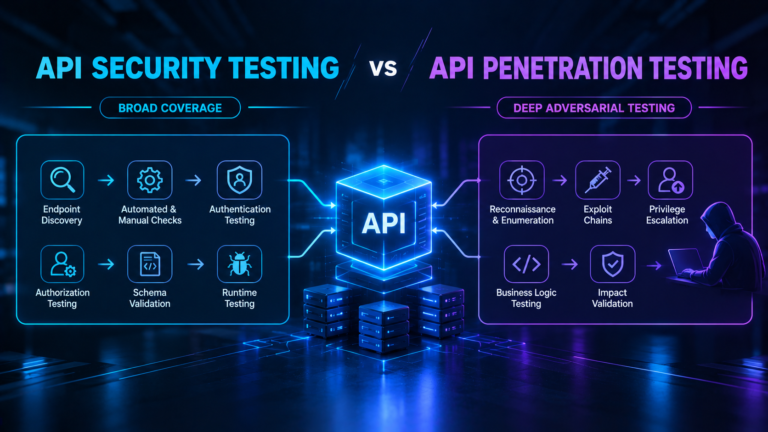
ASPM sits at the governance and visibility layer of the API security stack, above individual testing tools and below the incident response process. Each testing method, API security testing broadly, SAST during development, DAST against deployed APIs, manual penetration testing for authorization and business logic, finds and validates vulnerabilities in whatever it is pointed at. ASPM’s job is making sure each one is pointed at the right APIs in the first place, and that what each finds lands in one tracked view instead of scattered across separate tool-specific reports.
Why Did ASPM Emerge as a Discipline?
ASPM emerged as a discipline because the combination of API sprawl, microservice architecture, and the speed of modern software development has made it impossible to maintain accurate API inventory through manual processes, and impossible to apply security governance consistently to an inventory you cannot enumerate accurately.
Ten years ago, most organizations had a manageable number of APIs created by a central team and documented in a central registry. That model does not reflect how APIs are created in 2026. Development teams create microservices that expose APIs for internal communication. Platform teams build integration layers that expose new endpoints. Third-party tools add API connections during onboarding. Mobile app backends accrete endpoints with each release cycle. None of these creation events reliably update a central security inventory.
The result is a category of risk that our external assessments at Bugstrix surface consistently: APIs that are live, accessible, and handling real traffic but that have never been security tested because nobody in the security team knew they existed. These are not necessarily obscure or unusual endpoints. They include staging environments accidentally left exposed in production network segments, legacy authentication endpoints that were deprecated functionally but never decommissioned, and partner integration APIs that were stood up for a specific project and then forgotten.
The pattern is the same one that drove the creation of cloud security posture management for cloud infrastructure. APIs, like cloud resources, are created faster than manual governance can track, change continuously, and accumulate security risk in the gaps between periodic reviews. ASPM applies the same continuous discovery and monitoring approach that CSPM applies to cloud configuration, to the API layer specifically. Our post on cloud security posture management covers the CSPM parallel in depth, which provides a useful frame of reference for understanding what ASPM addresses.
What Does an ASPM Program Cover?
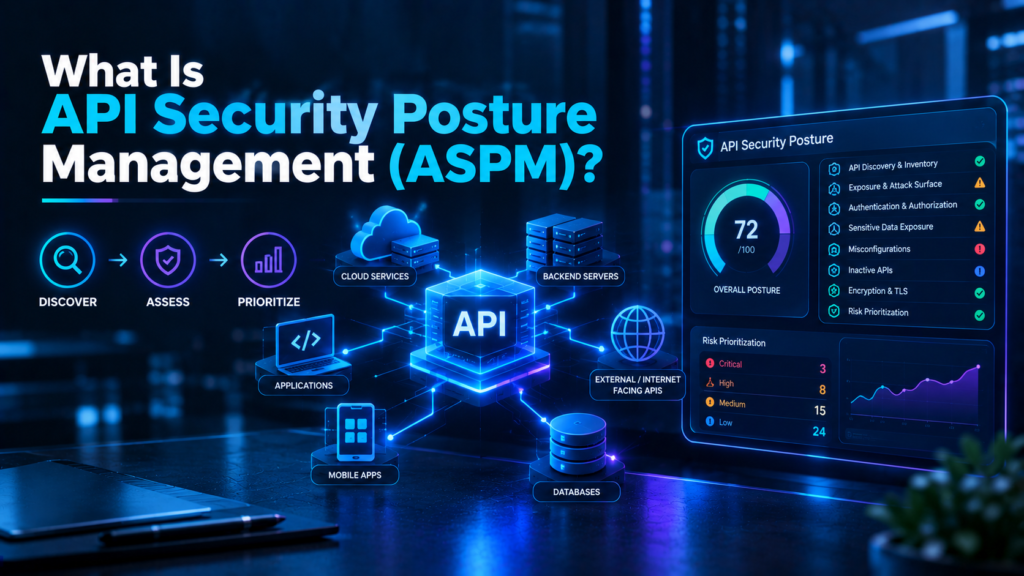
An ASPM program covers six functional areas that together provide continuous visibility into the complete API security posture: API discovery and inventory, risk classification, security policy enforcement, testing tool integration, runtime monitoring, and remediation tracking.
API discovery is the foundational capability that makes everything else possible. Effective discovery combines passive traffic analysis, active crawling of network segments, integration with API gateways and service meshes, analysis of code repositories for API definitions, and review of third-party tool configurations. The goal is a complete inventory that reflects reality rather than documentation, and that stays current as APIs are created, modified, and decommissioned.
Risk classification assigns a risk profile to each discovered API based on factors including what data the API accesses or exposes, whether the API is internet-facing or internal, what authentication mechanism protects it, how much traffic it handles, and whether it is actively maintained or orphaned. Risk classification prioritizes which APIs need immediate security attention and which can be addressed in a planned remediation cycle.
Security policy enforcement defines and monitors whether each API in the inventory meets the organization’s required security standards: authentication present and enforced, sensitive data properly encrypted in transit, rate limiting in place on sensitive operations, and security headers configured correctly. Policy violations are surfaced as findings that require remediation, regardless of whether a security tester has specifically examined that API.
Testing tool integration aggregates findings from SAST analysis during development, DAST scanning in CI/CD pipelines, vulnerability assessment scanning, and manual penetration testing results into a unified posture view. Without this integration, findings from different testing tools live in separate reports that are difficult to correlate. ASPM provides the single view that shows which APIs have been tested, what was found, and what remains open across all testing activities.
Runtime monitoring observes live API traffic for anomalous patterns: unusual query volumes, unexpected parameter values, access patterns inconsistent with normal user behavior, and responses that include data fields not expected in the documented API contract. Runtime monitoring catches attacks in progress and identifies abuse patterns that security testing before deployment could not have anticipated.
Remediation tracking closes the loop by tracking identified findings from all sources through assignment, remediation, and validation, providing the governance evidence that shows security issues are being actively addressed rather than discovered and forgotten.
How Is ASPM Different from Attack Surface Management?
ASPM and attack surface management address related but distinct aspects of external security visibility. Attack surface management discovers and monitors all of an organization’s internet-facing assets, including domains, subdomains, IP addresses, web applications, and APIs, providing continuous visibility into the full external exposure. ASPM focuses specifically on the API layer, going deeper into API-specific risk attributes than general attack surface management can practically achieve.
The relationship is that attack surface management provides the external discovery layer that ASPM builds API-specific governance on top of. An ASM program that discovers a previously unknown API endpoint has identified an external exposure. ASPM then classifies that endpoint, determines its authentication status, compares its configuration against API security policies, and routes it into the testing and remediation workflow.
For organizations without a dedicated ASPM capability, attack surface management often provides the most important component of what ASPM offers: the discovery of API endpoints that the internal team was not aware of. Our post on attack surface management covers what continuous external discovery involves, which provides context for understanding where ASPM’s API-specific governance extends the ASM foundation.
Our attack surface management service provides the continuous external discovery layer that identifies unknown API exposure alongside the broader external attack surface, which forms the foundation of an ASPM program for organizations building that capability.
How Does ASPM Relate to SAST, DAST, and Penetration Testing?
ASPM is the coordination and governance layer that sits above individual security testing tools, not a testing tool itself. It does not replace SAST, DAST, or penetration testing. It ensures those activities are applied to the complete API inventory, aggregates their findings into a unified view, and tracks remediation across all finding sources.
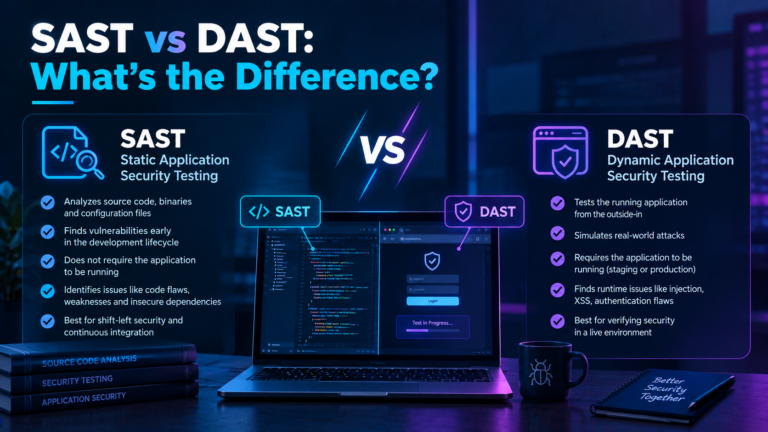
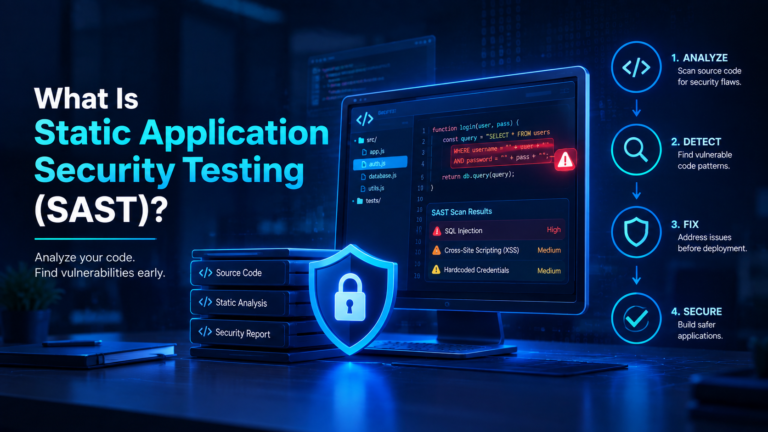
SAST finds code-level vulnerabilities during development: insecure cryptographic implementations, hardcoded credentials, injection-prone data handling, and authorization logic gaps in the code before the API is deployed. ASPM integrates SAST findings from the development phase alongside findings from later testing stages, and alongside findings from expert code review where SAST’s automated output needs manual validation, so the full security picture of each API includes its development-phase history rather than only what was found in production.
DAST finds runtime vulnerabilities in deployed APIs by sending crafted inputs and analyzing responses. ASPM integrates DAST scan results for every API in the inventory, including APIs that DAST was not specifically directed to test because they were discovered by ASPM rather than listed in a pre-defined target inventory. This is where ASPM’s value in extending DAST coverage is most concrete: shadow APIs and undocumented endpoints that DAST would never reach without ASPM directing it there.
Manual penetration testing validates the authorization model, business logic, and chained attack paths that automated tools cannot assess. ASPM identifies which APIs have never been penetration tested, which were last tested before significant changes, and which carry high-risk classifications that should prioritize them for the next testing cycle. It also stores penetration test findings alongside SAST and DAST findings for unified remediation tracking. Our web application penetration testing services cover the manual testing engagement that validates the APIs ASPM has flagged as highest priority, and our post on API penetration testing costs covers what to budget once ASPM has identified which APIs need it.
What Specific Risks Does ASPM Address?
ASPM addresses the specific risk categories that accumulate in organizations with large, fast-growing API inventories where security governance has not kept pace with API creation. These are consistent patterns across the organizations Bugstrix assesses that do not have ASPM in place.
Shadow APIs. Endpoints that are live and accessible but not tracked in any security inventory. These accumulate through development team autonomy, third-party integrations, and microservice proliferation. In our external API assessments, shadow APIs are consistently among the highest-risk findings because they typically have weaker authentication, fewer security controls, and have never been security tested. Their existence in the inventory is itself the critical finding, separate from whatever specific vulnerabilities they contain.
Zombie APIs. Endpoints that were deprecated functionally but never decommissioned. They continue to accept traffic, may run on outdated frameworks with unpatched vulnerabilities, and are rarely monitored because the teams responsible for them no longer consider them active. ASPM identifies zombie APIs by comparing the actively maintained API inventory against the full discovery inventory.
Ungoverned authentication. APIs in the inventory that either have no authentication or that use authentication mechanisms not meeting the organization’s required standards. This is a policy enforcement finding rather than a specific vulnerability, and it requires inventory-wide visibility to identify systematically.
Broken access control. Authorization failures that allow one user to access another’s data, or a lower-privilege role to access functionality restricted to higher-privilege roles. This is the most consistently critical finding in Bugstrix API penetration testing engagements. Our post on broken access control in SaaS applications covers why this category is so persistent and how it manifests specifically in SaaS API contexts. ASPM does not directly detect broken access control that requires manual penetration testing, but it identifies which APIs have not been tested for it and prioritizes them for testing engagement.
Untested APIs. Endpoints in the inventory that have been deployed and are handling traffic but have never been included in a DAST scan or manual penetration test. ASPM tracks testing coverage against the full inventory, making untested coverage gaps visible to the security team rather than invisible.
Who Needs ASPM?
ASPM provides the most value to organizations with large, fast-growing, or complex API inventories where the number of APIs makes manual governance impractical and where the speed of API creation consistently outpaces security review.
The organization types where ASPM delivers the most immediate risk reduction:
SaaS platforms are the clearest ASPM candidates. Their product is delivered through APIs, development teams ship new endpoints continuously, and the API inventory changes with every release. Without continuous discovery, the security team’s picture of what APIs exist is perpetually weeks or months out of date.
Microservice architectures. Organizations that have adopted microservice patterns have APIs for internal service-to-service communication that are often not included in external security testing scope, but that can be reached by an attacker who compromises a single service. ASPM provides visibility into this internal API surface alongside the external one.
Organizations with multiple development teams. When API creation is distributed across teams that operate independently, no single team has the complete picture. ASPM provides the cross-team inventory that no individual team is positioned to maintain manually.
API-first product companies. Companies whose primary product interface is an API rather than a web UI have both the highest concentration of API risk and the highest business consequence when API security fails.
Regulated industries with API-heavy architectures. Financial services, healthcare, and insurance organizations that have heavily adopted API-based integration for partner connectivity, payment processing, and data exchange face compliance obligations that require demonstrable security governance across the full API inventory.
What Happens in the First Weeks After ASPM Goes Live?
The first discovery scan is where most of the friction in an ASPM rollout actually happens, and it is worth planning for specifically rather than treating ASPM adoption as a simple tooling switch-on. Given that real API inventories run 30 to 60 percent larger than what the asset register shows, the first scan routinely surfaces more APIs than the security team, or the leadership funding the program, expected to see.
That surprise creates a real operational decision, not just a bigger dashboard number. Every newly discovered shadow or zombie API needs an owner before it can be triaged, and figuring out who owns an API nobody knew existed is often harder than assessing its risk once ownership is established. Some of these APIs will trace back to a team that still maintains the underlying service and simply never reported it. Others will trace to nobody at all, because the team that built them has moved on or the project that justified them ended. Those orphaned APIs need a decommission-or-adopt decision, not just a ticket: bringing a genuinely unused endpoint under governance costs ongoing effort for no benefit, while decommissioning one that quietly still has active callers can break something in production.
The other operational reality worth planning for is that flagging a team’s undocumented API is easily read as a criticism of that team, particularly when the flag arrives as a security finding rather than as a heads-up. Programs that frame the first discovery pass as an inventory-accuracy exercise, not an audit of who did something wrong, get faster cooperation identifying owners and faster resolution on the decommission-or-adopt decisions than programs that lead with severity ratings on day one.
The practical sequencing that avoids the worst of this friction: run discovery first and let it complete before committing to remediation timelines, triage the resulting inventory by risk classification rather than trying to address everything the first scan turns up at once, and treat the initial wave of shadow and zombie API findings as a one-time cleanup rather than the ongoing steady-state workload, which drops substantially once the inventory is current and new APIs are being registered as they are created rather than discovered after the fact.
Frequently Asked Questions
Is ASPM a tool or a practice?
ASPM is both. As a practice, it describes the ongoing organizational activity of discovering, governing, and monitoring API security posture. As a tool category, it describes platforms that automate the discovery, risk classification, policy enforcement, and testing integration that an ASPM practice requires. Organizations implement ASPM as a practice regardless of whether they use a dedicated commercial ASPM platform, because the inventory problem it addresses exists whether or not a specific tool is solving it.
What is the difference between ASPM and an API gateway?
An API gateway manages and routes API traffic, enforcing rate limits, authentication, and routing policies on traffic it handles. It knows about the APIs it has been configured to manage. ASPM discovers all APIs, including those not routing through the gateway, monitors their security configuration, and integrates security testing findings. The two are complementary: the API gateway enforces runtime controls on managed APIs; ASPM ensures the complete inventory is visible and governed, including the endpoints that bypass the gateway.
Does ASPM replace API penetration testing?
No. ASPM provides inventory, risk classification, and continuous monitoring. It does not validate whether authorization failures, business logic flaws, or chained attack paths exist in specific APIs. Manual penetration testing remains necessary for that depth of validation, and compliance frameworks that require penetration testing evidence do not accept ASPM monitoring output as a substitute. ASPM makes penetration testing more targeted and more complete by ensuring it is applied to the full inventory rather than whatever APIs the security team happened to know about.
How is ASPM related to CSPM?
ASPM and CSPM apply the same continuous discovery and posture monitoring concept to different layers of the technology stack. CSPM monitors cloud infrastructure configuration. ASPM monitors API security posture. Both solve the same fundamental problem: environments that change faster than manual governance can track, where security risk accumulates in the gaps between periodic reviews. Organizations with both cloud infrastructure and significant API surface areas benefit from both programs rather than treating them as alternatives.
What is a shadow API and why does it matter?
A shadow API is an endpoint that is live and accessible but not tracked in the organization’s official API inventory or security governance process. Shadow APIs matter because they are almost never security tested, rarely have the same authentication and monitoring standards as documented APIs, and are often the easiest entry point in an environment where well-known APIs have received security attention. Discovering and governing shadow APIs is one of the highest-value outcomes an ASPM program delivers.
The Inventory Problem Is the Security Problem
Most API security programs spend their effort on testing. The question most commonly asked is what testing methodology to use, how frequently to test, and what tools to deploy. These are important questions. They are also the wrong starting point if the answer to “which APIs are we testing?” is “the ones we know about.”
The finding that appears most consistently in Bugstrix external API assessments is not a specific vulnerability class. It is the discovery of API endpoints the client’s security team was not aware of. Endpoints that handle real traffic. Endpoints that expose the same data and business logic as the documented APIs. Endpoints that have never been in a penetration test scope because nobody knew to include them.
ASPM exists to close that gap. It ensures security testing is applied to the complete API surface rather than the documented subset, that risk classification tells you which APIs need immediate attention, and that remediation is tracked to closure across all finding sources. The testing methods remain essential. They are just more effective when applied to a complete and accurate inventory.
Contact us to discuss building an API security program for your organization