API Security Testing vs API Penetration Testing: What’s the Difference?

Written By
Sarwat Iftikhar
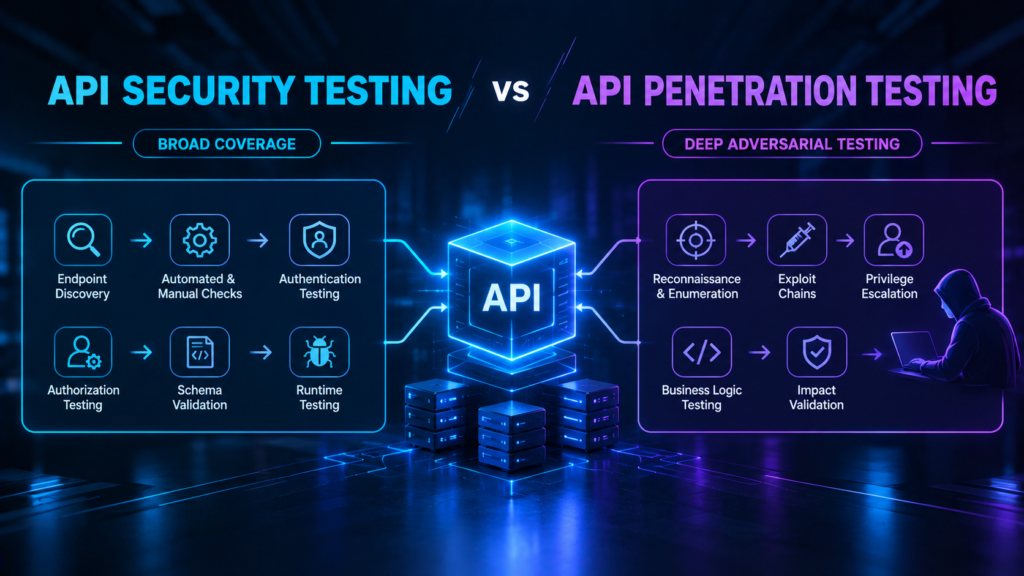
The terms API security testing and API penetration testing are used interchangeably in a lot of vendor materials, which creates genuine confusion when organizations try to evaluate what they actually need. They are not the same thing. API penetration testing is one specific approach within the broader category of API security testing, and the difference between them matters for what you find, what evidence you produce, and what you can do with the results.
Understanding the distinction is also practically useful for buying decisions. An organization that books a “security test” expecting penetration testing depth and receives an automated scan report has not gotten what it needed. An organization that commissions a manual penetration test when a structured automated assessment would satisfy its actual requirement has overspent. The right approach depends on what question you are trying to answer.
Key Takeaways
- API security testing is a broad category that includes all methods for evaluating API security, from automated scanning and static analysis to fuzzing, security audits, and manual penetration testing.
- API penetration testing is a specific discipline within that category: a human-driven, adversarial assessment that actively exploits vulnerabilities to demonstrate real-world impact, develop attack chains, and validate findings through exploitation evidence.
- Automated API security testing provides efficient breadth coverage and is well-suited to CI/CD integration. Manual API penetration testing provides the depth, business logic coverage, and compliance evidence that automated tooling cannot supply.
- Neither approach is a substitute for the other. A complete API security program uses both: automated testing for continuous coverage and manual penetration testing for periodic depth validation and compliance evidence.
- In Bugstrix API assessments, the critical findings that cause real breaches, authorization failures and business logic flaws are almost entirely absent from automated security testing output. They require manual penetration testing designed around the specific permission model and intended behavior of the API.
What Is API Security Testing?
API security testing is the broad category of practices used to evaluate the security of application programming interfaces, encompassing automated scanning, static analysis, fuzz testing, security audits, and manual penetration testing. The term describes any structured activity aimed at identifying security weaknesses in an API, regardless of methodology or depth.
The breadth of the category is what makes the term ambiguous in vendor conversations. When a provider says they offer “API security testing,” that description covers everything from an automated DAST scan that takes minutes to a multi-week manual penetration test by a specialist with deep knowledge of the specific API architecture in scope. The price, the findings, and the usefulness of the output differ dramatically between those extremes.
Automated API security testing tools crawl API endpoints, submit crafted payloads, and analyze responses to identify known vulnerability classes such as injection flaws, missing authentication, exposed error messages, and security header misconfigurations. This automated layer is fast, scalable, and well-suited to running continuously in CI/CD pipelines. It covers the attack surface efficiently for known vulnerability patterns. It does not cover business logic, complex authorization scenarios, or the finding categories that require a human tester to understand the API’s intended behavior and test against it.
Our post on API security testing covers the full landscape of what structured API security evaluation involves, which provides useful context before examining where penetration testing specifically fits within that landscape.
What Is API Penetration Testing?
API penetration testing is a specific discipline within API security testing in which a qualified human tester actively simulates an attacker against the API, exploiting confirmed vulnerabilities to demonstrate real-world impact, developing attack chains that combine multiple findings, and testing business logic and authorization in ways that require understanding the API’s intended behavior rather than just its technical structure.
The defining characteristics of penetration testing as distinct from other security testing approaches are active exploitation, human judgment applied to finding chaining, and the production of validated findings with exploitation evidence rather than a list of potential weaknesses. A penetration tester does not just identify that an endpoint might be vulnerable to authorization bypass. They demonstrate the bypass, confirm what data or functionality it exposes, and document the specific attack path an adversary would follow.
This distinction from automated testing is the same fundamental difference that exists across all security testing disciplines. Our post on manual vs automated penetration testing explains where automated tooling provides genuine value and where human judgment is irreplaceable, which applies directly to the API context.
API penetration testing specifically covers the finding categories that automated tools consistently miss: authorization failures across user roles and permission boundaries, business logic flaws that require understanding what the API is supposed to enforce, IDOR vulnerabilities that require knowing which resources should be scoped to which user, and chained attacks that combine individually lower-severity findings into critical impact paths.
What Is the Core Difference Between the Two?
The core difference between API security testing and API penetration testing is the same as the difference between a vulnerability assessment and a penetration test applied to any other context: one catalogues potential weaknesses, the other actively validates which weaknesses are exploitable and demonstrates what an attacker could accomplish through them.
The structural parallel to the broader testing landscape is exact. The same difference that separates a vulnerability assessment from a penetration test applies here: one identifies what may be vulnerable, the other proves what is actually exploitable and demonstrates the realistic consequences. Our post on vulnerability assessment vs penetration testing covers this relationship in detail, and the same principles apply directly when both approaches are applied specifically to APIs.
What Does Each Approach Find?
The finding profiles of automated API security testing and manual API penetration testing overlap in some areas and diverge sharply in others. The categories where they diverge are consistently the ones that matter most in real breach scenarios.
| Finding Category | Automated API Security Testing | API Penetration Testing |
| Injection vulnerabilities (SQL, command) | Yes | Yes |
| Missing authentication on endpoints | Yes | Yes |
| Security header misconfigurations | Yes | Yes |
| Known CVEs in API frameworks | Yes | Partial |
| Exposed error messages and stack traces | Yes | Yes |
| Rate limiting weaknesses | Partial | Yes |
| Authentication bypass scenarios | Partial | Yes |
| Authorization failures across user roles | Rarely | Yes |
| IDOR and broken object-level authorization | Rarely | Yes |
| Business logic flaws | No | Yes |
| Multi-tenant data isolation failures | No | Yes |
| Chained attack paths across endpoints | No | Yes |
The bottom three rows are where the distinction has the most practical significance. Authorization failures, IDOR vulnerabilities, business logic flaws, and multi-tenant isolation failures are the categories that most commonly appear in real-world API breaches. They require a tester who has been given context about the API’s intended permission model and business rules, and who can design test cases around what the API is supposed to prevent rather than just what automated patterns can detect.
Automated security testing finds what matches its rule set. Manual penetration testing finds what a motivated human with an attacker’s mindset discovers when given time and context to investigate. Both matter. The findings that matter most for breach prevention are disproportionately in the manual-only category.
In Bugstrix API penetration testing engagements, authorization failures and business logic flaws account for the majority of critical and high-severity findings across all API types. Automated scanning output for the same APIs typically surfaces none of these.
When Should You Use Each Approach?
The right approach depends on what question the security program is trying to answer and what the output needs to accomplish.
Use automated API security testing when:
- You need continuous coverage of the API attack surface between periodic manual testing cycles
- You want to catch known vulnerability classes, dependency issues, and configuration problems early in the CI/CD pipeline
- You are establishing a security baseline before commissioning a deeper assessment
- Your budget does not accommodate frequent manual penetration testing, and you need ongoing visibility
- You want to validate that previously identified vulnerabilities have not regressed after remediation
Use API penetration testing when:
- You need to demonstrate to auditors, enterprise buyers, or cyber insurers that your API security controls work under realistic adversarial conditions
- Compliance frameworks require penetration testing evidence specifically, which automated testing does not satisfy
- You have deployed a new API or significantly changed authentication or authorization logic and need to validate the security of the changes
- You want to understand whether identified vulnerabilities are genuinely exploitable in your specific deployment context
- You need to identify authorization failures, business logic flaws, and chained attack paths that automated tooling cannot reach
Use both when:
You are a SaaS company, API-first product, or any organization where the API is the primary customer-facing interface. In these organizations, automated API security testing running continuously in CI/CD catches regression vulnerabilities and known patterns as they are introduced, while periodic manual penetration testing validates the security of the authorization model, business logic, and overall API design. Neither approach produces the complete picture alone.
Which Does Compliance Require?
Compliance frameworks that require security testing of APIs do not accept automated scanning output as equivalent to manual penetration testing evidence. The two produce different evidence types that satisfy different requirements.
PCI DSS v4.0 under Requirement 11.4 mandates annual penetration testing with a documented, industry-accepted methodology. The requirement explicitly covers application-layer testing, which includes APIs that are part of the Cardholder Data Environment. Automated scanning satisfies the quarterly vulnerability scanning requirement under Requirement 11.3.2 but does not satisfy the annual penetration testing requirement. Both are mandatory and distinct.
SOC 2 auditors expect penetration testing evidence under CC4.1. They also look for evidence of ongoing vulnerability management and monitoring activities. Automated API security testing contributes to the monitoring evidence. Manual penetration testing produces the control effectiveness evidence that CC4.1 specifically calls for.
ISO 27001 Annex A.8.8 requires technical vulnerability management that includes regular vulnerability identification across in-scope systems. Automated security testing satisfies this as part of an ongoing vulnerability management program. Annex A.8.29 requires security testing in development and acceptance contexts. Manual penetration testing produces stronger evidence for both controls than automated scanning alone.
The practical takeaway: if compliance evidence is the driver, manual API penetration testing is required. Automated API security testing complements it and satisfies different but related compliance controls.
For a comprehensive overview of what penetration testing covers and how compliance frameworks evaluate it, our post on penetration testing covers the methodology landscape.
How Do the Two Approaches Work Together in Practice?
The most effective API security programs use automated testing and manual penetration testing as complementary layers in an integrated program, with each layer addressing what the other cannot. Running one without the other leaves a significant category of risk unaddressed.
Automated security testing as the continuous layer. Automated API security testing runs in CI/CD pipelines on every build or deployment, scanning for known vulnerability patterns across all discovered endpoints. It catches injection vulnerabilities, authentication misconfigurations, and dependency issues before they reach production. It maintains baseline coverage between manual testing cycles and generates the ongoing monitoring evidence that compliance programs need alongside penetration test evidence.
Manual penetration testing as the periodic depth layer. Manual API penetration testing runs on a defined cadence, typically annually for compliance purposes and after significant changes to authentication, authorization, or core business logic. It validates whether the API’s permission model is actually enforced, whether business logic rules hold under adversarial testing, and whether multiple lower-severity findings can be chained into a critical attack path. It produces the exploitation evidence and compliance documentation that automated testing cannot generate.
Each layer informs the other. Findings from manual penetration testing identify the vulnerability classes and testing approaches to prioritize in automated coverage. Automated testing findings identify the endpoints and components that have accumulated technical debt between penetration testing cycles, directing manual testing effort toward the highest-risk areas in the next engagement.
Our web application penetration testing services are structured to cover the API layer with dedicated API penetration testing methodology, not just the browser-facing application layer. For organizations with mobile applications whose backends are APIs, our mobile app penetration testing services cover both the device-side and the API-side attack surface together.
What Does API Penetration Testing Cover That Security Testing Alone Does Not?
API penetration testing covers three specific areas that automated API security testing structurally cannot reach, regardless of how well the automated tooling is configured or how comprehensive its rule set is.
Authorization and object-level access control. Testing whether user A can access user B’s data through an API endpoint requires knowing which users exist, which resources belong to which user, and what the permission model is supposed to enforce. Automated tools have no access to this application-specific context. Manual testers who have been briefed on the permission model design test cases around it specifically, systematically checking each endpoint for access control enforcement gaps.
Business logic. Whether a transfer can be initiated for more than the available balance, whether an order can be placed with a negative quantity, whether a promotional discount can be applied multiple times through the API despite being limited to once in the UI, all of these are business logic vulnerabilities that require knowing what the API is supposed to prevent. No automated rule set covers application-specific business logic. Every business logic finding comes from a manual tester who understood the intended behavior and tested against it.
Chained attack paths. A manual penetration tester who finds an information disclosure vulnerability on one endpoint and a rate limiting weakness on another investigates whether the two can be combined into a credential stuffing attack that the individual findings would not suggest. Automated tools identify each finding in isolation. Manual testers develop the attack chains that show what an adversary would actually accomplish by combining multiple findings, which is the evidence that drives realistic risk assessment and prioritization decisions.
Our vulnerability assessment services and security assessment services cover the automated and structured assessment layer for organizations building their API security program from a baseline. Manual penetration testing engagement completes the depth layer on top of that foundation.
Frequently Asked Questions
Is automated API security testing good enough for a small team or early-stage product?
It depends on what the API handles. Automated API security testing provides meaningful coverage for early-stage products where the priority is catching common vulnerabilities efficiently before they accumulate into technical debt. If the API handles personal data, financial transactions, or any data type with compliance implications, manual penetration testing before the first enterprise customer onboarding is a worthwhile investment regardless of team size. A security failure in a new product costs more to recover from than the cost of a penetration test.
How often should each approach be run?
Automated API security testing should run on every build or deployment when integrated into CI/CD, or at minimum weekly when running on a scheduled basis. Manual API penetration testing should run annually for ongoing compliance programs, and additionally after any significant change to authentication or authorization logic, after major feature releases that add new endpoints or modify business-critical workflows, and before any significant enterprise customer onboarding or compliance audit.
Can automated API security testing satisfy PCI DSS penetration testing requirements?
No. PCI DSS Requirement 11.4 requires annual penetration testing with a documented industry-accepted methodology, covering application-layer testing among other requirements. Automated scanning satisfies the quarterly scanning requirements under Requirement 11.3.2, which is a separate and distinct obligation. Both requirements must be satisfied independently. Submitting automated scanning output as penetration testing evidence will be rejected by a Qualified Security Assessor.
What should an API penetration test report include that a security scan report does not?
An API penetration test report should include exploitation evidence for each confirmed finding, meaning the actual request and response that demonstrates the vulnerability was genuinely exploitable rather than theoretically present. It should include attack chain narratives that show how multiple findings combine, authorization testing coverage confirming which roles and resource combinations were tested, business logic testing results describing what was tested and what passed or failed, and a severity assessment grounded in the actual business impact of each finding rather than generic CVSS scores alone.
Is DAST the same as API security testing?
DAST is a category of automated security testing that includes API testing as one of its applications. When applied to APIs, DAST tools crawl endpoint inventories, submit payloads, and analyze responses to identify known vulnerability classes. DAST is a form of automated API security testing, not the complete category. Full API security testing encompasses DAST alongside static analysis, manual code review, fuzzing, and manual penetration testing. Penetration testing in the manual, adversarial sense is a distinct discipline from DAST regardless of whether it is applied to APIs or web applications.
Two Different Tools, One Security Program
The confusion between API security testing and API penetration testing largely comes from vendors using the terms interchangeably. They are not interchangeable. One describes a category of practices. The other describes one specific, manual, adversarial practice within that category.
Both belong in a complete API security program. Automated security testing keeps the CI/CD pipeline secure, catches known vulnerabilities early, and maintains continuous coverage between manual testing cycles. Manual penetration testing validates the security of what automated tools cannot reach, authorization enforcement, business logic, and chained attack paths, and produces the compliance evidence that frameworks specifically require.
Choosing one over the other as if they are alternatives produces a security program with either insufficient depth or insufficient continuity. The organizations that handle API security well in 2026 are the ones that use both, at the right cadence, for what each is actually designed to deliver.
For API penetration testing costs across different scope types, our post on API penetration testing costs covers what to expect based on endpoint count, API type, and authentication complexity.
Contact us to discuss an API security assessment for your organization